
Lecture
Persons and objects that are under the protection of international humanitarian law and the procedure for dealing with them.
Objective: to form students' knowledge of the essence of international humanitarian law (IHL); to foster an understanding of the need to prevent the development of military conflicts; to help instil such personal qualities as compassion and respect for human rights.
The world community has entered the third millennium. Unfortunately, it has not rid itself of armed conflicts.
When opposing parties cannot or will not overcome their differences through peaceful negotiations, they resort to weapons. And then people are confronted with death, loss, hatred and deprivation.
– What goal did the warring parties set themselves?
– What were the consequences of the wars?
- Recall, from your history course, which wars we studied?
There are also many local wars in Europe, Asia and Africa. More than thirty of them occur in the world every year. These wars have claimed millions of lives.
The First World War resulted in 10 million deaths, in a ratio of 20 servicemen to 1 civilian, not counting twenty-one million who died from epidemics.
In the Second World War, more than 62 million people died, in approximately equal proportions of servicemen and civilians.
In modern warfare, the ratio of those killed may be 10 civilians to one serviceman.
Shocked by the consequences of the Second World War, the international community, in the UN Charter, declared the use of force to resolve disputes unlawful.
The first written multilateral international treaty was the Geneva Convention of 1864, which codified the incomplete and scattered laws and customs of war concerning the treatment of wounded soldiers.
(Convention – a document having binding force)
This convention laid the foundation for modern international humanitarian law.
First of all, let us clarify what the concept of humanitarian means? (Humanitarian – directed towards the human person, towards the rights and interests of the individual.)
IHL provides protection to persons not taking a direct part or who have ceased to take part in hostilities, and limits the choice of means and methods of waging war.
IHL combines legal and moral principles; it is oriented towards compassion, mercy, assistance and protection.
In international law, the proportion of norms oriented towards the individual is steadily increasing. This refers to such aspects as the universal human standards of individual rights and freedoms agreed upon by states, the measures binding on states to ensure rights and freedoms and to protect them from infringement, as well as granting the individual the legal opportunity to exercise and defend the recognised rights and freedoms.
The basis is the principle of respect for human rights and fundamental freedoms, which presupposes their universal significance: firstly, the completeness of the individual's subjective rights in terms of their list and internal content; secondly, their extension to all people without any discrimination; thirdly, the involvement of all states in the relevant actions to ensure these rights; fourthly, equally respectful treatment of fundamental rights and freedoms both in normal life situations and in conditions of a state of emergency or during armed conflicts.
The universal value of rights and freedoms can only be guaranteed on condition of the universal nature of legal regulation and legal protection.
Recently, the term "international humanitarian law" has been proposed to designate the branch under consideration.
The use of the word "humanitarian" is consistent with the terminology of the UN Charter and the acts of the CSCE.
International humanitarian law (the law of war, the law of armed conflicts) — a set of international legal norms and principles regulating the protection of victims of war, as well as limiting the methods and means of waging war.
International law of armed conflicts is codified in the Hague Conventions, the Geneva Conventions on the Protection of War Victims of 1949 and the Additional Protocols thereto of 1977, resolutions of the UN General Assembly and other documents.
Certain restrictions established by international humanitarian law also apply to armed conflicts of a non-international (internal) character.
International humanitarian law (IHL) represents a set of norms defining the rights and freedoms of the individual common to the international community, establishing the obligations of states to consolidate, ensure and protect these rights and freedoms, and granting individuals the legal means to exercise and defend the rights and freedoms recognised for them.
This branch of law includes norms of three types: 1) norms operating in normal situations of peacetime (certain derogations are permitted when a state of emergency is introduced); 2) norms intended for conditions of armed conflict with the aim of their maximum possible humanisation; 3) norms whose application is mandatory in any situation (for example, the right to recognition of legal personality, the right to freedom of thought, conscience and religion, the prohibition of torture or other cruel, inhuman treatment and punishment).
The specificity of international humanitarian law lies in the fact that the participants in the relations regulated by its norms, the bearers of the corresponding rights and obligations, are, alongside states, individuals (natural persons); naturally, the nature of these rights and obligations differs between states and individuals.
Persons under the protection of international humanitarian law:
• victims of armed conflicts;
• medical and religious personnel;
• parlementaires and persons accompanying them;
• civil defence personnel;
• personnel responsible for the protection and safeguarding of cultural property; • personnel participating in humanitarian actions.
Objects under the protection of international humanitarian law:
• medical units;
• sanitary transport vehicles;
• civilian objects;
• cultural property;
• particularly dangerous objects;
• civil defence objects;
• sanitary and safety zones;
• undefended localities and demilitarised zones.
Attacks on such objects are prohibited, except in cases provided for by international humanitarian law.
IHL (the law of armed conflicts, the law of war) seeks to mitigate the consequences of war by limiting the choice of means and methods of conducting military operations, obliging the warring parties to spare persons who are not taking part or who have ceased to take part in hostilities.
J.-J. Rousseau, in the treatise «On the Social Contract», wrote: «War is a relation not between men, but between states, and men become enemies only accidentally, not as human beings, nor even as citizens, but as soldiers…» And further Rousseau draws a logical conclusion: soldiers can only be fought as long as they themselves are fighting. As soon as they lay down their arms, they once again become mere people. And they should be spared.
IHL recognises two categories of armed conflicts:
a) international;
b) non-international.
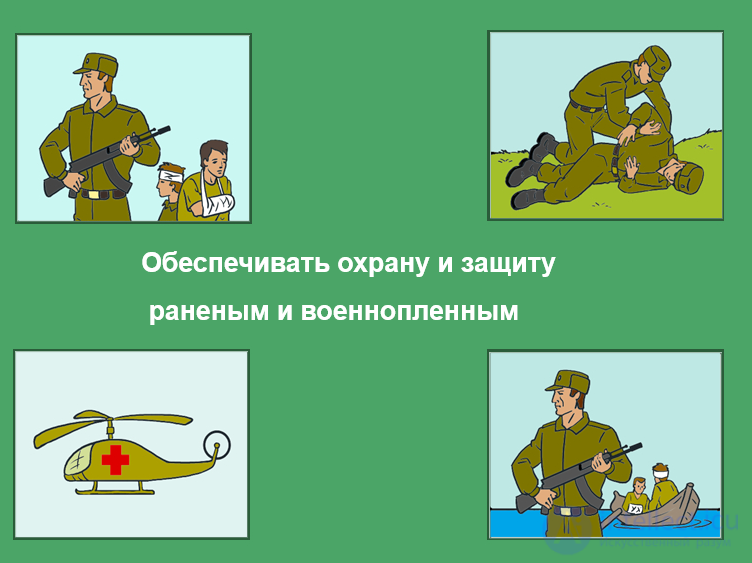
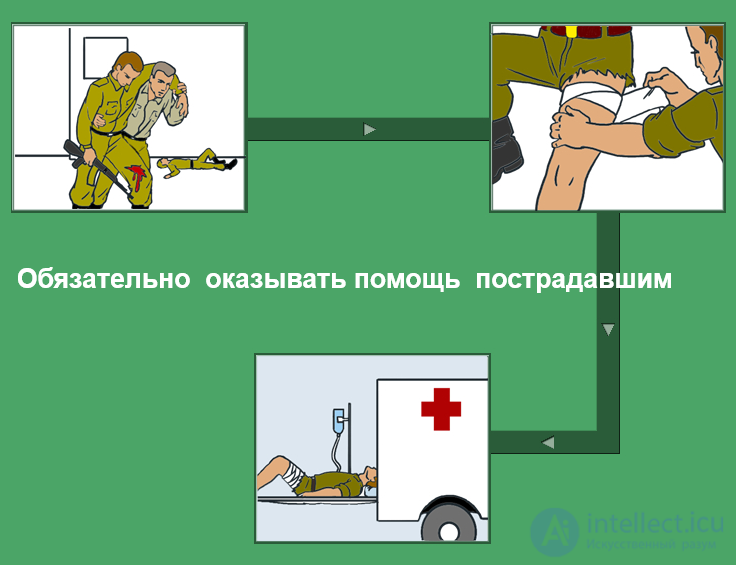
IHL obliges mercy to be shown towards the wounded and sick.
The basic n o r m s of humanitarian law applied during armed conflicts:
1. Persons who are hors de combat, as well as persons who do not take a direct part in hostilities, especially the civilian population, have the right to respect for their life, as well as to physical and mental integrity. In all circumstances they must be treated with protection and humanity, without any adverse distinction.
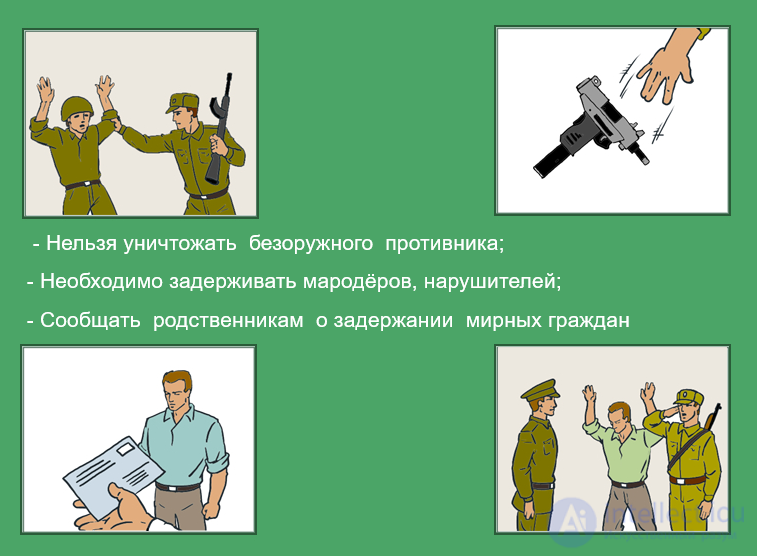
2. It is prohibited to kill or wound an adversary who surrenders or who has ceased to take part in hostilities.
3. The wounded and sick must be collected and cared for by the party to the conflict in whose power they find themselves. Medical personnel, medical facilities, transport vehicles and materials are also under protection. The emblem of the red cross (the red crescent or the red lion and sun) is a sign of such protection and must be respected.
4. Captured combatants and civilians who find themselves in the power of the adversary are entitled to respect for their life, dignity, personal rights and convictions. They must be protected against all acts of violence and reprisals. They must have the right to correspond with their families and to receive relief.
5. Everyone is entitled to fundamental judicial guarantees. No one shall be held responsible for an act they have not committed. No one shall be subjected to physical or mental torture, corporal punishment or cruel or degrading treatment.
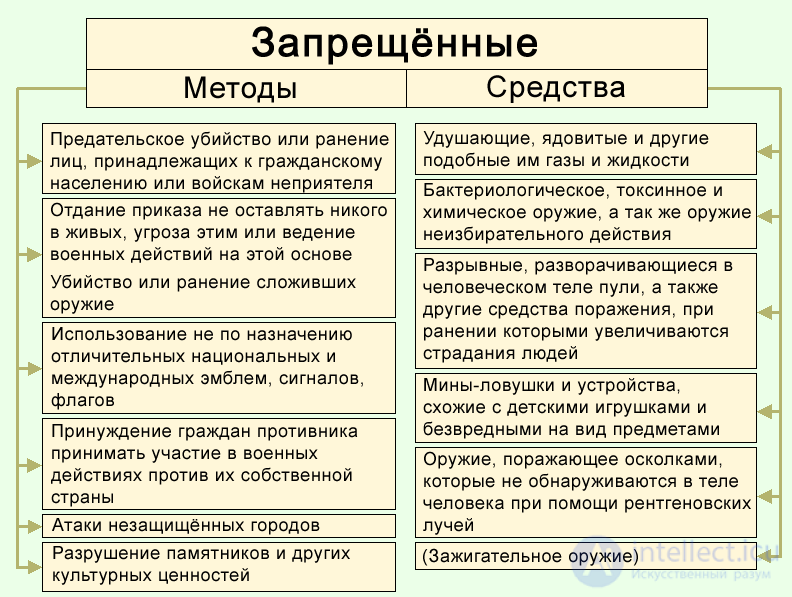
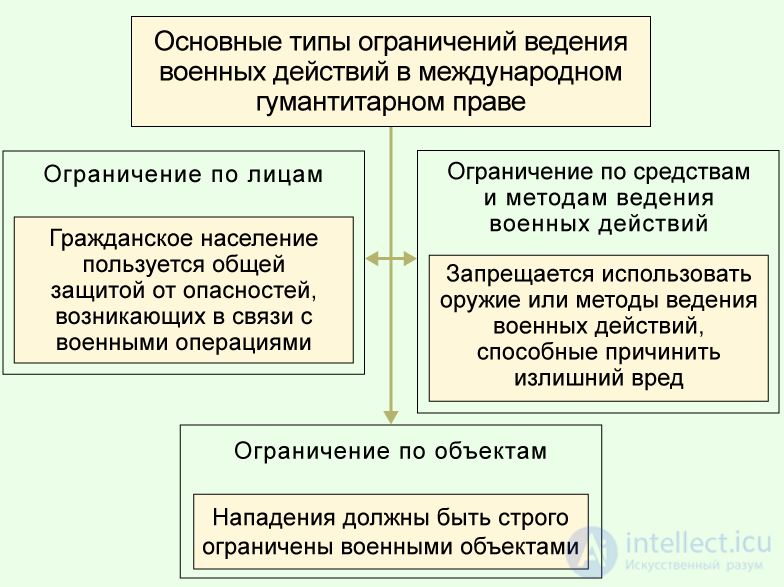
6. The right of the parties to a conflict and their armed forces to choose methods and means of warfare is not unlimited. It is prohibited to use weapons and methods of warfare capable of causing unnecessary destruction or excessive suffering.
7. The parties to the conflict must at all times distinguish between the civilian population and combatants, so as to spare the civilian population and civilian objects. Neither the civilian population as a whole nor individual civilians shall be attacked. Attacks shall be directed solely against military objectives.
IHL is outside of politics and is guided solely by principles of humanity. The effect of humanitarian law does not stop at state borders. All warring parties must comply with it, regardless of political or other considerations.
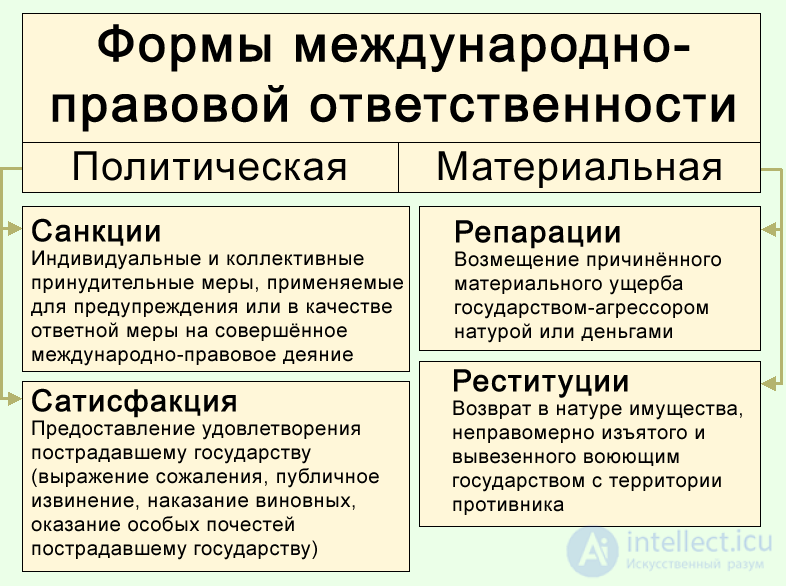
Failure to comply with the norms of IHL entails liability both at the international and national levels.
A state bears international legal responsibility for the consequences of all unlawful acts committed by each of its servicemen. A person who violates IHL cannot count on release from liability and punishment, even if this violation was committed on the orders of official authorities.
The law of human rights and international humanitarian law have different spheres of application. International humanitarian law applies only in the event of armed conflict and provides for a whole range of guarantees reflecting the specific features of such conflicts. A significant number of human rights have no equivalent in international humanitarian law.
Nevertheless, there are "overlaps" between certain human rights and some norms of international humanitarian law. This concerns above all rights included in the "immutable core" of human rights, the effect of which cannot be restricted or suspended under any circumstances.
Moreover, international humanitarian law and human rights law complement each other. Certain rights provided for by international humanitarian law reinforce some human rights:
— either because they correspond to human rights whose effect may be suspended in the event of a state of emergency (this refers, for example, to judicial guarantees, which as such are not part of the "immutable core" of human rights);
— or because the norms of international humanitarian law go further in terms of protecting the individual than the corresponding human rights (this refers, for example, to the right to life of persons enjoying the protection of international humanitarian law).

Comments