
Lecture
Rescue operations at livestock farms include the veterinary treatment of animals that have been in a zone contaminated by chemical warfare agents or bacterial agents, as well as animals contaminated with radioactive substances above permissible levels (more than 7.2-10 A{kg — 100 mR/h)
In the process of veterinary treatment, radioactive substances are removed from the external body surfaces of animals, and chemical warfare agents
and bacterial agents that have got onto the skin are decontaminated. Affected animals are given emergency and first
therapeutic aid.
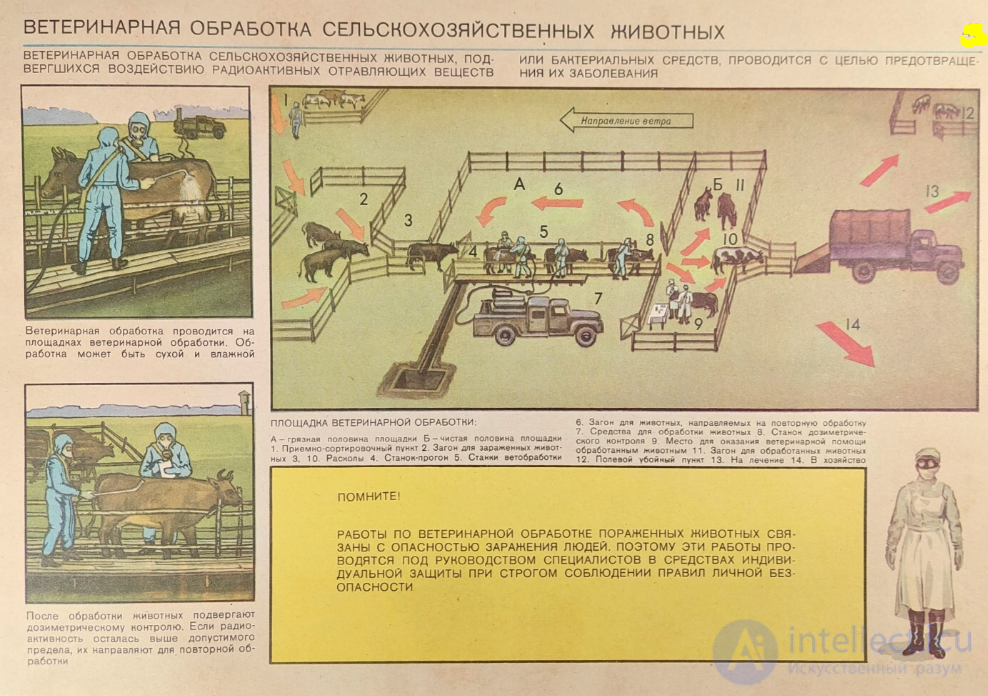
For the veterinary treatment of animals, special sites are equipped near
livestock farms and on pastures. They must have convenient access roads
and be located near a water source.
The order and sequence of treating the skin surfaces of animals depend on the type
of damaging agent and the severity of the lesion. Before treatment begins, it is necessary,
using instruments, to determine the type and degree of contamination. After this, the appropriate agent for treating the animal's skin surface is selected. At the same time, the
question of the need to use therapeutic and prophylactic preparations is decided.
Livestock subject to treatment are kept in pens, from which 5—6 animals (depending on the number of processing stalls) are directed into the stalls and treated with the appropriate solution simultaneously from both sides, using a brush-shower. To avoid injury to people, the brushes are attached to poles 80—100 cm long, along
which a hose is laid; the solution is delivered to the brush through it. The nasal and oral
cavities, as well as the animal's eyes, should be rinsed with a 2 %-solution of soda or
a 0.2 %-solution of chloramine.
Animals contaminated with chemical warfare agents of the V-gas type and mustard gas are treated with a paste of bleaching powder (2 kg of lime per 1 litre of water); a 3 %-aqueous solution
of potassium permanganate, acidified with a 1 %-solution of acetic or hydrochloric acid,
is used to treat the skin surfaces of animals affected by nitrogen mustard; they are wiped with a solution of caustic soda or a 10—12 %-aqueous solution of ammonia in cases of sarin and lewisite poisoning. After treatment with the stated solutions, the animals
are held for 20—30 min, during which the chemical warfare agents break down, after which they are washed with clean water and moved to the «clean» half of the site.
In cases of animal contamination with chemical warfare agents, dry treatment can also be carried out. The surface of their body is sprinkled with bleaching powder or calcium hypochlorite, which is then rubbed into the coat with a wisp of available
material.
15—30 min after treatment, the bleaching powder should be removed from the skin surfaces with a brush, rags, a broom or a straw wisp.
In cases of animals affected by bacterial agents, veterinary treatment is started as early as possible. Against spore-forming microflora, solutions
of disinfectants are used. These include: an 8 %-solution of iodine chloride;
a solution of hydrogen peroxide in a 0.5 %-solution of acetic acid; a 10 %-solution of DTS-GK; a clarified solution of bleaching powder containing not less than 4 % active chlorine. In cases of animal contamination with viruses or non-spore-forming microflora, solutions of the same preparations are used at a concentration reduced by a factor of 1.5—2. All solutions are prepared immediately before use.
For better wetting of the animals' coat with disinfectant solutions, it is advisable to add 0.01 % emulsifier (OP-7,
Animals treated with the disinfectant solution are moved to
and held there for 1 h (during this time the microorganisms are;
after which they are again driven into the stalls, washed with warm water and moved
half.
To deliver solutions and water onto the animals' bodies, the Komarov unit (DUK) may be used, the sanitary decontamination laboratory unit
(LSD), as well as sprayers, sprinkler units and other machines
delivering water under pressure. With the disinfection unit, in 8 h it is possible to treat
300 large animals, or carry out spraying of up to 500 small animals; the output of the LSD unit for treating animals is 400—500 head
of cattle per hour
Among the simplest means of treating animals' skin surfaces, one can use
aqueous solutions of household soap, detergents of the «Novost
also a 0.3 %-solution of emulsifier OP-7 or OP-10, adding to it 0.7
sodium hexametaphosphate. If there are no detergents, the animals' skin
is washed with clean water under a pressure of 0.2—0.3 MPa (2—3 atm).
If the skin surfaces of animals are contaminated with radioactive dust, one can
carry out their veterinary treatment with the standard foaming agent PO-1, which gives good results. Foam is supplied from the foaming unit by a fire engine under pressure and covers the entire surface of the animal's body. After 2—3 minutes of contact
the foam is removed with brushes fixed to long handles. Together with the foam, 65—75 % of the radioactive dust is removed from the animal. After foam treatment
it is not necessary to rinse with water
If animals are contaminated with radioactive dust, their veterinary treatment can also be carried out by the dry method, using the appropriate
(veterinary decontamination vehicle) and vacuum cleaners. The collected dust
is buried in the ground. The best method of dry treatment for sheep is shearing them.
In cases of contamination of pigs, sheep and calves with chemical warfare agents or bacterial agents, they are treated with decontaminating solutions in the same sequence as cattle. Poultry contaminated with chemical warfare agents should be washed with a 0.5 %-solution of caustic soda or a solution of
DTS-GK. Radioactive dust is removed from small animals and poultry with water, applied
under a pressure of 3—3.5 atm.
Veterinary treatment of animals is carried out by animal-protection teams and specialists of veterinary-treatment institutions
When treating animals affected by radioactive substances, respiratory and skin protective equipment should be used (a gas mask, a respirator,
an anti-dust fabric mask), a light protective suit (coveralls, a raincoat), protective stockings, rubber gloves. If standard-issue skin
protective equipment is unavailable, it is permitted to use work clothing: a cotton coverall, a rubberised (PVC) apron, rubber boots
When treating animals affected by chemical warfare agents, a gas mask, protective suit and protective stockings must be used. These items reliably
protect the human body not only from droplets but also from the vapours of chemical warfare
agents. While performing the work it is forbidden to remove protective equipment, drink
water, or smoke. Safety rules and personal hygiene should be observed with particular care when eliminating bacterial contamination.
Residents of rural areas must be firmly aware of the methods of protecting farm animals from weapons of mass destruction and be able to carry out the entire range of work involved in their veterinary treatment
If chemical warfare agents (with the exception of lewisite) are detected in meat at concentrations exceeding the permissible levels (MPC and MPL), the product is subjected to decontamination by means of thermal or other food processing, or is sent for disposal.
Decontamination of meat and fat containing chemical warfare agents in quantities not exceeding the MPL is carried out in accordance with the Rules for Veterinary Control of Slaughter Animals and Examination of Meat Products, as well as in accordance with the Guidelines for the Protection of Meat Raw Materials and Products from Weapons of Mass Destruction.
Meat is subject to disposal in the following cases:
When it contains arsenic in excess of 0.5 mg/kg, characteristic of lewisite poisoning.
When mustard gas, soman or V-gases are present at concentrations above the MPL after 3–4 days of storage in a refrigerator, if there are no conditions for further storage.
When there is microbial contamination that rules out the possibility of using the meat for food.
When more than 50% of the surface of the carcass is affected by lewisite or mustard gas.
Hides of animals that have sustained skin lesions from persistent chemical warfare agents, or that were contaminated during primary treatment, are subject to mandatory degassing. In the case of preserving hides contaminated with mustard gas by the acid-salt method, their preliminary decontamination is necessary.
Two methods are used for degassing such hides:
Treatment with disinfectants recommended for anthrax in cattle and pigs, with the addition of a 5% solution of chloramine B. This method changes the appearance of the hide — its colour and the presence of hair.
Soaking in a 5% solution of chloramine B for 24 hours, followed by rinsing with water and drying at a temperature of 35–40 °C for 1–2 hours. The hair coat is preserved, and preservation is carried out in the usual manner.
Hides infected with V-gases are decontaminated by holding them for 48 hours in a solution containing 1.2% calcium hydroxide and 0.05% sodium sulphide, then rinsing and drying by the standard method.
Decontaminated hides are stored separately from the hides of healthy animals and are transported in specially designated transport. Hides that cannot be degassed are subject to destruction.
The intestines of animals infected via the digestive or respiratory system are destroyed without exception. In cases of skin lesions, ordinary preservation of the intestines is permitted.
The blood of animals affected by chemical warfare agents is used exclusively for technical purposes and is disposed of.
Enzyme-hormonal raw material from such animals is not suitable for medical use.

Comments