
Lecture
Objective: to form students' knowledge of the types of first medical aid (PMP), of the causes, severity, clinical manifestations and complications, diagnostic methods, and principles of treatment of crush syndrome (SDS) at the stages of medical evacuation; to form knowledge of the mechanism of death by drowning; to learn to diagnose drowning; to learn the rules for performing cardiopulmonary resuscitation.
Drowning- blockage of the respiratory tract by water9or another liquid). By mud, silt, sewage.
Mechanism of death: death occurs from oxygen starvation, due to a mechanical obstruction to the entry of air into the lungs. Stages of drowning: deep breaths at the moment of submersion, followed by breath-holding, shortness of breath, agonal gasps.
When a drowning person is submerged in water, water enters the lungs, breathing stops, acute oxygen starvation develops, and cardiac activity ceases. It is necessary to remove the casualty from the water as early as possible and begin providing first medical aid.
The scope of first medical aid measures depends on the severity of the casualty's condition.
A) External signs: fine bubbly foam around the openings of the nose and mouth, which forms during the convulsive period due to bronchial spasm caused by the mixing of air, water and mucus. The foam sometimes fills the windpipe and trachea (persistent, remains on drying). Paleness of the skin (in corpses), the presence of "goose bumps" is explained by contraction of the hair erector muscles. Livor mortis has a pink tinge.
B) Internal signs: water in the lungs, stomach, microorganisms from the body of water in the blood and tissues.
Reviving a person pulled from the water can be effective during the period of clinical death. But often those brought back to life die in the following hours and days due to pulmonary oedema or pneumonia.
1) Terminal state - the final stage of life, a borderline state between life and death. After cardiac activity and breathing stop, the body enters a state of apparent vital activity for 5-6 minutes, which then passes into biological death.
2)Artificial respiration: artificial lung ventilation.
A) Direct indications for A.R.: -absence of breathing; -rare, shallow breathing; -periodic breathing; -clinical death.
B) Mechanism of therapeutic action: -ventilation of the lungs; -reflex restoration of central nervous system functions; -improvement of blood circulation; -restoration of cardiac activity. 25-30 times per minute.
3) Manual methods of A.R.: 120 types.
Expiratory (active exhalation).
Expiratory-inspiratory (active exhalation and active inhalation).
Inspiratory (active inhalation)
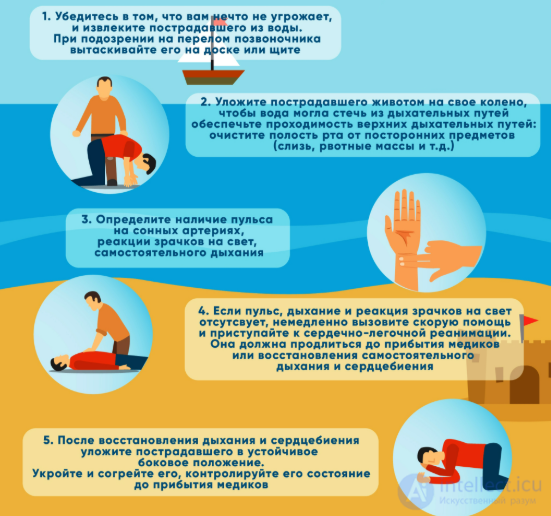
How to pull a casualty out of the water?
What should be paid attention to:
If the casualty is conscious:
If the casualty is unconscious, but breathing and pulse are preserved:
If the casualty has neither breathing nor a pulse:
4-5 minutes - the time during which a person can be revived after cardiac arrest
It is important to know that paralysis of the respiratory centre occurs 4-6 minutes after a person is submerged in water, while cardiac activity can persist for up to 15 minutes. Therefore, first medical aid measures for drowning must be carried out taking into account the casualty's remaining time reserve for survival.
Before beginning artificial respiration, the casualty should be laid on their back, the oral and nasal cavity examined, and it should be ensured that their airways are clear for the passage of air. Tilt their head back as far as possible, open the mouth, then wipe the oral cavity clean of saliva with a napkin and begin performing artificial respiration. Place a single layer of napkin (or a handkerchief) over the casualty's open mouth, pinch their nose, take a deep breath and forcefully exhale into the casualty's mouth. The volume of air blown in should be such that with each breath it causes fuller expansion of the casualty's lungs. This can be seen from the movement of their chest. Air must be blown in rhythmically (16-18 times per minute), with one exhalation every 3-4 seconds, until natural breathing is restored.
Attention!
If cardiac activity stops together with breathing, artificial respiration and chest compressions are performed simultaneously.
In this case it is better if aid to the casualty is provided by two people. One performs chest compressions, while the other – artificial respiration using the «mouth-to-mouth» method.
Once breathing and cardiac activity are restored, the casualty must be warmed, given hot tea to drink, and taken to a medical facility.
In case of a threat of repeated cardiac arrest, which inevitably occurs after drowning, the pulse on the carotid artery should be constantly monitored and resuscitation continued.
Artificial respiration and chest compressions, if the casualty does not regain consciousness, are stopped only when clear signs of death appear
During earthquakes, explosions, mine collapses, etc., the injured may end up under the debris of buildings and structures, or under collapsed rock, in a state of more or less prolonged compression of the soft tissues of the body (most often the limbs).
Prolonged compression of soft tissues causes a special type of injury known as crush syndrome.
Crush syndrome (synonyms: compartment syndrome, crush syndrome, traumatic toxicosis, (prolonged) crushing syndrome, compression injury, crush injury syndrome; eponym: Bywaters syndrome) — toxicosis arising from prolonged disruption of blood supply to compressed soft tissues, characterised, in addition to local changes, by systemic pathological changes in the form of hyperkalaemia and renal failure.
Clinical forms
1. Mild - occurs in cases where the duration of compression of the limb segments does not exceed 4 hours.
2. Moderate - compression, usually of the entire limb, lasting 6 hours. In most cases there are no pronounced haemodynamic disturbances, and kidney function is relatively little affected.
3. Severe form occurs as a result of compression of the entire limb, more often the thigh and shin, lasting 7-8 hours. Symptoms of renal failure and haemodynamic disturbances are clearly manifested.
4. Extremely severe form develops if both limbs are compressed for 6 hours or more. Casualties die from acute renal failure within the first 2-3 days.
One of the early symptoms of the early period of the syndrome is oliguria: the volume of urine during the first 2 days decreases to 50-200 ml. in severe forms anuria sometimes occurs. Restoration of arterial pressure does not always lead to an increase in diuresis. The urine has a high specific gravity (1025 and above), an acidic reaction and a red colour, caused by the release of haemoglobin and myoglobin.
By the 3rd day, by the end of the early period, as a result of treatment the patients' condition improves significantly (a light interval), haemodynamic indicators stabilise; swelling of the limbs decreases. Unfortunately, this improvement is subjective. Diuresis remains low (50-100 ml). on the 4th day the clinical picture of the second period of the disease begins to form.
By the 4th day, nausea, vomiting, general weakness, lethargy, sluggishness, apathy and signs of uraemia reappear. Lower back pain occurs, caused by stretching of the kidney's fibrous capsule. In connection with this, a picture of an acute abdomen sometimes develops. Symptoms of pronounced renal failure increase. Continuous vomiting appears. The level of urea in the blood rises to 300-540 mg%, and the alkaline reserve of the blood falls. Due to increasing uraemia, the patients' condition gradually worsens, and marked hyperkalaemia is observed. Death occurs on the 8th-12th day after the injury against a background of uraemia.
With correct and timely treatment, by the 10th-12th day all manifestations of renal failure gradually subside, and the late period begins. In the late period, local manifestations of crush syndrome come to the fore; swelling and pain in the injured limb gradually decrease and completely disappear by the end of the month. Full restoration of limb function usually does not occur, due to damage to the major nerve trunks and muscle tissue. Over time, most of the muscle fibres die, being replaced by connective tissue, which leads to the development of atrophy and contractures. In this period, severe purulent complications of a general and local nature are observed.
1. The rescuer's tactics when freeing a compressed limb and after freeing it, depending on the degree of tissue ischaemia (compensated, decompensated and irreversible).
2. Bandaging, immobilisation and cooling of the compressed limb using standard issue and improvised means.
3. Warming the casualty, preparing and giving the casualty an alkaline drink, the procedure for medical evacuation of the casualty.
4. Give plenty of alkaline drink and administer pain relief (analgin, ketanov, ketalong, dexalgin, etc.)
5. Immediately after release, apply a tight bandage to the injured limb and remove the tourniquet.
6. Apply splints.
7. Reapply cold to the injured limbs.
8. Continue giving plenty of warm liquid until the doctors arrive.
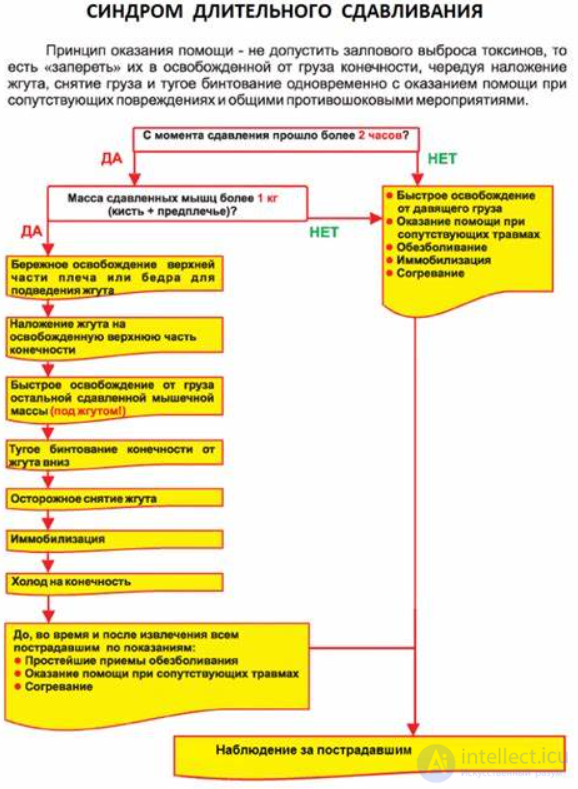
First aid for crush syndrome.
1. Determining the advisability of applying a tourniquet after the limb has been extracted.
2. Cooling of the compressed limb. Assistance in cases of limb compression where freeing it is impossible. Forced amputation of limbs.
It should be noted that crushing of the tissues as such does not actually occur; rather, there is a disruption of blood supply due to compression of the vessels. As a result, muscle tissue dies, and as it decomposes toxic substances are formed which, when the compressed limb is released, rush into the bloodstream, first causing toxic shock and then disruption of the function of vital organs - the liver and especially the kidneys suffer first - they become blocked by the protein of dead muscle, renal failure develops, and the person dies from the accumulation in the body of poisonous substances that are formed by the work of organs and tissues and are normally removed by the kidneys.
As a result, 3 periods are distinguished in the course of crush syndrome:
- early, from the moment the casualty is freed up to 24 - 48 hours. Characterised by the development of a shock-like state.
Immediately after the limb is freed it is pale, cold to the touch, the nails are blue, and there is no pulsation in the vessels. Then rapidly increasing swelling develops, of an almost wood-like consistency. Blisters filled with cloudy or bloody fluid appear on the skin. The casualty is troubled by severe pain in the affected limb.
The casualty's general condition - pale skin with a bluish tinge, lethargy, indifference to their surroundings, though this may be preceded by speech and motor agitation. They are troubled by thirst, and repeated vomiting may occur. Blood pressure drops sharply. The casualty may already die during this period from the sharp drop in blood pressure. If they survive, the second period sets in.
- intermediate period, 3 - 7 days - development of acute renal failure, due to blockage of the renal tubules by breakdown products of dead muscle. A rise in body temperature up to 39C is observed, along with lower back pain, apathy, nausea, vomiting. If the patient does not die from renal failure, the 3rd period sets in.
The late period, or recovery period - 3 - 4 weeks.
Kidney function normalises and complications from the affected limb come to the fore - various suppurations.
Ischaemia of the limbs and tissues is a condition that arises when blood supply to organs and tissues is disrupted or stops.
The main function of blood is to carry out internal respiration, i.e. the delivery of oxygen to the tissues and the removal from them of metabolic products (acids, carbon dioxide). The former occurs through the arteries, the latter through the veins. When blood supply is disrupted, oxygen is not delivered to the tissues, and toxic metabolic substances accumulate in them.
As a result, cells die first, then tissues, and then the entire organ. The longer the ischaemia lasts, the more tissue dies.
Providing aid to casualties:
Knowledge of the causes of compression syndrome, its types and the periods of its course allows rescuers to correctly assess the condition of the injured person, and the correct sequence of providing first medical aid for crush syndrome and its proper execution will reduce the effect of toxic substances on the body. All this will help save the lives of many casualties.

Comments