
Lecture
Aim: to form students' knowledge of the main infectious diseases and of the main methods of preventing infectious diseases.
Humanity has repeatedly been subjected to epidemics of various dangerous diseases that have destroyed tens and hundreds of thousands of people.
Diseases caused by specific causative agents: pathogenic microorganisms, protozoa, bacteria, viruses, and simple fungi, which show pathogenicity to people, animals and plants, are called infectious.
Infection - the invasion and multiplication in the body of a human or animal of pathogenic (disease-causing) microorganisms, which cause corresponding biochemical, immunological, morphological and other changes in the body.
Throughout recorded history, the greatest scourges for humanity have been plague, smallpox, cholera and yellow fever, which claimed a large number of human lives.
However, the battle with the causative agents of infection is still ongoing, and the only infectious disease successfully eradicated in the world – is smallpox.
The eradication of other diseases, such as tetanus, measles, whooping cough, diphtheria and poliomyelitis, for which effective immunisation is quite feasible on a global scale, has today been achieved to more than 90%.
High immigration of population from “third world” countries has led, in industrially developed states, to a sharp increase in the number of people suffering from infectious diseases.
While humanity has managed to learn to control old epidemics, new ones have appeared. It is necessary to note the presence of the ongoing epidemic of human immunodeficiency virus (HIV) infection, which is accompanied by devastating consequences not only in Africa and Asia, but also in Europe and North America.
Despite improvements in living conditions in economically developed countries, the widespread practice of vaccination, and the availability of effective antibiotics, infectious diseases still occupy a significant place in the structure of human morbidity and mortality, yielding first place only to diseases of the cardiovascular system and malignant oncological diseases. The majority of deaths among children — are infectious diseases of the respiratory organs and intestines, caused by viruses and bacteria.
Depending on the course of the infection, cases can be asymptomatic and clinically manifest.
Types of infectious diseases, depending on the organ affected, are usually divided into the following classes:
1. Intestinal infections: infections in which the pathogen is excreted with faeces and urine. The factors of transmission are food, water, soil, flies, dirty hands, and household items. Infection occurs through the mouth.
6. Infections of the skin and mucous membranes (venereal diseases, anthrax, erysipelas, scabies, trachoma) enter the body of a healthy person through wounds and other skin damage. As well as through mucous membranes.
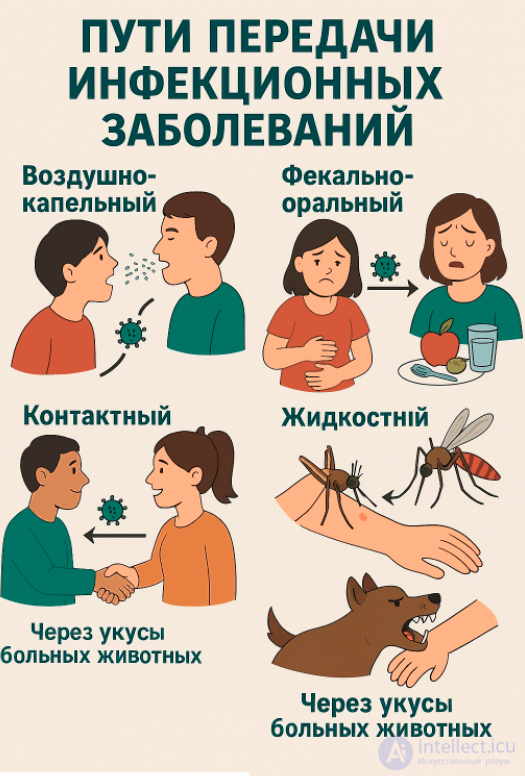
1. faecal-oral: this is a route of transmission in which a pathogenic microorganism enters the body of a healthy person with particles of faeces or vomit from a sick person via food, water, or dishes;
2. airborne droplet: this is a route of transmission in which a pathogenic microorganism enters the body of a healthy person when sneezing, kissing, or talking with a sick person;
3. via bodily fluids: this is a route of transmission in which a pathogenic microorganism enters the body of a healthy person through the bites of blood-sucking insects (fleas, lice, insects, etc.);
4.contact or contact-household: this is a route of transmission in which a pathogenic microorganism enters the body of a healthy person through close contact with a sick person;
5. through the bites of sick animals.
Particularly dangerous infections.
table Characteristics of dangerous infectious diseases:
| Disease | Source of disease | Signs (symptoms) | Prognosis |
|---|---|---|---|
| Cholera | Sick person, contaminated water and food | Watery diarrhoea, vomiting, dehydration, muscle cramps |
With timely treatment — favourable; without treatment — death from dehydration is possible |
| Plague | Rodents (rats), fleas | Fever, enlarged lymph nodes (buboes), weakness, pneumonia, sepsis |
Without treatment — high mortality; with treatment — a favourable outcome is possible |
| Tularaemia | Wild animals, rodents, contaminated water, tick bites | Fever, enlarged lymph nodes, skin ulcers, conjunctivitis | With timely antibiotic treatment — favourable |
| Anthrax | Sick animals, bacterial spores in soil | Cutaneous form — black carbuncle; pulmonary — shortness of breath, fever; intestinal — pain, vomiting |
Pulmonary form — often fatal; cutaneous — usually curable with early treatment |
| Smallpox | Sick person (airborne droplet route) | Fever, rash with blisters that later crust over |
High mortality (up to 30%); eradicated by vaccination in 1980 |
| Yellow fever | Mosquitoes (Aedes aegypti), infected people and primates | Fever, jaundice, bleeding, muscle pain |
From a mild form to a fatal outcome; vaccine is effective |
| Typhus | Lice, infected people | High fever, headache, rash, confusion |
With treatment — good prognosis; without treatment — death is possible |
| Typhoid fever | Contaminated food and water | Fever, weakness, abdominal pain, rose-coloured rash, constipation or diarrhoea |
With antibiotic therapy — favourable; relapses are possible |
| Botulism | Foods contaminated with Clostridium botulinum toxin | Visual disturbances, muscle weakness, paralysis of the respiratory muscles |
Without treatment — high mortality; with administration of antitoxin — chances of recovery are high |
| Ebola haemorrhagic fever | Infected animals (bats), contact with the sick | Fever, bleeding, vomiting, diarrhoea, multiple organ failure |
High mortality (up to 90%); survival depends on care and immunity |
| SARS | Sick person (droplet route), possibly of animal origin | Fever, cough, difficulty breathing, pneumonia | With timely support — recovery is possible; mortality around 10% |
| Rabies | Sick animals (most often — dogs, foxes, bats); transmitted through a bite or saliva | Tingling at the bite site, anxiety, headache, hydrophobia, convulsions, aggression, paralysis |
Almost always fatal once symptoms appear; with emergency vaccination — curable |
Infections have characteristic forms of spread. The mass spread of foci of an infectious disease among the population of a given locality is defined as an epidemic. A pandemic is an epidemic that covers a significant part of the population of a country, and sometimes of many countries and continents (influenza, cholera, plague and certain other infectious diseases). An epidemic focus is the main site of spread of the source of the causative agent of infection, together with the adjoining territory within which the causative agent is capable of infecting the people located there. It is a structural part of the epidemic process and the place where the main anti-epidemic measures are carried out. The epidemic process - the process by which an infectious disease spreads among the population, with epidemic foci arising one after another in succession - occurs only when a source of infection, factors ensuring transmission of the causative agents, and people susceptible to the given infection are present together.
Modern medicine has a number of methods and means at its disposal that make it possible to successfully combat infectious diseases:
In addition to the measures listed for acting on the causative agents of infections, there also exist methods and means for combating disease vectors: disinfection, disinsection and deratisation.
Disinfection, or decontamination, - a set of special measures aimed at destroying the causative agents of contagious diseases in the environment surrounding humans. Particular forms of disinfection are disinsection, which is understood as the destruction of insects and ticks - vectors of infectious diseases, and deratisation - the extermination of rodents that are dangerous from an epidemiological standpoint.
Disinfection is divided into preventive, current and terminal.
Preventive disinfection is carried out with the aim of preventing the possibility of infectious diseases arising, or of infection from objects and items in common use.
Current disinfection is carried out at the patient's bedside with the aim of preventing the spread of infection (decontamination of the patient's discharges and objects contaminated by them).
Terminal disinfection is carried out at the focus of infection after isolation, hospitalisation, recovery or death of the patient, with the aim of completely freeing the infectious focus from the causative agents of the disease. Depending on the indications, biological, mechanical, physical and chemical methods and means of decontamination are used for disinfection. The biological method is used when purifying wastewater at irrigation fields. Mechanical methods include wet cleaning of premises and furnishings, beating out clothing and bedding, freeing premises of dust with the help of vacuum cleaners, whitewashing and painting premises, and washing hands.
Physical means and methods are the simplest and most accessible ways of disinfecting. These include sunlight and irradiation with ultraviolet emitters, ironing with a hot iron, burning rubbish and objects of no value, and treatment with boiling water or heating to boiling point. Reliable disinfection and disinsection of contaminated clothing, bedding, etc. can be carried out in special disinfection chambers.
To destroy insects, physical methods (boiling, ironing with a heated iron, etc.), chemical methods (the use of insecticidal agents) and combined methods are used; extermination of rodents is in most cases carried out with the help of mechanical devices (traps of various types) and chemical preparations. Among insecticidal agents, the most widely used are DDT, hexachlorane and chlorophos; among preparations intended for exterminating rodents – crimidine (ratsid), zinc phosphide and potassium sulphate.
After disinfection, disinsection and deratisation have been carried out, complete sanitary treatment is performed on the persons who took part in carrying out these measures. If necessary, sanitary treatment of the rest of the population is also organised.
At the same time as the measures examined above, in the zone of quarantine (observation) detection is carried out of people who have fallen ill, and even of those suspected of illness. (Quarantine is the name for a complex of regime, administrative and sanitary anti-epidemic measures aimed at preventing the spread of infectious diseases and eliminating the focus of infection).
Signs of illness are a raised temperature, feeling unwell, headaches, the appearance of a rash, etc. Sanitary squad members and medical workers find out this information through the persons responsible for the flats and the owners of the houses, and immediately report it to the commander of the unit or to a medical institution so that measures can be taken to isolate and treat the patients.
After the patient has been sent to a special infectious diseases hospital, disinfection is carried out in the flat where he lived; the patient's belongings and clothing are also decontaminated. Everyone who was in contact with the patient undergoes sanitary treatment and is isolated (at home or in special premises).
If it is not possible to hospitalise an infectious patient, he is isolated at home, and one of the family members cares for him. The patient should use separate dishes, a towel, soap, a bedpan and a urinal. His temperature is measured morning and evening at the same time, and the thermometer readings are recorded on a special temperature chart indicating the date and time of measurement. Before each meal the patient is helped to wash his hands and rinse his mouth and throat, and in the morning and before going to sleep at night – to wash his face and brush his teeth.
Seriously ill patients need to have their face wiped with a damp towel or cloth; the eyes and oral cavity are wiped with swabs moistened with a 1–2% solution of boric acid or baking soda. Towels and cloths used to treat the patient are disinfected, and paper napkins and swabs are burned. To prevent bedsores it is necessary to straighten the patient's bed and help him change position, and if necessary to use inflatable rings.
At least twice a day the room in which the patient is located should be ventilated and wet-cleaned using disinfecting solutions.
The person caring for the patient should wear a cotton-gauze mask, a gown (or appropriate clothing), gloves, and means of emergency and specific prophylaxis; he must carefully monitor the cleanliness of his hands (nails should be cut short) and clothing. After each contact with the patient's discharges, linen, dishes and other items, hands must be washed and disinfected with a 3% solution of lysol or a 1% solution of chloramine. A towel should also be kept on hand, one end of which should be moistened with a disinfecting solution.
Immunity - the non-susceptibility of the organism to infectious and non-infectious agents and substances that differ from it in foreign properties. Depending on the method of acquisition, two main types of immunity are distinguished: innate and acquired. Innate immunity (hereditary, species, constitutional) is an evolutionarily developed non-susceptibility inherent in a given biological species (human, animal) and transmitted by heredity.
Acquired immunity arises after an infectious disease has been suffered, or after the administration of vaccines, and is not transmitted by heredity. Acquired immunity is especially specific and is developed strictly against a particular causative agent (antigen). Two types of acquired immunity are distinguished: active and passive. Actively acquired immunity arises as a result of an infection that has been suffered or that is proceeding latently, and after the administration of vaccines; it can persist for a long time, and after certain diseases (measles, chickenpox) - for the whole of a person's life. Passively acquired immunity arises when antibodies are transferred from the mother to the foetus through the placenta. Thanks to it, non-susceptibility to certain infections is created. To create resistance of the organism (acquired immunity) to infectious diseases, specific prophylaxis (immunisation) of contagious diseases of humans and animals is used.
Vaccines - preparations made from killed or live attenuated pathogenic microorganisms, as well as from neutralised toxins. Sera (immune) - therapeutic preparations obtained from the blood serum of a person or animal immunised with some antigen, and containing ready-made antibodies. They are used for therapeutic and prophylactic purposes.
Autovaccines (from Greek αὐτός – «self» and Latin vaccina, « bovine»; from vacca – « cow») – are vaccines made from pathogenic or opportunistic microorganisms isolated from the body of the same patient for whose treatment these vaccines are used.
Autovaccines began to be used at the start of the twentieth century, when more and more evidence began to appear of their effectiveness against certain infections. These vaccines rely on activating the human immune system to produce immunity against the causative agent of infection. They are usually produced when a person or a small group of people have fallen ill with some disease of bacterial or viral origin. Autovaccines are very similar to ordinary vaccines in terms of their use, but at the same time they differ from them in certain respects and in certain cases have an advantage over ordinary vaccines. At present several autovaccines are available in some countries for veterinary use. The use of this type of vaccine in humans is limited and has not received wide approval owing to the lack of scientific evidence and research.
| Ordinary vaccines | Autovaccines | |
|---|---|---|
| Similarities |
|
|
| Differences |
|
|
One of the main advantages is their effectiveness in preventing disease. Indeed, all autovaccines are designed precisely to limit the occurrence and spread of disease, and also to treat diseases caused by antibiotic-resistant bacteria. In addition, the use of autovaccines can reduce production costs. The costs of researching and developing an ordinary vaccine are higher than the costs required for producing autovaccines. In some cases ordinary vaccines do not provide complete immunity to a disease, and are therefore not cost-effective. Autovaccines can successfully solve this problem.
In addition, a single autovaccine can combine several antigens from different strains, which makes it possible to reduce the number of injections required.
Yet another advantage is the assurance of food safety. Autovaccines allow livestock and poultry to remain healthy and fit for human consumption by inducing immunity in the animals, reducing the release of microbial toxins caused by infections, and limiting the use of unnecessary therapeutic agents. Autovaccines are also a good and quick alternative when no vaccines exist against some new disease, or against a fairly rare disease, or for a fairly rare species of animal. This type of vaccine can also be used when there is high antigenic variability within a single species of bacteria, because of which ordinary vaccines cannot provide specific immunity.
An example is provided by diseases caused by the streptococcus Streptococcus suis . There are several commercial vaccines that target only serotype 2; therefore animals infected with any other serotype remain unprotected. In addition, the antigenic variability of Streptococcus suis strains within serotype 2 is very high.
One of the main drawbacks is that the antigen of the disease-causing agent cannot always be correctly and precisely identified, owing to limitations in knowledge and technology. Another drawback is that the number of adjuvants used in autovaccines to ensure their safety is very limited, since new adjuvants require prolonged safety testing. [ In addition, the cost of producing an autovaccine developed individually for each person or group of people may, in the long term, be higher than the cost of an ordinary vaccine.
In general autovaccines are considered safe. However, at the injection site a side effect may occur, for example mild redness and swelling, as well as rare systemic reactions such as fever, sore throat, headache and malaise.
The successes of modern medicine in combating infectious diseases (the elimination of plague, cholera, smallpox, relapsing fever, and a significant reduction in childhood infections) do not diminish the relevance of the problem of preventing infectious diseases.
The main direction of the activity of modern public health has been and remains preventive. At the same time, the complex of preventive measures with respect to infectious diseases is directed at all
three links of the epidemic process :
- the source of infection, the routes of its transmission, and the susceptible organism.
Measures carried out with respect to the source of infection include early, active and complete detection of patients, their timely isolation, hospitalisation and treatment, and the carrying out of disinfection measures at the focus.
Breaking the second link of the epidemic process is extremely important - the routes of transmission of the causative agent, and therefore in the prevention of infectious diseases enormous importance is given to observing the rules of personal hygiene, promoting hygienic habits and sanitary culture among the population, and providing practical assistance to the health authorities in carrying out preventive and anti-epidemic measures.
In foci of disease, special sanitary-hygienic control is provided over the sale of food products, the sanitary condition of catering and water-supply facilities, compliance with the sanitary and technological rules for preparing, storing and transporting products and ready meals, and the use of water, as well as over the completeness of disinfection measures carried out.
Preventive measures directed at the third link of the epidemic chain - the susceptibility of the population - consist in creating artificial immunity against infectious diseases.
In cases where the type of causative agent of an infectious disease has not yet been established, and it is unclear against which diseases the population should be vaccinated in order to prevent their occurrence, complex preparations of antibiotics and other antimicrobial agents are used. Such preventive treatment is called emergency prophylaxis. For this purpose an individual first-aid kit (AI-2) is used, which contains special antimicrobial preparations: antibacterial agents No. 1 and No. 2. Once the type of causative agent has been established, prophylaxis (preventive vaccinations) is carried out with preparations specific to the given causative agent. Depending on the type of vaccine and infection, vaccinations may be carried out by the intradermal, subcutaneous, cutaneous and aerosol methods
When it is established that the enemy has used bacteriological weapons, quarantine is imposed. (Quarantine is the name for a complex of regime, administrative and sanitary anti-epidemic measures aimed at preventing the spread of infectious diseases and eliminating the focus of infection). Quarantine involves organising an armed cordon around the focus, prohibiting the movement of persons and groups of the population beyond the boundaries of the quarantine zone without prior temporary isolation and medical observation, prohibiting the removal of property from it without prior decontamination, and also prohibiting the passage of transport and people through the focus of infection.
Quarantine involves the separation of the population and the limitation of contacts. At enterprises and institutions continuing their production activity, an appropriate anti-epidemic work regime is established. All medical personnel attending to patients work in special anti-plague suits, which is aimed at preventing hospital-acquired infections. A complete anti-plague suit consists of a coverall, a hood, boots, a cotton-gauze mask over the nose and mouth area, goggles, rubber gloves and a medical gown
If subsequent laboratory tests at the focus do not reveal the causative agents of especially dangerous infections, and there is no threat of the spread of mass disease, the quarantine is replaced by an observation regime.
Observation is the name for a complex of measures providing for intensified medical surveillance of the focus of infection and the carrying out within it of therapeutic-preventive and restrictive measures.
The duration of quarantine and observation is determined by the length of the maximum incubation period of the disease, calculated from the moment of isolation of the last patient and the completion of disinfection at the focus.
Timely isolation of patients in the quarantine zone is one of the most important measures against the spread of infections at the focus. Therefore, in order to actively detect those who have fallen ill and to apply preventive agents urgently to persons who have been in contact with patients, house-to-house (apartment-to-apartment) rounds are carried out at the focus of infection, organised by therapeutic-preventive institutions on a territorial-production basis with the involvement of sanitary squads and sanitary posts.
At economic facilities continuing production activity in the quarantine zone, the active detection of patients, the issuing, on the instructions of medical workers, of emergency prophylaxis agents, and the monitoring of those who have been in contact, are carried out daily by the personnel of sanitary posts at the beginning and end of the working day (shift).
Most Civil Defence services, special Civil Defence units, medical institutions located within the focus, as well as additional health-service forces and resources sent to the focus for reinforcement, take part in eliminating foci of infectious disease that have arisen.
The work of treatment institutions in an infectious focus has a number of specific features.
To exclude the possibility of infection being carried out of and spread beyond the hospital, the work of the treatment institution is carried out under a strict anti-epidemic regime, providing for the guarding and isolation of the territory of the treatment institution (infectious diseases hospital), barracks-style accommodation of the hospital's personnel, the organisation of the transfer of medicines, food and other necessary sanitary and household supplies through special transfer points, and increased protection of personnel from hospital-acquired infection through the use of anti-plague suits while working.

Comments