
Lecture
Objective: to develop students' knowledge of the classification of respiratory personal protective equipment (RPPE); to study the design and rules of use of RPPE, and the capabilities of certain RPPE for protection against hazardous substances and atmospheric contaminants; to teach the manufacture and use of the simplest RPPE.
Personal protective equipment for the respiratory organs and skin (PPE) is intended to prevent excessive exposure of people to hazardous and harmful aerosols, gases and vapours that have entered the environment as a result of the destruction of equipment and utilities at the relevant facilities, or as a result of the use of weapons of mass destruction. They are also intended to reduce undesirable effects of light, thermal and ionising radiation.
Protective equipment against weapons of mass destruction can be collective or individual. We will focus on individual protective equipment. It protects a person's respiratory organs and skin against radioactive and chemical warfare agents, and bacteriological agents.
- What is meant by individual respiratory protective equipment? What is its purpose?
-Is all personal protective equipment equally effective, or not?
-Can it then be divided into groups?
-On what physical principles is the design of individual respiratory protective equipment based?
-Is household use of individual respiratory protective equipment possible?
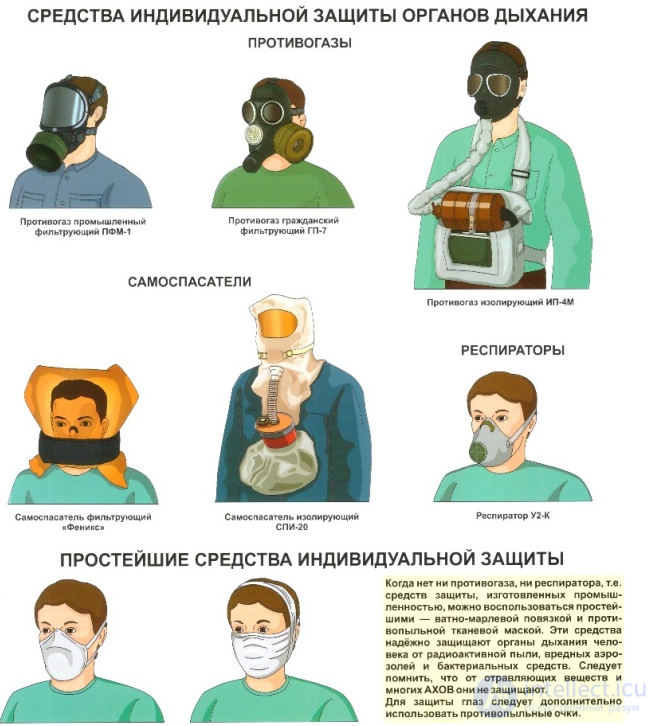
Individual respiratory protective equipment includes: filtering and self-contained gas masks, respirators, an additional cartridge kit (DP-2), a hopcalite cartridge (DP-1), the simplest respiratory protective equipment (anti-dust fabric masks PTM-1; cotton-gauze bandages).
By purpose, PPE is divided into:
— respiratory personal protective equipment (RPPE);
— skin protective equipment (SPE);
— medical personal protective equipment (MPPE).
By method of manufacture, PPE is divided into that produced by industry (standard-issue) and that made by the population from available materials.
By protective principle, all PPE is divided into filtering and self-contained (isolating) types.
Classification of RPPE
Respiratory personal protective equipment includes: the gas mask, respirators, self-contained breathing apparatus, infant protective chambers, and the simplest equipment (anti-dust fabric masks and cotton-gauze bandages).
There are several types of gas masks.
The gas mask is the most reliable means of respiratory protection
Its appearance is linked to the appearance of a new type of weapon of mass destruction — chemical weapons. Chemical warfare agents were first used
in the First World War by the troops of Kaiser Germany against the positions of the Anglo-French forces. It was necessary to create reliable means of protection against chemical warfare agents in a short time. Chemists, physicians and other specialists from many countries worked on this task. The Russian chemist Nikolai Dmitrievich Zelinsky (1861—1953) succeeded better than others, proposing the use of charcoal as the absorbing substance in the protective device. The design he proposed proved so successful that it became the prototype of modern filtering gas masks.
Zelinsky's gas mask consisted of a rubber mask with eyepieces and a box filled with an adsorbing substance — activated charcoal — in which contaminated air was purified. It reliably protected a person's face, eyes and respiratory organs from toxic gases. Constantly being improved, the gas mask has survived to the present day and remains the most widespread means of respiratory protection.
All RPPE is divided by operating principle into filtering and self-contained (isolating) types.
By purpose, filtering RPPE can be divided into three groups:
1) gas masks and respirators for the personnel of the Armed Forces, intended mainly for protection against radioactive dust (RD), chemical warfare agents (CWA) and biological (bacteriological) aerosols (BA). They also have protective properties against a number of hazardous chemical substances;
2) civilian gas masks and respirators, intended for civil defence units and the population. All of them, as a rule, with the exception of children's RPPE, are somewhat simplified in design versions of the protective equipment for Armed Forces personnel;
3) industrial gas masks and respirators, intended to protect the working personnel of an industrial facility against exposure to a specific hazardous chemical substance; their design is quite varied and is determined by the specifics of the enterprise's production activity and the nature of a possible emergency situation at it.
Respiratory protection using filtering RPPE is based on purifying the contaminated outside air of the harmful contaminants it contains. When using filtering protective equipment, a person breathes the oxygen contained in the surrounding atmosphere. Despite the great variety of harmful contaminants, air purification comes down to removing aerosols and molecules (vapour, gas) from it.
Filtering gas masks.
Filtering gas masks are the most universal means of respiratory protection, since they provide a high degree of air purification from harmful contaminants both in the form of aerosols and in the form of vapours (gases).
By age category, gas masks are divided into gas masks intended: for adults, for preschool-age children and school-age children; children's protective chambers are intended to protect children under 1.5 years of age.
The operating principle of gas masks is as follows. Contaminated outside air is used for breathing, and it is purified of harmful contaminants as it passes through the filtering-absorbing box. Already-purified air enters the gas mask's face piece. Exhaled air is released from the face piece to the outside through a special valve.
Civilian filtering gas masks.
Civilian gas masks are more accessible to the population; there are enough of them in the country to provide for the entire population living in areas at risk of an emergency situation resulting from large-scale releases of hazardous chemical substances into the environment, as well as in the event of the use of weapons of mass destruction.
There are the following types of civilian gas masks.
All civilian gas masks are fitted with a standard small-size gas mask box, which has certain distinguishing features in the composition of its filling material. Their main difference lies in the design features and dimensions of the face pieces.
For the adult population, gas masks of the GP-5 (GP-5M) and GP-7 (its modifications GP-7V, GP-7VM) types are used.
The GP-5 gas mask consists of:
The gas mask is selected according to the measurement of a closed line passing through the crown of the head, the cheeks and the chin, using a table.
Determining the size of the GP-5 gas mask
|
Measurement result |
Size |
|
Up to 63.0 cm |
0 |
|
63.5 - 65.5 cm |
1 |
|
66.0 - 68.0 cm |
2 |
|
68.5 - 70.5 cm |
3 |
|
71.0 cm and more |
4 |
The PDF-7 gas mask has become widespread for protecting younger (starting from 1.5 years) and older children.
The most advanced models are the children's gas masks PDF-2D for preschool age and PDF-2Sh for school age. Checking, assembling and preparing children's gas masks are practically no different from the same operations with gas masks for adults. Tests carried out have shown that the protective duration of children's civilian gas masks is roughly twice that of gas masks for adults.
To protect infants under one and a half years old from chemical warfare agents, radioactive iodine and dust, and bacteriological agents, the KZD-4 and KZD-6 protective infant chambers are intended.
Despite the fact that civilian gas masks are fitted with small-size boxes containing a thin layer of charge (activated charcoal), their protective capacity against the concentrations of chemical warfare agents created under field conditions is practically unlimited. Tests have shown that civilian gas masks, alongside protection against chemical warfare agents, also protect against chlorine, hydrogen sulphide, phosgene and certain other hazardous chemical substances.
However, in emergency situations caused by large-scale releases of hazardous chemical substances, when concentrations in the atmosphere may be several orders of magnitude higher than from chemical warfare agents under field conditions, the protective duration of gas masks is quite limited. And in a number of cases it is equal to zero. This is due, firstly, to the fact that civilian gas masks do not provide protection against a number of hazardous chemical substances, such as ammonia, dimethylamine, methyl chloride, nitrogen oxides, ethylene oxide, and carbon monoxide. Secondly, at short distances from a continuously acting source of contamination, under conditions of high concentrations, the charge in the gas mask box may break through instantly.
In order to expand the capabilities of the gas mask for protection against various hazardous chemical substances and to increase its protective properties, industry currently manufactures special additional hopcalite cartridges DP-1, DP-2, DPG-1, DPGZ and PZU-PK. The additional (hopcalite) cartridge is used together with the gas mask box.
Inside the cartridge there is one (DPG-Z) or two (DPG-1) layers: a special absorber and hopcalite. Outside air, entering the filtering-absorbing box (FAB), is preliminarily purified of aerosols and vapours of hazardous chemical substances. Then, entering the additional cartridge, it is finally purified of harmful contaminants. The cartridge is cylindrical in shape and outwardly resembles the FAB of the GP-5, GP-7 gas masks. On its base an internal thread is cut for attachment to the FAB of the GP-5 or GP-7.
The protective properties of industrial gas mask boxes against hazardous chemical substances are considerably higher than those of civilian gas mask boxes (without an additional cartridge). Therefore, industrial gas masks can be used across a wider range of concentrations, i.e. they can be used at shorter distances from the source of contamination compared with civilian gas masks. The use of civilian gas masks without an additional cartridge is possible only at large distances (hundreds of metres or more) from the source of danger.
- In what positions can a gas mask be?
marching, ready, and combat.
2) The gas mask is carried in a bag on the left side with the valve facing outward, the strap slung over the right shoulder.
3) In the marching position the gas mask is on the side, with the valve fastened.
4) At the command "Prepare gas masks!" the bag is secured with a waist strap and the valve is opened.
5) At the command "Gas!" the gas mask is put into the combat position, and the face piece must be put on.
- How to put on a gas mask correctly?
Procedure for bringing the gas mask into the combat position:
at the command "GAS!":
1) Hold your breath and close your eyes.
2) Remove your headgear and clamp it between your knees or set it down nearby.
3) Take hold of the lower parts so that the thumbs are on the outside and the other fingers on the inside, bring the face piece up to the chin and, with a sharp upward and backward motion, pull it over the head so that there are no folds.
4) Exhale fully, open your eyes and resume breathing.
5) Put on the headgear, fasten the bag and secure it, if this has not already been done.
The gas mask is considered correctly fitted if the eyepiece lenses are in front of the eyes, the face piece fits snugly against the face, and there are no wrinkles on the head.
- Why is it necessary to take a deep exhale?
A deep exhale is necessary so that any contaminated air that got inside while putting on the mask is expelled.
- How to take off a gas mask correctly?
Rules for removing a gas mask.
A gas mask may be removed after the command "Remove gas masks!". To do this you need to lift up your headgear, take hold of the valve, pull it slightly and, with a brisk forward and upward motion, remove the gas mask. Then put your headgear back on, turn the face piece inside out, wipe it thoroughly and fold it so that the eyepiece lenses are covered, and put it in the bag.
Respirators are used to protect the respiratory organs from harmful gases, vapours, aerosols and dust.
A respirator is, in essence, a personal means of protecting the respiratory organs from harmful substances contained in the air. They are widely used in mines, in pits, at chemical and metallurgical enterprises, at nuclear power plants, and when working with fertilisers and agrochemicals in agriculture
Respirators are classified by purpose, design and service life
By purpose, respirators are divided into anti-dust, anti-gas and combined gas-and-dust protective types.
By design, respirators are divided into two types:
— respirators in which the half-mask and the filtering element together serve as the face piece;
— respirators that purify inhaled air in filtering cartridges attached to the half-mask.
Depending on their service life, respirators are either single-use or reusable (with provision for replacing filters)
The type of respirator is selected depending on the characteristics of the harmful substances and their maximum permissible concentration in the air.
The most widely used are anti-dust respirators of the R-2, U-2K, "Kama", ShB-1 "Lepestok" types and others.
In emergency situations, these respirators can be used to protect the respiratory organs from radioactive dust and biological agents. It should be borne in mind that anti-dust respirators do not provide protection against vapours and gases of harmful substances.
In the civil defence system, the R-2 and R-2D respirators are the most widely used
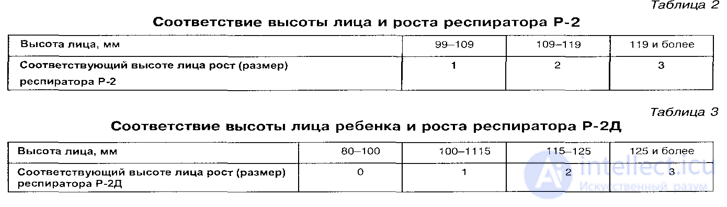
The R-2 respirator is intended for equipping the personnel of emergency response units and forces, while the R-2D — is for protecting the respiratory organs of children from 7 to 17 years old, differing from the adult version in size. The R-2 respirator is produced in three sizes (heights) (1, 2, 3), the R-2D — in four (0, 1, 2, 3)  . To select the R-2 respirator by size, you need to know the height of the face, that is, the distance between the point of the deepest indentation on the bridge of the nose and the lowest point of the chin. The respirator size (height) is chosen according to the measured height of the face (Tables 2, 3).
The tightness of the respirator's fit to the face is checked as follows: cover the opening of the exhalation safety screen tightly with the palm of the hand and exhale gently. If air does not escape from the half-mask, but only slightly inflates it, the respirator provides an airtight seal.
In industrial settings, at relatively low concentrations (10—15 MPC), gas-and-dust protective respirators may be used to protect the respiratory organs from vapours, gases and aerosols of hazardous chemical substances: RU-60M, RPG-67 and "Snezhok-GP-E". They are used to protect the respiratory organs not only from harmful substances but also from mechanical particles suspended in the air of a production facility.
The RU-60M and RPG-67 respirators are made in the form of a rubber half-mask PR-7 with a knitted obturator. The RU-60M is used with two absorbing cartridges, in which the charge and filter are placed. The RPG-67 is used with a KD cartridge without a filter and protects only against vapours and gases of hazardous chemical substances.
The "Snezhok-GP-E" gas-and-dust protective respirator has a dust-aerosol filter and an absorbing filter, which provide protection both from aerosols and vapours and from gases of hazardous chemical substances (hydrogen fluoride, hydrogen chloride, chlorine and sulphur dioxide).
In all cases, gas-and-dust protective respirators have limited use. They cannot be used if the hazardous chemical substances affect the eyes and skin.
When there is neither a gas mask nor a respirator, the simplest protective equipment can be used.
The simplest respiratory PPE includes the PTM-1 anti-dust fabric mask and the cotton-gauze bandage. These items can be used by the population in the same way as anti-dust respirators. They quite reliably protect the respiratory organs from radioactive dust, harmful aerosols and bacteriological agents. They are made either to order from civil defence and emergencies management authorities in sewing workshops, or by the population itself according to patterns recommended by the civil defence and emergencies authorities.
The PTM-1 mask consists of two main parts — the body and the fastening.
Viewing openings are cut in the body, into which glass or plates of transparent material (plexiglass, celluloid) are inserted. The body of the mask is made of four to five layers of fabric: two to three inner layers — of dense fabrics (flannel, baize), the outer one — of a loose fabric — (staple fibre, knit). The fastening is made from a single layer of any fabric.
A cotton-gauze bandage is made as follows:
— take a piece of gauze measuring 100 by 50 cm;
— place an even layer of cotton wool measuring 30 by 20 cm and about 2 cm thick in the middle of it;
— fold the gauze over on both sides, covering the cotton wool with it;
— cut the ends of the gauze that are free of cotton wool down the middle with scissors so that two pairs of ties are formed;
— secure the ties with stitches of thread (sew them over).
If there is gauze but no cotton wool, a gauze bandage can be made. To do this, instead of cotton wool, five to six layers of gauze are placed in the middle of the piece.
When used, the cotton-gauze bandage is applied so that its lower edge covers the bottom of the chin, while the upper edge reaches the eye sockets.
In doing so, the mouth and nose must be well covered. The cut ends of the bandage are tied: first the upper ones - at the back of the head behind the ears, then the lower ones — on the crown of the head. Special anti-dust goggles of various designs are used to protect the eyes. Goggles can also be made by oneself.
In emergencies, if an anti-dust mask and bandage are unavailable, improvised means can be used: any fabric folded into several layers, clothing, a towel, a scarf, a handkerchief, etc.
The protective properties of the PTM, CGB and improvised means can be enhanced by moistening them with water or a special solution.
To protect the respiratory organs under conditions of chemical contamination, anti-dust respirators and the simplest personal protective equipment are used only in exceptional cases. For example, during evacuation from a zone of chemical contamination, after pre-soaking them in a 5—10 percent solution of baking soda or a 2 percent solution of citric (acetic) acid.
Self-contained (isolating) respiratory PPE
The use of filtering gas masks when carrying out emergency rescue and other urgent work directly at the site of a hazardous chemical substance spill is unsafe. In such cases it is recommended to use self-contained (isolating) type respiratory personal protective equipment.
Self-contained gas masks are intended for carrying out emergency rescue work under conditions of high concentrations of harmful vapours in the air, when there is a shortage or absence of oxygen in the air, and also when working underwater.
These include the IP-4, IP-4M, IP-4MK gas masks for working on land and the IP-5 gas mask for working underwater.
Their operating principle is that outside air is not used for breathing. A person wearing the gas mask breathes a mixture of oxygen from a special container and exhaled air after it has been purified of moisture and carbon dioxide. The drawback of the self-contained gas mask is the limited time it can be worn.
These protective devices operate on the basis of chemically bound oxygen. Oxygen is released as a result of a chemical reaction that takes place in the regenerative cartridge when the starting mechanism is triggered. Sodium and potassium superoxide compounds are the most widely used regenerating agents. All superoxide compounds are characterized by the presence of active oxygen, which is released in molecular form during the reaction of the superoxide with water or carbon dioxide.
All self-contained (isolating) gas masks based on chemically bound oxygen consist of a regenerative cartridge with a starting device, a breathing bag with an excess-pressure valve, a facepiece (available in three sizes) with a connecting tube, a frame, and a carrying bag with accessories. The regenerative cartridge serves to absorb carbon dioxide and water vapour from the air exhaled by the wearer, and to supply the oxygen needed for breathing into the inhaled air. The breathing bag serves as an air reservoir. It is fitted with an excess-pressure valve that keeps the pressure in the breathing bag from exceeding 40 mm of water column. The facepiece serves to isolate the respiratory organs, eyes, and face from the environment and to direct air to the respiratory organs from the breathing bag through the regenerative cartridge. The frame keeps the breathing bag from being crushed during operation and also secures the regenerative cartridge.
Nowadays, self-contained gas masks and breathing apparatus operating on compressed oxygen (KIP-8, KIP-9) and on compressed air (AP-96, AP-98-7K, AP-2000, IVA-24M, ASV-2, AVKh-324NT, and others) are also widely used. The self-contained gas masks and breathing apparatus listed above make it possible to remain in air contaminated with the highest concentrations of hazardous chemical substances. The cost of these gas masks considerably exceeds the cost of filtering gas masks. Therefore, under current norms, they are issued only to those production personnel of chemically hazardous facilities whose work is directly related to operations in especially dangerous areas. These are, above all, the personnel of gas-rescue and dispatching services of chemically hazardous industries and the personnel of units intended to carry out work directly at the site of a hazardous chemical spill (reconnaissance teams, rescuers, and those eliminating the consequences of chemical accidents).
Self-contained gas masks are reusable equipment. As the regenerative cartridges or cylinders are used up, they are replaced with new ones. Using these gas masks requires advance special training of the personnel who will work in them.
Self-rescuers.
In addition to self-contained gas masks and breathing apparatus, isolating respiratory protective equipment also includes self-rescuers of the SPI-20 and PDU-3 type, which are used for short-term protection against hazardous chemical substances during an emergency exit from a contaminated zone.
These devices also include regenerative cartridges and breathing bags with an excess-pressure valve. Unlike self-contained gas masks, self-rescuers are single-use protective equipment, and their use presents no particular difficulty for untrained personnel.
Isolating respiratory protective equipment also includes hose gas masks, which supply the respiratory organs with clean air by means of fans or compressors through connecting hoses. They are used mainly when carrying out repair and cleaning work in various tanks, cisterns, basements, and other enclosed spaces where hazardous chemical substances may accumulate in high concentrations.
1.What is individual respiratory protective equipment? What types is it divided into?
2. What is a gas mask? What types of gas masks do you know?
3. What does a gas mask protect against? What can a gas mask not protect against?
4.What is a respirator? What are respirators for? What types of respirators do you know, and how do they differ?
5. What simple means of respiratory protection do you know? How is a cotton-gauze mask made?
6. Describe the purpose and design of the GP-5 or GP-7 filtering gas mask
7. What is skin protective equipment for?
8. Name the simplest means of skin protection and describe the rules for using them.
9.Name the most common isolating and filtering skin protective equipment and briefly characterize them.
Test on the topic «PPE»
1. The gas mask is removed on the command:
a) «Stand down!»;
b) «Remove gas masks!»;
c) «Gas!».
2. What belongs to individual respiratory protective equipment?
3. A gas mask serves to protect the respiratory organs, eyes, and exposed skin from
There is a mistake in the sequence above. Find it.
4. GP-5 gas masks can be of the following sizes:
a) 0;
b) 3;
c) 2;
d) 5.
There is a mistake in the sequence above. Find it.

Comments