
Lecture
Purpose: to develop students' knowledge of the main methods of resuscitation and transport in acute illnesses, and to examine methods of carrying and transporting patients.
As is known, resuscitation in the literal sense of the word means the revival of an organism that is in a state of clinical death (Lat. re—again, anima — life). However, nowadays this concept is given a broader meaning. The most essential branch of resuscitation in surgery is the prevention and treatment of severe complications during surgery and in the immediate postoperative period. During anaesthesia and surgical intervention, resuscitation measures are aimed mainly at maintaining adequate gas exchange and circulation, since at this stage changes in these functions most often come to the fore. In the early postoperative period these are joined by correction of the water-salt, electrolyte and protein balance, the acid-base balance, the coagulating and anticoagulating capacity of the blood, as well as combating liver failure, kidney failure, and disturbances of cerebral circulation.
Resuscitation consists of several stages and includes a number of essential rules. Moreover, compliance with them, as well as with the sequence of the stages, is mandatory, since their effectiveness depends on this.
If cardiac activity stops and consciousness is lost, resuscitation measures must be started immediately.
When the heart stops, the first thing required is 2 precordial thumps to the sternum. To do this, the person performing resuscitation delivers two quick blows with the base of the palm to the lower third of the xiphoid process. This measure is an alternative to defibrillation. Usually, if possible, an electric-pulse discharge (defibrillation) is preferred instead.
If cardiac activity has not been restored, chest compressions and artificial ventilation of the lungs must be started immediately. In adults, cardiopulmonary resuscitation is performed at a ratio of 15:2. That is, 15 compressions (presses) of the chest, followed by 2 breaths through the mouth or nose. In doing so, the airway (mouth and nose) must be kept clear for the passage of air. Otherwise, they must be cleared - freed of foreign bodies, fluid, etc.
As for children in the first 5 years of life, cardiopulmonary resuscitation is performed at a ratio of 5:1, and precordial thumps are not given.
Resuscitation measures may not be interrupted for more than 30 sec. It is within this time that tracheal intubation must be carried out or the defibrillator prepared for delivering a shock.
Resuscitation measures must be continued until signs of cardiac activity and spontaneous breathing appear. Otherwise, if these measures are ineffective for at least 30 minutes, resuscitation is discontinued.
Continuity of cardiopulmonary resuscitation and other resuscitation measures.
This means that, in the event of successful "revival," intensive treatment of the organism's main disorders must be started, with continuous support (as needed) of circulation and breathing.
Resuscitation can be started at any stage of providing medical care, but the main place for it to be carried out most effectively is specialised resuscitation departments of hospitals, where all measures are carried out until the patient is stabilised at a level no lower than moderate severity. That is, until the ability to breathe independently and to maintain haemodynamics (blood pressure, heart rate) at an optimal level appears.
Transporting patients can be carried out in various ways.
Depending on the severity of the condition and the type of injury or illness, casualties are transported to the ambulance and from the ambulance to the admissions department: carried by hand; on foot; on crutches, with support; on a stretcher.
In ambulances, patients are transported lying on a stretcher with the head end or foot end raised (depending on the diagnosis), or sitting. Children are carried in arms. The paramedic must in all cases remain in the cabin next to the patient and monitor their condition, and if necessary — provide assistance. At the paramedic's discretion, the patient may be accompanied by a relative or acquaintance. Children, as a rule, are transported accompanied by their parents.
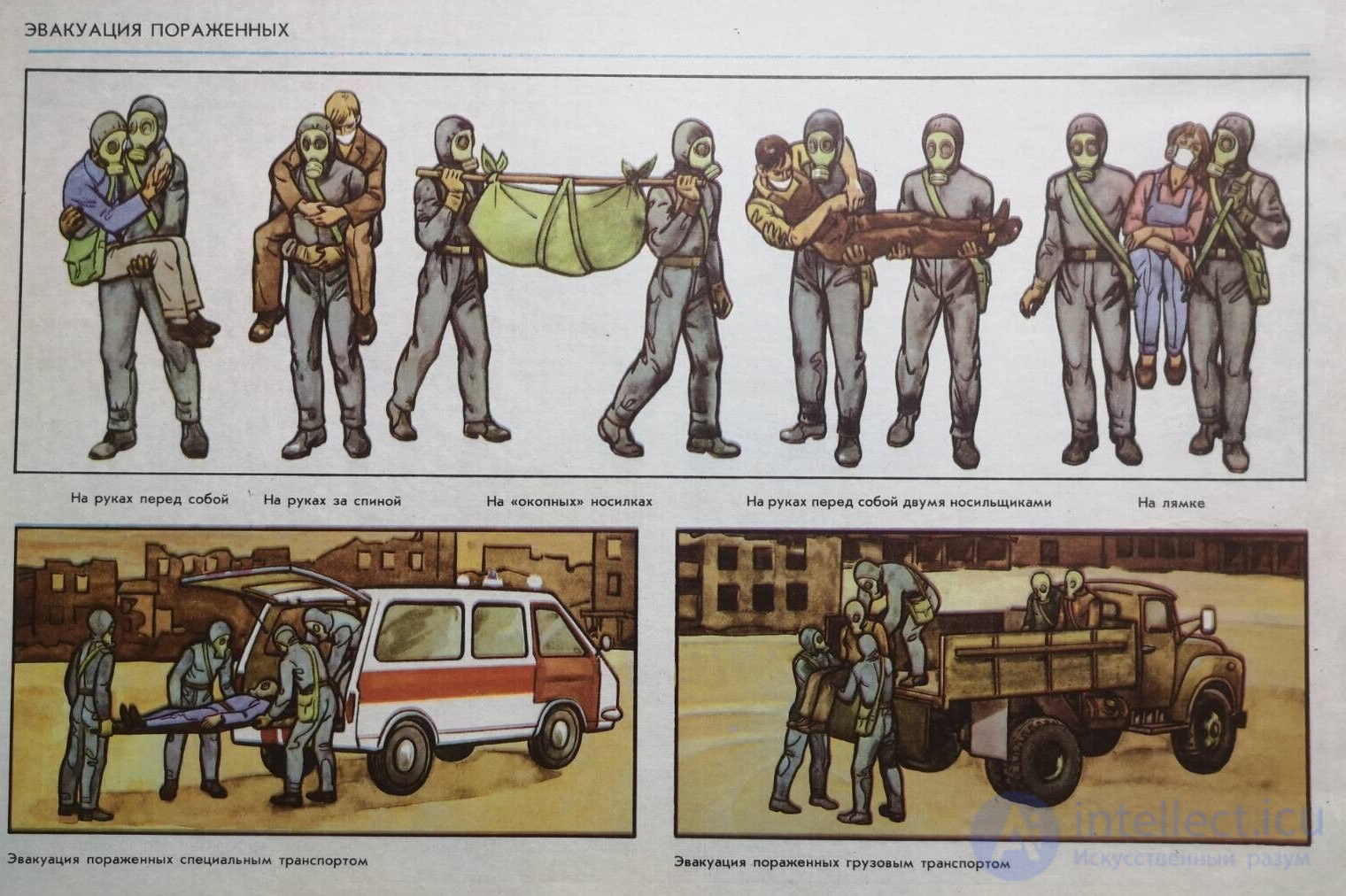
On foot, or sitting in the vehicle, are transported patients with non-severe somatic illnesses, with injuries to the upper limbs, and with surgical conditions that do not require hospitalisation on a stretcher. If such patients become dizzy and/or the transport time is long, they should be placed on a stretcher.
On crutches with support it is possible to transport patients with injuries to the lower leg and foot (after transport immobilisation) in
cases of non-severe injuries.
Transport by carrying with support
Children are transported by carrying, as are adults when it is not possible to use a stretcher.
Transport on a stretcher is used for all patients who are unconscious, in a state of shock, severely ill patients, those with impaired cerebral circulation, with acute myocardial infarction, all women in labour, pregnant women with complications of pregnancy (eclampsia, threatened miscarriage, etc.), with hip injuries (fracture, extensive wounds), with severe or moderately severe surgical or gynaecological conditions of the abdominal organs, with craniocerebral injuries, with combined injuries, with spinal injuries.
Technique of carrying on a stretcher
Where possible, a blanket or a sturdy cover should first be laid on the stretcher so that one half of it (lengthwise) covers the stretcher, while the other half lies alongside. After the patient has been placed on the stretcher, they are covered with this half. Later it is more convenient to remove the patient from the stretcher by holding the edges of the cover. If the patient cannot get onto the stretcher unaided, it is placed with its foot end toward the head of the bed, and three people lift the patient and move them onto the stretcher. In cold weather, a hat should be put on the patient and their legs wrapped up. One should also not forget the need for additional warming of patients who are in a state of shock.
On stairs, the patient is taken down feet first and carried up head first. Exception — acute blood loss, very low blood pressure. In this case the opposite is done.
When it is not possible to carry a stretcher through an apartment or up stairs, the patient is carried on a blanket. As a last resort, if this too is impossible for some reason, the stretcher is set up at the entrance, and the patient is carried down by hand, and in the lift — on a stool or chair, which should be placed there in advance.
Patients who are unconscious are transported in a stable lateral position because of the risk of aspiration of vomit and of the tongue falling back
Patients with spinal injuries should be transported on their back, on a rigid board. If one is not available — on an ordinary semi-soft stretcher, on their front. In the case of injury to the cervical spine — always on the back, after immobilisation. It is forbidden to place patients with a spinal injury on their side!
It is forbidden to place in a horizontal position patients in a state of pulmonary oedema, during an attack of bronchial or cardiac asthma, or respiratory failure caused by other reasons. They should be transported in a sitting position, and children — held upright in the arms.
After transporting an infectious patient, the ambulance is disinfected. The staff must change their gowns. More than one infectious patient may be transported together only if they have the same infectious disease, taking into account the degree of infectiousness at different stages of the illness.
Transport of extremely critically ill patients is permitted only by resuscitation teams. Before transport, a set of therapeutic measures aimed at stabilising the condition must be carried out.

Comments