
Lecture
Goal: to build students' knowledge of the effects, types and damaging factors of chemical weapons of mass destruction, and of what to do when chemical weapons are used.
Chemical weapons – the earliest (historical) type of chemical warfare agent. They were first used by German units during the First World War.
The history of chemical weapons goes back to ancient times. In Ancient China, quicklime was used, with which jars were filled and hurled over fortress walls. When dispersed, the lime damaged the eyes, and on contact with water it formed a poisonous gas. In other countries various resins, plant poisons, and other substances were used. The action of these substances was directed at the respiratory organs, vision, the cardiovascular system and the nervous system.
Chemical weapons – are, first and foremost, gaseous substances that act through the respiratory organs. There are lethal and non-lethal, or tear-inducing, types of weapons. Chemical weapons can also be used by terrorist organisations; for example, such a weapon was used by the «Aum Shinrikyo» sect in the Tokyo subway.
Along with the emergence of chemical weapons came questions of protection against them. At that time, anti-smoke masks were in service with the troops, but they proved ineffective against chemical weapons. The problem of protection against chemical weapons was successfully solved in our country. In 1916, chemist N.D. Zelinsky developed an effective gas mask design. In 1925, the use of chemical weapons was prohibited by the Geneva Convention as inhumane and against humanity. Despite this, many countries, including those that had signed the Geneva Convention, continued and still continue to produce chemical weapons, improve them, and prepare for their use.
After the end of the Second World War, despite the emergence of nuclear weapons, the improvement and development of chemical weapons continued. New types of chemical warfare agents (CWAs) were developed in the USA, including binary munitions, which are relatively safe during storage, transport, servicing and preparation for use. Police began to widely use irritant CWAs, the so-called «tear gas», to disperse mass demonstrations, to put down riots, and in counter-terrorism operations. So the history of chemical weapons continues.
Chemical weapons – are a type of weapon of mass destruction whose effect is based on the toxic properties of certain chemical substances. They include chemical warfare agents and the means of delivering them.
Chemical warfare agents (CWAs) - are chemical compounds capable of injuring people and animals over large areas and of penetrating various structures. They can also contaminate terrain and bodies of water.
Their carriers are rockets, aerial bombs, artillery shells and mines.
CWAs are used in a droplet-liquid state, as vapour, and as an aerosol.
They can enter the human body and cause injury through the respiratory organs, the digestive organs, the skin and the eyes.
By tactical purpose, CWAs are divided into groups depending on the nature of their damaging effect:
By their (physical) effect on the human body, CWAs are divided into:
In accidents and disasters, poisoning occurs when hazardous chemical substances enter the body through the organs
of respiration and digestion, the skin, and the mucous membranes. The nature and severity of the injuries are determined by the following main factors: the kind and nature of the toxic action, the degree of toxicity, the concentration of the chemical substances at the affected site (area), and the duration of exposure to the person.
Signs of poisoning by chemical substances.
irritation phenomena - coughing, throat tickling and soreness, watering and stinging of the eyes, chest pain, headache;
increasing and developing phenomena on the part of the central nervous system (CNS) - headache, dizziness, a feeling of intoxication and fear, nausea, vomiting, a state of euphoria, impaired
coordination of movements, drowsiness, general lethargy, apathy, and so on.
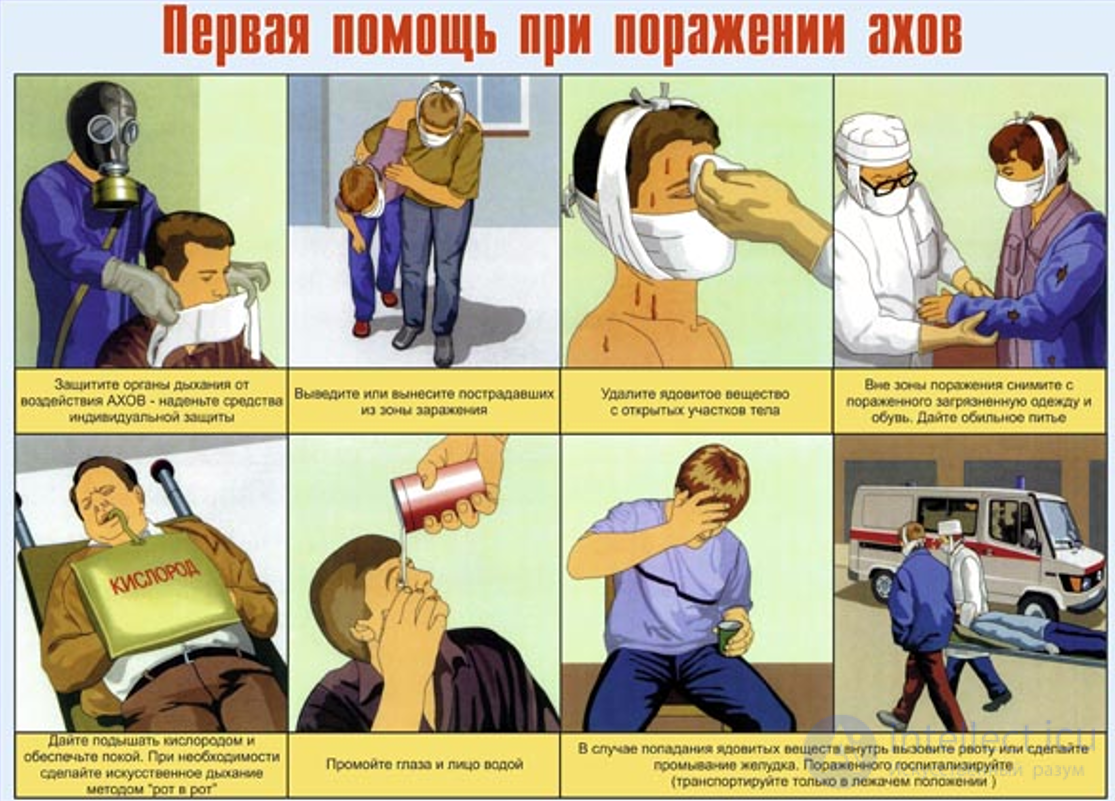
First aid must be given as quickly as possible and consist of:
LETHAL - intended to inflict fatal injury on enemy personnel or to incapacitate them for a long period;
TEMPORARILY INCAPACITATING – psychochemical substances that act on the human nervous system and cause temporary mental disorders;
IRRITANT (POLICE) AGENTS - affect the sensitive nerve endings of the mucous membranes of the upper respiratory tract and act on the eyes.
|
|
Damaging effect |
Modes of injury |
Signs of injury |
Additional information |
|||
|
|
|
||||||
|
|
affect the human nervous system |
through the respiratory organs, in vapour and droplet-liquid form through the skin, as well as together with food and water |
salivation, constriction of the pupils (miosis), difficulty breathing, nausea, vomiting, convulsions, paralysis |
● persistence of the agent is more than a day in summer, several weeks or even months in winter; ● a very small amount of the agent is enough to cause injury (hazardous concentrations 5* 10-5 mg/l ● the agent contains phosphorus in its composition and is sometimes called an organophosphorus agent (OPA) |
|||
|
|
|
||||||
|
|
multifaceted, depending on the route of penetration |
in droplet-liquid and vapour form - the eyes and skin; when vapours are inhaled, the respiratory tract and lungs when it enters with food and water - the digestive organs
|
reddening of the skin, formation of small blisters that then merge into larger ones and, after 2-3 days, burst, turning into slow-healing ulcers. Any local injuries cause general poisoning of the body: the temperature rises, malaise appears. |
● have a period of latent action (mustard gas - injury becomes apparent after 2 hours or more); ● hazardous concentrations — 0.002-0.003 mg/l, lethal - 0.3 mg/l.
|
|||
|
|
||||||
|
multifaceted, depending on the route of penetration and the dose |
act on the body through the respiratory organs.
|
sweetish, unpleasant taste in the mouth, coughing, dizziness, general weakness. |
|
||||
|
|
||||||
|
multifaceted |
through the respiratory organs (do not act through the skin) |
metallic taste in the mouth, throat irritation, dizziness, weakness, nausea, sharp convulsions, paralysis. |
|
||||
|
|
||||||
|
act on the central nervous system |
through the respiratory organs (do not act through the skin) |
psychological (hallucinations, fear, depression) or physical (blindness, deafness) disorders |
|
||||
|
|
||||||
|
affect the sensitive endings of the mucous membranes of the upper respiratory tract, act on the eyes |
through the respiratory organs and mucous membranes |
acute burning in the mouth, throat and eyes, heavy watering of the eyes, coughing, difficulty breathing |
|
||||
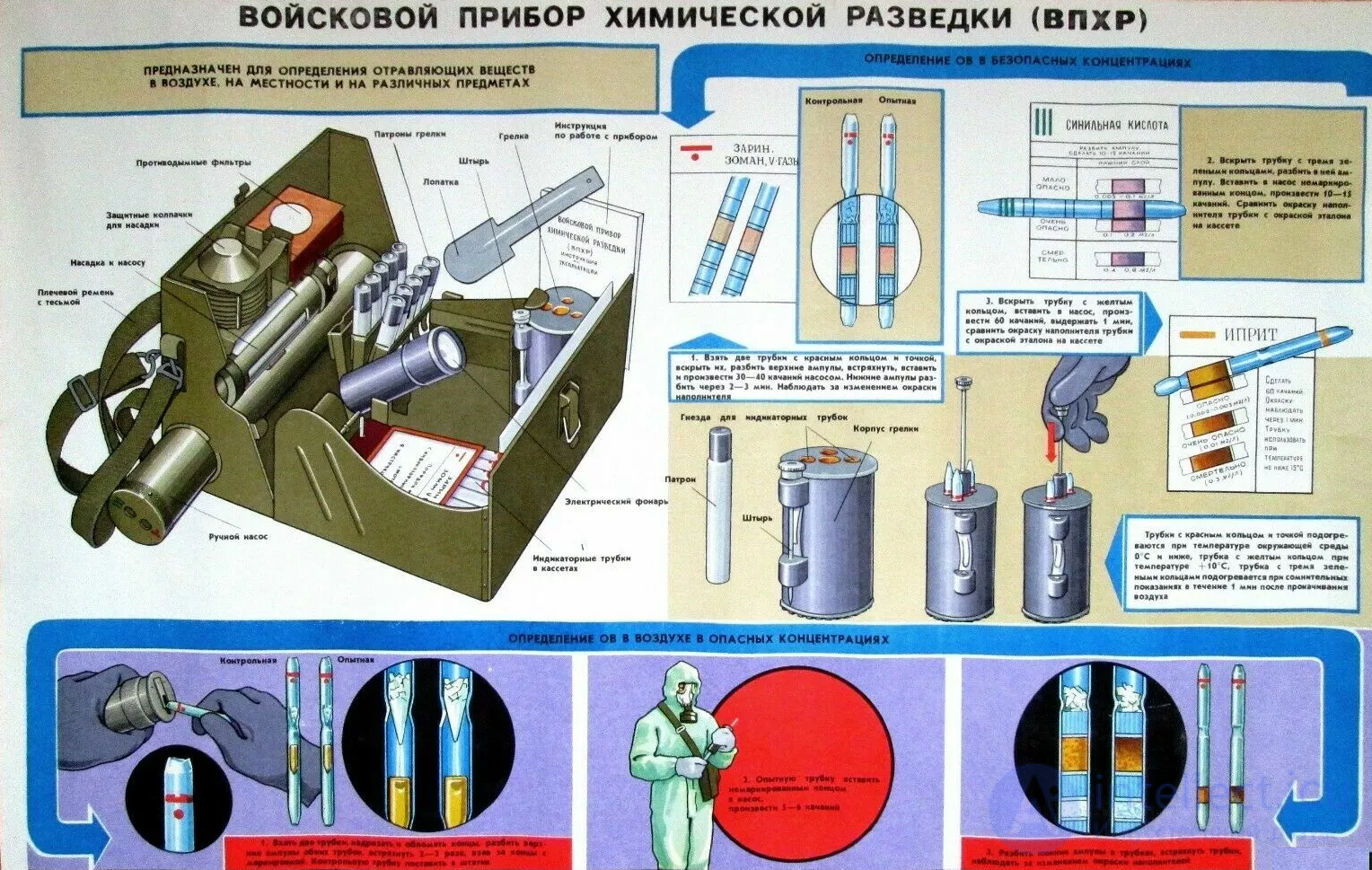
To determine the actual agent used, an analysis of the contaminated air, objects, water or soil is carried out using special reagents
The territory within which mass injuries of people and farm animals occurred as a result of exposure to chemical weapons is called the affected area. Its size depends on the scale and method of use of the agent, the type of agent, meteorological conditions, terrain relief, and other factors.
The territory that was directly exposed to chemical weapons, and the territory over which the cloud of contaminated air spread at damaging concentrations, is called the zone of chemical contamination. Primary and secondary contamination zones are distinguished.
The primary contamination zone is formed as a result of the primary cloud of contaminated air, whose source is the vapours and aerosols of the agent that appear directly when chemical munitions burst. The secondary contamination zone is formed as a result of the cloud that forms when droplets of the agent that have settled after the bursting of chemical munitions evaporate.
In extreme situations involving the release of a toxic warfare agent into the environment, the greatest danger is posed by the places of its direct release into the environment and by the initially contaminated cloud. The zone of chemical contamination by a toxic warfare agent is characterised by its length (depth) and width. The depth of the zone depends on the degree of toxicity of the chemical agent, the nature of the terrain, and the meteorological factors of the environment. The width of the vapour dispersion zone is taken as 0.03-0.85 of the depth, depending on atmospheric stability.
The concentration of the toxic warfare agent in the contaminated cloud is constantly changing, with the highest concentration being near the release site, but gradually decreasing towards the periphery and along the path of the spreading contaminated cloud. The zone of chemical contamination by a toxic warfare agent is characterised by highly mobile boundaries. The mobility of the contaminated cloud is significantly influenced by: - turbulence (eddying) of the air; - meteorological conditions; - the season; - the nature of the terrain; - the physico-chemical properties of the agent (boiling point, volatility, density, etc.). Of the above factors, the speed of air movement is of very great importance. At an air speed of more than 6 m/s, the contaminated cloud disperses quickly and the concentration of the agent in it decreases.
The most common and effective measures of protection against chemical weapons are the use of respiratory and skin protection equipment. First and foremost these are gas masks, and to a lesser extent – respirators and the simplest means of respiratory protection. Respirators and the simplest means of respiratory protection are often unable to protect a person from chemical warfare agents.
When a person is inside a building, sealing is carried out. In this case, the safe occupancy time is determined by the volume of the premises, the number of people in it, the quality of the air at the time of sealing, and the physical activity of the people inside it.
One can also protect oneself from the effects of chemical weapons while inside a vehicle (a combat vehicle) that is specially equipped with devices creating excess pressure inside the hull. The final method – is the use, for breathing, of breathing mixtures placed in cylinders or other containers not connected to the atmospheric air.
One should leave the zone of chemical contamination by moving perpendicular to the direction of the wind.
To save the lives of casualties affected by organophosphorus chemical warfare agents (OPAs) and by some other agents it is necessary to use specific medicinal agents - antidotes. The effectiveness of antidotes against OPAs is fully manifested only when administered in the initial period of poisoning or in the first minutes after the appearance of signs of severe injury (convulsions). Carrying out partial sanitary treatment of exposed areas of skin on exposure to OPAs and mustard gas, especially in droplet-liquid form, within the first 5 minutes after contact with the agent, prevents or significantly reduces the severity of injury. Staying in a chemical contamination zone without protective equipment leads to the continuous intake of the agent into the body and significantly worsens the condition of the casualties. First medical aid measures for casualties affected by an agent must be carried out in the shortest possible time. Therefore, providing self- and mutual aid is of paramount importance for saving casualties affected by an agent, as is the timely subsequent implementation of all necessary first medical aid and treatment measures.
To avoid being affected by the agent, before entering a chemical contamination zone one must take a preventive dose (1 tablet) of the antidote from the individual first-aid kit (AI-2), and put on protective clothing, protective rubber boots, gloves and a gas mask. It should be kept in mind that people contaminated with OPAs, mustard gas and some other agents pose a considerable danger to those providing them with first medical aid, even after they have been evacuated from the chemical contamination zone. Agents remain on the clothing, hair and skin of casualties for a more or less prolonged time and can cause injury on contact with unprotected skin. Injury can also occur through desorption (evaporation) of agent vapours from contaminated clothing, especially in enclosed spaces and vehicles.
First medical aid in case of agent injury.
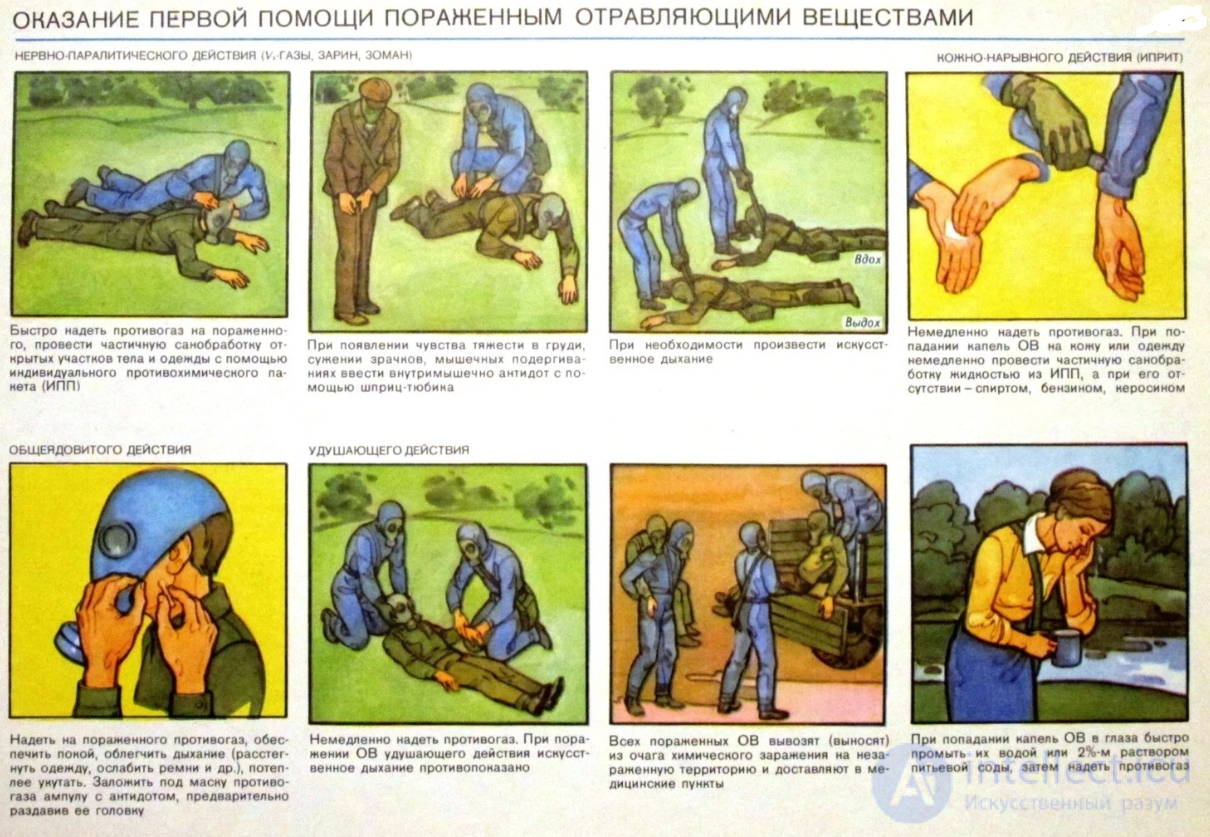
Consists of carrying out the following urgent measures. Regardless of the type of agent used, the first thing to do for the casualty is to immediately put on a gas mask or replace a damaged gas mask with a serviceable one. This will stop further intake of the toxic substance into the body through the respiratory organs, and will also protect the eyes, the skin of the face and, partially, the skin of the head from the agent.
If the casualty is in the zone of direct use of the agent, when the finest droplets of the toxic substance land on the face, the skin of the face must first be treated with the liquid from the individual anti-chemical packet (IACP) and only then should the gas mask be put on.
If the casualty is lying down, then to put a GP-4U gas mask on him one must kneel at his head, rest his head on one's knees, remove the casualty's headgear, take the gas mask's face piece out, and, grasping the temporal and occipital straps, take the mask with both hands by the edges so that the thumbs are on the outside and the other fingers point inward; then the lower part of the mask should be applied to the chin, the mask pulled onto the face and the occipital straps brought behind the ears (the back-strap should then be in the centre of the back of the head); the mask should be adjusted by taking the free ends of the occipital straps and pulling them so that the mask fits snugly against the face, the headgear put back on, and the gas mask bag closed with its flap.
To put on a GP-5 gas mask, one must insert the fingers of both hands, except for the thumbs, inside the helmet-mask at its chin part, and, holding the edges of the face piece on the outside with the thumbs, put the helmet-mask on the head starting from the chin, so that the eyepieces line up exactly with the eyes.
Subsequent first medical aid measures are carried out depending on the type of agent used.
In the case of OPA injury, immediately after putting on the gas mask, 2 doses of the OPA antidote are administered intramuscularly or subcutaneously using an auto-injector syringe to a severely affected casualty, and 1 dose to a moderately affected casualty. A slightly affected casualty is given 2 antidote tablets from the individual first-aid kit under the tongue (red case, compartment 2) before putting on the gas mask, or is given a dose of antidote from an auto-injector syringe.
Then partial sanitary treatment of exposed areas of skin is carried out with the liquid from the individual anti-chemical packet (IACP). If the gas mask is on, the packet should be opened, the swab generously moistened, and the exposed skin of the neck and hands, the edges of the collar and cuffs adjacent to the skin, and the face piece of the gas mask should be wiped.
If the gas mask is not on, the eyes must be tightly closed, and the skin of the face and neck quickly wiped with a swab moistened with a degassing agent. Without opening the eyes, wipe the skin around them with a dry swab and put on the gas mask. Then moisten the swab again and use it to wipe the hands, the edges of the collar and cuffs adjacent to the skin. When treating the skin of the face with the liquid from the packet, care must be taken to protect the eyes
If necessary, and if conditions allow, artificial respiration is performed (as a rule, artificial respiration is not performed in a chemical contamination zone, in a contaminated atmosphere). All casualties are then evacuated from the chemical contamination zone to a first medical aid unit (OPM) or to medical facilities.
In the case of injury by a blister (vesicant) agent, immediately after putting on the gas mask, partial sanitary treatment of exposed areas of skin is carried out with IACP liquid and all casualties are evacuated to an OPM or medical facility.
In the case of injury by a general poisonous (systemic) agent, after immediately putting on the gas mask, the casualty is given the antidote to inhale (an ampoule of antidote is crushed and placed under the gas mask). If breathing stops, artificial respiration is performed. Casualties are urgently carried and transported out of the contaminated zone to an OPM or medical facility.
After putting on the gas mask, everyone who was in the zone affected by a choking agent must be carried or transported to the nearest medical facility. In cold weather, casualties should be kept warm and covered. After being carried out of the contaminated zone, casualties must be given complete rest and their breathing eased (collars and clothing unfastened, and, if possible, removed). Artificial respiration is prohibited in cases of injury by choking agents!
In the case of poisoning by psychotomimetic agents, first medical aid consists of putting on the gas mask, carrying out partial sanitary treatment of exposed areas of skin, and evacuating casualties to an OPM, and then to specialised toxicological or psychoneurological hospitals of the hospital base. If the agent has entered the stomach with water or food, tubeless gastric lavage is carried out. If, during evacuation, the casualty develops motor agitation or aggressive behaviour that is dangerous to himself or others, he is secured to the stretcher.
In the case of injury by tear-inducing and irritant agents, casualties should put on gas masks and be led out of the contamination zone.
To relieve irritation, the eyes are rinsed and the mouth is rinsed with clean water. In severe cases of injury by irritant agents, an antidote is used.
It should be remembered that not only specially created chemical warfare agents are dangerous to humans, but also industrial substances created for other purposes that nonetheless have a poisonous effect on the human body. Protection against them can be achieved using the same methods.
All existing hazardous chemical substances (HCS) can be classified along the following lines: by degree of hazard; by persistence of action; by toxic manifestation; by physical state.
Let us examine each of these areas in more detail.
By degree of hazard
|
Degree of hazard |
MPC, mg/m3 |
LC, mg/m3 |
Type of HCS |
|
Extremely hazardous |
0.1 |
500 |
Mercury, lead, hydrogen fluoride, etc. |
|
Highly hazardous |
up to 0.1 |
5000 |
Chlorine, hydrocyanic acid, carbon disulphide, fluorine, phosgene, arsenic, hydrogen fluoride |
|
Moderately hazardous |
10 |
50 000 |
Hydrogen sulphide, hydrochloric acid, hydrogen chloride, sulphurous hydrogen |
|
Low hazard |
more than 10 |
More than 50 000 |
Ammonia, dichloromethane, methyl acrylate |
By persistence of action
Persistence - the ability of a chemical substance to retain its damaging effect on terrain for a certain period of time.
The persistence of chemical substances depends on the following factors: boiling point; its volatility; viscosity; physical state.
Volatility – the ability of a substance to pass into a vapour state.
|
Persistent |
Non-persistent |
|
Hazardous for several days or even weeks |
Hazardous from several minutes to 1-2 hours |
|
Acids (hydrochloric, nitric), nitrobenzene, acetonitrile |
chlorine, ammonia, hydrogen sulphide, hydrocyanic acid, cyanogen chloride |
By toxic manifestation (toxicological groups).
Toxicity - the ability of an HCS to inflict injuries of varying severity on a person at certain doses
Characteristics of HCS
|
Choking action |
Chlorine, chloropicrin |
Injury to the upper respiratory tract: irritation, cauterisation, inflammation of the mucous membrane of the respiratory tract - up to toxic pulmonary oedema |
|
Choking and general poisonous action |
Hydrogen sulphide, carbon dioxide, phosgene, hydrogen fluoride, nitric acid. |
Pulmonary oedema, poisoning of blood and tissues |
|
General poisonous action |
Carbon monoxide (carbon monoxide gas), hydrocyanic acid |
Carbon monoxide - limits the delivery of oxygen to tissues (a blood poison). Hydrocyanic acid - deprives cells of the ability to divide |
|
Neurotropic action |
Carbon disulphide, tetraethyl lead |
Suppress enzyme activity and disrupt the transmission of nerve impulses, which can lead to the complete death of the organism |
|
Choking and neurotropic action |
Ammonia, methylamine |
Pulmonary oedema, damage to the nervous system, suppression of the respiratory centre, suppression of cardiac activity |
|
Metabolic action (disruption of metabolism) |
Dioxin, ethylene oxide |
Damage the CNS, liver, kidneys, disrupt the process of oxygen transport to tissues |
By physical state.
By physical state, all HCS can be divided into three classes.
|
Gases |
Liquids |
Solid substances |
|
Ammonia, chlorine, sulphur dioxide, hydrogen sulphide |
Volatile: (hydrocyanic acid, carbon disulphide) |
Volatile (arsenic oxide, white phosphorus) |
|
Low-volatility (phenol, barium chloride) |
||
|
Non-volatile (alkaloids, Paris green) |
Non-volatile (arsenic, salts of hydrocyanic acid) |
|
|
Fuming acids (nitric acid, hydrochloric acid) |
By route of entry into the body
|
Modes of entry: |
Routes of entry |
|
a) inhalation action |
Through the respiratory organs |
|
b) oral action |
Through the mouth |
|
c) percutaneous (skin-resorptive) action |
Through the skin |
Among the most common representatives of HCS that we encounter in everyday life and in industrial settings, mention should be made of “chlorine” and “ammonia”.
CHLORINE.
Used for: disinfecting water, as a bleaching agent, as a detergent with a bleaching effect, for producing insecticides, in glycerine production, for chlorinating roasting of non-ferrous metal ores, and for other purposes.
Chlorine is a greenish-yellow gas, with a sharp, irritating odour. Its boiling point and freezing point are respectively -34.1oC and -101oC. It is 2.5 times heavier than air, and therefore, in the event of an accident (or loss of containment), it spreads over the ground as a greenish-white fog, filling first of all lower floors, basements, various depressions, low-lying areas, tunnels, passages and wells.
Poisonous: MPC= 1 mg/m3. The threshold damaging concentration - TDC= 10 mg/m3 (irritation). Lethal concentration - LC = 2500 mg/m3 (over 5 min.). Damaging toxic dose - 0.6 mg*min/l (irritant), lethal toxic dose - 6.0 mg*min/l. Density 3.2 kg/m3. Chlorine dissolves well in water (neutralising 1 tonne requires 150 tonnes of water).
It is a strong oxidiser; in the presence of moisture it becomes active and readily attacks metals, causing corrosion.
Chlorine injury causes sharp pain in the sternum, dry cough, vomiting, shortness of breath, stinging in the eyes, and watering of the eyes. Impaired coordination of movement is possible.
First medical aid
A gas mask must be put on the casualty and he must be carried out of the danger zone. Remove outer clothing and, if necessary, perform artificial respiration (“mouth-to-mouth”). Inhalation of a 0.5% solution of baking soda should be provided (since chlorine is an oxidiser). Surface treatment of exposed areas of skin and mucous membranes is carried out with a 2% solution of baking soda. Give plenty of fluids to drink (tea, coffee, warm water with soda). Ensure rest and warmth.
Protection.
At concentrations up to 2500 mg/m3 both civilian and industrial gas masks can be used for protection against chlorine. Civilian gas masks (GP-5; GP-7) were originally designed for protection against chlorine (1914-1916). At low concentrations they provide reliable protection for about 40 minutes. With additional filter cartridges, the protection time is increased (DPG-1 - 80 min; DPG-3 - 100 min; PZU - 30-50 min.).
Among industrial gas masks, it is recommended to use a special yellow filter canister with the index “B” (90 min.). In addition, filter canisters with the indices “A; BKF; E; MKF” can be used.
At high concentrations, or near the site of a spill (accident site), only isolating protective equipment should be used (IP-4M; IP-5; KIP-7; KIP-8, etc.).
AMMONIA.
Ammonia is a colourless gas with a characteristic sharp odour (of spirit of ammonia). Its boiling point and freezing point are respectively -33.4oC and -77.8oC.
Ammonia is transported in liquid form, under a pressure of 6-8 bar. In the event of an accident (loss of containment), it boils and readily turns into gas owing to its low boiling point. It is 1.7 times lighter than air. Under isothermal conditions (inversion) it remains as a cloud for a long time. Under convection the cloud disperses quickly.
Ammonia is used in the production of nitric acid, soda, urea, hydrocyanic acid, in fertiliser production, in dyeing fabrics, in silvering mirrors, and so on.
It is most widely used as a refrigerant (as the working substance of refrigeration machines).
Poisonous: MPC = 20 mg/m3, (the odour is noticeable at ...40 mg/m3 ). At concentrations of 40-80 mg/m - sharp irritation of the eyes and upper respiratory tract occurs, and headache develops. TDC = 100-200 mg/m3, LC = 1500-1700 mg/m3 (exposure time 30-60 min.). Throat irritation .....0.28. Eye irritation.......0.49. Coughing ........................ 1.2.
Toxic doses:
· damaging - 15 mg*min/l;
· lethal - 100 mg*min/l.
It dissolves well in water: one volume of water absorbs about 700 volumes of ammonia (at t = 20OC). A 10% solution of ammonia is known as spirit of ammonia, and a 20% solution as ammonia water. It has alkaline properties (close to alkalis).
It is combustible and even explosive (at K=16-28% and t=18oC). A mixture of ammonia with chlorine is also explosive.
Signs of poisoning: difficulty breathing; stinging, watering of the eyes; nausea, vomiting; impaired coordination, delirious state.
Contact with the liquid can cause burns, frostbite, and ulcers.
First medical aid
Put a gas mask on and carry the casualty out of the danger zone, ensure a supply of fresh air. Remove outer clothing and anything constricting breathing. Inhalation of warm water vapour (with the addition of acetic, citric, or boric acid) and drinking warm milk are beneficial.
If the presence of ammonia vapour in the stomach is established, vomiting should be induced.
Affected areas of skin and the mucous membranes of the eyes should be rinsed with water or a 2% solution of boric acid. For sharp pain in the eyes - instil 1-2 drops of a 1% solution of novocaine. In addition, it is beneficial to apply compresses to affected areas of skin - with a 5% solution of acetic or citric acid. If burns appear, apply a sterile dressing. Ensure the casualty has rest and warmth. Transport in a lying position. Artificial respiration by pressing on the chest is prohibited (since with pulmonary oedema the tissues become fragile, and mechanical pressure on the chest may damage the lung tissue).
Artificial respiration by the “mouth-to-mouth” method is possible.
ACRYLONITRILE (ACN)
ACN - a colourless, highly volatile liquid with an unpleasant odour. Soluble in water. Vapours are heavier than air. They accumulate in low-lying areas, basements, and tunnels. Fire- and explosion-hazardous. Poisonous if swallowed. Hazardous if inhaled. The vapours irritate the mucous membranes and skin. Contact causes burns to the skin and eyes. It acts through intact skin. On burning it forms toxic gases. Inhalation may be fatal.
Signs of poisoning: headache, dizziness, weakness, nausea, vomiting, shortness of breath, sweating, palpitations, decreased body temperature, weakened pulse, convulsions, loss of consciousness, redness and burning of the skin.
Make a training IPP (individual anti-chemical packet): fill an empty screw-cap cologne bottle with water, and make 4 gauze swabs from a bandage. Then practise treating exposed areas of skin (hands, neck, face) with the training IPP liquid. While doing so, make sure the entire surface of the exposed skin is moistened with the IPP liquid.
1. When and where was chemical weaponry first used?
2. What threat do chemical warfare agents pose to the population?
3. What types of chemical weapons do you know?
4. Briefly characterise chemical warfare agents of general toxic (systemic) action.
5. Briefly characterise chemical warfare agents of choking (pulmonary) action.
6. Briefly characterise chemical warfare agents of blister (vesicant) action.
7. Briefly characterise chemical warfare agents of nerve-paralytic action.
8. Briefly characterise chemical warfare agents of psychochemical action.
9. Briefly characterise chemical warfare agents of irritant action.
10. What means of delivery and use of chemical weapons do you know?
11. What is meant by a zone of chemical-weapon contamination?

Comments