
Lecture
Objective: to study the mechanism of the main pathological symptoms in diseases of the digestive system and learn to assess their diagnostic significance; to build students' knowledge on this topic, teach them to recognise acute diseases of the gastrointestinal tract, and develop the skills to model first aid in diseases of the main systems of the human body.
Pre-medical aid is a set of emergency medical measures carried out for a person suddenly taken ill, at the scene of the incident and while he or she is being transported to a medical facility. The main purpose of this aid is to eliminate the particularly dangerous or distressing manifestations of the illness under conditions of limited time and information about the patient's health. The objectives of pre-medical aid are:
The measures of the first group are most often carried out as mutual aid or self-help. The second group of measures is carried out by people who have studied the main signs of illnesses and special first-aid techniques. In many cases the entire responsibility for the life and health of the patient rests on the person providing aid. The outcome of the illness, and even the patient's life, often depends on how quickly and correctly that person can orient themselves in an extreme situation.
Illness is a process that develops in the human body under the influence of various internal and external adverse factors and is accompanied by acute or chronic disturbances of the body's vital functions and a weakening of its defensive reactions. Accordingly, any illness should be regarded as a disease of the entire organism, even though only specific organs may be markedly damaged in the process: the heart, lungs, liver, or others.
Illness cannot be regarded solely as a biological phenomenon, since it brings a person not only physical but also psychological suffering. Illness reduces a person's mental and physical capacity for work, limits their participation in public life and self-realisation, and from this point of view has its own social component. In turn, social conditions are able not only to leave their mark on the course of an illness, but even to predetermine the emergence of new illnesses, for example, so-called «social diseases», «occupational diseases», and so on.
Illnesses may be acute and chronic. The former have a course limited in time, while the latter may accompany a person throughout their life, although complete recovery is possible with some chronic illnesses too. A number of periods, or stages, are distinguished in the development of any illness. In an acute illness, the following periods are distinguished:
In the course of an illness complications – changes in organs and systems that were not previously involved in the disease process may arise. Like the primary changes, these disappear on recovery.
In the chronic form of the disease the same periods are distinguished, but the outcome of the illness does not always end in recovery, and some signs of the disease persist. In the course of a chronic disease, phases of exacerbation are distinguished, as a relapse of the illness, when all its symptoms and signs become fairly pronounced, as well as phases of remission – a significant, growing improvement in the patient's condition up to the complete restoration of the person's capacity for work. Complications on the part of various organs and systems are also possible in chronic disease.
The outcome of an acute illness may be recovery, death (in rare cases), or transition to a chronic form. The outcome of a chronic illness is also not always fatal (lethal) for patients. In many cases the patient's capacity for work and vital activity are preserved for a long time, which depends on the type of illness itself, the severity of its course, the presence of complications, and the effect on the functioning of the person's vital organs and systems.
The causes of disease may be brought about by the external environment and internal factors.
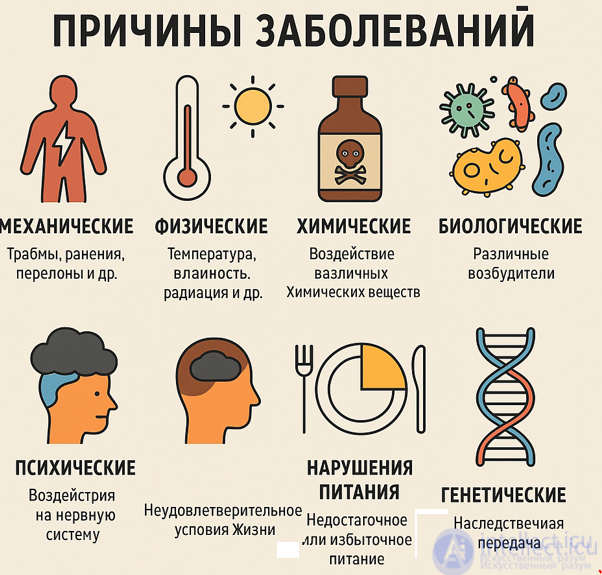
External and internal causes are closely interrelated. By their nature they can be extremely varied. Among them, several main groups:
It should be kept in mind that with one and the same cause, the mechanism of the development of the disease may be different.
Each disease manifests itself through symptoms characteristic of it – signs that are revealed with the help of clinical examination methods. Symptoms are divided into objective and subjective.
Objective symptoms are signs of the disease that are revealed by direct visual and instrumental examination of the patient, for example, elevated blood pressure, enlargement of the heart, liver, and others.
Subjective symptoms are the patient's own sensations (for example, pain in the chest, abdomen, weakness). In many cases subjective symptoms have a corresponding causal basis in the form of dysfunction of a particular organ or an entire organ system; in a number of other cases they reflect a particular physical state that has not yet acquired the features of a disease, for example, mental fatigue, physical overexertion.
Syndrome is a combination of different but closely related symptoms characteristic of particular diseases. For example, in inflammation of the lungs and bronchi, a combination of cough, sputum production, and changes in external respiratory function indicators is observed.
The organ systems of the human body:
musculoskeletal, digestive, respiratory, excretory, reproductive, circulatory (cardiovascular), integumentary, endocrine, and nervous. All organ systems are interconnected and form a single organism.
Convulsive syndrome
Convulsive syndrome manifests itself as involuntary contractions of the skeletal muscles. Convulsions may involve the muscles of the whole body or appear locally.
Among the causes of convulsive syndrome are infectious, toxic, traumatic, and tumour lesions of the brain, disorders of cerebral circulation, epilepsy, and hysteria.
In terms of frequency of occurrence, first place is held by the convulsive syndrome that occurs in epilepsy. An epileptic seizure develops suddenly. The patient loses consciousness and falls, and injuries are possible in the process. The skin is pale at first, then turns blue. A grand mal seizure is characterised by strong muscle contractions, and biting of the tongue, bodily injuries, and involuntary urination are possible. The duration of the attack is up to several minutes. After the attack the patient regains consciousness and most often falls asleep. In another course, an epileptic seizure may manifest as twitching of individual muscles.
First aid consists of protecting the patient from bruising, easing breathing, and preventing biting of the tongue. To do this, insert the handle of a tablespoon wrapped in cloth, or a wooden object, between the molars. Place items that soften blows (a blanket, clothing, a bag) under the head. It is unacceptable to try to forcibly restrain the convulsions. After the seizure ends, the patient should be allowed to rest. If the convulsions recur after a short time, call an «ambulance»
First aid for fainting
Possible equipment used: ammonia (smelling salts).
Diseases of the digestive system – this is a whole complex of characteristic symptoms, either constant or periodically appearing, indicating disorders in the functioning of the digestive system or one of its individual organs. The study of such diseases is the concern of the science of «gastroenterology».
The causes of digestive system disorders are:
Congenital or hereditary diseases.
Improper diet.
The entry of disease-causing pathogens into the human body.
Stress. An unfavourable psycho-emotional state can trigger the onset or recurrence of gastrointestinal diseases.
There are many gastrointestinal infections. Let us list the main ones.
DISEASES:
1. gastrointestinal infections (dysentery, botulism, salmonellosis, cholera);
2. helminthic diseases (ascariasis, enterobiasis, echinococcosis);
3. diseases of an unhealthy lifestyle (gastritis, obesity).
Acute and chronic diseases of the gastrointestinal tract have a number of signs by which it is easy to determine whether you have problems with this part of the body. These include the following symptoms:
-Abdominal pain. With ulcers it is sharp, with a fixed location; in the case of appendicitis and hernia it is severe and throbbing; when a person has colic, it is cramping.
-Heartburn. Painful sensations are characteristic of it with an ulcer, and it intensifies with a hernia.
-Belching. A sour taste indicates a digestive disorder, while a smell of rotten eggs indicates pathological retention of food in the stomach and intestines.
Among the symptoms, vomiting and nausea are also distinguished, which are more characteristic of chronic diseases, for example, gastritis. If the vomit contains blood-streaked discharge and clots, this may indicate a bleeding ulcer or stomach cancer. If a patient regularly suffers from flatulence, they may be diagnosed with dysbacteriosis, secretory insufficiency of the pancreas, or complete or partial intestinal obstruction.
In diseases of the oesophagus
the most common complaints are: dysphagia, pain (constant, aching, or paroxysmal, behind the sternum radiating to the left shoulder, arm, and left side of the chest, mimicking angina pectoris, but closely related to food intake), vomiting (without nausea, unlike vomiting of gastrointestinal origin), regurgitation, heartburn, salivation, and bleeding.
In diseases of the stomach: nausea, vomiting (which brings relief), belching (sour – with increased acidity, rotten – with pyloric stenosis, air – with decreased acidity), heartburn (more often with increased acidity), impaired appetite, pain (early, late, hunger, and night pain – with an ulcer), dyspepsia, bleeding (with an ulcer, a tumour, erosive gastritis.
Acute abdominal pain may be one of the signs of acute appendicitis, cholecystitis, perforated ulcer, acute intestinal obstruction, strangulated hernia, or pyloric stenosis (part of the stomach).
First aid:
Note!: Do not administer antispasmodics; narcotic analgesics (so as not to «mask» the clinical picture of the disease); give the patient anything to drink or eat; place a heating pad on the abdominal area (this intensifies the inflammatory process and bleeding); perform gastric lavage or a cleansing enema; or give laxatives.
It most often occurs during an exacerbation of peptic ulcer disease (in autumn or spring), but it may also be the first sign of the disease.
Signs: dagger-like abdominal pain due to irritation of the peritoneal nerve endings by gastric contents, a «board-like abdomen» (flattening, retraction of the abdomen, complete absence of respiratory movements of the abdominal wall) due to tension of the abdominal wall muscles, flatulence, constipation, weakness, a Hippocratic face (suffering, pale, sharpened features, an earthy tinge, sweating), a pulse that is initially slow and then rapid, collapse (very often), dryness and a white coating on the tongue, and on auscultation – disappearance of hepatic dullness.
First aid:
Note!: Do not administer antispasmodics; narcotic analgesics (so as not to «mask» the clinical picture of the disease); give the patient anything to drink or eat; place a heating pad on the abdominal area (this intensifies the inflammatory process and bleeding); perform gastric lavage or a cleansing enema; or give laxatives.
Gastric bleeding is a formidable complication of duodenal ulcer disease (ulcer bleeding) and represents a threat to the patient's life.
Signs: weakness, pale skin, sweating, mild nausea, dizziness, a fainting state, reduced blood pressure, tachycardia, anaemia due to blood loss; pain in the epigastric region; the tongue is coated with a white, dry coating; vomit the colour of «coffee grounds»; a sign of intestinal bleeding – «tarry» stool appears after a day.
First aid:
They are characteristic of the majority of patients who seek medical care.
Firstly, there is gastritis, the development of which is triggered by the bacterium Helicobacter pylori, as well as dietary errors, harmful habits, and constant nervous strain. In gastritis the mucous membrane of the stomach walls is affected, which is why a person feels pain and suffers from indigestion.
Secondly, there is a gastric and duodenal ulcer. Among other things, it is characterised by painful sensations, as well as heartburn and problems with food absorption. An ulcer forms when the organs of the gastrointestinal tract are damaged and the integrity of the tissues is disrupted, and this can lead to life-threatening complications.
The third, and most common, disease of the gastrointestinal tract is colitis. It arises under the influence of pathogenic bacteria, against a background of infection. It is localised in the intestinal mucosa and is inflammatory in nature. Non-specific colitis causes ulcerative lesions, which become the cause of peritonitis, intestinal bleeding, malignant growths, and obstruction.
Other diseases
The list of them is enormous. Which diseases of the gastrointestinal tract are most common among patients? First of all, these are pancreatitis and dysbacteriosis. The first belongs to the inflammatory diseases of the pancreas, characterised by vomiting, nausea, indigestion, and pain. The second is the consequence of a change in the natural state of the intestinal microflora, as a result of which its full functioning is disrupted, and problems arise with the absorption of food and its normal excretion from the body
Dysentery — is an acute bacterial intestinal infection affecting the large intestine, mainly its terminal section. The causative agent of dysentery is the dysentery bacillus — Shigella. Shigella enter the human body through the mouth via contaminated water, food, or dirty hands, pass through the entire gastrointestinal tract, and become fixed on the mucous membrane of its distal sections. There the Shigella multiply and release a toxin that affects all tissues, but primarily the nerve cells and fibres. In the terminal section of the large intestine, inflammation first arises, then ulcers form, and then comes the stage of their healing and the elimination of Shigella from the body. The source of infection is a person with acute or chronic dysentery, and a bacterial carrier. Shigella can spread via contaminated water and infected food; flies are of great importance, as they are able to carry a large number of microorganisms on their legs.
The disease begins acutely with a rise in body temperature, chills, and reduced appetite. Then abdominal pain appears, at first dull and spread over the whole abdomen. The pain usually intensifies before defecation. Significant dehydration of the body may occur. The stool is abundant and watery, and only after 1—2 days does its volume decrease, with mucus and streaks of blood appearing in it.
In the treatment of dysentery, diet plays the most important role. Foods rich in plant fibre and irritating to the intestine are excluded from the diet. Food is given mainly boiled and pureed. Pureed mucous soups, dairy-free porridges, and meat and fish in the form of soufflés and meatballs are used. Meals should be taken in small portions every 2—3 hours.
The most common diseases of the GI tract also include the following conditions: cholecystitis — inflammation of the gallbladder, accompanied by bitterness in the mouth, nausea, pain, bowel problems and dyspeptic phenomena, cirrhosis of the liver — a fatally dangerous condition in which extensive damage to the cells of the organ occurs. Digestive diseases also include haemorrhoids and appendicitis.
Appendicitis - This is inflammation of the appendix, that is, the vermiform appendix of the caecum, located almost at the boundary between the small and large intestine.
Causative factors of appendix inflammation:
The symptoms of appendicitis include:
Treatment of appendicitis is exclusively surgical, and in cases of pronounced symptoms of peritonitis (inflammation of the peritoneum) it is recommended to administer antibiotics even before the operation
Gallstone disease - A disease in which stones made of cholesterol, bile pigments, and calcium salts form both in the gallbladder and in the bile ducts, as a result of a metabolic disorder, infection, or bile stasis.
The symptoms of gallstone disease include:
-Severe pain in the area of the right hypochondrium, which radiates, firstly, to the right shoulder blade, and secondly, to the collarbone and sternum.
-Vomiting. It is important to note that often, after the stomach has been completely emptied,
-the patient still continues to vomit, but not food, rather yellow or green bile.
-Difficulty breathing due to tension of the anterior abdominal wall muscles and of the diaphragm.
-Fever.
In the first instance, the doctor prescribes painkillers for gallstone disease. High temperature and persistent pain are indications for hospitalisation of the patient.
A set of preventive measures:
Unfortunately, our compatriots often neglect the basic rules of a healthy lifestyle: diet, taking only medicines prescribed by a doctor, quitting smoking, and so on. Meanwhile, observing them can save a person from developing many diseases, including diseases of the digestive system. Such a set of preventive measures should include: a balanced diet; giving up bad habits; a careful attitude to medicines and certain medical procedures; psychological comfort; combating excess weight; timely visits to doctors.
In urological practice, urgent (requiring emergency care) conditions are quite frequent: renal colic, urinary retention, anuria.
What are genitourinary infections? Infectious diseases are understood to be pathologies caused by certain microorganisms and proceeding with the development of an inflammatory reaction, which may end in complete recovery or become chronic, when periods of relative well-being alternate with exacerbations. Which diseases belong to this group? Patients and some medical workers often equate genitourinary infections with genitourinary diseases. However, such notions do not quite accurately reflect the essence of each term. The World Health Organization recommends classifying as genitourinary infections specific clinical nosologies in which an organ of the reproductive or urinary system is affected. Moreover, the causative agents may vary. Sexually transmitted diseases, on the other hand, form a group that has a corresponding route of spread but may affect many organs, with the classification of infections determined according to the type of causative agent. Thus, we are talking about classifications based on different criteria. According to World Health Organization recommendations, genitourinary infections are understood to include the following diseases: urethritis (inflammation of the urethra); cystitis (inflammation of the bladder); pyelonephritis or glomerulonephritis (inflammation of the kidneys); adnexitis (inflammation of the ovaries); salpingitis (inflammation of the fallopian tubes); endometritis (inflammation of the uterine mucosa); balanitis (inflammation of the glans penis); balanoposthitis (inflammation of the glans penis and foreskin); prostatitis (inflammation of the prostate gland); vesiculitis (inflammation of the seminal vesicles); epididymitis (inflammation of the epididymis). Thus, genitourinary infections concern exclusively the organs that make up these systems of the human body.
Symptoms and signs of inflammatory diseases of the genitourinary system.
Symptoms of a lower urinary tract infection:
When cystitis requires treatment, the mucous membrane of the urethra and bladder becomes inflamed and irritated;
Pain and discomfort in the lower abdomen;
Symptoms of an upper urinary tract infection are characterised by a rapid increase in intensity and may include the signs of a lower urinary tract infection.
When pyelonephritis requires treatment, the following symptoms occur:
First aid for acute illnesses.
Vascular insufficiency. Acute coronary insufficiency. Angina pectoris. Myocardial infarction, cardiogenic shock.
The pace of modern life is so fast and intense that not everyone can keep up with it. Insufficient physical activity, constant stress, smoking and alcoholism, worsening ecology, improper and often irregular nutrition, poor living conditions and family troubles - all of this ultimately leads to diseases of the cardiovascular system, which have risen to first place among causes of death, overtaking malignant diseases! These are the so-called risk factors for these diseases.
Recently, cardiovascular pathology has become markedly more common among younger people. Heart attacks, infarctions and even strokes have increasingly begun to occur in young people too, which was less often observed in the past. Among cardiovascular diseases, the most frequent and most dangerous condition, often leading to death, is coronary heart disease and its forms: acute myocardial infarction and cardiogenic shock, angina pectoris, acute coronary insufficiency. As well as other vascular diseases, such as acute cerebrovascular accident (strokes), the comatose states that accompany them, and acute vascular insufficiency. At the basis of coronary heart disease (CHD)
First aid for acute infarction:
Before the ambulance arrives, the patient must be laid down and provided with maximum physical and psychological rest. If choking or shortness of breath occurs, the patient is placed in a semi-sitting position. Distracting remedies also bring noticeable relief: mustard plasters over the area of the heart and sternum, warmers to the feet, warming of the hands. The patient needs constant observation during the acute period. The first attack is often followed by repeated, more severe attacks. The course of the disease may be complicated by acute cardiovascular insufficiency (cardiogenic shock), heart rhythm disturbances, including life-threatening variants, and others. Transportation of a patient with myocardial infarction is carried out lying down on a stretcher.
Hypertensive crisis - is an emergency condition that occurs during a crisis course of hypertension and is characterised by a rapid (over minutes, hours) or comparatively gradual (over hours, several days) significant increase in blood pressure from its baseline, with disturbance of the patient's general condition and of the functions of organs and body systems (acute cerebrovascular accident and heart failure). Crises can occur at any stage of hypertension.
First aid: A patient with a hypertensive crisis should be laid down with the head end raised on a pillow, kept calm, and an ambulance should be called urgently. In cases of pronounced shortness of breath and the appearance of wheezing that can be heard at a distance, the patient is placed in a semi-reclining position and given, sublingually (if available), a nitroglycerin tablet and a diuretic (1 – 2 furosemide tablets). Many patients with hypertension know from their treating doctors which medications to take during crises even before the ambulance arrives. Most often patients use clonidine or nifedipine (one tablet by mouth) or certain other medications.
Acute cerebrovascular accident (stroke) - consists of a disruption of blood flow to some area of the brain because of the blockage of a vessel's lumen by a thrombus or embolus, or compression of brain tissue by blood when a vessel wall ruptures. Both are quite serious conditions capable of causing damage to brain tissue. The main causes of strokes are: hypertension, atherosclerosis, abnormalities in the structure of cerebral vessels, and diseases that lead to increased clotting, thickening of the blood and increased formation of thrombi.
First aid for stroke:
- From the very onset of the illness, the patient should observe bed rest. Paralysed limbs must not be pressed down by the body. If consciousness is lost, it is necessary to ensure airway patency (tilt the head back, secure the tongue if it retracts, clear the airway of mucus). An ambulance must be called for the patient urgently, since the outcome of strokes largely depends on treatment being started early.
- stay with the casualty until the ambulance arrives;
Acute vascular insufficiency (fainting) – this is a short-term condition that arises as a result of a sharp drop in vascular tone and the dilation of vessels throughout the body, as a result of which blood is redistributed from the brain to peripheral vessels, with the development of acute insufficiency of blood supply to the brain and profound oxygen starvation.
First aid: If the patient has not lost consciousness, he should be asked to sit down, lean forward and lower his head to improve blood supply and oxygen delivery to the brain. If the patient has lost consciousness, he is laid on his back with the head lowered and the legs raised
The collar and belt must be undone, the face splashed with water and rubbed with a towel soaked in cold water, and ammonia vapour given to inhale. In a stuffy room it is good to open the windows to ensure a supply of fresh air. If consciousness is retained, cardiac and sedative medications are given.
Anaphylactic shock – a severe general allergic reaction that occurs on repeated entry into the body of certain substances - so-called allergens. It is most often caused by various medicinal products (antibiotics, sera, enzymes, vitamins, etc.), the venom of stinging Hymenoptera insects (bees, wasps), and sometimes foodstuffs and others. Anaphylactic shock develops within a few minutes or several tens of minutes after the allergen enters the body and is characterised by:
The less time that passes between the allergen entering the body and the onset of shock, the more severe it is, and if timely aid is not provided, a fatal outcome is possible.
Prevention of anaphylactic shock consists in remembering and preventing allergens from entering the body under any circumstances or conditions. Foods that cause manifestations of food allergy must be excluded from the diet.
First aid. This consists, above all, in stopping any further entry of the allergen into the body (discontinuing the medicinal product, removing the insect's sting, evacuating the patient).
The patient is positioned so as to ensure a supply of fresh air. In cases of loss of consciousness, care must be taken to prevent the tongue from retracting or aspiration of vomit.
Ice packs are applied around the site where the allergen was introduced. If available, anti-allergy medications are given (diphenhydramine, chloropyramine, clemastine, etc.) An ambulance must be called urgently.
Foreign bodies entering the airway.
First aid: If the casualty is unconscious, aid begins with an examination of the oral cavity. If a foreign object is visually detected, an attempt can be made to remove it with a finger. To do this, having opened the mouth, the thumb of one hand pulls the lower jaw and tongue back, while simultaneously pressing the tongue against the jaw. The index finger of the other hand is inserted deep into the casualty's mouth along the inner surface of the cheek, and an attempt is made to hook the object and remove it. If it is not possible to remove the foreign body, and the condition sharply worsens, one must not lose time and must immediately proceed to remove it using the Heimlich manoeuvre. To perform the manoeuvre, the casualty must be laid on his back, straddled at the hips, one hand placed with the base of the palm on the abdomen along the midline, slightly above the navel, the other palm placed on top of the hand, and five sharp thrusting movements made in the direction of the head. After every five compressions, the oral cavity is examined (stomach contents may enter the oral cavity and must be immediately removed with a napkin or handkerchief). Airway patency is checked with two trial breaths of artificial respiration (there should be movement of the chest). In obese people and pregnant women, the Heimlich manoeuvre is performed by pressing on the chest (also five times) two centimetres above the xiphoid process.

Comments