
Lecture
Objective: to build students' knowledge of how the warning of the population about emergency situations is organised, to acquaint students with one of the principal measures for the emergency protection of the population from the damaging factors of emergency situations — the evacuation of the population, and to form a conviction of the need to prepare for evacuation in advance.
The ancient Greeks used to say: «Forewarned — forearmed.» Unfortunately, the situations in which this applies are often irreversible - you will most likely never return to the places you left. But you need to get as far away as possible from the site of a technogenic or military incident. That is why it is necessary to know the features of population warning and the actions to take.
One of the principal tasks of civil defence communications is to warn the leadership of central and local executive authorities, enterprises, institutions and organisations, and the population of the threat of an emergency situation arising in peacetime and wartime, and to constantly inform them of the developing situation.
Warning – is the timely delivery to the population of danger signals and the information necessary about the situation and the rules of conduct under the conditions that have arisen. The population is entitled to know about dangerous events, especially when these are linked to an impending danger. If a person is warned in time, they have the opportunity to meet and repel the threat to their life and health. The civil defence system has a warning service for this purpose.
The Civil Defence and Emergency Situations Warning System – is an organisational – technical combination of forces, specialised warning equipment and a communications system that ensures the transmission of warning signals and information about an emergency situation.
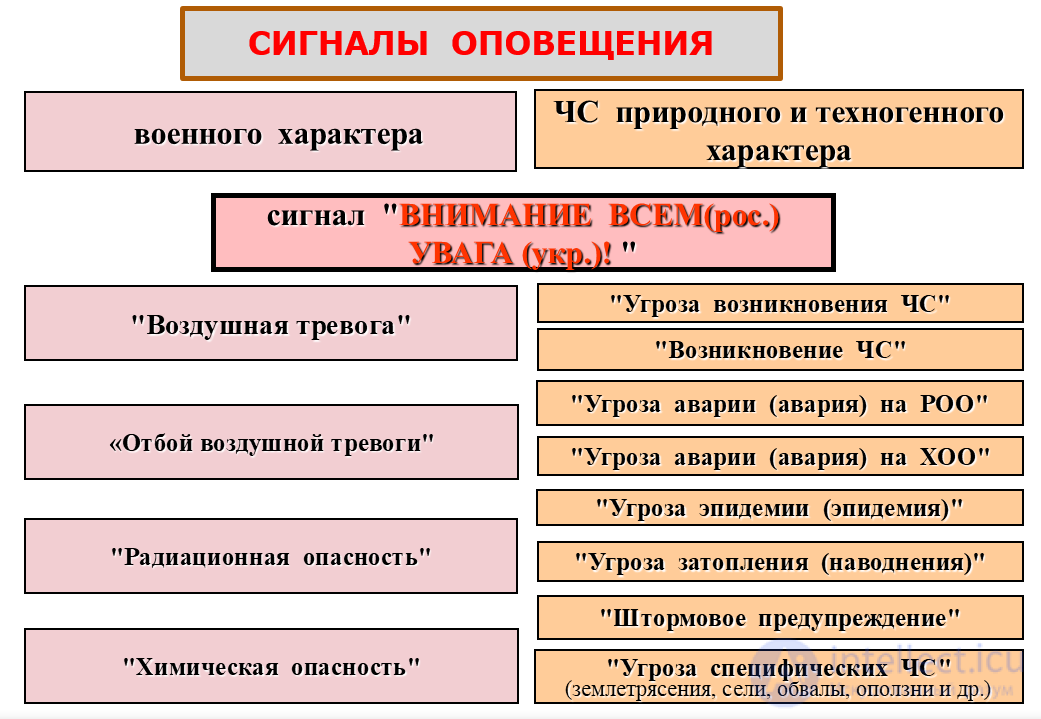
1. Ensuring the timely delivery to civil defence and emergency situations management bodies and the population of instructions on carrying out civil defence and RSChS (Unified State System for the Prevention and Elimination of Emergency Situations) measures.
2. Ensuring the timely delivery to civil defence and emergency situations management bodies and the population of civil defence warning signals and other information.
In addition to this, universal compulsory training of the population is organised and conducted.
The population warning system for emergency situations forms part of the Unified State System for the Prevention and Elimination of Emergency Situations.
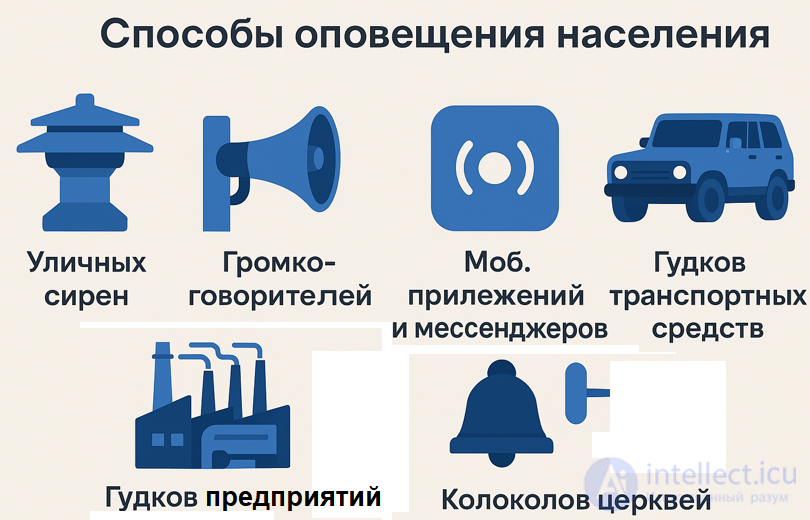
Question: How is the population warned when an emergency situation arises? (radio, television, sound and light signals, civil defence sirens, factory whistles, church bells, school bells).
The principal method of warning the population about the threat of radioactive, chemical or bacteriological contamination, the threat and occurrence of natural disasters, major accidents and catastrophes at economic and transport facilities, and the threat of an enemy attack is the transmission of spoken information over local lines using wired, radio and television broadcasting. To attract the population's attention, sirens, intermittent factory whistles, transport and other equipment are activated through public-address systems, including those installed on public order police and traffic police vehicles, which signifies the transmission of the warning signal «ATTENTION EVERYONE!». During the Great Patriotic War, people knew: if a siren sounded – this was the signal «Air Raid Warning!». At the end of 1988, the warning procedure was reviewed and changed. Now the wailing of sirens and intermittent whistles signify the civil defence signal: «Attention everyone!»(Russian) Uvaha (Ukrainian).
Question: What are your actions when this signal sounds?
On hearing the siren, you should:

If evacuation is necessary, follow these recommendations:
Warning signals are transmitted out of turn by all communications and broadcasting services. Information is transmitted within 5 minutes of the sound signal being given. In hazardous areas, the message is duplicated by a mobile public-address device.
Remember! Sirens and intermittent whistles from other signalling devices signify the civil defence signal: «Attention everyone!».
On hearing such a signal, immediately switch on the loudspeaker, radio receiver or television and listen to the announcement from the Directorate (department) of the civil defence headquarters for emergency situations and civil protection of the population (UGZNChS) of the region (city, district or facility).
For every case of an emergency situation, the UGZNChS has prepared sample versions of announcements, which are subsequently adjusted to take account of the specific events. Information is transmitted within 5 minutes of the sound signals being given.
For every case of a probable emergency situation, the local civil defence and emergency situations authorities have sample versions of announcements, which are adjusted to take account of the developing situation.
In peacetime:
The rules of conduct for the population in response to civil defence warning signals are established in advance and apply to the entire population and all facilities, and are also determined by specific actions. Responsibility for warning rests with the territorial civil defence authorities.
Let us give some sample announcements.
In the event of an accident at a chemically hazardous facility: «Attention! This is the emergency warning service of the city. Citizens! An accident has occurred at the plant with the release of a highly toxic substance – ammonia. A cloud of contaminated air is spreading in the direction of (the district is indicated). The facilities (facilities are listed) fall within the chemical contamination zone. Residents of the streets (streets are listed) are advised to remain inside buildings. Apartments must be sealed in all rooms. Residents of the streets (streets are listed) must immediately leave residential buildings, institution and enterprise buildings, and educational establishments, and proceed to the district (the district is named). Citizens! Remain calm and continue to act in accordance with our instructions».
In the event of an accident at a nuclear power installation: «Attention! This is the emergency warning service of the district. Citizens! An accident has occurred at the nuclear power plant. Radioactive fallout is expected in the area of the plant and in the settlements (settlements are listed). Residents of these settlements must remain in their homes. Residential premises and locations where livestock are kept must be sealed urgently. Take an iodine preparation to protect the body. Citizens! Remain calm. Continue to act in accordance with our instructions».
Task: describe your actions in this situation.
In the event of a threat of earthquake: «Attention! This is the emergency warning service of the city. Citizens! Because of a possible earthquake, turn off the gas, water and electricity, and put out any fire in stoves. Take the necessary clothing, documents, food and water and go outside. Take up a position away from buildings, bridges and power lines. Inform your neighbours of the message received. If indoors, at the first tremor stand in a doorway (balcony doorway). Citizens! Remain calm. Continue to act in accordance with our instructions».
POISONING OF PEOPLE BY HAZARDOUS CHEMICAL SUBSTANCES (AHOV) in accidents and catastrophes occurs when AHOV enters the body through the organs
of respiration and digestion, the skin and the mucous membranes. The nature and severity of the injuries are determined by the following main factors: the type and nature of the toxic action, the degree of toxicity, the concentration of chemical substances at the affected facility (territory), and the duration of exposure of the person.
Example of an announcement of an accident at a chemically hazardous facility (KhOO). «Attention! This is the Directorate (department, civil defence headquarters) for emergency situations and civil protection of the population…of the region (city, district).
Citizens! Today… (date, month and time) an accident occurred at the … water-supply pumping station with the release into the atmosphere of chlorine – a hazardous chemical substance. Clouds of contaminated air are spreading in the … (given) direction at a speed of … km/h and will reach … (locations, districts, settlements) within … (minutes, hours). The following fall within the chemical contamination zone … (cities, districts, settlements, etc. are listed).
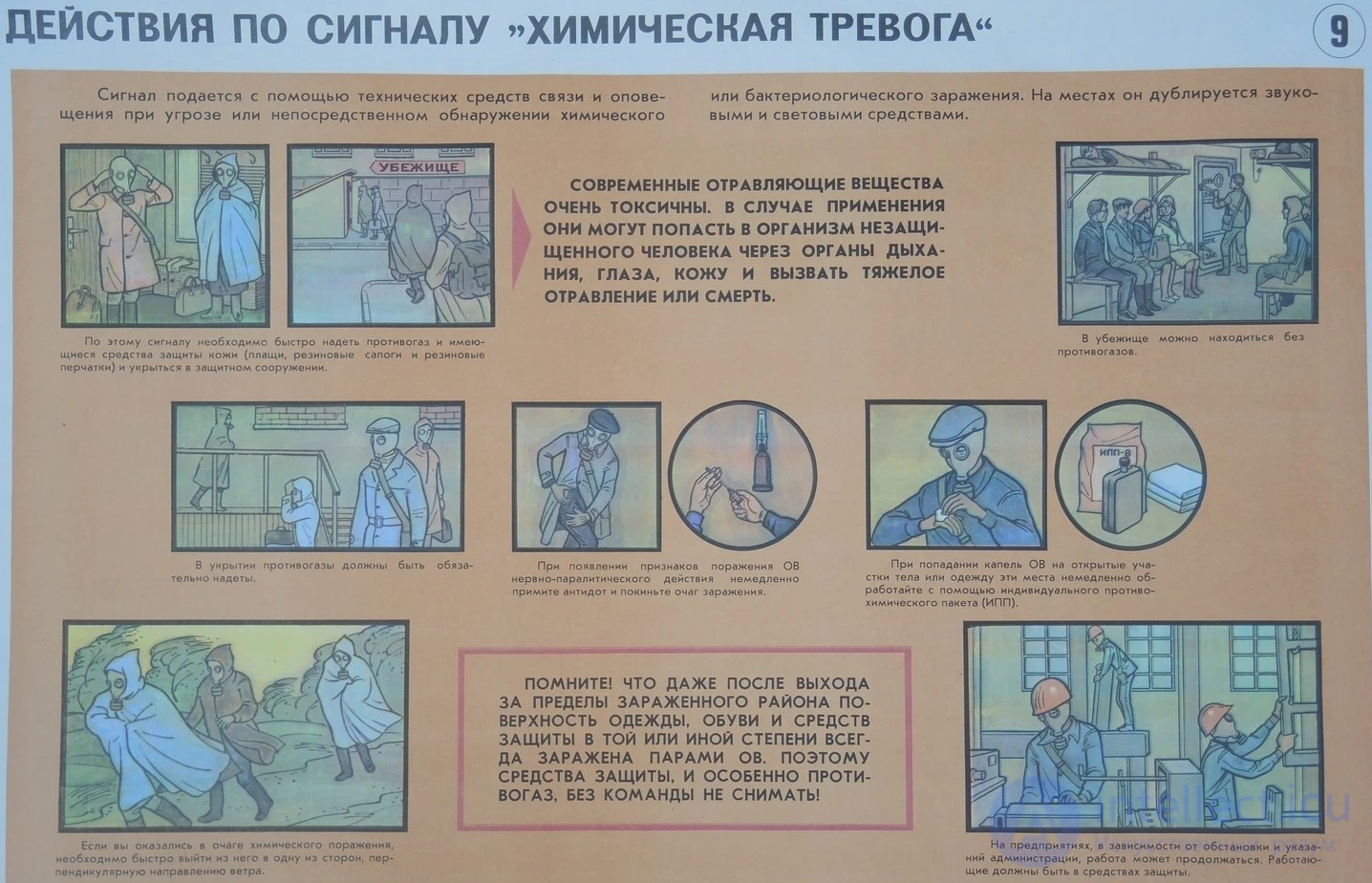
Residents of … (cities, settlements, residential areas) must not leave their premises; close the windows and doors, and seal apartments (houses). Do not take shelter in basements and lower floors, since chlorine is heavier than air and fills low-lying areas (ravines, ditches, gullies) and basement premises.
Residents of … (settlements, residential areas, blocks, etc.) must urgently leave their apartments and places of economic activity in accordance with the evacuation plans and proceed to … districts (specify which).
All residents should put on personal protective equipment: gas masks of all types, children's gas masks, protective chambers for infants, or, in their absence – a cotton-gauze mask or a towel moistened with water or a 2% solution of baking soda.
Inform your neighbours. Listen for our further announcements. Continue to act in accordance with the instructions of the UGZNChS … of the region (city, district)».
Having heard the announcement, every person must act without panic, thoughtfully and quickly, taking account of the specific conditions in which they find themselves. The population's actions after listening to the spoken information depend on the specific conditions.
Analysis of specific situations has shown that the effectiveness of responses to citizens' appeals in areas where the Unified Duty Dispatch Service (EDDS) operates has increased by 40%.
Life is full of unpleasant surprises, and disregarding useful information is, at the very least, unwise.
Evacuation of the population — is one of the key civil defence measures under emergency conditions. Whether it is military operations or a technogenic accident, a well-organised evacuation can save lives and minimise the consequences of a catastrophe. This article covers the principles, stages and features of evacuation under such conditions.
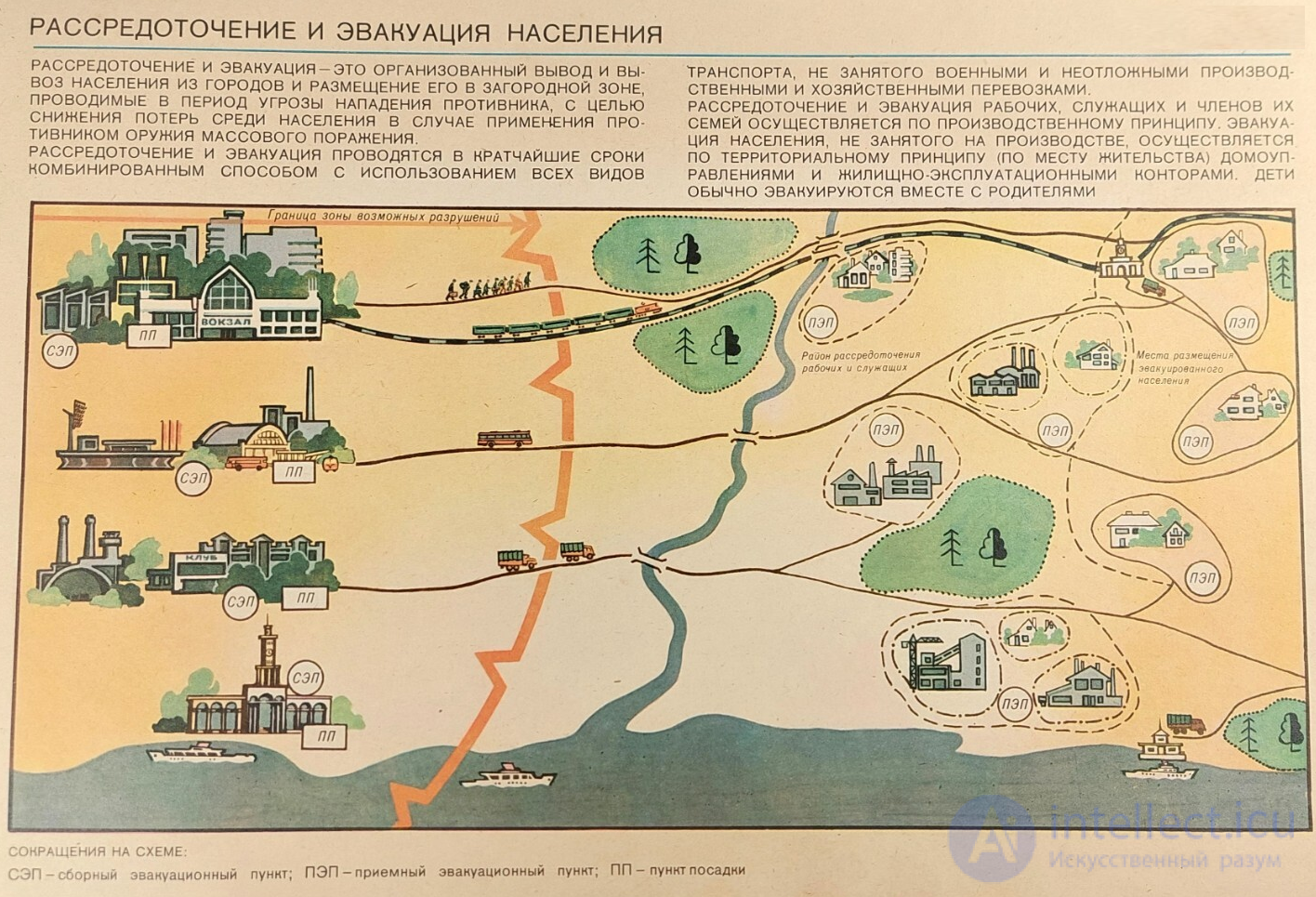
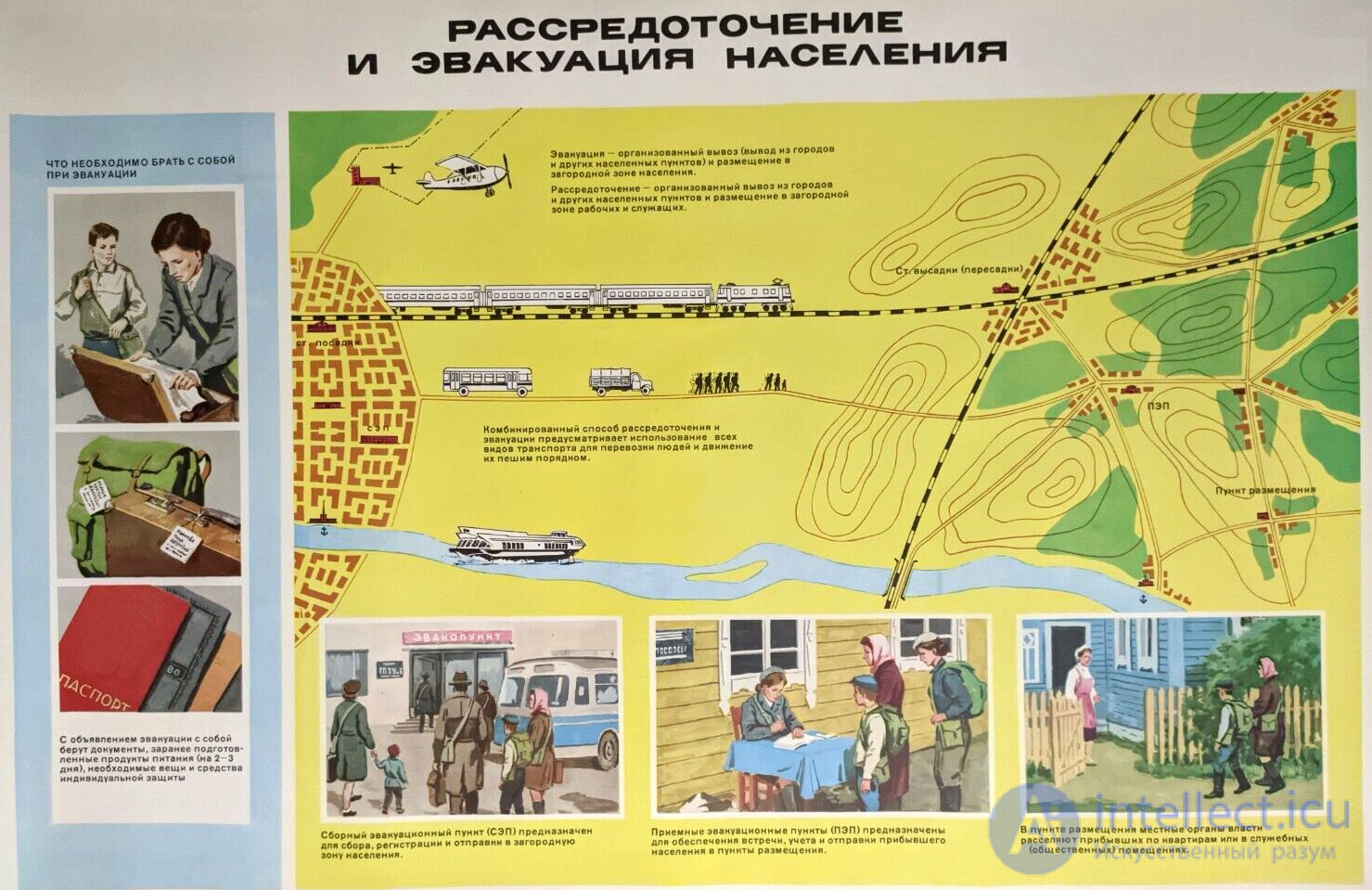
Dispersal and evacuation are an important means of protecting the population from weapons of mass destruction.
Dispersal — the organised removal (departure) of workers and employees who continue to work in the cities from large cities, and their accommodation in the surrounding rural area. They return to the city for work, and afterwards — go back out to rest.
Evacuation — the organised removal of workers, employees, members of their families and persons unable to work from cities where the operation of enterprises does not continue under conditions of war.
The combined method of evacuation involves:
the bulk of the population leaving on foot,
the transportation of certain categories (workers of operating enterprises, persons with disabilities, the elderly, pregnant women, children) by all types of transport: rail, road, water and horse-drawn.
Examples of transport capacity:
A passenger carriage and a 4-axle freight wagon — up to 100 people,
A 25-seat bus — up to 40 people,
A truck — 20 people,
A dump truck — 15 people.
To maintain order, echelon commanders and seniors in each vehicle are appointed.
Dispersal and evacuation are an important means of protecting the population from weapons of mass destruction.
Dispersal — the organised removal (departure) from large cities and accommodation in the surrounding rural area of workers and employees of enterprises and organisations that continue production activity in the cities in wartime. After being removed and resettled in the surrounding rural area, workers and employees travel into the city daily to work at their enterprises, and at the end of the working shift return to the surrounding rural area to rest.
The evacuation zone — is the territory outside the zone of possible destruction, where temporary or permanent accommodation of evacuees is organised.
Evacuation — the organised removal (departure) of workers and employees, members of their families, non-working pensioners, persons with disabilities, pre-school-age children with their parents, schoolchildren, students and other categories of the population not engaged in production and not sustaining the life of the city.
Evacuation of people beyond the zone of possible destruction within the shortest possible time may be carried out by the combined method.
The combined method — the mass removal of the population from large cities on foot, combined with the removal of certain categories of the population by all types of transport.
Transport is used to remove workers of enterprises continuing production activity in the cities, non-working pensioners, persons with disabilities, pre-school-age children with their parents, schoolchildren and other categories of the population. The rest of the population leaves on foot over a distance of up to 10 kilometres.
The evacuation is organised in columns of 500—1000 people. Column commanders are appointed, medical personnel may be included in the columns, as well as persons responsible for liaison with transport boarding points. The planned speed of movement of a column — 4—5 kilometres per hour, daily march — 20—25 kilometres.
To remove the population from the zone of possible destruction, a route of movement and settlements for temporary accommodation are designated. Catering and medical care are organised at these points, and if necessary — resettlement.
Wired and wireless radio broadcasting and local communication facilities (village Soviets, boards of kolkhozes and sovkhozes) may be used for warning.
Wired television, telephone communication, and also messengers may be used for warning. The evacuation order must be brought to the attention of every family and every person.
The procedure for forming and moving columns, their routes and destination settlements, are determined by the civil defence authorities.
Along the route to the dispersal and evacuation points, assembly points (motor columns) are designated, with seniors appointed in each carriage (vehicle) — seniors.
For removing the population from cities located in coastal zones of seas or major rivers, water transport may be used (sea-going vessels, river craft, fishing boats, etc.).
PROCEDURE FOR WARNING OF THE START OF DISPERSAL AND EVACUATION
Dispersal and evacuation are carried out only by order of the government.
The population is warned through the mass media, by radio, television, by civil defence signals (intermittent siren whistles, transport and industrial enterprise whistles), and also through local authorities, housing administrations, and volunteer public order squads.
On the signal, radio receivers must be switched on and the announcement listened to.
After receiving a signal of evacuation or dispersal, preparations must begin immediately and one must report to the designated assembly point, strictly following the established routes and instructions.
RESPONSIBILITIES OF THE POPULATION WHEN CARRYING OUT DISPERSAL AND EVACUATION
On learning of an upcoming evacuation, one should immediately prepare to leave (depart) for the surrounding rural area: gather the most essential items (clothing, footwear, linen, personal hygiene items), prepare and pack documents, money and valuables.
It is necessary to take water, a stock of food and water with you (for 2—3 days).
The assembly point, place and time of departure are given in the notice received through the mass media or from local authorities. When boarding transport and en route, the established rules of conduct must be strictly observed, and the instructions of commanders and seniors must be carried out.
It is advisable to have with you a first-aid kit with a set of necessary medicines, and personal protective equipment (gas masks, respirators, cotton-gauze masks).
During dispersal and evacuation, it is strictly forbidden to take pets, firearms and edged weapons, or flammable and explosive substances.
Persons refusing to evacuate are subject to administrative liability.
Order, organisation and a high level of public awareness — are the most important conditions for the successful conduct of evacuation measures.
During evacuation, one must remain calm, follow the instructions of commanders and seniors, and take care of oneself and others.
The outcome of evacuation and dispersal will depend largely on the population's degree of preparedness for them, and on the organisation and discipline shown in carrying out these measures.
This is carried out only by order of the government, through:
radio networks, TV, loudspeakers;
local authorities (village councils, kolkhozes, etc.);
telephone and messengers.
Information must reach every family and every person.
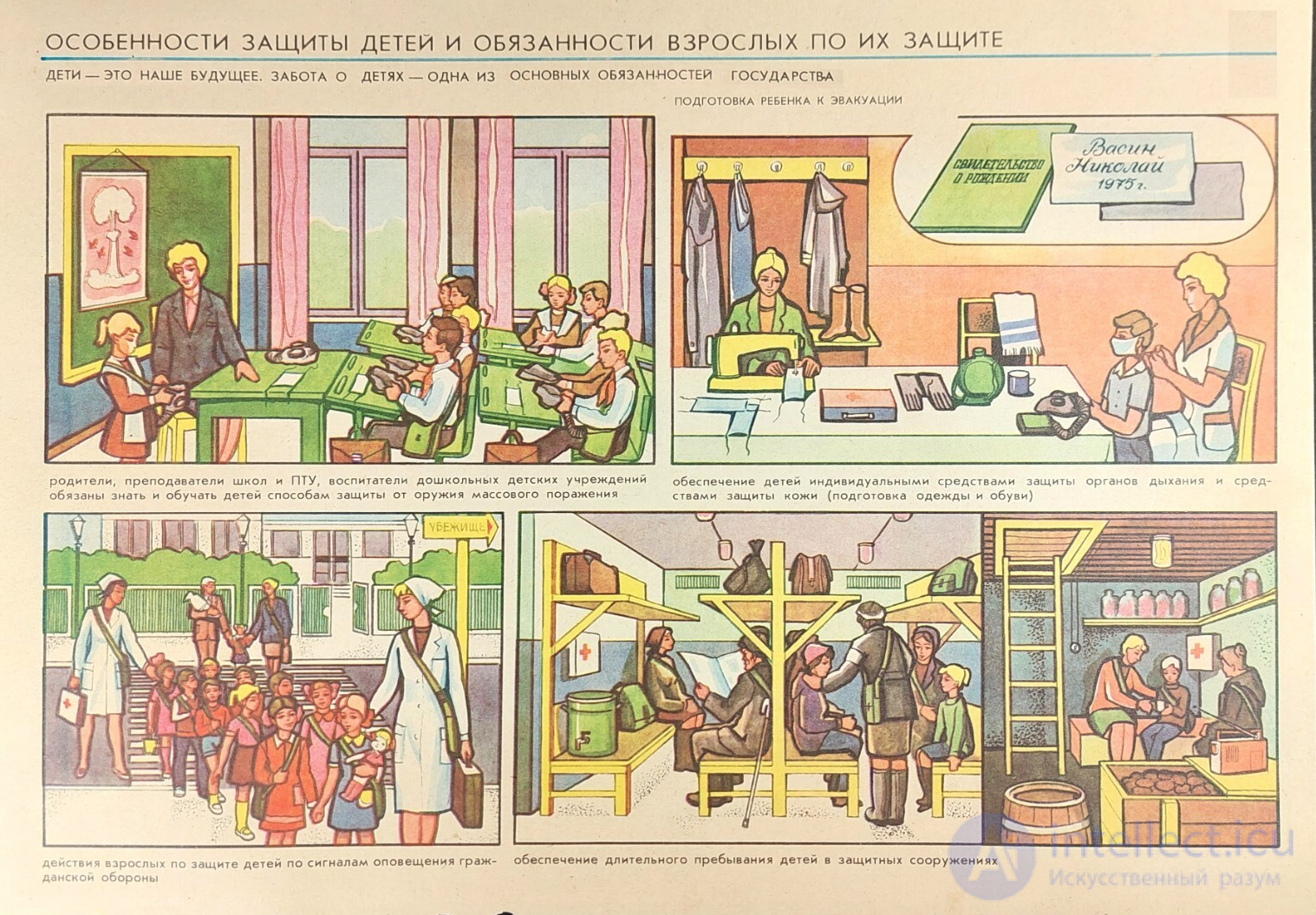
Preparation for departure includes:
gathering clothing, footwear, linen, bedding;
documents, money, a first-aid kit, a stock of food (for 2–3 days);
packing into backpacks and suitcases (weight — no more than 50 kg per adult);
personal protective equipment (gas masks, respirators, masks).
the use of armed forces on the territory of populated areas;
air raids, artillery bombardment;
the use of chemical, bacteriological or radiological weapons.
accidents at nuclear power plants;
releases of hazardous chemical substances;
major fires, explosions, building collapses;
leakage of flammable or radioactive materials.
Preparation:
compiling lists of evacuees;
organising assembly points;
warning the population.
Transportation:
use of transport (buses, trains, special equipment);
escort of columns by forces of the Ministry of Internal Affairs and the Ministry of Emergency Situations.
Accommodation and provision:
temporary accommodation points (PVR);
supply of food, clothing, medicines;
psychological support.
Free of charge: all evacuation operations (transportation, meals, provision of first aid, temporary accommodation) must be carried out free of charge
Priority for vulnerable groups: children, the elderly, persons with disabilities and pregnant women are evacuated first.
Centralised management: coordination of actions between the authorities, the Ministry of Emergency Situations, and military structures.
Informing the population: regular instructions, brochures, loudspeakers.
Observance of the right to refuse evacuation (where provided for by legislation).
Dispersal - it is impermissible to have places of large concentration of population or military personnel
| Type of catastrophe | Features of evacuation |
|---|---|
| Military conflict | Concealment is needed, protection from shelling, military escort |
| Radiation accident | Decontamination, personal protective equipment, route with the wind |
| Chemical leak | Gas masks, sealing of premises, evacuation on the leeward side |
| Fire/explosion | Urgent evacuation of the hazardous zone, accounting for secondary threats |
Evacuation — is not simply the movement of people, but an entire set of measures, honed to the point of automatism. Only the coordinated work of services, a clear plan and an informed population can minimise the damage from any catastrophe. That is why it is important for every citizen to know the basics of behaviour during evacuation — this is a contribution to their own safety and survival in a critical situation.

Comments