
Lecture
Objective: to form students' knowledge of the main types of injuries related to the musculoskeletal system and methods of providing first aid (FA); to teach how to distinguish signs of skeletal damage, develop the ability to provide first aid for skeletal injuries and to substantiate it, teach practical skills in providing first aid for fractures - teach the rules of limb immobilisation.
Equipment: teaching tables, stands, diagrams of applying dressings, a diagram of fracture types, a diagram “Emergency actions”; bandages, splints, improvised splints.
Dislocation – a persistent displacement of the articular ends of the bones forming a given joint.
Main signs: altered shape of the given joint, impaired function of that joint, pain.
First aid: for dislocations of the joints of the upper or lower limbs, the limb is immobilised with a splint and the casualty is urgently hospitalised in a surgical department.
Fracture — a partial or complete disruption of the integrity of a bone as a result of impact, compression, crushing, bending (during a fall)
Signs: pain at the fracture site, deformation, abnormal mobility, on palpation – bone crepitus; pallor of the skin, dilated pupils, presence of traumatic swelling at the fracture site. Possible: painful shock and collapse.
Main methods of providing aid for fractures:
1. If a fracture or even a severe bruise is suspected, the limb must not be moved, pulled, or shifted before immobilisation is carried out.
2. In all cases, immobilisation of the bone fracture is carried out by applying a splint, binding the limb to the body, laying the person on a rigid board, or giving them the necessary posture.
3. The splint must necessarily span two joints for the upper limbs and three joints for the lower limbs.
4. In closed fractures, it is not necessary to remove clothing from the casualty.
5. Never apply a rigid splint directly to the body. A soft padding of cotton wool, foam rubber, clothing, etc. must be placed underneath.
6. While moving the casualty onto and off the stretcher, the injured limb should be held by an assistant.
Main types of fractures and first aid:
1). Fractures of the shoulder, forearm and hands.
First aid: splinting of at least two joints of the injured limb (above and below the fracture). The forearm is suspended on a triangular bandage.
2). Injury to the collarbone and shoulder blade.
First aid: the main goal – to eliminate the effect of the weight of the arm and shoulder girdle. To do this, it is necessary to draw the casualty's arms behind the back and apply a fastening ring of bandage over the shoulders, encompassing the forearms.
3). Injury to the chest.
First aid: for fractures of the sternum and ribs, a pressure dressing of towel and bandages is applied and the casualty is given a sitting position.
4).Fractures of the lower limbs.
First aid: for fractures of the lower limbs, a splint must be applied spanning all three joints at once.
5). Fractures and bruises of the pelvic bones.
First aid: immobilisation of bone injuries is very difficult, since even involuntary movement of the lower limbs causes displacement of bone fragments. The casualty is laid on a rigid board, given a position with the limbs half-bent and slightly spread apart, with a roll placed under the knee joints (frog position). This relaxes the muscles somewhat and reduces pain.
6). Injuries to the spine and neck.
Signs: besides the signs listed above, when raising straightened legs – increased pain in the spinal region.
First aid:
a) for neck injury – immobilisation of the neck and head. Place a roll under the head, fix the neck with a dressing, tie the casualty to the stretcher to reduce mobility;
b) for spinal injury, lay the casualty on a rigid board or a wide plank, on their back or front. Act carefully, as there is a risk of damage to the spinal cord by bone fragments.
Remember: in all cases of fractures, the casualty must be immediately delivered to the nearest medical facility. Attention: for open fractures, setting the fragments is strictly forbidden! It is necessary to stop the bleeding, apply a sterile dressing and fix the limb with a splint in the position in which it is found.
Remember: any movement of the injured limb and improper immobilisation can worsen the injury – turn a closed fracture into an open one, cause shock, collapse, bleeding.
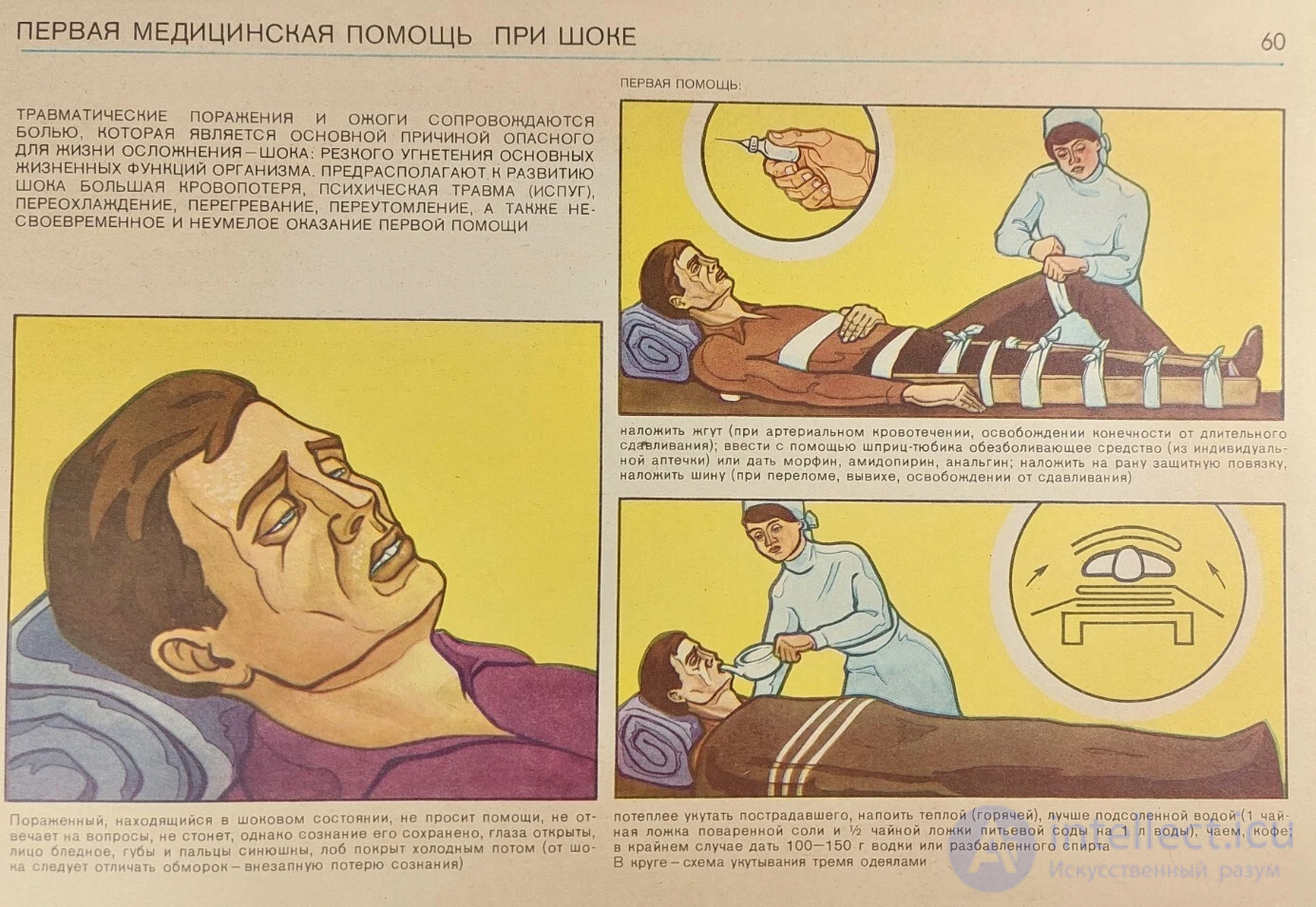
One of the formidable complications in trauma is traumatic shock or collapse.
Transport immobilisation – this is ensuring the immobility of a given part of a casualty's body until the moment they are delivered to a medical facility. This measure is one of the anti-shock treatment procedures for fractures and dislocations of limbs.
At all stages of treating injured patients, correct transportation is of great importance. The choice of transportation method depends on the casualty's condition, the type of injury, and the transport means available.
Casualties with fractures can only be transported after a transport splint has been applied (standard, or made from improvised means), limiting the mobility of the injured limb. This will help reduce the manifestation of the pain syndrome and lower the likelihood of traumatic shock developing.
In the case of an open fracture, before proceeding directly to applying the splint, the bleeding should be stopped (a haemostatic tourniquet, a pressure dressing), the edges of the wound treated with alcohol, brilliant green or iodine tincture, and an aseptic dressing applied to it. A sterile bandage or a dressing pack, which can be bought at any pharmacy, is used to apply the dressing. If it is not possible to obtain them, a piece of clean (preferably ironed on both sides with a hot iron) white cotton or linen fabric can be used.
Before applying the splint, the limb should be wrapped with a piece of fabric, clothing, gauze, or a layer of cotton wool. After it has been applied, transportation of casualties with fractures is carried out in accordance with general rules. The method of delivery to the medical facility is chosen by the person providing first aid, depending on the available options.
Transportation of a patient with injuries:
1. Of the skull bones and brain is carried out:
2) with injuries of the nasal bones and jaw, transported:
3) for fractures of the ribs and collarbone, transported:
• in a sitting position;
4) for a fracture of the pelvic bones, carried out in the position:
• on the back with the lower limbs half-bent at the knees and spread apart at the hip joints;
5) for a spinal fracture, should be transported:
A gentle method of transporting the injured is transport by inland waterways, and also by rail, especially in passenger carriages. The only drawback of such transportation methods, especially over short distances (up to 100 km), is the repeated reloading of the injured (the need to bring casualties to loading points, and then reload them onto road transport at unloading points).
In all injuries and conditions accompanied by shock, as well as significant blood loss, the patient is transported only lying down with the foot end of the stretcher raised to reduce loss of blood from the brain. In cold weather, measures should be taken to prevent chilling.
Correct and safe transportation at all stages of treatment is one of the most important factors determining the outcome of a disease or injury.
Practical tasks:
No. 1
Severe sharp pain in the area of the left shin, swelling. Abnormal mobility of the leg. There is also swelling and pain in the ankle joint.
Determine the diagnosis. Provide aid; determine the transportation method.
No. 2 Aching pain in the knee joint (right leg). Swelling gradually develops, pain on movement. In addition, the casualty complains of pain in the shoulder (right) after a fall, but although arm movements are painful, no other external signs are observed. Determine the diagnosis. Provide aid. Determine the method of transportation.
No. 3
After a sharp jump and falling on the side, the casualty feels severe pain in the right thigh, unable to move the leg. The left joint (ankle) is severely swollen and bruised. Suggest the type and degree of injury. Provide aid; suggest a method of transportation.
No. 4 The casualty fell on an outstretched arm. The right elbow joint is swollen, feels severe pain. There is also swelling on the index finger of the right hand. Provide aid. Suggest a method of transportation.
No. 5
The casualty complains of pain in the forearm. Bone fragments are protruding from the wound. The patient periodically loses consciousness. Determine the type of injury.
Provide aid. Suggest a method of transportation.
1. What types of injuries are classified as closed injuries?
2. What is called a bruise?
3. What signs are characteristic of a bruise?
4. Give a definition of a sprain.
5. Name the characteristic signs of a sprain.
6. As a result of what can a person get a sprain of ligaments, muscles and tendons?
7. Name the signs of a ligament rupture.
8. What signs are characteristic of a muscle rupture?
9. What is called a dislocation?
10. What is called a fracture?
11. What types of fractures exist and how is first aid provided for them?
12. Name the basic principles of immobilisation and transportation of casualties with fractures

Comments