
Lecture
Objective: formation of students' knowledge about the significance of the emergence of an organisation such as the Red Cross; to form a respectful attitude towards human rights and freedoms, formation of civic position; to help instil such personal qualities as compassion and respect for human rights
«Now that we have learned to fly through the sky like birds,
to swim through the water like fish,
it remains for us to learn to live on Earth like people». (B. Shaw.)
The famous Catholic nun, founder of the female monastic congregation "Missionaries of Charity", Mother Teresa of Calcutta was canonised.
Humanity has entered a new century. What will it be like? Will we manage to put up a barrier against inhumanity and violence? This probably depends largely on us, on our ability to negotiate, to live by the rules, and to treat one another humanely.
Let us begin with a parable from the «Gospel of Luke».
It tells of a man who was going from Jerusalem to Jericho and fell into the hands of robbers, who stripped him, beat him and went away, leaving him half dead, lying on the ground. By chance a priest was passing along the same road. Seeing the beaten man, he went away and did not stop to help him. Another clergyman came to that place and did likewise. However, a certain Samaritan (the Samaritans were an Aramaic tribe at odds with the Jews), passing by and seeing this man, took pity on him. Coming up to him, he bandaged his wounds, washing them with oil and wine, and then, setting him on his own donkey, brought him to an inn and took care of him. The next day he took out two denarii, gave them to the innkeeper and said:
«Take care of this man. And if you spend more than this on him, I will repay you when I return»».
This parable is an example of a merciful attitude towards a person.
How do you understand the word «mercy»?
(Mercy: at the heart of this feeling lies compassion, a benevolent, caring, loving attitude towards another person.)
I ask you to recall those qualities which, in your opinion, correspond to the personality of a humane person.
We want the people of our planet to be understood and accepted by human society. Life will be easier and more pleasant for all of us if we understand each other better. And this is all relevant for a peaceful community of people.
Mercy and tolerance are especially needed during war.
What can war be compared to?
War. …When opposing sides cannot or will not overcome their differences through peaceful negotiations, they resort to weapons. And then people become participants in or witnesses to dramatic events. Day after day they encounter death, loss, hatred and deprivation. And this is not only the lot of servicemen.
We often hear about armed conflicts and terrorist acts, hostage-takings and people's grief. Innocent people suffer most in these situations. The path to universal peace is long and difficult. And if peace cannot be achieved, then every effort must be made to reduce the suffering brought by war to people. This can be done with the help of legal norms. The topic of our lesson is international humanitarian law. It is relevant in the modern world.
Armed conflicts continue, and the civilian population, children above all, suffer in them
Here is what statistics tell us about this. About 2 million children have been killed in wars worldwide, 6 million have received serious injuries or become disabled, and almost 30 million have become refugees. Children are left without parents, die in bombings and concentration camps, and become hostages.
On 9 February 1863 the charitable Geneva Society for «Public Welfare» decided to create a commission of 5 people to study the possibility of putting the ideas of Henry Dunant into practice. Thus was created the international committee for aiding the wounded, which later came to be called the International Committee of the Red Cross.
The International Committee of the Red Cross (ICRC) was formed in 1880. And now the ICRC headquarters is located in Geneva. It has offices in almost 60 countries, and carries out its activities in more than 80 countries of the world.
For many years, the delegates of the International Committee of the Red Cross were citizens of Switzerland. Since the mid-90s of the 20th century, citizens of other countries have also begun to appear. The first Russian to be entrusted with this honourable and responsible position was Archil Kryukov in 2001. Archil was originally from Leningrad; when in 1990 Archil went to study in Moscow, his family moved to Moscow. He represented the International Red Cross in the East African republic, where there was a conflict between the two main peoples inhabiting Rwanda. Archil recalled: «You go out onto the street - hundreds of children rush after you with hands outstretched for alms. The heaviest legacy of war is the huge number of homeless, destitute, lost children». Child homelessness – this is one of the main problems that Archil dealt with, being a representative of the International Committee of the Red Cross; together with his colleagues (there were about 30 of them) they worked on reuniting families that had been separated as a result of war.
All over the world the Red Cross — is a powerful and respected organisation, and ask in any European country about this organisation, and they will answer you immediately.
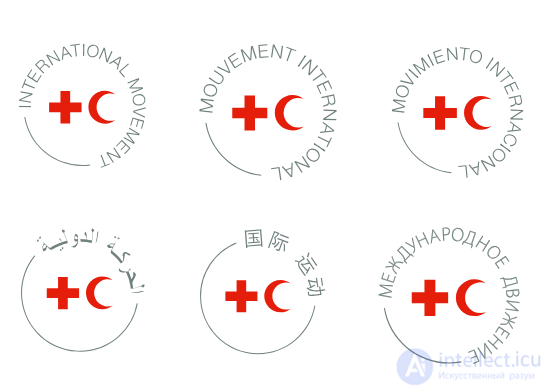
The International Red Cross and Red Crescent Movement is guided by the Fundamental Principles: humanity, impartiality, neutrality, independence, voluntary service, unity, universality.
The tasks of the International Committee of the Red Cross include:
- visiting prisoners of war, as well as civilians detained in connection with an armed military conflict;
- tracing persons who are missing;
- reuniting separated families;
- providing food, water and medical care to civilians who are deprived of basic necessities;
-disseminating knowledge of international humanitarian law and monitoring compliance with its norms;
- drawing attention to violations of IHL and contributing to its development.
With the aim of protecting and assisting victims of armed conflicts, the ICRC
a) works on improving international humanitarian law, on explaining and disseminating the text of the Geneva Conventions;
b) organises visits to military and civilian prisoners who find themselves in camps and prisons as a result of armed conflicts; reunites families scattered as a result of military operations; provides medical assistance to victims;
c) helps the civilian population experiencing material need;
provides assistance to war invalids;
d) takes measures to protect refugees and other displaced persons.
4. Symbols of the International Red Cross and Red Crescent organisation.
To recognise people and property that have the corresponding right to protection, international distinctive signs and emblems are used. Distinctive signs must be of large size and clearly visible.
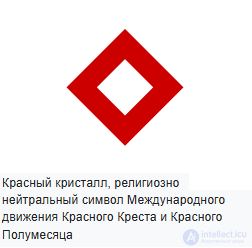
(1.For all medical formations and religious personnel, the distinctive sign is the red cross on a white background; this sign has no religious meaning.
Muslim countries, first Turkey and then others, adopted the sign of the red crescent.
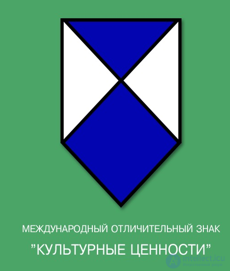
2. The sign of the blue and white shield denotes cultural property.
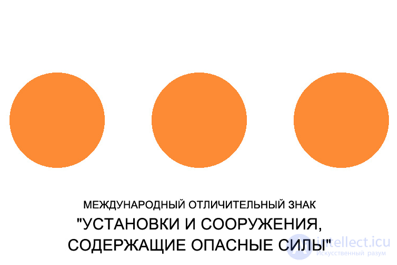
3.The sign of three orange circles, placed on a white field, denote installations and structures containing dangerous forces.
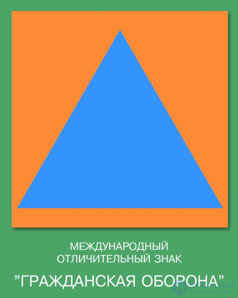
4. A blue equilateral triangle on an orange background - objects and personnel of civil defence.
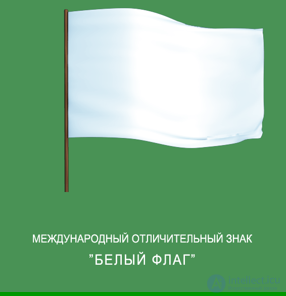
6. A white flag – this is the flag of parlementaires, used for negotiations.)
The white flag (the flag of truce, used for negotiations or surrender).
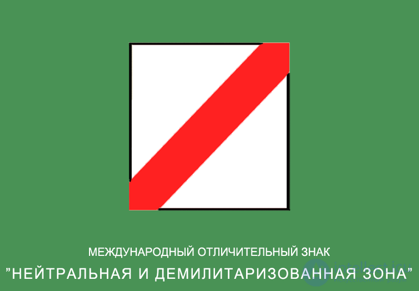
7. Territory is neutral, demilitarised and unguarded.
The red cross on a white field is the distinctive emblem used to designate the medical units of the armed forces. The emblem is used both as a protective sign and as a distinctive sign. During armed conflicts, the emblem is used above all as a protective sign to designate the personnel of institutions,
The principle by which the ICRC is guided is «even war has limits restricting the methods and means of conducting military operations».
The states parties to the Geneva Conventions of 1949 undertook the obligation to take measures to prevent and suppress abuses of the emblem, both in peacetime and in wartime.
Responsibility for violation of international humanitarian law.
International humanitarian law defines the rules of conduct for participants in military operations. Like any laws, IHL is not always complied with. A person who violates the norms of law bears responsibility. In international humanitarian law, personal criminal responsibility is provided for particularly serious offences committed during an international armed conflict, which are called war crimes.
They are specified in the 1st and 2nd Geneva Conventions. (aloud) and in Article 356 of the Criminal Code.
Do you accept that there are opinions different from your own, do you treat them with respect and tolerance?
The proposed test will help assess the degree of your tolerance. One condition – answer quickly, without thinking too much.
Do you find it unpleasant to be in a situation where you need to give up a plan you devised because your friends proposed a different plan:
You meet with friends, and someone suggests starting a game. What would you prefer:
3. You calmly accept unpleasant news for you:
4. Do you feel aversion towards people who are intoxicated:
5. Can you easily make contact with people who have different views and habits than you:
6. How do you react to a joke of which you become the object:
7. Do you agree with the opinion that many people «are not in the right place», «do not do their own job»:
8. You bring a friend (girlfriend) into your company, who becomes the object of everyone's attention. How do you react to this:
9. At a party you meet an elderly person who criticises modern youth and extols the old days. How do you react:
FOR ANSWERS
1-B2-B3-B4-A 1. GIVE YOURSELF 2 POINTS EACH5-B 2.6-B 7-A8-B9-A
COUNT THE NUMBER
OF POINTS YOU SCORED
0 – 5 POINTS – You are unyielding and stubborn, imposing your opinion on others in order to achieve your goal. It is difficult for you to maintain normal relations with those who think differently from you.
5 – 12 POINTS – You firmly defend your convictions, but are capable of changing your point of view.
13 – 18 POINTS – You can accept another idea, understand any action. You are quite critical of your own opinion, capable of abandoning a point of view that turned out to be mistaken.

Comments