
Lecture
Shock wave therapy (SWT) – is a type of physiotherapy based on the effect of a shock-type wave produced in the low-frequency infrasound spectrum, which is not perceptible to the ear. The shock wave emitter device used to carry out the procedures is ideal for treating motor dysfunctions as well as a large number of various diseases. Most such devices are portable, which makes them convenient to use, and they are also lightweight.
The history of extracorporeal shock wave therapy (ESWT) began in 1951 in the USA, when Dr. F.Rieber used a shock wave generator to treat brain tumors. The results were unsatisfactory, but scientists did not abandon their attempts to use shock waves in medicine, and thanks to this, in 1980 in Munich a kidney stone was destroyed in a human for the first time without surgery, using shock waves instead.
Experiments with shock waves continued, and as a result, in the late 1980s it was discovered that if the pressure and energy density of the pulse flow were reduced, its destructive capacity would decrease, while it would still have an anti-inflammatory, analgesic and stimulating effect on tissue. Traumatologists and orthopedists were the first to adopt ESWT. Since then, the design of wave generators has been repeatedly modified and their capabilities expanded. Today, extracorporeal shock wave therapy is widely used throughout the world. This gentle technology is successfully used in orthopedics, neurology, rheumatology, phlebology and aesthetic medicine.
In the 1990s, to treat the effects of chronic muscle overstrain and sports injuries, Germany and Switzerland began using a new method — shock wave therapy.
The first use of shock waves in medicine relates to the treatment of kidney stone disease. Experiments on crushing kidney stones with shock waves began in the 1970s, and a few years later this method, which became known as «lithotripsy», became widely accepted. Along the way, researchers also studied how shock waves act on bone, and in the 1980s articles appeared on their effect on soft tissue, ligaments and tendons. It turned out that shock wave therapy could successfully treat conditions such as «heel spur» and chronic radial or ulnar epicondylitis — «tennis elbow».
It took several years to select the optimal frequency and energy of the sound waves. As a result, certified devices appeared that generate low-frequency waves — from 1 to 15 Hz. The shock wave produced by the device is either focused on a small volumetric area with a cross-sectional size of 2—8 mm, or propagates radially, covering a large area. Treatment is carried out on an outpatient basis, and the course includes 3—5 sessions of 2000 pulses each, with intervals of 5—7 days.
The principle of operation of shock wave therapy is based on converting the pulse from a shock wave effect into a sound wave, which is transmitted into the external environment. The human body is 65-80% water, and the acoustic wave propagating through it is absorbed at the boundary with bone. The difference in tissue density affects the power of the effect, with the greatest effect achieved in denser tissues, as well as at the interface between tissues, such as bone and tendon, muscle and fascia.
The shock wave in the device is generated, as a rule, by one of the following methods: electromagnetic, electrohydraulic, piezoelectric, pneumatic. An electromagnetic generator forms a sound wave through the elastic deformation of a metal membrane (this principle is used, for example, in acoustic speakers). The electrohydraulic method is based on the principle whereby a spark causes heating and a shock wave in a liquid medium. In the piezoelectric method, the shock wave is formed by the vibrations of quartz crystals under the action of high voltage. In the pneumatic method, vibrations are created by pulses of compressed air.
The effect of shock wave pulses does not destroy tissue, but «loosens» it, improving microcirculation and stimulating the processes of damage repair. Even a single session of ESWT significantly reduces the intensity of pain, promotes the restoration of range of motion in the joints, and increases resistance to physical exertion. In recent years, the use of extracorporeal shock wave therapy has increasingly made it possible to avoid surgery in the treatment of musculoskeletal injuries and degenerative-dystrophic diseases.
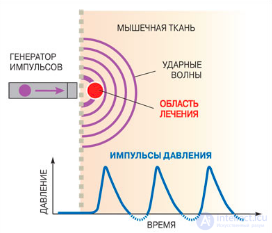
are generated by an electric spark. If a spark discharge occurs in water, pulses arise that are focused and directed, for example, at kidney stones. They pass through the skin without causing any damage. Devices used for this application are, as a rule, large in size and have high output power.
are generated by means of a projectile (striker), which strikes the back side of a small metal plate. This plate, i.e. the applicator, directs the pulses to the target. These shock waves are much more compact and are easily positioned on the skin (so they can be used for acupuncture points). The device used to perform acupuncture shock wave therapy – « Masterpuls MG-100» by Storz Medical, Switzerland, has an applicator adapted for acting on acupuncture points.
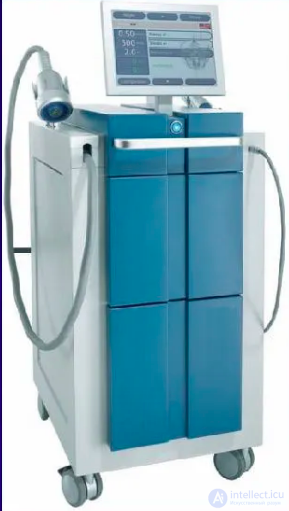
Fig. Device for shock wave therapy EWATage Extra
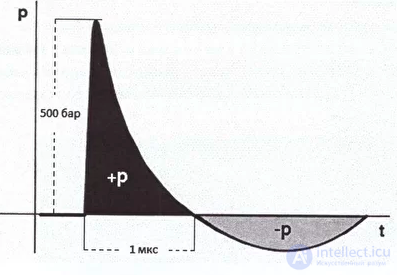

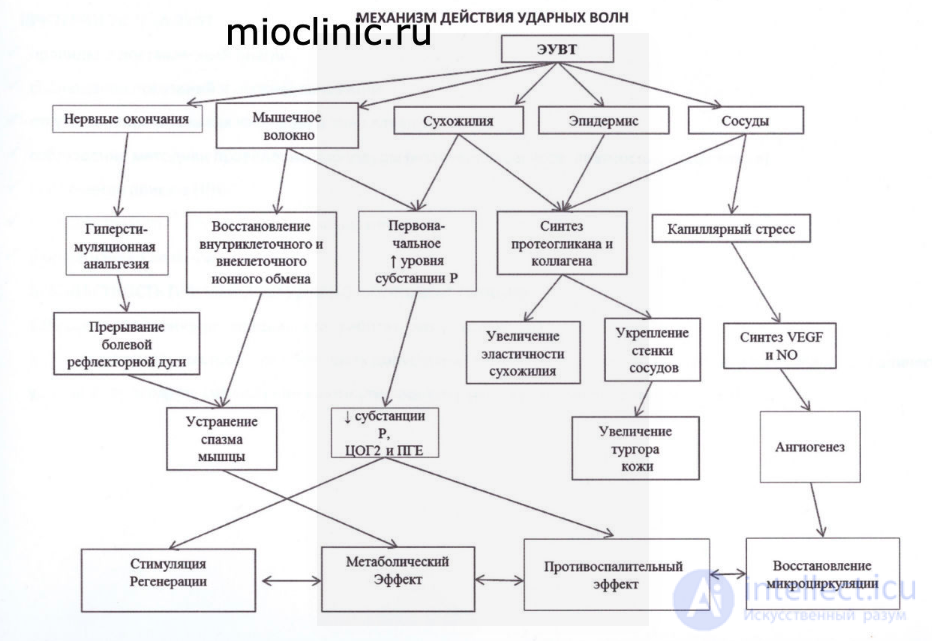
Fig. Mechanism of action of Focused Shock Wave Therapy
7 main effects achieved in the treatment zone when using ESWT:
The device «Master Pulse MP-200» (Germany), using a wide range of applicators, allows precise dosing of the intensity of the effect, adjusting the depth of wave penetration, and clearly marking the treatment zone. At the same time, the wave does not cause release of heat and does not create a high-density electromagnetic field, so if the patient has metal implants in the treatment zone, this is not a contraindication to the use of the ESWT method.
Method ESWT is used to treat:
Extracorporeal shock wave therapy in orthopedics
In recent years, the method of extracorporeal shock wave therapy has increasingly been used in orthopedics. This is because, despite the use of other modern methods of treating musculoskeletal injuries and degenerative-dystrophic diseases, many problems arise. For example, bone fractures in 10-13% of patients are complicated by the development of contractures, joint ankylosis and post-traumatic arthrosis. Also a fairly common pathology is painful syndrome at the attachment sites of tendons and ligaments. According to expert estimates, 80% of the adult population suffers from these diseases, and physiotherapy, the use of non-steroidal anti-inflammatory drugs, corticosteroid injections, acupuncture and massage do not bring relief in all cases. Surgery also does not always achieve the desired result, and is moreover always associated with a lengthy rehabilitation period and the risk of complications.
A shock wave therapy session is conducted once every 5-8 days, mainly using the D-actor and R-15 applicators, with a single procedure lasting up to 20 minutes. Main parameters: pressure – from 1.6 to 3.0 bar, frequency on average 8 Hz, number of pulses up to 4000 per procedure. The pain syndrome decreased immediately after the first procedure in 70% of treated patients.
The ESWT method makes it possible in many cases to speed up recovery, as well as to avoid surgery.
Extracorporeal shock wave therapy for the treatment of trophic ulcers
Thanks to ESWT, tissue damage repair processes are stimulated, microcirculation is improved, metabolic processes are accelerated, and microcapillaries proliferate in the area of the pathology. All this leads to the restoration of blood supply in the tissues and healing of the ulcer.
Comprehensive therapy is prescribed after diagnosis and identification of the cause that led to the appearance of the trophic ulcer. A course of treatment for trophic ulcers consists of 5-8 ESWT sessions with intervals of 5-7 days between them. The D-actor applicator is used, with a single procedure lasting up to 30 minutes, main parameters: average pressure value 2.6 bar, frequency on average 7 Hz. Number of pulses up to 5000 per procedure. Both the edges of the wound and its center are treated through a sterile oilcloth. Treatment success rate is more than 90%.
Extracorporeal shock wave therapy in the treatment of herniated intervertebral discs
Currently, non-surgical methods for treating herniated intervertebral discs include manual therapy, skeletal traction, epidural blocks and physiotherapy. However, all these methods only eliminate the consequence of the disease, while the hernia itself remains unchanged and continues to progress. The use of the shock wave therapy method has proven its effectiveness over a long period of time in comparison with other methods of non-invasive treatment, which in fact only allow delaying surgery for some time. Moreover, this method has a number of advantages over surgical intervention
Main advantages of the method
In this case, a focusing applicator and D-actor are used. Parameters are as follows: pressure - average value 2.0 bar, frequency on average 7 Hz. Number of pulses up to 3000 per procedure.
Extracorporeal shock wave therapy in the treatment of cellulite
Cellulite not only spoils the figure from an aesthetic point of view, but is also associated with excess weight gain, pain syndrome, deterioration of well-being, and also negatively affects a person's psychological self-esteem.
The shock wave therapy method is not recommended if the patient has:
The method is not indicated for:
If therapy is required for the treatment of adolescents and children, the recommendations are given by a doctor, individually in each case, after a preliminary examination.
Rehabilitation after surgical treatment proceeds quickly if shock wave therapy devices are used to restore the patient's mobility.
In orthopedics, positive dynamics are observed in 95% of cases when a course of SWT was performed.

Comments