
Lecture
Physiotherapy — a medical discipline that studies the effect on the body of physical factors of the external environment, artificially produced physical factors, and uses these factors for therapeutic and preventive purposes.
The word «physiotherapy» comes from the Greek phisis — nature and therapeia — treatment.
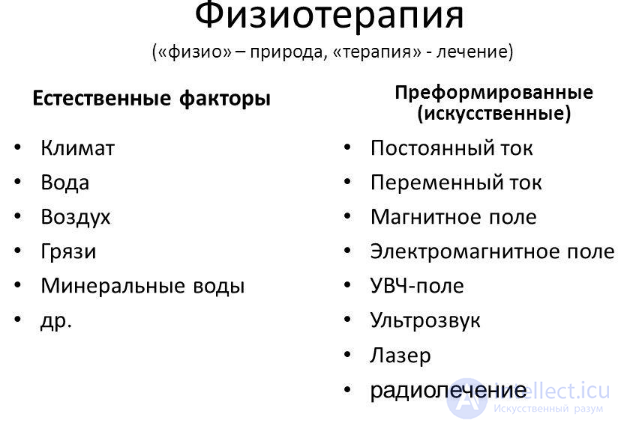
People began using the factors of nature to treat diseases a very long time ago. For several millennia now, medicine has used the healing properties of mineral waters and therapeutic muds. Already in Ancient Rome the therapeutic and preventive effect of sunlight was actively used. Consequently, physiotherapy arose as a way and a result of humanity's communication with nature. In the methods of modern physiotherapy, centuries of folk experience in health improvement and healing are combined with the achievements of modern science.
Physiotherapy emerged as an independent discipline only in the 20th century. An important role in the development of physiotherapy was played by the works of such outstanding physiologists as I. M. Sechenov and I. P. Pavlov. A huge contribution to the development of physiotherapy as a science was made by the works of the founders of domestic clinical medicine S. P. Botkin, G. A. Zakharyin, A. Ya. Kozhevnikov, G. A. Ostroumov, N. I. Pirogov. Physiotherapy took a step forward in its development thanks to practicing physiotherapists and scientists such as A. E. Shcherbak, S. A. Brushtein, S. B. Vermel, A. P. Parfenov, A. N. Sbrosov, E. I. Pasynkov.
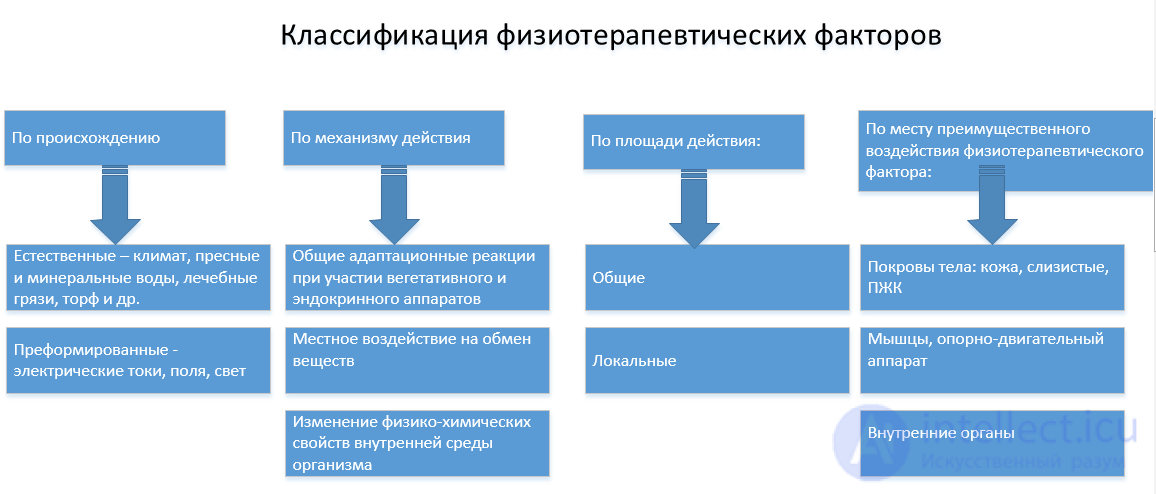
I. By origin:
II. By mechanism of action:
III. By area of action:
IV. By the site of predominant action of the physiotherapeutic factor:
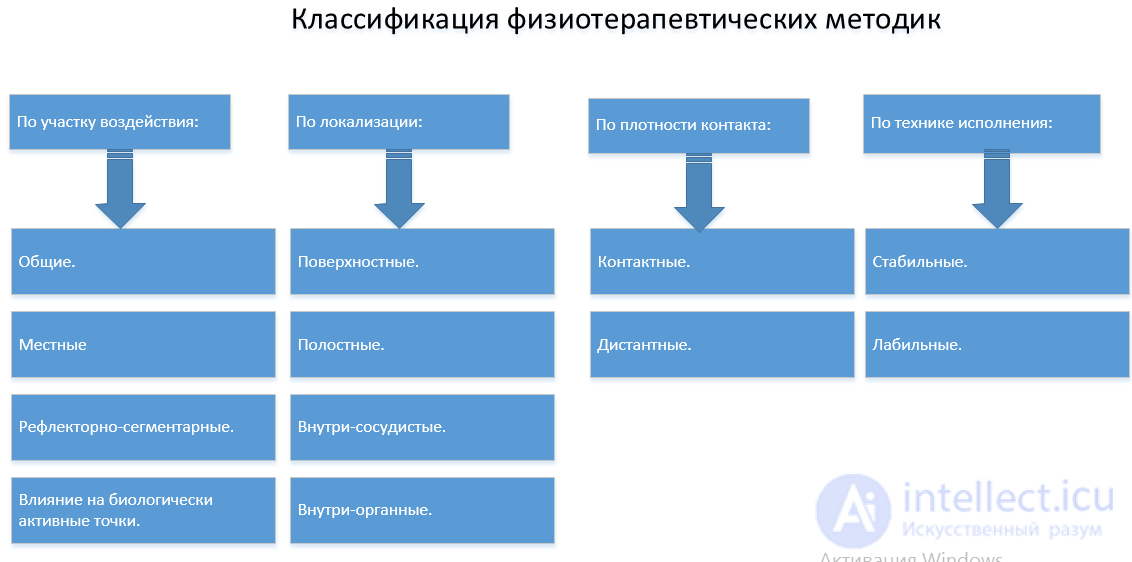
I By area of action:
II By localization:
III By density of contact:
IV By technique of performance:
Modern technical progress, associated with the rapid development of physics, biophysics, radioelectronics, biology and others, has had a great influence on the development of physiotherapy. Modern physiotherapy uses new, quite complex methods based on the achievements of radioelectronics (pulsed currents of various frequency and shape, pulsed ultra-high-frequency electric field, microwaves, ultrasound). Physiotherapy studies and uses the effect on the body of the physical forces of nature, both natural (solar radiation, water, air, climatic factors, peloids — therapeutic muds, Naftalan sands) and physical factors obtained with the help of special apparatus and devices (heat and cold, electric current, various physical fields, ultraviolet and infrared radiation, UHF, various mechanical effects) for therapeutic and health-improving purposes. However, the older, simpler methods of physiotherapy (heat-water therapy, light therapy, massage) have not lost their significance.
Health can be maintained in different ways — through the constant use of medications, or by following a healthy lifestyle and monitoring one's wellbeing. Therapeutic physical factors play a significant role among the various ways of acquiring health. With their help, immune mechanisms are activated, as well as the affected organs and systems. That is why the factors of nature are used not only for treatment, but also for the prevention of diseases, protection of the body, and its hardening.
In modern physiotherapy there is a fundamental principle: the most effective treatment dosages are those that are adequate to the current physiological state of the body. Therefore, the intensity and duration of the exposure must be selected strictly individually — and this is one of the conditions for success in treatment and prevention.
A number of advantages of physical treatment methods over other therapeutic means should be noted:
The therapeutic effect of physical factors is formed through the involvement of local, reflex-segmental and general reactions of the body. Local reactions manifest in a limited area of the body and occur in the tissues that have absorbed the energy of the physical factor. The mechanism of formation of local reactions depends on the form of energy: mechanical, electrical, magnetic, light, thermal. The body's reactions to mechanical factors depend on their parameters. Local reactions are expressed in changes in metabolism, regional blood circulation and microcirculation, local immunobiological processes, and the formation of biologically active substances. The local shifts caused by physical factors determine their anti-inflammatory, anti-edematous, resolving, trophic-stimulating, analgesic and bactericidal effects.
As a result of somatic, visceral and autonomic reflexes formed as a consequence of therapeutic physical factors, reflex-segmental reactions arise. The general response of the body is formed as a result of the propagation of ascending impulse currents from the spinal cord to the overlying parts of the brain. This is accompanied by dynamic homeostatic shifts in the activity of various internal organs, metabolic-trophic changes, changes in the immune status and reactivity of the body, the development of adaptive reactions, an increase in the level of mobilization of the body's functional reserves, and restoration of adaptation systems disrupted by the disease.
All organs and systems of the body are involved in the adaptive response, as a rule, after extensive or intensive physiotherapeutic procedures, as well as after exposure to special zones (acupuncture points, the collar zone, and other zones).
When applying physiotherapeutic methods to treat a specific patient, it is necessary to individually select the type of energy used and the procedure technique. In each case, it is necessary to take into account the etiological and pathogenetic justification for using the physiotherapeutic factor, the nature of the clinical manifestations, the individual features of the disease course, the initial functional state of the body, and the specificity of the therapeutic action of the chosen factor. Taking into account the specific action on the body of a particular physical factor, the general principles of using physical factors for therapeutic and preventive purposes can be formulated:
I. The principle of an individual approach in treatment with physical factors. When prescribing treatment, the following must be taken into account:
It is very important to know the age-related restrictions on the use of physiotherapeutic factors. The absence of a pronounced therapeutic effect after the first procedures cannot be grounds for discontinuing or replacing one physical factor with another. The parameters of therapeutic physical factors are selected strictly individually. A necessary element of an individual approach in treatment is creating a positive emotional attitude in the patient toward the upcoming treatment.
2. The principle of unity of etiological, pathogenetic and symptomatic physiotherapy. Based on this principle, it is necessary to prescribe such therapeutic factors as would eliminate the etiological agent and eliminate the manifestation of the main symptoms of the disease. In the acute period of the disease, it is necessary to eliminate or weaken the etiological agent. In the subacute course of the disease, physiotherapeutic procedures should be aimed at resolving the pathological process, eliminating its residual manifestations, and normalizing the disrupted functions of various organs and systems.
3. The principle of course treatment with physical factors. The optimal therapeutic effect of treatment with physiotherapeutic factors occurs as a result of course treatment. Its duration for some forms is 6—8, for others — 8-12, less often 15—30 procedures, carried out daily or every 1—2 days. It should be remembered that prolonged use of the same physical factor leads to the body's adaptation to that factor and a decrease in the effectiveness of treatment.
It is also necessary to take into account that when physiotherapy is applied, delayed manifestations of the treatment are observed, which are often more favorable than the factor itself. The aftereffect periods of most factors range from 2 weeks to 4 months. To prescribe the optimal duration of the course, it is necessary to take into account the dynamics of objective indicators of the patient's condition.
4. The principle of optimal treatment with physical factors. When prescribing physiotherapeutic procedures, it should be taken into account that physical factors have unequal therapeutic effectiveness in the treatment of a specific disease. The parameters of the therapeutic factor and the method of its application should correspond as closely as possible to the nature and period of the pathological process.
It should be noted that there are certain contraindications to the use of physiotherapy. These include: malignant neoplasms, systemic blood diseases, cachexia, stage III hypertensive disease, pronounced atherosclerosis of cerebral vessels, diseases of the cardiovascular system in the stage of decompensation, bleeding, severe general condition of the patient, febrile condition, active tuberculosis, epilepsy, psychoses with symptoms of psychomotor agitation.
5. The principle of dynamic treatment with physiotherapeutic factors. Physiotherapy currently has at its disposal a very wide range of natural and artificial physical factors, differing in physical properties and therapeutic action, obtained mainly by transforming electrical energy into various types and forms of energy for actively affecting the human body.
There are 10 groups of artificially produced and natural therapeutic physical factors.
Group 1: low-voltage electric currents. This includes galvanic current and medicinal electrophoresis, pulsed currents of direct and alternating direction.
Group 2: high-voltage electric currents. This includes darsonvalization and diathermy.
Group 3: electric and magnetic fields. This group includes a constant high-voltage electric field, a constant low-frequency magnetic field, an alternating high-frequency magnetic field, an alternating ultra-high-frequency electric field, an ultra-high-frequency electromagnetic field.
Group 4: light. This group includes infrared, visible, ultraviolet, monochromatic (coherent) radiation.
Group 5: mechanical vibrations. They include infrasound — vibration, ultrasound.
Group 6: artificial air environment. This includes aeroions, hydroaeroions, aerosols and electroaerosols.
Group 7: variable air pressure.
Group 8: radioactive factors. This includes radon water, alpha applicators.
Group 9: water-therapy factors. These include fresh water, artificially prepared mineral waters.
Group 10: heat-therapy factors. They include mud, peat, paraffin, ozokerite.
|
Type of energy |
Mode of action |
Characteristics |
Name of method |
|
Direct electric current |
Continuous |
Low voltage and low current |
Galvanization Medicinal electrophoresis |
|
Pulsed |
Low voltage, low current, low and audio frequency, rectangular, tetanizing, exponential, diadynamic half-sine currents |
Electrosleep, central electroanalgesia Electrostimulation Diadynamic therapy Diadynamophoresis Electroacupuncture |
|
|
Alternating electric current |
Continuous and pulsed |
Low voltage, low current, audio frequency |
Interference therapy Amplipulse therapy (SMT) Amplipulse-phoresis Fluctuorization Fluctuophoresis |
|
Continuous |
Supratonal frequency, low current and high voltage |
Ultratone therapy |
|
|
High frequency and voltage, high current |
Diathermy Diathermosurgery |
||
|
Pulsed |
High frequency and voltage, low current |
Local darsonvalization |
|
Type of energy |
Mode of action |
Characteristic |
Name of method |
|
Electromagnetic field |
Pulsed |
High-frequency induction |
General darsonvalization |
|
Continuous |
High- and ultra-high-frequency induction |
Inductothermy Galvanoinductothermy Electrophoresis-inductothermy UHF-inductothermy |
|
|
Continuous, pulsed |
Predominantly ultra-high-frequency electric field |
UHF therapy Pulsed UHF therapy |
|
|
Continuous |
Microwave (SHF) |
Decimeter-wave therapy Centimeter-wave therapy Millimeter-wave therapy |
|
|
Constant electric field |
Continuous |
High voltage |
Franklinization Aeroion therapy Aeroionophoresis |
Physiotherapy is currently widely used at all stages of patient rehabilitation, starting from paramedic health posts and rural district hospitals to multidisciplinary and specialized hospitals, outpatient clinics, dispensaries of various specialties and maternity hospitals. The first structural unit providing qualified physiotherapy care to the population is the physiotherapy department (room). The physiotherapy department (room) is located in specially equipped premises that fully meet the requirements of the «Rules for Arrangement, Operation and Safety Engineering». The main tasks of the department (room) are carrying out treatment, rehabilitation and preventive measures using physical factors. The nurse of the physiotherapy room must work under the direct supervision of the physician and the senior nurse. She carries out physiotherapy procedures as prescribed by the physician in accordance with the method, monitors the patient's condition, controls the operation of devices and apparatus during the procedure, ensures their safekeeping, monitors the sanitary and hygienic condition of the rooms and regulates patient visits.
In addition to such structural units as the physiotherapy department and room, independent physiotherapy hospitals operate as specialized medical-preventive institutions that provide highly qualified medical care using modern physical methods of prevention, diagnosis and treatment of diseases. The main tasks of physiotherapy hospitals are to provide outpatient and inpatient care to the adult and child population living in its service area, and to provide health authorities and institutions with methodological and consultative assistance on issues of balneology and physiotherapy.
When prescribing physiotherapy procedures, appropriate entries must be made in the outpatient and treatment charts (form No. 044/u): the name of the procedure, the treatment zones, the techniques used, the dosages, and the number of procedures received. Upon the patient's arrival at the physiotherapy room, the nurse records the necessary data about them in the register of primary-visit patients and familiarizes them with the rules of conduct during procedures. It is strictly forbidden to touch metal pipes. If any unpleasant sensations occur, this must be reported to the nurse.
Physiotherapy rooms keep a daily record of the number of procedure units dispensed and performed. One conventional physiotherapy unit is defined as work requiring 8 minutes to complete. The workload norm for nurses of physiotherapy rooms serving adults and children is 15,000 conventional physiotherapy units per year. All procedures must be carried out only according to standardized and approved methods approved by the Ministry of Health, or methods described in special manuals.
To ensure high therapeutic effectiveness, create the most favorable conditions for treatment, and ensure the safety of patients' and staff's health when carrying out physiotherapy procedures, it is necessary to strictly comply with the «Rules for the Arrangement, Operation and Safety Engineering of Physiotherapy Departments (Rooms)», approved by the USSR Ministry of Health (OST 42-21-16-89). According to these rules, already at the design stage of the medical institution (room), a layout plan must be provided for all physiotherapy apparatus, protective devices and auxiliary equipment, indicating all dimensions, ventilation systems, grounding, electric lighting and power electrical network. Newly built or reconstructed physiotherapy departments (rooms) are accepted in the established order by a special commission. The acceptance of buildings and premises is formalized by an act of the said commission with a conclusion on the possibility of their operation.
Persons newly hired to work in physiotherapy departments (rooms) are admitted to work only after appropriate instruction on safe practices and methods of work and verification of knowledge of safety rules in accordance with the profile of their work. Regular safety instruction for working personnel must be conducted at least once a year. Upon receiving a new apparatus, unscheduled instruction on its operation and care must be conducted. Registration of the completed initial and periodic instruction is recorded in a special log kept by the head of the department or room. Persons with completed secondary medical education, holding certificates of completion of specialization in physiotherapy under a special program, and familiar with safety rules, are admitted to independently carry out procedures. Junior medical personnel are prohibited from carrying out physiotherapy procedures. Persons under 18 years of age are not permitted to work with UHF and microwave generators or to be within the range of influence of these rays.
Maintenance and repair of physiotherapy apparatus may be entrusted to persons with special education, holding a certificate authorizing them to carry out this work. Inspection of the equipment by a specialist must be conducted at least once every two weeks.
Medical and technical personnel of physiotherapy departments must undergo mandatory medical examinations upon hiring and every year thereafter.
Locating physiotherapy rooms and departments in basement, semi-basement and ground-floor premises is prohibited.
Separate rooms must be equipped for carrying out physiotherapy procedures for each type of treatment: light therapy, low-frequency currents, high-frequency currents, inhalation room, mud and paraffin therapy, etc. When the number of apparatus is small, placement of electro-light therapy equipment in a single room is permitted, with the exception of stationary UHF and microwave generators. Physiotherapy room premises may be used only for their direct purpose.
Simultaneous administration of procedures by one nurse in different rooms is not permitted, since it is necessary to constantly monitor the operation of the apparatus and the condition of patients. All treatment rooms must have running cold water and a sewage system.
Before the start of each work shift, nurses must verify the serviceability of the apparatus and grounding devices, and report any defects found to the head of department.
Physiotherapy departments must have rest rooms for patients, equipped with couches and chairs at a rate of 4 m2 per couch and 2 m2 per chair. The number of rest places is provided depending on the capacity of the department and should correspond to 80% of the work places in the heat-water-mud therapy department, and after all procedures have been taken — 25% of the total number of work places, with 40% of the places in the rest room provided by chairs.
Rooms for carrying out electro-light therapy procedures must be dry and bright, with a height of at least 3 m. The use of synthetic materials for floor covering or for making curtains that create static electric charges is not permitted. The walls must be painted with light-colored oil paint up to a height of 2 m, and the remaining parts of the walls and ceiling with distemper paint.
The area of electro-light therapy rooms is calculated at 6 m2 per couch with a service passage, and if there is only one couch in the room, at least 12 m2. Booths in the rooms are installed on a frame made of plastic or well-polished wooden posts, or of nickel-plated metal tubes or tubes coated with oil paint. Booths must be at least 2 m high, 2.2 m long, and 1.8—2 m wide. Only one stationary apparatus and one couch may be installed in each booth with local lighting. Electro-light therapy procedures are carried out on wooden couches with a raisable headrest.
A specially isolated room of at least 8 m2 must be allocated in the room for carrying out preparatory work, equipped with a drying-exhaust cabinet, a wash sink, sterilizers, a work table, and a washing machine.
The air temperature must be at least 20 °C. Paraffin and ozokerite are heated in an exhaust cabinet in a specially designated kitchen, the walls of which are covered with glazed tile to a height of 2.5 m from the floor. The table on which the paraffin heaters are placed must be covered with fireproof material.
Violations of safety rules can cause a short circuit in the physiotherapy room and cause electrical injury to both the patient and the personnel. A person affected by electric current may sustain burns at the entry and exit points of the current, and in deep tissues along the path of the field lines. General disturbances of the cardiovascular, respiratory and central nervous systems may occur, manifesting as convulsive muscle contraction, cyanosis, arrhythmia, loss of consciousness, and in severe cases — cessation of breathing and cardiac arrest. Clinical manifestations depend on the strength of the current, the duration of contact, the area of exposure and the resistance of the victim's body.
In accordance with this, mild, moderate and severe injuries from current exposure are distinguished. In mild injury, convulsive muscle twitching without loss of consciousness, pallor of the skin, and sudden fright are observed. Moderate electric current injuries are accompanied by loss of consciousness, muffled heart sounds, weakened pulse, tachycardia, and difficulty breathing due to convulsive contraction of the skeletal musculature. In severe forms, the phenomena of cardiac and respiratory failure are more sharply expressed, arrhythmia is observed, up to cardiac fibrillation, the rhythm and depth of breathing are disturbed, and respiratory arrest is possible.
In addition to the direct clinical manifestations, at the moment of current exposure, complications associated with electrical injury may be observed, such as hearing and speech disorders, vegetative-endocrine disturbances, and psychiatric disturbances with various manifestations. Yellow-brown areas ranging in size from a point to 2—3 cm in diameter appear on the skin, with a depression in the center and thickened edges, which are devoid of pain sensitivity.
First aid to the victim consists of immediately freeing them from the action of the current while observing personal safety measures, i.e. stopping contact with the current source and determining the degree of respiratory and circulatory disturbance. A victim with breathing disturbances but a preserved pulse must immediately be given artificial lung ventilation using the «mouth to mouth» method, and upon arrival of the «ambulance» team, connected to an artificial lung ventilation apparatus.
Victims with circulatory disturbances or cardiac arrest undergo resuscitation measures including artificial lung ventilation (ALV), with mandatory clearing of the oral cavity and upper respiratory tract of secretions using a napkin or suction, then 1—2 blows with the fist are delivered to the lower third of the sternum and closed-chest cardiac massage is begun. At the same time, the victim is given a 0.1% adrenaline solution subcutaneously, intramuscularly or intravenously at a dose of 0.75, 0.5 or 0.3 respectively, and intravenously 5—10 ml of a 10% calcium chloride solution. Following this, 200 ml of a 2% sodium bicarbonate solution is injected as a stream into the vein, repeating such infusions every 10 minutes until circulation is restored.
The medical personnel of the physiotherapy room (department) are required to carry out the above measures until the arrival of the «ambulance» team.
When a patient is exposed to medicinal substances to which they have increased individual sensitivity, anaphylactic shock may develop. A severe anaphylactic reaction can occur even with the use of small doses of this substance or its low concentration. To prevent the occurrence of such reactions, it is necessary to ask the patient how they tolerate various medications; in doubtful cases, sensitivity tests to medicinal substances must be performed. Anaphylactic shock manifests as suffocation, anxiety, skin itching, loss of consciousness (coma), a significant drop in blood pressure, sharp pallor of the skin, and dilation of the pupils.
Death can occur within a few minutes. If anaphylactic shock develops, the nurse must immediately stop the procedure, lay the patient down, administer 0.5 ml of a 0.1% adrenaline hydrochloride solution subcutaneously, and immediately call a physician. Further emergency care measures are carried out according to the physician's instructions. These include repeated intravenous injections of prednisolone hemisuccinate (50 mg), 10 ml of a 2.4% aminophylline solution, and 2 ml of cordiamine subcutaneously. Further treatment is carried out in the intensive care unit, where the patient receives a drip intravenous infusion of corticosteroid hormonal drugs, anti-shock plasma substitutes (polyglucin), and antihistamines are prescribed (diphenhydramine, chlorpyramine).
With increased load of physiotherapy procedures, especially thermal ones, patients suffering from cardiopulmonary diseases may develop symptoms of disease exacerbation (hypertensive crisis, cerebrovascular accident, angina attack, status asthmaticus). In these cases, it is necessary to stop the prescribed procedures and begin the use of appropriate medications.
To prevent the spread of nosocomial infection and ensure infectious safety of both working personnel and patients receiving treatment in the physiotherapy department (room), it is necessary to be guided by the regulatory documents of the Russian Ministry of Health governing the sanitary-epidemiological regime of medical institutions. On the basis of existing sanitary rules, wet cleaning is carried out daily after each shift. At least once a month, curtains are changed, walls, lighting fixtures and ventilation grilles are washed. The inner surface of cabinets and bedside tables for storing linen are wiped daily with a 1% chloramine solution. Couches and pillows are covered with individual napkins (under exposed areas of the body).
Patients enter the hydrotherapy facility in rubber slippers. After each procedure, baths are washed with pastes, rinsed with hot water, and then, after a 15-minute interval, wiped with a 1% chloramine solution. Rubber slippers are immersed for 1 hour in a 5% chloramine solution after each patient, and brushes for cleaning baths are immersed for 30 minutes in a 1% chloramine solution at the end of the shift. Rubber pads are wiped with a 1% chloramine solution after each use, and rubber mats are treated twice with a 1% chloramine solution at the end of the working day.
Hydrophilic pads for galvanization or electrophoresis are thoroughly rinsed under running water after each procedure (water consumption up to 10 l per pad) and boiled for 30 minutes. If the pads are individually assigned to a specific patient or disposable filter-paper pads are used, boiling may be carried out at the end of the course of treatment.
Pieces of oilcloth for insulating electrodes are wiped twice with a 1% chloramine solution.
Contact skin electrodes of ultrasound apparatus are wiped with 70% ethyl alcohol before and after each procedure.
Electrodes from apparatus for microwave (SHF) therapy, magnetotherapy, ultratonotherapy, and darsonvalization are immersed in one of the following solutions:
Tubes for the OKUF apparatus are washed with warm soapy water after each procedure and then immersed in one of the above-mentioned solutions. Non-contact electrodes (UHF, ultratherm) are wiped with a swab moistened with a 1% chloramine solution.
Masks of the «Electrosleep» apparatus are wiped twice with a 15-minute interval using a 3% hydrogen peroxide solution. When disinfecting parts of apparatus that come into contact with the patient, the recommendations specified in the device's manual must be taken into account.
When carrying out UV irradiation, goggles are wiped before and after each use with a 3% hydrogen peroxide solution.

Comments