
Lecture
A hot air oven is used to sterilize equipment and materials used in medicine. The hot air oven is a type of dry heat sterilization. Dry heat sterilization is used for equipment that cannot be wetted, as well as for materials that do not melt, ignite, or change shape when exposed to high temperatures. Moist heat sterilization uses water to boil items or steam to sterilize them and does not take as long as dry heat sterilization. Examples of items that are not sterilized in a hot air oven include surgical dressings, rubber products, or plastic. Items that are sterilized in a hot air oven include:
Glass tubes can be sterilized using a hot air oven
test glass Tubes can be sterilized in a hot air drying cabinet. Hot air drying cabinets use
extremely high temperatures for several hours to destroy microorganisms and bacterial spores. Ovens use heat conduction to sterilize items, heating the outer surfaces of the item, which then absorb heat and transfer it to the center of the item.
The commonly used temperatures and times required by ovens to sterilize materials are 170 degrees Celsius for 30 minutes, 160 degrees Celsius for 60 minutes, and 150 degrees Celsius for 150 minutes.
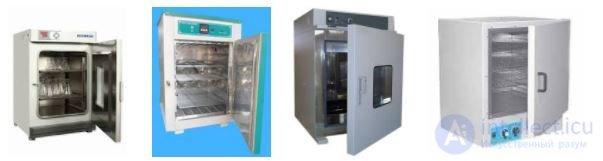
Dry heat sterilization is carried out by conduction. Heat is absorbed by the outer surface of the item and then passes layer by layer toward the center of the item. Eventually, the entire item heats up to the temperature required for sterilization.
Dry heat causes most of its damage by oxidizing molecules. The essential components of the cell are destroyed, and the organism dies. The temperature is maintained for almost an hour to kill the most resistant spores.
The most common time-temperature relationships for sterilization using hot air sterilizers:
170 ° C (340 ° F) for 30 minutes,
160 ° C (320 ° F) for 60 minutes, and
150 ° C (300 ° F) for 150 minutes or longer, depending on volume.
Note: Bacillus atrophaeus spores should be used to monitor the dry heat sterilization process, since they are more resistant to dry heat than Geobacillus stearothermophilus spores. The primary lethal process is believed to be oxidation of cell components.
There are two types of dry heat sterilizers:
A static-air sterilizer is called an oven-type sterilizer because heating coils at the bottom of the unit cause hot air to rise inside the chamber by gravity convection. This type of dry heat sterilizer heats up much more slowly, requires more time to reach the sterilization temperature, and has less uniform temperature control throughout the chamber than a forced-air sterilizer.
A forced or mechanical convection sterilizer is equipped with a motor-driven fan that circulates heated air throughout the chamber at high speed, providing faster energy transfer from the air to the instruments.
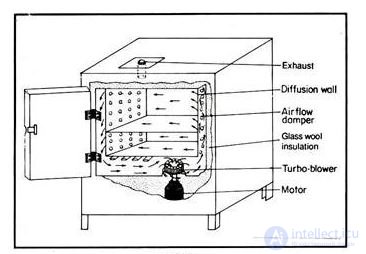
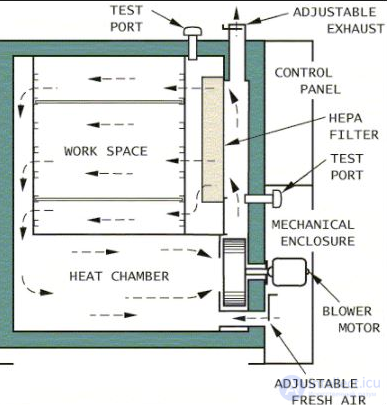
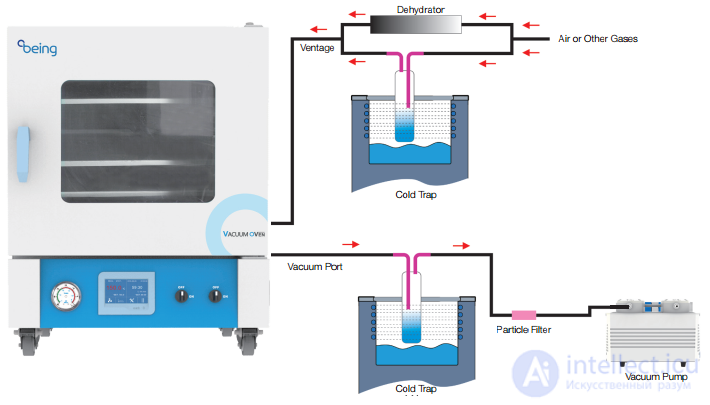
The dry heat cabinet is simple to install and has relatively low operating costs;
Penetrates materials
Non-toxic and does not harm the environment;
Does not cause corrosion of metal and sharp instruments.
Disadvantages of dry heat sterilization
The method is labor-intensive due to the low rate of heat penetration and microbial destruction.
High temperatures are not suitable for most materials.
Dry heat sterilization is carried out by conduction. Heat is absorbed by the outer surface of the item and then passes layer by layer toward the center of the item. Eventually, the entire item heats up to the temperature required for sterilization.
Dry heat causes most of its damage by oxidizing molecules. The essential components of the cell are destroyed, and the organism dies. The temperature is maintained for almost an hour to kill the most resistant spores.
The most common time-temperature relationships for sterilization using hot air sterilizers:
170 ° C (340 ° F) for 30 minutes,
160 ° C (320 ° F) for 60 minutes, and
150 ° C (300 ° F) for 150 minutes or longer, depending on volume.
Different types of hot air
ovens There are two types of hot air ovens. One of them is a forced hot air oven, and the other is a static hot air oven. A forced hot air oven is more efficient than a static air oven.
A forced hot air oven works by heating the oven and using a fan to move the hot air. This helps prevent hot air from collecting at the top of the oven and cooler air settling at the bottom. The fan keeps hot air circulating in the oven at a constant temperature.
A static air hot air oven works by using a heating coil at the bottom of the oven. Heat intensifies throughout the oven, and it takes longer to reach the desired temperature. Since the heat does not circulate as it does in a forced hot air oven, the temperature in the oven is uneven.

Comments