
Lecture
RELIABILITY OF ELECTRONIC COMPONENTS OF MEDICAL EQUIPMENT
PROBLEMS OF ENSURING RELIABLE OPERATION OF TECHNICAL EQUIPMENT IN MEDICAL AND BIOLOGICAL ORGANIZATIONS
Reliability is the ability of a product to retain the technical characteristics and parameters built into it during design and manufacture over a specified period of operation, storage and transportation. The concept of reliability applies to all technical objects — from a single part to a complex product as a whole. The reliability of a complex product depends on the reliability of each of the elements that make it up.
The problems of failure-free — reliable — operation of products are of enormous national-economic importance, since they affect economic indicators and, no less importantly, influence social, moral-ethical and scientific-technical factors; high reliability of products stimulates the acceleration of scientific and technical progress, while a low level of reliability hinders technical development.
Reliability — is a complex property of products, characterized by failure-free operation, durability, maintainability and storability of both the product as a whole and its parts. The failure — of even a single element leads to the failure of the entire product or a deterioration in the quality of its operation. Various components of a device — tubes, transistors, microchips, transformers, electric motors, mechanisms, etc. — have unequal reliability. The reliability or failure-free operation of a product is also understood as its property of maintaining output parameters within tolerances over a given time interval under real operating conditions, i.e., under given input influences; at the end of this interval the product may remain serviceable (meet the requirements imposed) or faulty — (not meet the requirements imposed). These opposite states of the product are, in the general case, probabilistic events.
Reliability is assessed by qualitative and quantitative indicators. Qualitative assessment is based on comparing the compliance or non-compliance of the product's main characteristics with a specific purpose. It often does not reflect factors such as cost-effectiveness, price, availability, etc. Quantitative reliability indicators make it possible to give a comprehensive assessment of both the failure-free operability of the product and other criteria, including cost-effectiveness, product service life, the composition of the spare-parts set, the cost of performing the assigned task, etc. Probability theory and the theory of random processes, as well as static programming, queuing theory and other theoretical and experimental (statistical) mathematical methods are used for the quantitative assessment of reliability. The definition of reliability must be theoretically substantiated for each specific product, taking into account its operating principle.
Failure — is a complete or partial loss of operability, i.e. a disruption of the normal functioning of the product. Failures are divided into sudden and gradual, independent and dependent, complete and partial, stable and self-clearing (or intermittent), obvious (overt) and hidden — latent. Each of them has causal relationships and affects the operability of the product differently. For example, sudden failures occur as a result of a sharp change in operating parameters due to random external factors; they are often preceded by defects not detected during production or by factors underestimated in time. Gradual failures result from the wearing out or aging of parts, etc.
When testing objects — products — for reliability, it is convenient to divide them into two groups: 1) products of continuous operation, which do not allow stoppages in operation, for example rockets, guided missiles, artificial Earth satellites, etc., and 2) products of periodic operation, during the operation of which stoppages are possible; these include metal-working machine tools, automobiles, televisions, etc.
For the quantitative assessment of the reliability of both groups of products, criteria such as the probability of failure-free operation, failure rate, failure intensity, mean time to failure, mean time between successive failures and others are often used. The choice of particular quantitative characteristics depends on how deeply the reliability of the product is being assessed.
The probability of failure-free operation P(t) is called the probabilistic function of the time interval during which not a single failure of the device occurs, identically equal to the statistical indicator
P (t) =p(T1 – 1) = N/N0 = (NQ – n)/N0,
where Tl — is the operating time of the product until the first failure; t — is the time during which the probability of failure-free operation is determined; N0 — is the total number of products put into operation; /V — is the number of products that remained serviceable after operating for time t; n — is the number of products that were damaged before the end of the given time interval. P(t) is a decreasing function of time (Fig. 1) and varies within the range 0≤p(t)≤1 with p(0) = 1 and p(∞)=0.

Fig. 1. Change in the probability of failure-free operation P(t) over time.
When calculating the probability of failure-free operation, the theoretical result practically coincides with the result of processing statistical data obtained when testing a large number of products.
Along with the probability of failure-free operation, the function Q(t)—the probability of failures — the event opposite to P(t):
Q(t) = 1- P(t) = 1 – N0-n/N0= (N0- N0 + n)/N0 = n/ N0
A decrease in the probability of failure-free operation (an increase in the number of failures) over time means wear of the elements, i.e., a decrease in the reliability reserve. The probability of failure-free operation of an arbitrarily complex product is equal to the product of the probabilities of failure-free operation of its elements:
i=N0
P(t) =Π Pi(t),
i=1
where Π — is the product of the probabilities Pi of the individual parts.
Failure rate a(t) is called the ratio of the number of failed products per unit time to the initial number of products
α(t) = n(∆t)/ N0(∆t),
where n(∆t) — is the number of failed samples in the time interval from t— ∆t /2 to t + ∆t/2.
It is possible to determine the relationship between a(t) and P(t), which is often used when calculating reliability. If we denote: N(t) — the number of samples serviceable at the start of operation, and N(t + ∆t) — the number of serviceable samples at the end of interval ∆t, after transformations we obtain:
n(∆t) = N(t) – N(t+(∆t);
N(t)=N0 P(t);
N(t + ∆t)= N0 P(t +(∆t);
α(t) = (P(t) - P(t + (∆t))/∆t
The failure rate a(t) is the probability density of the operating time of the product until the first failure.
Failure intensity λ(t) — is the ratio of the number of failed products per unit time to the average number of products operating serviceably during a given time interval:
λ(t) = n/N∆t
where N= (Ni + Ni+1)/2 — is the average number of samples operating serviceably in the time interval ∆t; Ni — is the number of serviceable products at the beginning, Ni+1 — at the end of the time interval.
The graph of the failure intensity λ(t) over time is shown in Fig. 2.
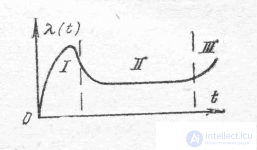
Fig. 2. Change in failure intensity λ(t) over time.
The initial section I reflects the run-in (break-in) process, during which elements with hidden manufacturing defects fail, usually leading to sudden failures. The number of failures increases according to an exponential law. Section II reflects the normal operation of all elements of the product, and the failure intensity remains approximately constant. The duration of this section is determined by the technical level of production, i.e., the quality of manufacture of the products. In section III (the wear section), the number of failures increases due to a gradual increase of parameters above the maximum permissible values. This indicator is often used to assess reliability, since it enters as a factor into other, more general characteristics of systems, for example efficiency, cost, etc.
When calculating the failure intensity, the relationship between λ(t), a(t) and P(t) is determined by the formula λ(t) = a(t)/P(t).
The failure intensity is expressed in units of time 1/h = h-1, multiplied by the corresponding coefficient (10-3, 10-6, ...), and varies within wide limits for different types of elements; it is given in reference tables and has approximately the following values: for a high-power vacuum triode, 20 10-6, for a germanium transistor, 0,9 10-6, for a silicon transistor, 0,5 10-6, for an electric motor, 30 10-6, for a battery, 7,2 10-6, for an integrated circuit, 0,8 10-8 h-1, etc. If all elements of a given type are equally reliable, the failure intensity of the product will be equal to:
n
λ(t) = Σ N i λi
i=1
where N — is the number of elements of the i-th type; r — is the number of types of elements
The mean time to failure Tcp is estimated by the mathematical expectation of the operating time of the product until the first failure. It is equal to the average operating time of a single product up to the moment of damage
i =N0
Tcp = (Σti)/N0
i =1
The quantitative assessment of the reliability of periodic-action products is carried out not only by means of the indicators given above, but also such as the mean time between successive failures tcp, the mean recovery time during operation τ, the availability factor Kr and others.
The mean time between successive failures tcp is the average total operating time of one of the products (i-ro product);
i = n
tcp = (Σti)/n
i = 1
The calculation of quantitative reliability indicators is often carried out using formulas (laws) for the distribution of failure-free operating time, proposed by individual authors. Probably the most universal is the exponential law, which relates the probability of failure-free operation to the failure intensity:
P(t) = exp (- ∫ λ(t)dt) ≈ e- λt
Ensuring reliable operation of technical equipment in medical and biological organizations
The introduction of modern medical technologies into widespread practice has made it possible to achieve significant progress in public health protection and has contributed to a significant reduction in morbidity and mortality rates. Unfortunately, the increasing complexity of hardware and the tightening of operational requirements for the technical and medical personnel servicing it, amid the widespread introduction of instrumental examination and treatment methods into practice, has also had its unpleasant consequences. Currently, in the USA, about 10,000 patients of medical institutions become victims of one kind of injury or another each year. For the most part, such cases are the result of improper operation of medical equipment, which in turn is related to insufficient training of medical personnel and lack of experience working with the equipment used. Often, until serious problems arise, medical personnel do not bother to familiarize themselves with the instructions and operating manuals for medical equipment. Moreover, any equipment ages over time and becomes unreliable. It is clear that healthcare sets engineers the task of developing failure-free and safe models of medical equipment.
The problem of ensuring the design and operational safety of medical equipment involves an extremely wide range of tasks, since it covers the broadest spectrum of medical manipulations and procedures associated with the use of the most diverse sources of energy. At the same time, according to the well-known principle «what will be, will be», some abnormal situation is bound to occur. The use of modern medical techniques confronts the patient with a significantly greater number of potential threats and dangers compared to the unpleasant surprises that await him at home or in the workplace. This is caused by two reasons'. first, medical manipulations are often accompanied by a breach of the integrity of the mucous membranes and skin, and second, their performance involves the use of a large number of potentially hazardous substances and energy sources, which, if safety procedures are not followed, can have a damaging effect on the patient and medical personnel. Thus, the patient is beset by a multitude of potential hazards. Their sources can include fire, an aggressive air environment, a short circuit (SC) to ground, fluid leaks, chemical substances, medications, microorganisms, insects, medical waste, sound, electric power, natural and man-made disasters, the living environment, falls, and bodily injuries.
The problem of creating a modern electronic instrument or system for medical research is multifaceted in nature and has several aspects, each of which can substantially affect the technical characteristics and design solutions applied by the developer. These aspects are related to the biological justification of the method (for example, the influence of the measuring transducer on the physiological processes being studied, the presence of specific errors, etc.), the methodology of its application (for example, preparation of the subject for the experiment, the conditions under which the experiment must be conducted), the methods of its technical implementation (for example, contact or non-contact information pickup, the presence of galvanic isolation, accounting for the mutual influence of measuring transducers, etc.), the methods of mathematical processing of biosignals (for example, analysis of signal shape, statistical processing of results, calculation of complex indicators, etc.), and engineering techniques that determine the structural and ergonomic design of the instrument (or system).
The wide range of tasks solved with the help of physiological equipment of these two classes does not allow developers to use universal solutions. At the same time, the circuit-design synthesis of individual electronic units can be carried out on a unified component base using general design principles. The design questions for the units that interact with the biological object under study can be considered more fundamental. For the selected class of medical equipment, these are electrodes and electrode systems — for electrophysiological equipment — and optical-electrical measuring transducers — for photometric devices.
Any medical instrument or apparatus, technical system or complex must be designed taking into account the medical task for which it is being developed. To do this, they must be considered as elements of a certain more complex technical system «patient-instrument-physician». When designing it, it is necessary to take into account the presence of two biological objects that are in a certain interaction, on the correct organization of which, ultimately, the solution of the medical task at hand depends. This circumstance forces us to look for more general approaches to the design of technical equipment intended for use in these systems. The theory of the synthesis of biotechnical systems (BTS) serves as such an approach; its main provisions were formulated by academician V.M. Akhutin in 1975. Over the period that has passed, this theory has developed into an independent field of scientific research and has its own followers, among whom the authors of this book count themselves. The bionic approach makes it possible to extend to the design method of medical electronic equipment two basic principles of synthesis of systems of this class — the principle of adequacy and the principle of identification of the information environment.
+In accordance with the first principle, it is necessary to ensure such a coupling of the instrument's elements (for the selected classes of equipment, primarily electrodes and optical-electrical measuring transducers) with the living organism that they would not distort the vital indicators being studied. The principle of identification of the information environment in the design of diagnostic systems puts forward requirements for minimizing the number of diagnostic features describing the patient's condition, on the one hand, while, on the other hand, the conceptual model of the patient's condition, formed on the basis of instrument readings, must be sufficient for making decisions when carrying out therapeutic measures. Moreover, the presentation of diagnostic information to the person forming the diagnostic conclusions must take into account the peculiarities of visual perception and the ways in which a person forms conceptual conclusions.

Comments