
Lecture
Clinical psychology is an important field studying various aspects of mental health, mental disorders and their treatment. Understanding and applying the principles of clinical psychology is crucial for specialists working in the fields of psychology and psychotherapy.
In this article we offer you the opportunity to test your knowledge and deepen your understanding of clinical psychology with tests and answers. The tests are a set of questions covering various aspects of clinical psychology, including diagnosis, treatment and theoretical approaches.
The purpose of these tests is not only to check your knowledge, but also to help you refresh your knowledge and broaden your understanding of important concepts in clinical psychology. Each test is accompanied by detailed answers and explanations so that you can better understand the correct answers and the concepts related to them.
Of course, these tests do not replace a full education and work experience in clinical psychology. They offer you an opportunity for self-testing and self-study, and can also serve as an auxiliary tool for exam preparation or professional development.
Are you ready to take this exciting and educational journey through the tests on clinical psychology? Let's begin and deepen our knowledge in this fascinating and important field!
Notation:
1. Which of the following features is a characteristic of oligophrenia:
2. Progressive dementia is:
3. Types of dementia include:
4. Pathologically increased nervous sensitivity is:
5. Which type of character accentuation is characterized by the following features: egocentrism, craving for attention, vivid display of emotions, tendency to suicide, flight into illness:
6. At what age is early childhood autism (RDA) diagnosed:
7. The clinical classification of types of mental development disorders was proposed by:
8. In what year was the clinical classification of developmental delay (ZPR) first proposed:
9. The most severe form of intellectual disability is:
10. Name the most complex form of developmental delay (ZPR):
11. Signs of psychopathy include:
12. At what age does neuropathy manifest:
13. An intelligence quotient of 20% and below is characteristic of the following type of intellectual disability:
14. Damage to the motor systems of the brain is:
Read the following statements and definitions carefully, insert the necessary word or continue the phrase.
15. Psychopathy is a………… disorder of character.
16. Dysgraphia is a disorder of ……………., in which substitutions of letters, omissions and transpositions of letters and syllables are observed.
17. List 3 types of neurosis.

18. Persistent hearing loss causing impaired speech perception is called ……….
19. Which type of neurosis is characterized by the following symptoms: characteristic attention-seeking, inflated desires and inability to realize them, sexual dysfunction - …………….
1. Compensation is:
2. A special anomaly of mental development in which there is a persistent and peculiar disturbance of communicative behavior and emotional contact with the surrounding world is called:
3. The types of deprivation do NOT include:
4. A mental state that arises as a result of psychological trauma, experiences and stress is:
5. Which type of character accentuation is characterized by the following features: a tendency toward a low, sullen mood, toward sexual perversions, viscosity, inertness of thinking, greed.
6. At what age is hearing impairment diagnosed:
7. The theory of psychocompensation was first proposed by:
8. In what year was the clinical syndrome of early childhood autism (RDA) first described:
9. The author of the classification of character pathologies caused by emotional disorders is:
10. The difference between intellectual disability and developmental delay (ZPR) is:
11. By what age does neuropathy smooth out under favorable conditions:
12. An intelligence quotient within 60% is characteristic of the following type of intellectual disability:
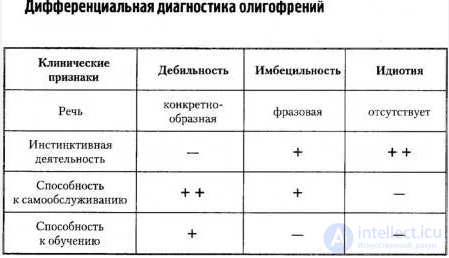
Read the following statements and definitions carefully, insert the necessary word or continue the phrase.
13. Intellectual disability is a total organic ……… lesion of the brain, an obligatory sign of which is underdevelopment of thinking.
14. Dyslexia is a disorder of ………….., arising from damage to various regions of the cerebral cortex.

15. Name 4 types of developmental delay (ZPR).
16. Name 2 main causes of psychopathy.
17. The most severe degree of hearing loss, in which intelligible perception of speech becomes impossible, is called …………….
18. Which type of neurosis is characterized by the following symptoms: increased fatigability, asthenic syndrome, difficulty concentrating, irritability, general lack of endurance - ………….
19. Loss of motor function with absence of muscle strength is ……………
Correct answer options
|
|
|
|
||
|
|
|
|
|
|
|
|
|
|
|
|
|
|
|
|
|
|
|
|
|
|
|
|
|
|
|
|
|
|
|
|
|
|
|
|
|
|
|
|
|
|
|
|
|
|
|
|
|
|
|
|
|
|
|
|
|
|
|
|
|
|
|
|
|
|
|
|
|
|
|
|
|
|
|
|
|
|
|
|
|
|
|
|
|
|
|
|
|
|
|
|
|
|
|
|
|
|
|
|
|
|
|
|
|
|
|
|
|
|
|
|
|
|
|
|
|
|
|
|
|
|
|
|
|
|
Criteria for evaluating test results in the course "Clinical Psychology"
|
|
|
|
|
|
|
|
|
|
|
|
|
|
|
|
|
|
|
|
^ Criteria for evaluating test results in the course "Clinical Psychology"
|
|
|
|
|
|
|
|
|
|
|
|
|
|
|
|
|
|
|
|

Comments