
Lecture
Psychodiagnostics tests with answers.
Welcome to the psychodiagnostics test! Psychodiagnostics is an important tool in psychology that helps to assess and measure various aspects of the human psyche, including personality traits, intellectual abilities, emotional state, and much more. By taking this test, you will be able to assess your knowledge and understanding of psychodiagnostics and expand your knowledge in this field.
Benefits of taking the test: Taking the psychodiagnostics test offers you several benefits:
Knowledge assessment: The test will help you evaluate your level of knowledge and understanding of psychodiagnostic methods and theories. It will help you identify the areas in which you have gaps and which deserve particular attention in your further preparation.
Expanding your knowledge: The test will give you an opportunity to learn new facts, concepts, and methods in the field of psychodiagnostics. You will be able to refresh your knowledge and broaden your horizons in this interesting field.
Self-assessment: The test results will allow you to assess your level of preparation and understanding of psychodiagnostics. This will help you better understand your strengths and weaknesses and take steps toward further improvement.
Preparing for the test: To prepare for the psychodiagnostics test, it is recommended to:
Study the basic concepts and methods: Become familiar with the basic notions, theories, and methods of psychodiagnostics. Study the various approaches and instruments used in assessing psychological characteristics.
Read specialized literature: Turn to textbooks, scientific articles, and other sources devoted to psychodiagnostics. Reading specialized literature will help you deepen your knowledge and understanding of this field.
Solve practical tasks: Work through practical tasks and cases related to psychodiagnostics. This will help you apply your knowledge in practice and develop skills in analyzing and evaluating psychological data.
How to answer the test questions: When answering the questions of the psychodiagnostics test, it is recommended to:
Read the questions carefully: Read each question attentively and pay attention to key words and phrases. This will help you grasp the essence of the question and choose the correct answer.
Analyze the answer options: Carefully analyze the proposed answer options. Compare them with one another and choose the one that best matches your knowledge and understanding of psychodiagnostics.
Be attentive to details: Pay attention to small details in the questions, which may contain key information or a hint to the correct answer. This will help you make a more well-founded choice.
Think over your answers: Before choosing a final answer, consider each answer option and analyze its logic and its relevance to the question. Avoid haste and make well-grounded decisions.
Enjoy the process of taking the test and use it as an opportunity to improve your knowledge and skills in psychodiagnostics. Good luck!
Option 1 – a task with several correct answers.
Options 2 and 3 – a task with a single answer
1. Modern psychological diagnostics is defined as:
2. The results of psychodiagnostic work in education are used for:
3. The sources of psychodiagnostics are:
4. The founder of the scientific study of individual differences, who created an instrument for measuring them – the test – is:
5. The (operational) classification of diagnostic methods involves division into the following groups:
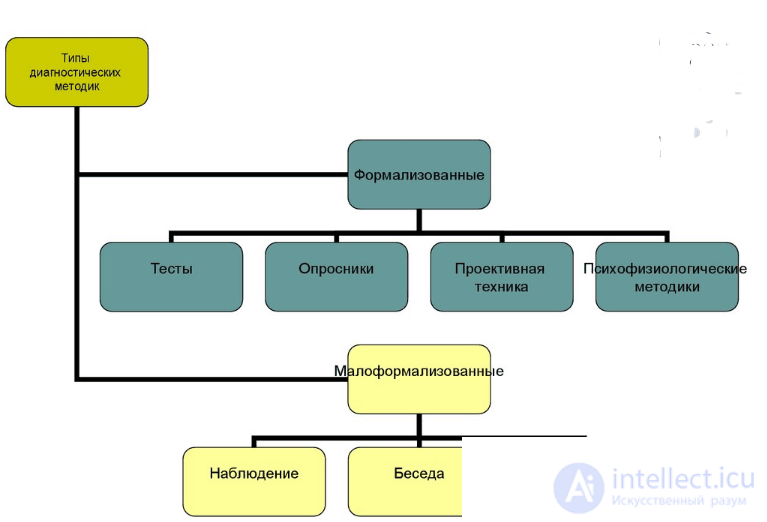
6. The distinguishing feature of tests, as opposed to questionnaires and projective methods, is:
7. The characteristic features of projective methods are:
8. Standardization of methods is:
9. Predictive validity involves:
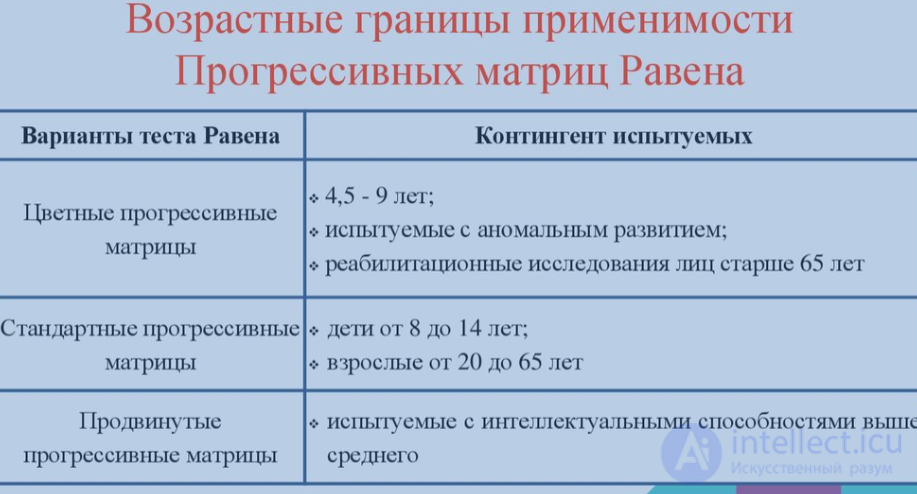
10. The group of culture-free intelligence tests includes:

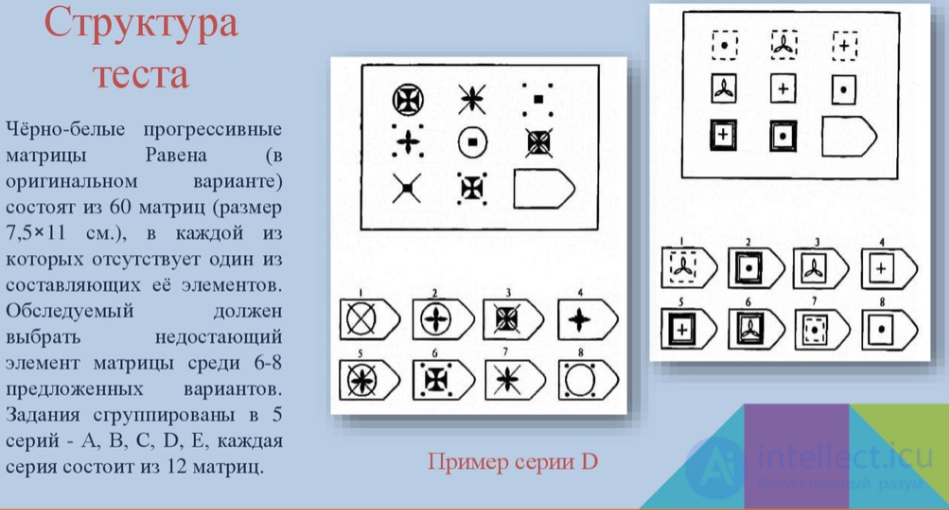
11. The group of proofreading-test methods includes the following tests:

12. The group of projective methods includes:
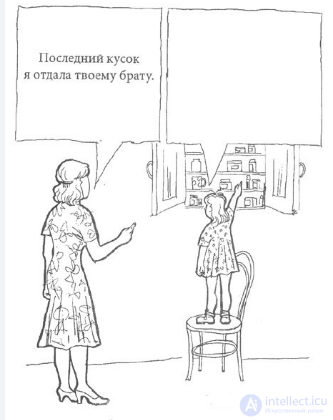
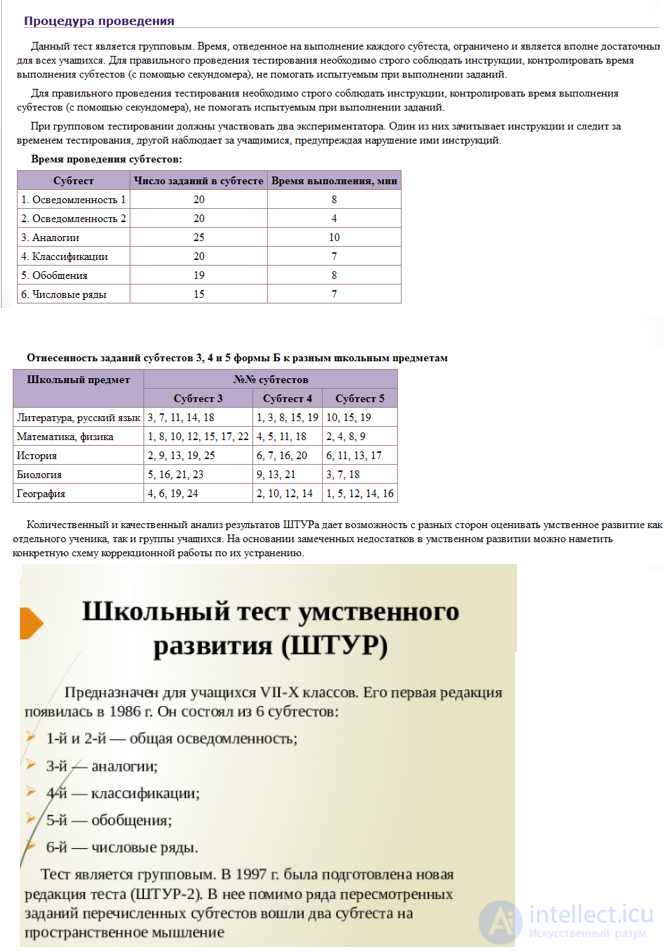
13. Koch's projective "Tree" technique belongs to the group of:
14. Verbal and nonverbal scales are contained in the test of:
15. The vegetative coefficient (energy supply) and the mood indicator (total deviation from the autogenic norm) are calculated in:
16. The author of the PDQ, the Pathocharacterological Diagnostic Questionnaire, is:
17. The Eysenck test questionnaire makes it possible to diagnose:
18. The levels of psychological diagnosis are:
19. A comprehensive psychological diagnosis contains:
20. The ethical principles of psychodiagnostics include:
1. What is the name of the field of psychological science that develops methods for identifying and measuring the individual psychological characteristics of a personality?

2. What is the name of the field of psychology concerned with the theory and practice of measuring mental phenomena?
3. What is the name of a time-fixed trial designed to establish quantitative (and qualitative) individual psychological differences?
4. What is the name of the method of systematic recording and quantification of content units in the material under study?
5. What are psychological diagnostic methods designed to reveal the mental potential of an individual called?
6. What are psychological diagnostic methods that reveal the degree to which the test taker has mastered specific knowledge, abilities, and skills called?

7. Which type of method involves the use of indefinite, ambiguous (weakly structured) stimuli that the test taker must construct, develop, complete, or interpret?
8. What is the name of the method of therapeutic conversation used in providing psychological help?
9. What is the name of the group of projective methods that involves drawing on a free or a given topic?
10. What is the name of the type of test designed to determine the level of individual achievement relative to some criterion on the basis of a logical-functional analysis of the content of the tasks?
11. What is the name of the characteristic of a method that reflects the accuracy of psychodiagnostic measurements as well as the resistance of test results to the influence of extraneous random factors?
12. What is the name of the comprehensive characteristic of a method (test) that includes information about the range of phenomena under study and the representativeness of the diagnostic procedure with respect to them?
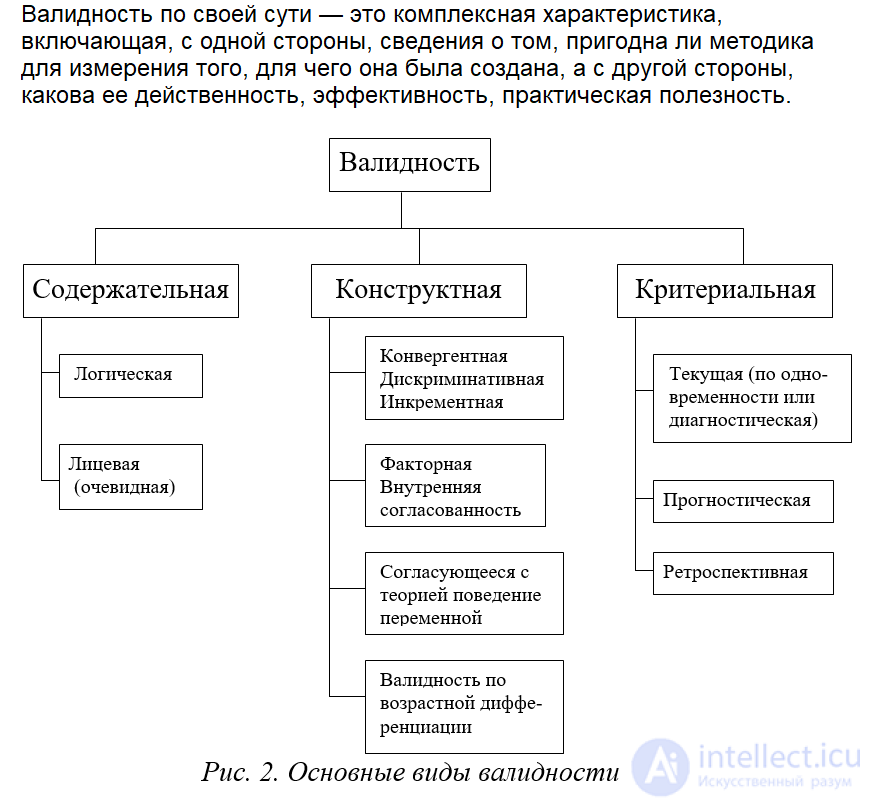
13. What is the name of the property of a sample to represent the characteristics of the population?
14. What is the name of the characteristic of the reliability of a psychodiagnostic method obtained by retesting the test takers with the same test?
15. What is the name of one of the main types of validity of a method, which characterizes the degree to which the content of the test items is representative of the measured domain of mental properties?
16. What is the name of the information about the degree of accuracy and soundness with which a method (test) makes it possible to judge the diagnosed psychological quality some time after the measurement?
17. Name the psychologist who created the world's first psychological laboratory of experimental psychology in 1879:
18. Name the psychologist who proposed the concept of the intelligence quotient (IQ):
19. Name the author who developed the two-factor theory of intelligence and the technique of factor analysis:
20. Name the interpretation of the g-factor proposed by H. Eysenck:
21. Name the researcher who proposed the "structure of intellect (SI)" model, which distinguished divergent and convergent thinking:
22. Name the author who created the concept of mental experience:
23. Which group of diagnostic methods does the Binet–Simon scale belong to?
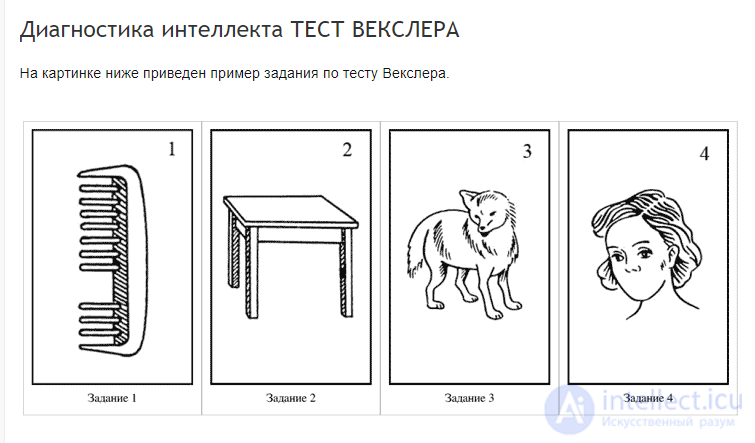
24. Which of the intelligence tests listed below contains verbal and nonverbal scales:
25. Name the author of the 16 PF personality questionnaire:
26. Name the author who developed the Pathocharacterological Diagnostic Questionnaire (PDQ):
27. Which of the methods listed below belongs to the class of projective ones?
28. Which group of projective methods does the Thematic Apperception Test (TAT) belong to?
29. Which of the methods listed below is used to diagnose school readiness?
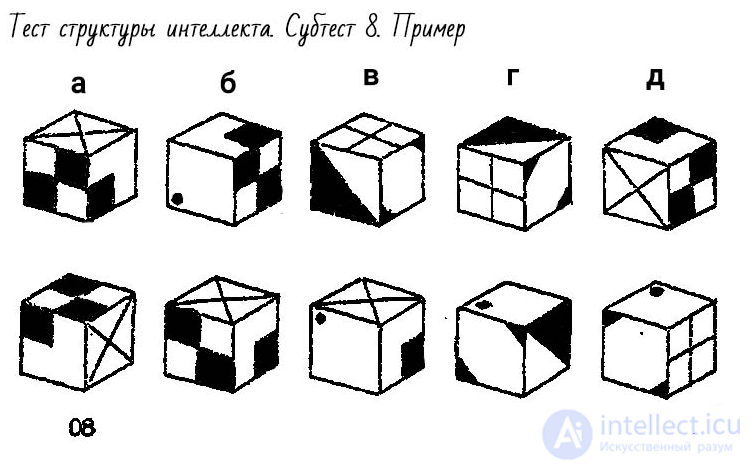
30. Name which personality properties can be diagnosed with the R. Amthauer test:
1. Psychodiagnostics is:
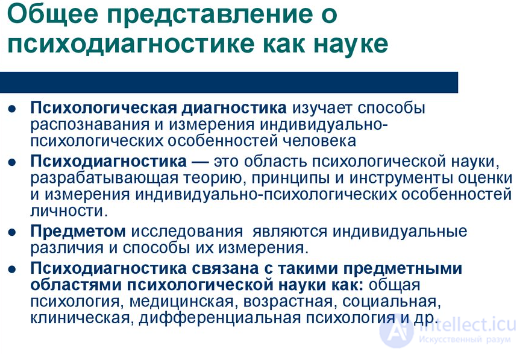
2. The ban on the use of tests in the USSR was connected with:
3. Psychodiagnostic practice includes everything except one:
4. Norms are:
5. A test is:
6. A limitation on the use of scaling methods is:
7. The semantic differential method is used for:

8. Data on a person's real behavior obtained through external observation are called:
9. The type of results recorded with questionnaires and other self-assessment methods is called:
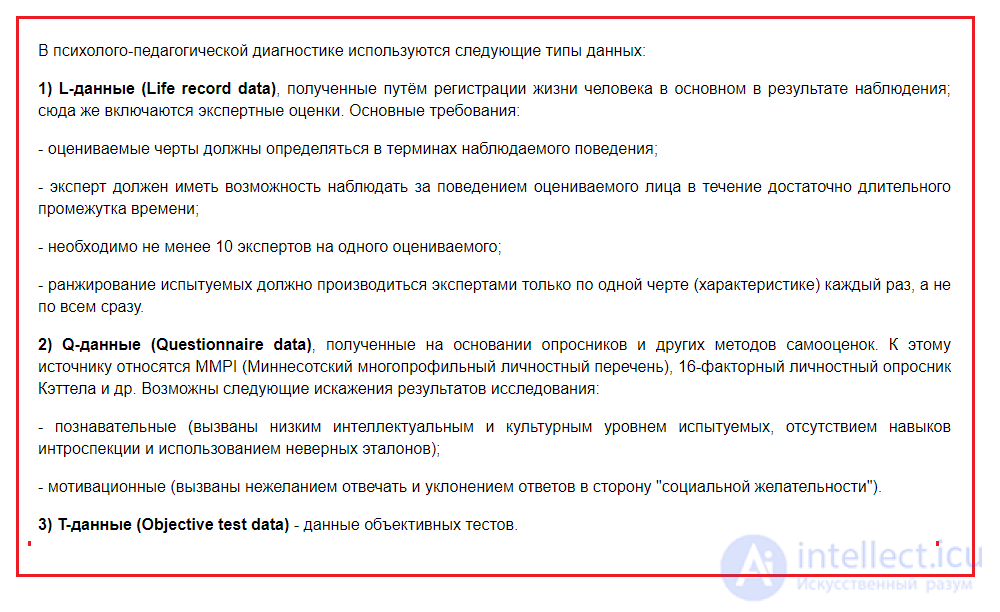
10. An assignment of numbers to objects in which equal differences between numbers correspond to equal differences in the measured attribute or property of the object implies the presence of a scale of:
11. The ordinal scale corresponds to measurement at the level of:
12. Ranking objects by the degree to which a certain attribute is expressed is the essence of measurement at the level:
13. The scale that is used extremely rarely in psychology is the scale of:
14. In the most general form, measurement scales are represented by the scale of:
15. No arithmetic operations can be performed on the scale of:
16. Establishing the equality of ratios between individual values is permissible at the level of the scale of:
17. The method that is not a primary one for modern psychogenetic research is the:
18. The first experimental psychological laboratory was opened by:
19. The first pedological laboratory was created by:
20. The association experiment for studying unconscious affective formations was developed and proposed by:
21. The author of the natural experiment is:
22. According to D. Campbell, potentially controllable variables belong to the following variables of an experiment:
23. As a criterion of the reliability of results, the validity achieved in a real experiment in comparison with an ideal one is called:
24. The measure of correspondence of the experimental procedure to objective reality characterizes the following validity:
25. In a laboratory experiment, the following validity is violated to the greatest extent:
26. The concept of "ecological validity" is more often used as a synonym for the concept of the following validity:
27. The factor of the presence of any external observer in an experiment is called the effect of:
28. The influence of the experimenter on the results is most significant in studies of:
29. As a specially developed method, introspection was used most consistently in the psychological research of:
30. Psychological techniques constructed on educational material and designed to assess the level of mastery of academic knowledge and skills are known as tests of:
31. The assessment of a person's capacity to acquire knowledge, abilities, and skills of a general or specific nature is carried out by means of testing of:
32. Assessing the consistency of indicators obtained when the same test takers are retested with the same test or an equivalent form of it characterizes a test in terms of its:
33. The test quality criterion used to determine its correspondence to the domain of the mental phenomena being measured is the following validity of the test:
34. The test quality criterion used in measuring a complex mental phenomenon with a hierarchical structure, which for this reason cannot be measured in a single act of testing, is known as:
35. The data of personality questionnaires should not be affected by:
36. The most frequently occurring value in a data set is called the:
37. If psychological data are obtained on an interval scale or a ratio scale, then to reveal the nature of the relationship between attributes the following correlation coefficient is used:
38. Tabulation, presentation and description of the set of results of a psychological study is carried out:
39. The widest range of application of mathematical methods in psychology is allowed by quantification of indicators on the scale of:
40. Variance is an indicator of:
41. Multivariate statistical methods do not include:
42. A visual assessment of similarity and difference between objects described by a large number of diverse variables is provided by:
43. A set of analytical and statistical procedures for identifying hidden variables (features), as well as the internal structure of the relationships between these features, is called:
44. What is the name of the part of the interview in which the client's life history is clarified:
45. In which type of interview does the psychologist use pre-formulated questions:
46. Which of the listed approaches is best for understanding the client's condition:
47. Which item correctly describes the purpose of using psychological testing:
48. Which type of question is NOT included in a diagnostic interview:
49. For what purpose, when it is possible, may the client be involved in choosing a test:
50. Who proposed the study of memory by the pictogram method:
51. Which item lists the methods that are best at revealing the versatility of thinking:
52. The Dembo-Rubinstein method is:
53. The target settings of the Bourdon test and Raven's matrices relate to each other as:
54. Which of the following statements does NOT reflect the basic rules for evaluating an MMPI profile:
55. Which statement more correctly defines what self-report tests are:
56. All of the following tests are varieties of standardized self-report except one:
57. The work of which two researchers stood at the origins of the testing method:
58. The so-called Eysenck circle is built on the following axes (choose the correct one):
59. The first-order and second-order factors identified by R. Cattell's questionnaire relate to each other as:
60. Which statement describes the meaning of index B in A.E. Lichko's Pathocharacterological Diagnostic Questionnaire (PDQ):
61. Which statement correctly describes the purpose of S. Rosenzweig's test:
62. Which of the four named factors is NOT among the main factors identified by the semantic differential method and assessed by C. Osgood as the "affective components of meanings":
63. Which of the following statements correctly describes the causes of possible distortions of results when using the semantic differential technique:
64. What was the original purpose of T. Leary's questionnaire:
65. The Sacks-Levy sentence completion method belongs to the group of:
66. The Rosenzweig frustration test belongs to one of the named groups:
67. In the structure of a psychological study, the semantic differential technique can be used:
68. Which of the following statements correctly describes the differences between the "draw-a-person" test as modified by K. Machover and the original test by F. Goodenough:
69. In which of the following areas is K. Koch's "Tree Test" usually used:
70. Which of the tasks is NOT included in the set of tasks of the Kern-Jirasek school readiness test:
71. For what purpose was F. Goodenough's "Draw-a-Person" test created:
72. Which of the colors in the Luscher test is NOT one of the basic ones:
73. Which of the following types of scales is used in the semantic differential technique:
74. Aptitude tests show:
75. The Rorschach test, Machover's "Draw-a-Person", the locus of control questionnaire, the TAT and the MMPI are intended FOR studying:
76. When a client first comes in, the task arises of studying the reasons for the visit and the factors related to his condition. By what method should this be done:
77. The phenomena and processes are listed below; the study of which of them is carried out with the help of the TAT:
78. Projective tests are most often associated with approaches focused on one of the following:
79. Which of the following terms denotes tests in which the subject is presented with ambiguous stimuli and asked to respond in the way that seems important to him:
80. Which of the following makes it possible to check whether the subject is lying while completing the MMPI tasks:
81. Which of the following tests contains three validity scales and ten clinical scales:
82. Which psychological tests provide information about cognitive abilities and deficiencies:
83. Which of the following researchers developed the 16-factor personality questionnaire:
84. Which of the following tests involves the formation of responses through the mechanisms of fantasy and projection:
85. Which of the tests makes it possible to compare verbal and nonverbal abilities:
86. Which of the following tests is NOT projective:
87. The Spielberger-Hanin questionnaire makes it possible to:
88. Which of the following tests is NOT intended FOR assessing intellectual abilities:
89. It is known that representatives of some cultures may achieve worse results on intelligence tests than representatives of others. It follows that intelligence tests are:
90. Which of the following factors can lead to lower scores on the Wechsler test:
91. The Stanford-Binet scale is used to assess intelligence in subjects of which age:
92. In the adult and children's versions of the Wechsler test, the results on which subtest are the most culturally dependent:
93. The assessment of the intelligence quotient is based on a comparison of:
94. The level of intelligence is considered average if the results obtained lie:
95. Which of the following traits is not specific to creative thinking:
96. In the modern definition of intelligence, it is considered that it:
97. Finding original solutions is determined by:
98. Internal (internal locus of) control indicates:
99. Which of the following characteristics belongs to cognitive styles:
100. The diagnosis of interests includes all of the following components except:
101. One of the psychodiagnostic methods that makes it possible to determine the degree to which the subject has mastered specific knowledge, skills and abilities:
the correct answer is a
102. A psychodiagnostic method that makes it possible to identify an individual's mental potential:
the correct answer is b
103. A set of psychodiagnostic methods that studies and makes it possible to assess creative abilities:
the correct answer is d
104. A psychodiagnostic method that makes it possible to measure various aspects of an individual's personality:
the correct answer is c
105. With the name of which Russian scientist is the doctrine of behaviorism associated:
comment - In the USSR, behaviorism, like other psychological movements, was regarded as a bourgeois perversion of psychology. This approach was criticized especially actively by A. N. Leontiev . His criticism included a critique of the biologizing tendency in behaviorism and of the fact that behaviorism denied the role, and indeed the very existence, of internal unobservable properties (such as goals, motives, meaning, prejudices and the like) in human behavior and activity. Another aspect of the criticism of behaviorism by cultural-activity psychology, close to the criticism from the neo-Freudianism that gravitated toward Marx's theory, was the problem of causality. Like E. Fromm, A. R. Luria, G. M. Andreeva and A. N. Leontiev pointed out that behaviorism does not seek to uncover the root causes of psychological defects, and therefore comes down to maximal correction without a fundamental change in the conditions in which pathologies arise . Behaviorism turned out to be the most "loyalist" school of psychology, since per tacitum consensum it recognized the living conditions in capitalist society as justified. Behaviorists did not publish openly apologetic texts, but they tacitly accepted the conditions in which they worked and did not try to uncover the causes of "socially determined inferiority" (E. Fromm). This sharply distinguished behaviorism from Freudianism, with the result that the clinic of cognitivism turned out to be more effective than Freudianism in the short term. In the medium term, however, the behaviorists played the same role as the "empiricists" in sociology. The slogan "make things better without changing anything" had a negative effect on the prestige of psychology, and in the long term served to legitimize the capitalist world as socially dangerous. In various years Skinner spoke out as an open apologist of capitalism, which gave Western psychology an even greater ideological coloring than that of the cultural-activity school . At the same time, close to behaviorism were reflexology (objective psychology) of V. M. Bekhterev, which arose in Russia in the 1910s-1920s, the physiological theory of conditioned reflexes in the behavior of animals and humans of I. P. Pavlov, the pedological concept of the activity of behavior and activity of the personality of A. F. Lazursky and M. Ya. Basov and the objective psychology of P. P. Blonsky.
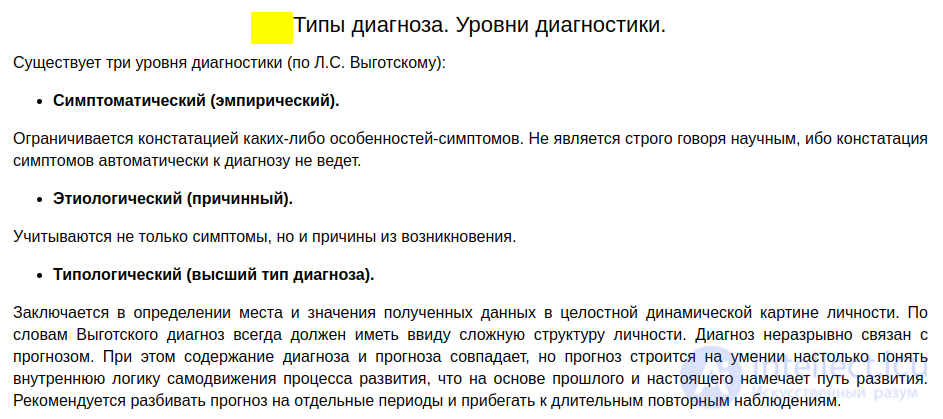
106. Which type of diagnosis (according to Vygotsky's classification) does not exist
Correct answers for Variant No. 1
|
|
|
|
|
|
|
|
|
|
|
|
|
|
|
|
|
|
|
|
|
|
|
|
|
|
|
|
|
|
|
|
|
|
|
|
|
|
|
|
|
|
|
|
|
|
|
|
|
|
|
|
|
|
|
|
|
|
|
|
|
|
|
|
|
|
|
|
|
|
|
|
|
|
|
|
|
Correct answers for Variant No. 2
|
|
|
|
|
|
|
|
|
|
|
16 |
|
|
|
|
|
|
17 |
|
|
|
|
|
|
18 |
|
|
|
|
|
|
19 |
|
|
|
|
|
|
20 |
|
|
|
|
|
|
21 |
|
|
|
|
|
|
22 |
|
|
|
|
|
|
23 |
|
|
|
|
|
|
24 |
|
|
|
|
|
|
25 |
|
|
|
|
|
|
26 |
|
|
|
|
|
|
27 |
|
|
|
|
|
|
28 |
|
|
|
|
|
|
29 |
|
|
|
|
|
|
30 |
|
|
Correct answers for Variant No. 3
|
|
|
|
|
|
|
|
|
|
|
|
|
|
|
|
|
|
|
|
|
|
|
|
|
|
|
|
|
|
|
|
|
|
|
|
|
|
|
|
|
|
|
|
|
|
|
|
|
|
|
|
|
|
|
|
|
|
|
|
|
|
|
|
|
|
|
|
|
|
|
|
|
|
|
|
|
|
|
|
|
|
|
|
|
|
|
|
|
|
|
|
|
|
|
|
|
|
|
|
|
|
|
|
|
|
|
|
|
|
|
|
|
|
|
|
|
|
|
|
|
|
|
|
|
|
|
|
|
|
|
|
|
|
|
|
|
|
|
|
|
|
|
|
|
|
|
|
|
|
|
|
|
|
|
|
|
|
|
|
|
|
|
|
|
|
|
|
|
|
|
|
|
|
|
|
|
|
|
|
|
|
|
|
|
|
|
|
|
|
|
|
|
|
|
|
|
|
|
|
|
|
|
|
|
|
|
|
|
|
|
|
|
|
|
|
|
|
|
|
|
|
|
|
|
|
|
|
|
|
|
|
|
|
|
|
|
|
|
|
|
|
|
|
|
|
|
|
|
|
|
|
|
|
|
|
|
|
|
|
|
|
|
|
|
|
|
|
|
|
|
|
|
|
|
|
|
|
|
|
|
|
|
|
|
|
|
|
|
|
|
|
|
|
|
|
|
|
|
|
|
|
|
|
|
|
|
|
|
|
|
|
|
|
|
|
|
|
|
|
|
|
|
|
|
|
|
|
|
|
|
|
|
|
|
|
|
|
|
|
|
|
|
|
|
|
|
|
|
|
Grading criteria for the results of testing in the psychodiagnostics course
|
|
|
|
|
|
|
|
|
|
|
|
|
|
|
|
|
|
|
|

Comments