tests with answers on the topic Psychological Service of Education
single-choice assignment
1. The psychological service of education is an integral phenomenon representing the unity of all of the following aspects except:
- A) the scientific
- B) the applied
- C) the methodological
- D) the practical
- E) the organizational
2. The first attempts at the practical use of psychological knowledge in the instruction and upbringing of children in Russia were carried out:
- A) in the second half of the 19th century
- B) in the 1960s
- C) at the turn of the 19th–20th centuries
- D) in the 1920s
3. Choose the factor that is not a determining one in the emergence and development of the psychological service within a state's education system:
- A) the scientific psychological concepts currently existing in society
- B) the needs and objectives of public education
- C) the political and economic characteristics of the country
- D) the country's geopolitical position
4. The basic concept of the school psychological service in our country was developed by:
- A) L.S. Vygotsky
- B) R.V. Ovcharova
- C) V.V. Rubtsov
- D) I.V. Dubrovina
- E) L.M. Fridman
5. The main goal of the psychological service of education:
- A) creating psychological-pedagogical conditions for optimizing schoolchildren's instruction
- B) ensuring the mental and psychological health of pupils and students of educational institutions
- C) maximizing the development of students' abilities
- D) providing timely support to the subjects of the educational environment and preventing deviations in their development

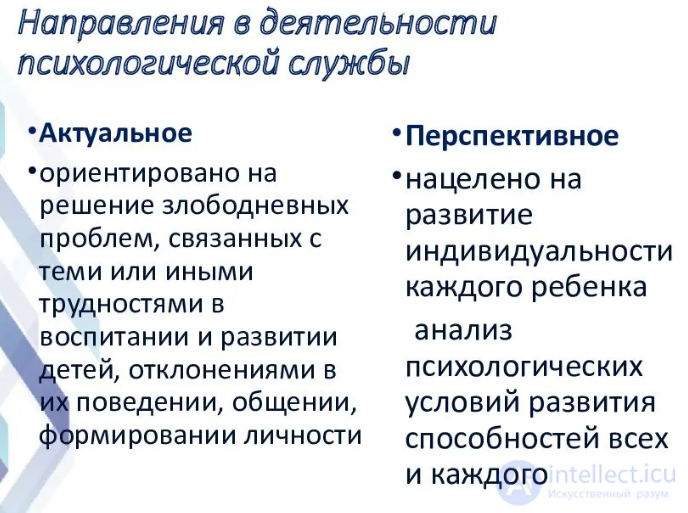
6. In the activity of the psychological service of education, the following areas are distinguished, except:
- A) the current (actual)
- B) the individual
- D) the prospective
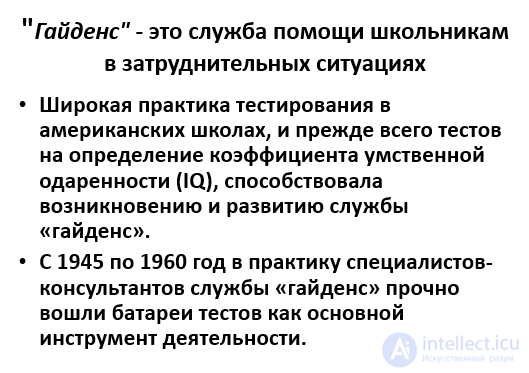
7. «Guidance» services operated in:
- A) England
- B) France
- C) the USA
- D) Russia
- E) the GDR
8. The scientific foundation of the concept of the psychological service of education consists of fundamental positions in psychology developed by:
- A) A.V. Zaporozhets
- B) S.L. Rubinstein
- C) J. Piaget
- D) D.B. Elkonin
9. The term «psychological support for development» first appeared in the work of the following domestic authors:
- A) Rubtsov V.V., Selyavina L.K., Malykh S.B.
- B) Bityanova M.R., Vasilyeva N.L.
- C) Bardier G., Romazan N., Cherednikova T.
10. The functional duties of an educational psychologist do not include:
- A) conducting psychoprophylactic and educational-outreach activities
- B) participating in the work of psychological-medical-pedagogical consultations
- C) organizing and conducting school cultural events
- D) individual and group corrective-developmental work
11. As a priority area of activity for an educational psychologist in a preschool educational institution, it is more advisable to choose:
- A) corrective-developmental work
- B) psychodiagnostic activity
- C) psychological counseling of parents and caregivers on issues of children's development
- D) psychoprophylaxis
12. The main purpose of determining psychological readiness for schooling is:
- A) preventing school maladjustment
- B) distributing first-graders among classes according to their abilities
- C) «screening out» children not ready to master the school curriculum, in order to preserve their psychological health
13. School maladjustment is:
- A) the establishment of conflictual relations between a child and peers and adults
- B) deviations in learning activity due to various neuro-psychic disorders observed in the child
- C) the formation of inadequate mechanisms of a child's adaptation to school in the form of disruptions in learning and behavior
14. The central, primary area of a psychologist's work with students in grades 9-11 is:
- A) teaching students social-psychological skills
- B) helping to determine life plans, clarify the future time perspective, and choose a profession
- C) preventing addictive states, forming a critical attitude toward social hazards
15. The content of an educational psychologist's corrective work is not associated with difficulties such as:
- A) low cognitive and learning motivation, underachievement
- B) a discrepancy between the level of mental development and the age norm, caused by organic disorders
- C) disorganized behavior, low level of voluntary self-regulation
- D) negative tendencies in personal development, communication problems
16. The primary level of psychoprophylaxis includes:
- A) the school psychologist's work with children who have minor emotional, behavioral, and learning disorders; concern for the mental health and psychological resources of practically all children
- B) the school psychologist's work with «at-risk» children; early detection of children's difficulties in learning and behavior
- C) the educational psychologist's concentration on children with pronounced learning or behavioral problems
17. Psychodiagnostics in educational institutions is not carried out for the purpose of:
- A) establishing certain regularities of children's mental development
- B) choosing the most appropriate pedagogical influence
- C) creating optimal psychological-pedagogical conditions for students' development
- D) implementing an individual approach
18. The concept of «parent education» implies:
- A) the accumulation of knowledge and skills for performing parental functions and raising children
- B) raising parents' psychological competence in matters of marital relations
- C) helping parents free themselves from complexes
- D) family psychotherapy
19. Less than all other types of teachers, the following need reconstruction of their psychological portraits:
- A) teacher-leaders
- B) teacher-hedonists
- C) teacher-realists
- D) teachers of a creative disposition
20. Choose the optimal model of interpersonal relations between an educational institution's psychologist and teachers
- A) «the director's therapist»
- B) «a specialist unto oneself»
- C) «one of us»
- D) «the academic»
Correct answer options
|
Question No.
|
Answer
|
points
|
Question No.
|
Answer
|
points
|
|
1
|
C
|
1
|
11
|
A
|
1
|
|
2
|
C
|
1
|
12
|
a
|
1
|
|
3
|
D
|
1
|
13
|
C
|
1
|
|
4
|
D
|
1
|
14
|
B
|
1
|
|
5
|
B
|
1
|
15
|
B
|
1
|
|
6
|
B
|
1
|
16
|
A
|
1
|
|
7
|
C
|
1
|
17
|
A
|
1
|
|
8
|
C
|
1
|
18
|
A
|
1
|
|
9
|
B
|
1
|
19
|
D
|
1
|
|
10
|
C
|
1
|
20
|
C
|
1
|
Criteria for evaluating the results of testing in the course Psychological Service of Education
|
Number of points
|
Performance
(% of correct answers)
|
Grade
|
|
from 18 to 20
|
from 100 to 86 %
|
5
|
|
from 15 to 17
|
from 85 to 70 %
|
4
|
|
from 10 to 14
|
from 69 to 51 %
|
3
|
|
less than 10
|
less than 50 %
|
2
|
See also
- [[b7324]]
- [[b7347]]
- [[b8014]]
- [[b8015]]
- [[b8016]]
- [[b8017]]
- [[b8018]]
- [[b8019]]
- [[b8020]]
- [[b8021]]
- [[b8022]]
- [[b8023]]
- [[b8024]]
- [[b8025]]
- [[b8026]]
See also
- Psychological processes: Teaching, learning, learning, learning activities. addiction, imprinting, capturing, sensitization, associative learning, habit formation, play, memorization
- Tests with answers to educational psychology
- 100 Tests with Answers and Diagrams - Fundamentals of General Psychology
- Pedagogical psychology test questions with answers - developmental psychology with diagrams
- 60 Tests with Answers — Pedagogical Psychology, with Hints
- Tests with answers and diagrams on the topic — Social Psychology
- Tests with answers on the topic: Methodology and methods of psychological-pedagogical research
- History of Psychology Tests with Answers
- Test questions with answers on the history of developmental psychology
- Test questions with answers on child psychology
- 155 Psychodiagnostics Test Questions with Answers and Diagrams
- Tests with Answers on the Psychological Service in Education, in Diagrams
- Child Practical Psychology — Tests with Answers and Diagrams
- Tests with Answers and Diagrams on Work Psychology
- tests with answers and diagrams on the topic of Clinical Psychology


Comments