
Lecture
A lie detector is a technical device used to measure a person’s physiological reactions, such as pulse, breathing, blood pressure, and skin electrical resistance, in order to determine whether a person is telling the truth or lying while answering questions. It is based on the assumption that physiological changes occur when answers are based on disinformation.
However, it is important to note that the lie detector is not a fully reliable method and can produce false-positive and false-negative results. Many factors, such as stress, training, experience in deception, and individual differences, can affect the accuracy of such tests. Most countries and states do not recognize lie detector results as unambiguous evidence in court.
The lie detector is the informal name for the polygraph device, which simultaneously records a complex of physiological indicators (EDA, EEG, plethysmogram, and others) in order to reveal the dynamics of emotional tension. An interview is conducted with the person undergoing the polygraph examination, during which, alongside neutral ones, questions of special interest are asked. From the nature of the physiological reactions accompanying the answers to different questions, one can judge a person’s emotional reactivity and, to some extent, the degree of their sincerity in the given situation. Since in most cases a specially untrained person does not control their autonomic reactions, the lie detector, by some estimates, detects deception in up to 71% of cases.
It should be kept in mind, however, that the interview (interrogation) procedure itself can be so unpleasant for a person that the physiological shifts arising in the course of it will reflect the person’s emotional reaction to the procedure itself. It is impossible to distinguish emotions provoked by the testing procedure from emotions caused by the target questions. At the same time, a person with high emotional stability will be able to feel relatively calm in this situation, and their autonomic reactions will not provide firm grounds for reaching an unambiguous judgment. For this reason, results obtained with a lie detector must be treated with due caution (see Video).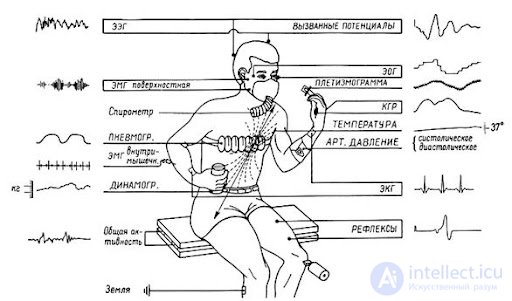
Multichannel recording of the most frequently studied types of human bioelectric activity (according to V. Block, 1970)
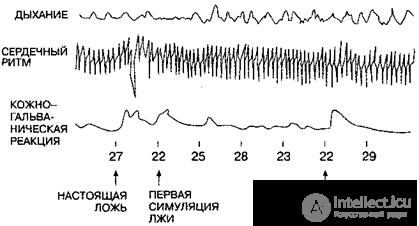
Fig. 1. Polygraph recordings of actual lying and simulated lying.
All muscles, including those that control the vocal cords, vibrate slightly during operation. If the speaker is under stress, this tremor, transmitted to the vocal cords, is suppressed by the activity of the speaker’s autonomic nervous system. When a recording of a person’s voice is played back through a device called a voice stress analyzer, a visual representation of their voice can be output onto chart paper. The trembling of the vocal cords in a person’s voice, when they are relaxed, resembles a series of waves (left part of Fig. 2). When the speaker is under stress, this trembling is suppressed (right part of Fig. 2).
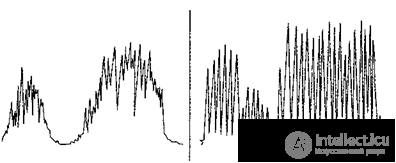
Fig. 2. The effect of stress on the voice pattern
It is applied, and quite strongly: you will be asked the same questions, sometimes slightly rephrased. If your reaction to a question is ambiguous, you will be asked the questions again and again, at different intervals, analyzing and comparing the results with each answer.
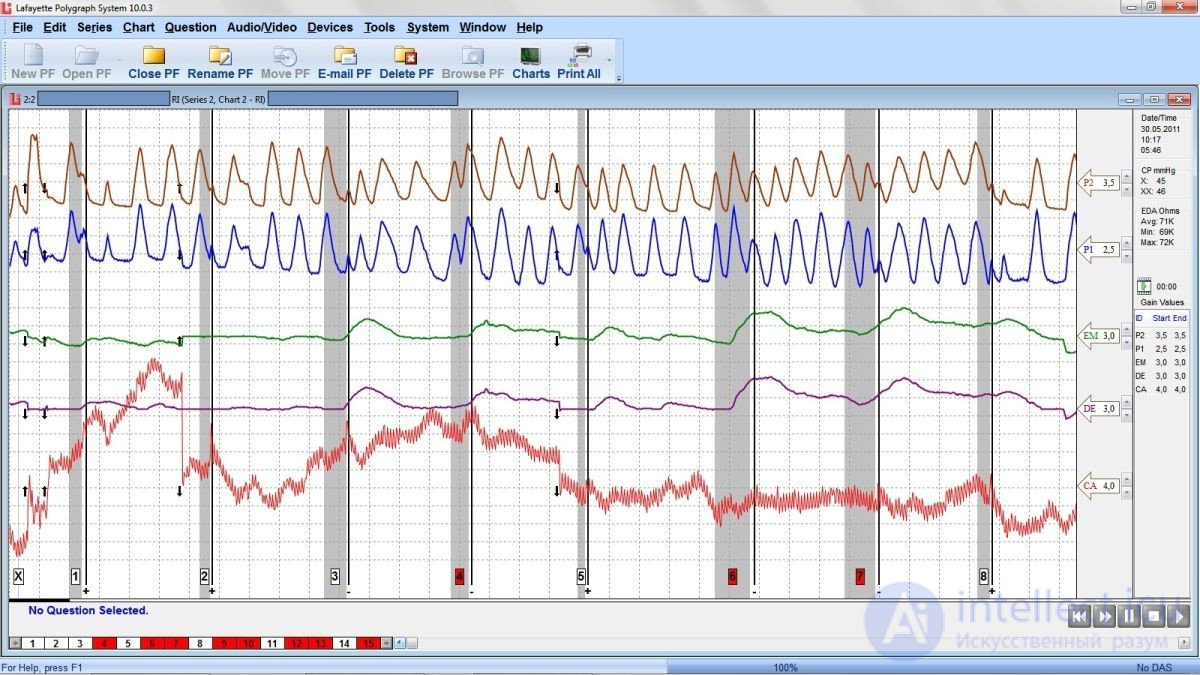
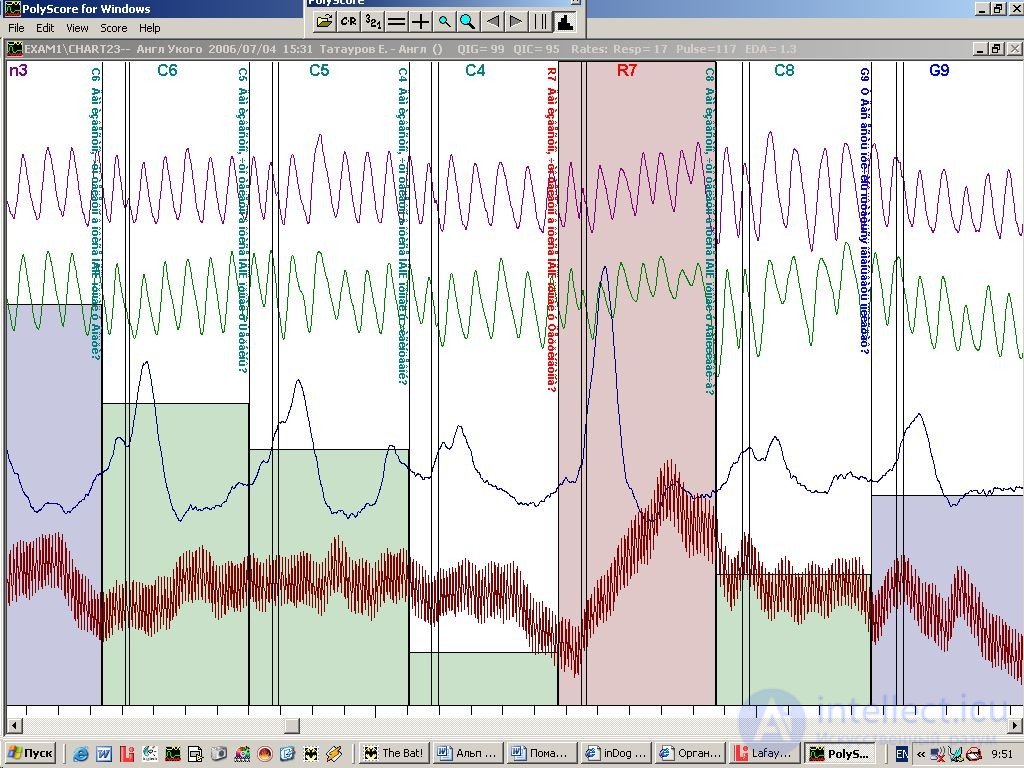
It is possible to deceive the lie detector and the polygraph. A little practice at inventing fictitious scenarios, followed by spontaneous lying, is enough for this. Scientific studies have shown that even when using the "Answer quickly, without thinking!" method, there is no absolute guarantee of the truthfulness of the answers. This is because physiological reactions to lying and to telling the truth can be similar, and experienced people can learn to control their reactions, fooling the test. Likewise, taking certain sedative or anxiolytic medications can distort test results and even allow deception.
The accuracy of the readings is 80% without training, but in fact the figure is at the level of 93-95%. That is, only 5-7 people out of a hundred are able to pass the polygraph in such a way that the result will be unclear (note the phrase «the result will be unclear»: that is, it will be ambiguous, and no unambiguous statement about the results can be made on its basis, but nevertheless some result will still be obtained).
In principle, the polygraph can be fooled, but this requires lengthy training. On short segments of 8-10 questions, from the fourth attempt, on the «numbers» test, it is possible to falsify the result. However, it is important to understand that those were 2-minute tests, and over a long stretch, without special preparation, it will be extremely difficult to control yourself: after all, you must control the body’s arousal throughout the entire test!
If a person is telling the truth, then all indicators are normal. But if they are lying and the information retrieved from memory does not match the answer, the body perceives this as a kind of danger. Every time the data from various receptors diverge, defensive reactions are triggered, just in case. The pulse changes, breathing quickens, sweating increases. Our own body gives us away. The polygraph records all these reactions, and from them a specialist determines whether the person is lying or not.
Features of the data
The polygraph tracks a mass of indicators, sometimes even unexpected ones. For example, it is known that when we lie, the pulse quickens. However, during testing it may return to normal and even drop below average. Pulse stability is much more important. Indeed, if the pulse is 60 beats per minute, this does not mean that the beats follow every second. The intervals between them can vary, but when a person is emotionally tense, the stability of the pulse increases, it becomes more even. It is by this parameter that a lie can be identified more accurately.
As for breathing, the polygraph measures the amplitude, the duration of inhalation-exhalation, their ratio, the slope angle of the curves, the inhalation-exhalation delay, and the envelope. So if you forcibly try to keep your breathing normal, it will be unnatural and immediately noticeable.
As you can see, the polygraph measures a huge number of indicators, and one of the most important is the electrical conductivity of the skin. And indeed, a weak electric current can pass through a person’s skin. The exact nature of this phenomenon has not been studied, but it is most likely related to sweating, when more moisture appears on the skin. A person lies, sweats, conductivity increases, and the polygraph records this. So on a lie detector a current is in fact passed through you. Not strong enough that you immediately tell the truth, but still.
It was very interesting to learn that the polygraph reacts extremely poorly in cases where the subject is asked questions in a language other than the one they know best. In particular, many polygraph examiners refuse to work with those who have a poor command of Russian: this is explained by the fact that the person starts translating the question into their «native» language, then generates an answer, then translates it back into Russian and answers «yes» or «no», and the truth gets lost in this process.
The mentally abnormal. That is, patients with schizophrenia suffering from hallucinations — those who cannot distinguish the real world from an imagined one and who can convince themselves of anything.
There is a category of «pathological liars», but essentially they manage to pass the polygraph for the same reason as the people in the previous point: through self-suggestion they confuse their own emotions.
An extremely rare category of people who are simply calm. For example, intelligence service officers who, after long training, have learned to pass polygraph testing.
if the polygraph data does not allow an objective picture to be given? then additional methods may be applied
The person is asked to write freely something about themselves — where they are from, how they came to the city, something about their family — and afterwards asked to describe the situation in their own words, and you know, after that the handwriting starts to drift up or down, the slant of the letters changes, the font size changes, and so on.
As I wrote above, a lie-detector test is not only polygraph data, it is also the skill of the polygraph examiner and knowledge of psychology. As soon as I got a big head after managing to falsify the results in the previous tests, I was offered a name test. The task is simple: on a sheet of paper I write 5 female names, my sister’s name among them, and the polygraph examiner’s task is to determine which one is actually my sister. And while I was filling in the names, the polygraph examiner glanced sideways at my sheet. During the test I tried to falsify my reaction on the third name, but in the end the polygraph examiner figured out the correct name, and here is how she explained it:
«Usually, statistically, no one writes the name first. The second was similar to the first, and you thought for too long over the last name. Therefore, it was either the third or the fourth name. Since you gave a more pronounced reaction on the third name, and I already knew that you give a deliberately exaggerated reaction on wrong answers, that leaves the 4th option.»
That is, as soon as your first contact with the polygraph examiner begins, they immediately start watching you, studying your behavior, and based on this they already build your psychological profile.

Comments