
Lecture
More weighty arguments in favor of choosing a particular technique arise when the indicators obtained with it receive a logically consistent, meaningful interpretation within the context of the psychological or psychophysiological model being studied.
Psychophysiological models. In science, a model is understood as simplified knowledge that carries certain, limited information about an object/phenomenon, reflecting some of its properties. Models can be used to simulate the functioning of, and to predict the properties of, the objects, processes, or phenomena being studied. In psychology, modeling has two aspects: modeling of the psyche and modeling of situations. The first refers to the symbolic or technical imitation of the mechanisms, processes, and results of mental activity; the second refers to organizing one or another type of human activity by artificially constructing the environment in which that activity is carried out.
Both aspects of modeling find their place in psychophysiological research. In the first case, the modeled features of human activity, mental processes, and states are predicted on the basis of objective physiological indicators, often recorded without a direct link to the phenomenon being studied. For example, it has been shown that certain individual features of perception and memory can be predicted from the characteristics of the brain's bioelectrical activity. In the second case, psychophysiological modeling involves simulating a particular mental activity under laboratory conditions in order to identify its physiological correlates and/or mechanisms. This necessarily requires creating certain artificial situations in which the mental processes and functions under study are engaged in one way or another. Numerous experiments aimed at identifying the physiological correlates of perception, memory, and so on serve as an example of this approach.
When interpreting the results of such experiments, the researcher must clearly understand that a model is never fully identical to the phenomenon or process being studied. As a rule, it accounts for only certain individual aspects of reality. Consequently, no matter how exhaustive, say, a psychophysiological experiment aimed at identifying the neurophysiological correlates of memory processes may seem, it will yield only partial knowledge about the nature of its physiological mechanisms, limited by the framework of the given model and the methodological techniques and indicators used. It is precisely for this reason that psychophysiology abounds in a variety of unrelated, and sometimes simply contradictory, experimental data. Data obtained within the context of different models represent fragmentary knowledge which, in the future, will presumably need to be integrated into a unified system describing the mechanisms of psychophysiological functioning.
Interpretation of indicators. The question of what significance the experimenter attaches to each of the indicators used deserves special attention. In principle, physiological indicators can play two main roles: a target (semantic) role and a supporting (auxiliary) role. For example, when studying the brain's bioelectrical activity during mental work, it is advisable to simultaneously record eye movements, muscle tension, and certain other indicators. In the context of such work, only the brain bioelectrical activity indicators carry the semantic load relevant to the given task. The other indicators serve to control for artifacts and the quality of the bioelectrical recording (recording of eye movements) and to monitor the subject's emotional states (recording of EDA/GSR), since it is well known that eye movements and emotional tension can introduce interference and distort the picture of brain bioelectrical activity, especially when the subject is solving some task. At the same time, in another study, the recording of both eye movements and EDA/GSR may play a semantic rather than a supporting role. For example, when the subject of the study is the strategy of visual search or the study of the physiological mechanisms of the human emotional sphere.
Thus, one and the same physiological indicator can be used to solve different tasks. In other words, the specifics of how an indicator is used are determined not only by its own functional capabilities but also by the psychological context in which it is embedded. A good knowledge of the nature and of all the capabilities of the physiological indicators used is an important factor in organizing a psychophysiological experiment.
The significance of experiments performed on animals. As already noted above, many problems in psychophysiology have been, and continue to be, solved in experiments on animals. (This concerns primarily the study of neuronal activity.) In this connection, special importance is acquired by a problem first formulated by L.S. Vygotsky. This is the problem of the relationship, specific to humans, between structural and functional units in the activity of the brain, and of identifying principles of the functioning of systems and of intra- and intersystem interactions that are new in comparison with animals.
It must be stated directly that the problem of the "relationship, specific to humans, between structural and functional units in the activity of the brain, and of identifying" new principles of system functioning in comparison with animals has unfortunately not yet received productive development. As O.S. Andrianov (1993) writes: "The rapid 'immersion' of biology and medicine... into the depths of living matter has pushed into the background the study of the most important problem — the evolutionary specificity of the human brain. Attempts to find, at the molecular level, some material substrate characteristic only of the human brain and determining the features of the most complex mental functions have not yet met with success."
Thus, the question arises of the legitimacy of transferring data obtained on animals to explain brain functions in humans. A widely accepted view holds that there exist universal mechanisms of cellular functioning and general principles of information coding, which makes it possible to extrapolate results (see, for example: Fundamentals of Psychophysiology, ed. Yu.I. Alexandrov, 1998).
E.N. Sokolov, one of the founders of Russian psychophysiology, in addressing the problem of transferring the results of research performed on animals to humans, formulated the principle of psychophysiological research as follows: human — neuron — model. This means that psychophysiological research begins with the study of a person's behavioral (psychophysiological) reactions. It then moves on to the study of the mechanisms of behavior using microelectrode recording of neuronal activity in experiments on animals, and, in humans, using the electroencephalogram and evoked potentials. The integration of all the data is carried out by constructing a model made up of neuron-like elements. In doing so, the model as a whole must reproduce the function under study, while the individual neuron-like elements must possess the characteristics and properties of real neurons. The prospects for research of this kind lie in constructing models of a "specifically human type," such as, for example, neurointelligence.
Criteria according to which various psychodiagnostic methods can be divided into individual groups:
By the type of test tasks used
4. By the addressee of the test material
5. By the form in which the test material is presented to the subjects:
6. By the nature of the data used for psychodiagnostic conclusions,
7. By the criterion of the presence of test norms — those with test norms (nomothetic) and those without test norms (idiographic).
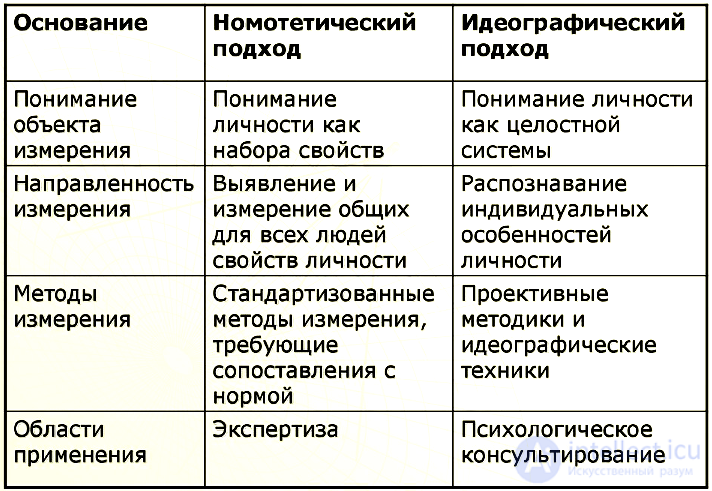
9. By internal structure
unidimensional: these diagnose and assess a single quality or trait; example — the Spielberger—Hanin test for assessing anxiety;
multidimensional: designed for the psychodiagnosis and assessment of several psychological
qualities of a person of the same or different types at once; the method is, as a rule, subdivided into several individual sub-methods — subscales, each assessing a separate
psychological quality; example — Cattell's personality test.
One and the same psychodiagnostic method can simultaneously be considered and classified from different angles, according to different criteria. Therefore almost any method can be assigned not to just one but to several classification groups at once.
In this connection, the classification criteria for psychodiagnostic methods identified and described above should
be regarded not as mutually exclusive but as mutually complementary in characterizing different methods, as
possible aspects of their analysis and division into classes.
Instrument-based psychophysiological techniques.
Diagnostically meaningful indicators are recorded by means of instrument-based recording (respiration, pulse, skin resistance, muscle tone, etc.). But these are not the behavioral reactions themselves, but their physiological indicators.
This is an indirect type of diagnosis.
These techniques are more often used to diagnose functional state.
In the absence of specialized equipment, this class of methods has limited application in a school or preschool educational setting.
. Instrument-based behavioral techniques.
The material presented above testifies to the great diversity and multi-level nature of psychophysiological methods. The sphere of competence of the psychophysiologist encompasses a great deal, ranging from the dynamics of neuronal activity in deep brain structures to local blood flow in a finger. A natural question arises as to how to combine indicators so different in their means of acquisition and content into a logically consistent system. Its solution, however, runs up against the absence of a single, generally accepted psychophysiological theory.
Psychophysiology, which was born as an experimental branch of psychology, largely remains so to this day, compensating for the imperfection of its theoretical foundation with the diversity and sophistication of its methodological arsenal. The wealth of this arsenal is great, and its resources and prospects appear inexhaustible. The rapid growth of new technologies will inevitably expand the possibilities of penetrating the mysteries of human corporeality. It will lead to the creation of new processing devices capable of formalizing the complex system of dependencies among the variables used in objective physiological indicators that are naturally linked to human mental activity. Regardless of whether new solutions turn out to be the result of the further development of computer technology, heuristic models, or other, as yet unknown ways of knowing, the development of science in our time anticipates a fundamental transformation of psychophysiological thinking and methods of work
1. Is it true that there are three fundamentally different approaches to EEG analysis: auditory, clinical, and statistical?
1,0,
2. Is it true that evoked potentials are divided into exogenous, mesogenous, and endogenous components?
1,0,
3. Is it true that an increase in cardiac workload strain can arise as a result of a decrease in sympathetic activity?
1,0,
4. Choose the correct answer.H. Berger discovered that 'brain waves' can be recorded from the surface of the skull in:
0,1,0,0,
5. Choose the correct answer.The dominant rhythm of the encephalogram of a healthy adult with closed eyes is:
0,0,1,0,
6. Choose the correct answer.Evoked potentials (EPs) are bioelectric oscillations that arise in nervous structures:
0,1,0,0,
7. Choose the correct answer.Evoked potentials are a sequence of positive and negative oscillations recorded within the interval:
1,0,0,0,
8. Choose the correct answer.The main difference between computed tomography and radiography is that:
0,0,0,1,
9. Choose the three correct answers.The new methods of computed tomography include:
1,1,0,1,
10. Choose the two correct answers.All neuron contacts are divided into several classes:
1,0,0,0,
11. Choose the correct answer.Generating impulses renders a neuron incapable of function for approximately
0,1,0,0,
12. Choose the correct answer.The electrical conductivity of the skin is determined by the state of:
1,0,0,0,
13. Choose the correct answer.The normal resting arterial blood pressure of a healthy person is
0,1,0,0,
14. Choose the correct answer.The electrocardiogram was first made by Einthoven in:
1,0,0,0,
15. Choose the correct answer.In ECG psychophysiology, a cardiotachometer is used to measure:
0,1,0,0,
16. Choose the correct answer.Recording the electromyogram makes it possible to detect the intention to begin a movement:
0,1,0,
17. Choose the correct answer.The polygraph (lie detector) provides information:
0,0,1,0,
18. Choose the correct answer.The positron emission tomography method makes it possible to study:
1,0,0,

Comments