You get a bonus - 1 coin for daily activity. Now you have 1 coin

60 Tests with Answers — Pedagogical Psychology, with Hints

Lecture


This test is designed to check knowledge in the field of pedagogical psychology, which may be useful for educators, teachers, and everyone interested in the principles of successful learning and interaction with children and adolescents. The test presents questions and brief hints on various topics related to pedagogical psychology, such as theories of learning, features of the psychological development of children and adolescents, psychological factors of successful learning, and so on. The test includes questions of varying levels of difficulty, which makes it possible to assess knowledge at different levels. In addition, the test contains the correct answer to each question, which will help you check and reinforce your knowledge.


1. Pedagogical psychology as an independent branch of scientific knowledge was formed:

  • A) at the beginning of the 19th century
  • B) in the middle of the 19th century
  • C) in the second half of the 19th century
  • D) at the beginning of the 20th century

in the second half of the 19th century and has been developing to this day. Its task is to study the psychological regularities of instruction and upbringing, as well as to develop practical recommendations for improving the process of instruction and upbringing.

2. The term «pedagogical psychology» was introduced into scientific usage by:
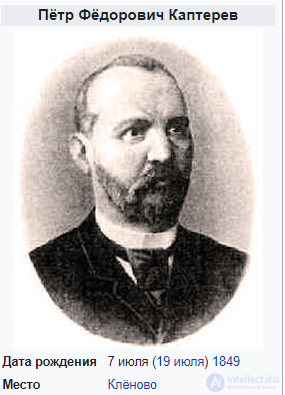
  • A) K.D. Ushinsky
  • B) L.S. Vygotsky
  • C) P.F. Kapterev
  • D) P.P. Blonsky

60 Tests with Answers — Pedagogical Psychology, with Hints

3. The founder of Russian pedagogical psychology is:
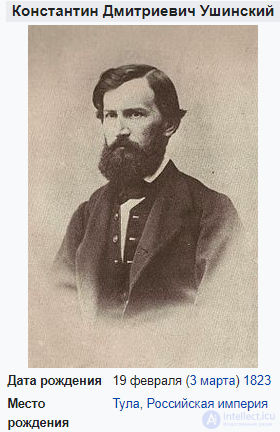
  • A) K.D. Ushinsky
  • B) L.S. Vygotsky
  • C) P.F. Kapterev
  • D) P.P. Blonsky

60 Tests with Answers — Pedagogical Psychology, with Hints

4. L.S. Vygotsky's activity in the field of pedagogical psychology is associated with the formation of such a field of knowledge as:

  • A) experimental pedagogy
  • B) pedology
  • C) psychopedagogy
  • D) the theory of upbringing.

5. What was valuable in pedology was the aspiration to study a child's development under conditions of:

  • A) a comprehensive approach
  • B) an activity-based approach
  • C) a practical focus on diagnosing mental development
  • D) a cybernetic approach

6. The third stage in the development of pedagogical psychology is called theoretical because during this period:

  • A) research was mainly theoretical in nature
  • B) V.V. Davydov created a concept of instruction aimed at developing theoretical thinking
  • C) theoretical psychological concepts of the educational process were created
  • D) theoretical pedagogy was actively developing

The third stage in the development of pedagogical psychology is associated with the 1960s-70s of the 20th century. During this time, there was a significant breakthrough in understanding the processes of instruction and pedagogical activity as a whole. Particular attention is paid to studying individual differences among students, identifying the features of their mental development and abilities. At this stage, pedagogical psychology becomes a scientific discipline that helps to develop new methods of instruction and upbringing, as well as to understand the mechanisms of students' psychological adaptation to the school environment.


7. The structure of pedagogical psychology includes all of the listed sections except:
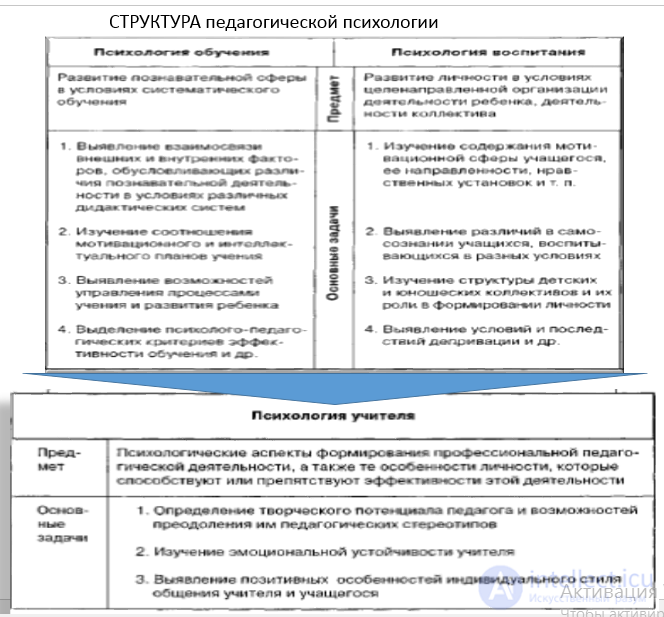
  • A) the psychology of upbringing
  • B) the psychology of the schoolchild
  • C) the psychology of the teacher
  • D) the psychology of instruction

60 Tests with Answers — Pedagogical Psychology, with Hints

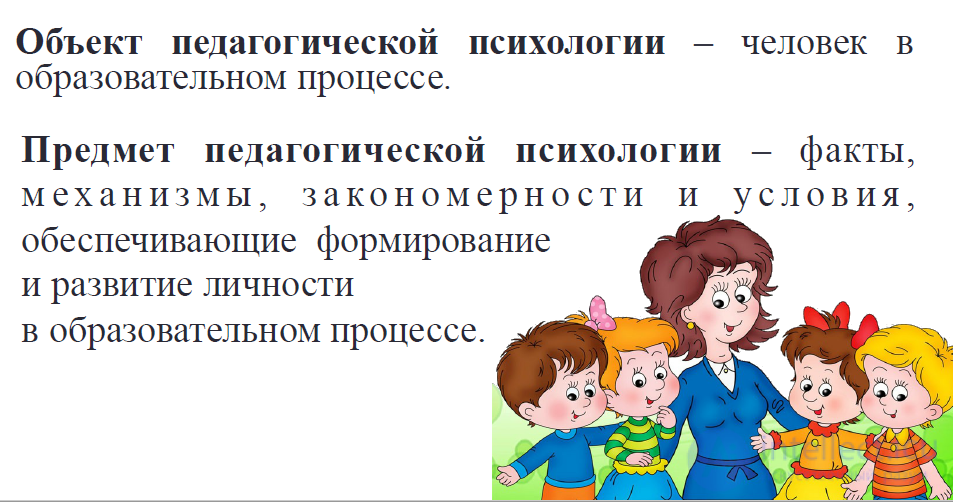
8. The object of pedagogical psychology is:

  • A) the regularities of instruction and upbringing
  • B) the developing person and the educational process
  • C) psychological new formations.
  • D) methods of instruction and upbringing

Pedagogical psychology: the regularities and mechanisms by which a person masters sociocultural experience in the educational process. In the broad sense, the subject of a science is what it studies within its object.

For example, in the educational process (the object), different aspects may be studied:

1. the person being taught (the student);

2. the subject of study or instruction;

3. the external conditions in which the student finds themselves (time, place, etc.);

4. the teacher conducting the instruction, etc.

The subject of domestic pedagogical psychologyconsists of:

  1. –the psychological mechanisms of managing instruction (N.F. Talyzina, L.N. Landa);

  2. – managing the process of mastering generalized methods of action (V.V. Davydov);

  3. –learning motivation (Markova A.K., Yu.M. Orlov)

  4. – the personal characteristics of learners and teachers (V.S. Merlin, V.A. Kan-Kalik and others)

60 Tests with Answers — Pedagogical Psychology, with Hints

9. Select the incorrect definition of the subject of pedagogical psychology:

  • A) the subject of pedagogical psychology consists of the facts, mechanisms, and regularities of a person's mastery of sociocultural experience and the changes in the level of a person's intellectual and personal development, as a subject of learning activity, brought about by this process of mastery
  • B) the subject of pedagogical psychology consists of the regularities of mastering knowledge, abilities, and skills, individual differences in these processes, and the regularities of forming creative, active thinking in schoolchildren
  • C) the subject of pedagogical psychology consists of the regularities and distinctive features of a person's mental development at different stages of ontogenesis
  • D) the subject of pedagogical psychology consists of the regularities of appropriating socially developed methods of action and the knowledge used in them at a given stage of development


10. The method of pedagogical psychology aimed at studying changes in a child's psyche in the process of the researcher's active influence on the subject is:
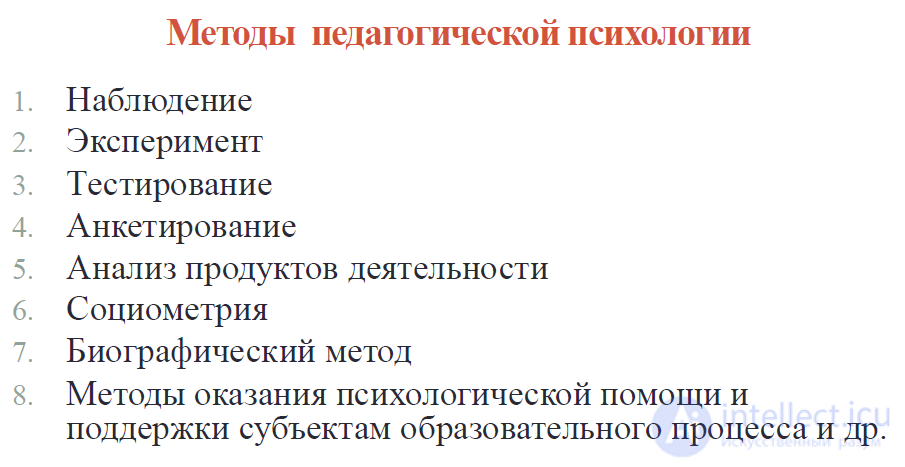
  • A) the pilot experiment
  • B) the formative experiment
  • C) the ascertaining experiment
  • D) participant observation

60 Tests with Answers — Pedagogical Psychology, with Hints

11. The most general concept denoting the process of a person acquiring knowledge by any available means:
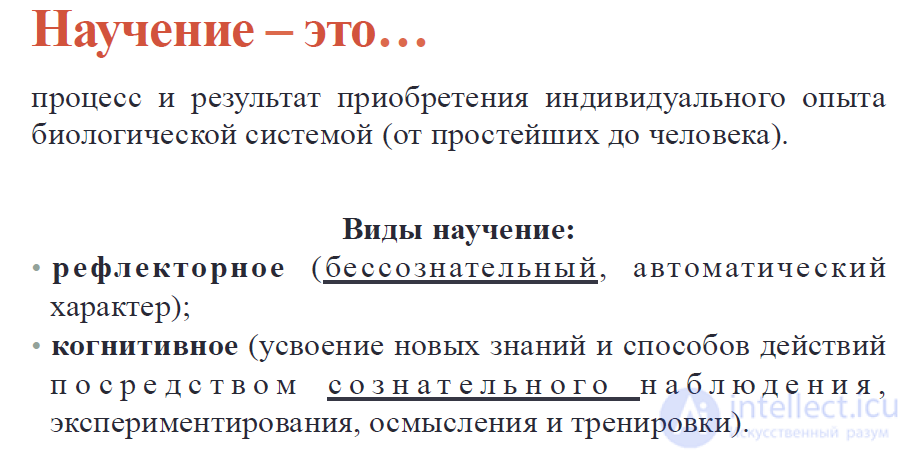
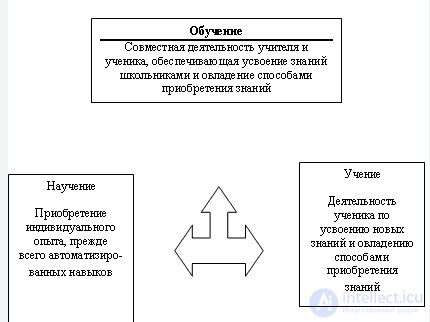
  • A) instruction
  • B) learning activity
  • C) learning (in the broad sense)
  • D) socialization

60 Tests with Answers — Pedagogical Psychology, with Hints

60 Tests with Answers — Pedagogical Psychology, with Hints

12. Учение (studying) is a process of:

  • A) transmitting knowledge from the older generation to the younger
  • B) group activity for mastering knowledge
  • C) interaction between teacher and student aimed at transmitting and receiving knowledge, abilities, and skills
  • D) a person's individual cognitive activity


13. The type of learning in which a situation is analyzed taking into account not only past experience but also possible consequences:
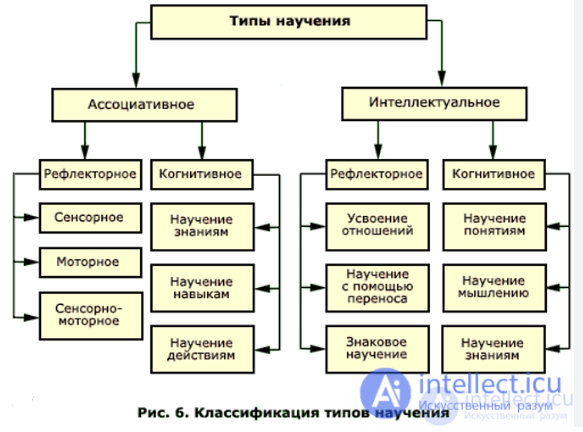
  • A) reactive
  • B) operant
  • C) cognitive
  • D) reflexive

60 Tests with Answers — Pedagogical Psychology, with Hints

14. Which of the following belongs to the types of operant learning:
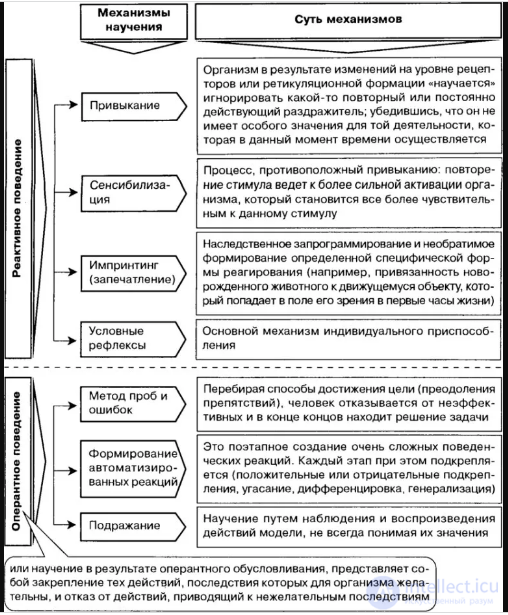
  • A) habituation
  • B) insight
  • C) imprinting
  • D) the trial-and-error method

60 Tests with Answers — Pedagogical Psychology, with Hints

15. According to behaviorism, the dependence of the speed of forming a connection on its correspondence to the subject's current state is called:
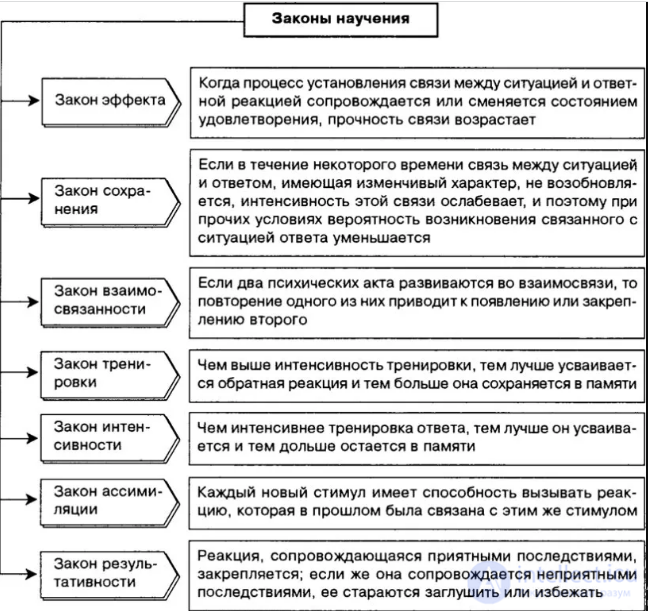
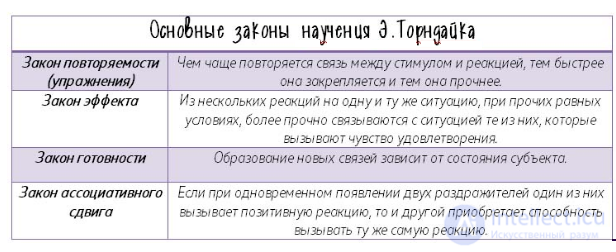
  • A) the law of readiness
  • B) the law of exercise
  • C) the law of effect
  • D) the law of the plateau in skill formation

60 Tests with Answers — Pedagogical Psychology, with Hints

60 Tests with Answers — Pedagogical Psychology, with Hints
16. The main characteristic of learning activity (according to D.B. Elkonin) is:

  • A) the performance of specific learning actions
  • B) the presence of feedback
  • C) the presence of a learning-cognitive motive
  • D) the presence of a goal-setting

17. Of the components listed, which belong to the structure of goal-directed learning activity (according to D.B. Elkonin - V.V. Davydov):

  • A) needs
  • B) the teacher's actions in assessing the student
  • C) the style of pedagogical activity
  • D) the student's assessment of the result of their own learning

18. The type of learning motive characterized by the student's orientation toward mastering knowledge – facts, phenomena, regularities – is called:

  • A) broad cognitive motives
  • B) broad social motives
  • C) learning-cognitive motives
  • D) narrowly personal motives

19. All of the following belong to the substantive characteristics of learning motives except:

  • A) stability
  • B) independent origin
  • C) awareness
  • D) generality

20. The specificity of a learning task as a component of learning activity lies in the fact that, in solving it, the student:

  • A) correctly completes the assigned task
  • B) masters a general method for solving an entire class of similar particular problems
  • C) masters a method for solving the specific problem posed
  • D) masters various methods for solving an entire class of similar particular problems


21. The psychological causes of schoolchildren's underachievement were established by:

  • A) L.I. Bozhovich
  • B) M.V. Matyukhina
  • C) A.K. Markova
  • D) N.A. Menchinskaya

22. Didactogeny is:

  • A) a student's positive attitude toward school
  • B) a set of personality abilities that ensure success in learning activity
  • C) a child's chronic underachievement in the course of instruction
  • D) a student's negative mental state caused by a breach of tact on the part of the teacher


23. The final stage in learning complex psychomotor skills is:

  • A) the associative stage
  • B) the cognitive stage
  • C) the latent stage
  • D) the autonomous stage

24. The principle of the leading role of instruction in a child's mental development was formulated by:

  • A) L.S. Vygotsky
  • B) S.L. Rubinstein
  • C) B.G. Ananyev
  • D) L.V. Zankov

25. Developmental instruction was founded on the concept of:

  • A) learning
  • B) the stage-by-stage formation of mental actions
  • C) the zone of proximal development
  • D) personal meaning

26. The level of actual mental development is characterized by:

  • A) learnedness, learnability
  • B) learnability, upbringability, developability
  • C) self-learnability, self-upbringability, self-developability
  • D) learnedness, upbringing level, level of development


27. Which of the following does not belong to the intellectual theories of instruction:

  • A) the theory of problem-based instruction
  • B) L.V. Zankov's theory of general mental development
  • C) V.V. Davydov's theory of substantive generalization
  • D) the theory of instruction as a process of managing the accumulation of knowledge.

28. The main goal of traditional instruction is:

  • A) the formation of knowledge, abilities, and skills
  • B) the formation of the capacity and need for self-development
  • C) the formation of civic duty and a sense of responsibility
  • D) the formation and improvement of intellectual functions

29. All of the following belong to the characteristics of traditional instruction except:

  • A) the main result of instruction is the student's formed knowledge, abilities, and skills
  • B) the learning process is distinguished by strict regimentation
  • C) the main tactic of communication is cooperation
  • D) the student is an object, not a subject, of the activity.


30. All of the following belong to the characteristics of innovative instruction except:

  • A) the goal of instruction is the development of the students' personality
  • B) the student is an object, not a subject, of the activity
  • C) the main tactic of communication is cooperation
  • D) the teacher makes wide use of active methods of instruction


31. The creator of the theory of the stage-by-stage formation of mental actions is:

  • A) L.I. Bozhovich
  • B) N.A. Menchinskaya
  • C) P.Ya. Galperin
  • D) L.S. Vygotsky

32. Select the correct sequence, from those given below, for the formation of mental actions according to the research of P.Ya. Galperin:

  • A) 1. An orienting or cognitive basis for the action is created; 2. the action is performed practically; 3. the action is performed in terms of speaking aloud; 4. the action is performed mentally.
  • B) 1. The action is performed practically; 2. it passes into the plane of oral speech; 3. it passes into the plane of inner speech; 4. an orienting basis for the action is developed.
  • C) 1. The action is performed in the plane of oral speech; 2. it passes into the plane of inner speech; 3. an orienting basis is created; 4. it is carried out practically.
  • D) 1. The action is performed in terms of speaking aloud; 2. the action is performed practically; 3. an orienting basis for the action is developed; 4. it passes into the plane of inner speech.


33. The essence of programmed instruction is that:

  • A) various teaching machines and devices are used
  • B) it is based on approved curricula
  • C) the material is broken down into small parts, portions, and the learner cannot take the next step in mastering the material without having mastered the previous one
  • D) it is aimed at developing creative thinking


34. The reinforcement of correct responses in programmed instruction is achieved through:

  • A) analysis of responses
  • B) repetition
  • C) exercise
  • D) reinforcement

35. The type of instruction that stimulates awareness of some contradiction in the course of activity, leading to a need for new knowledge, for that unknown element that would allow the resulting contradiction to be resolved:
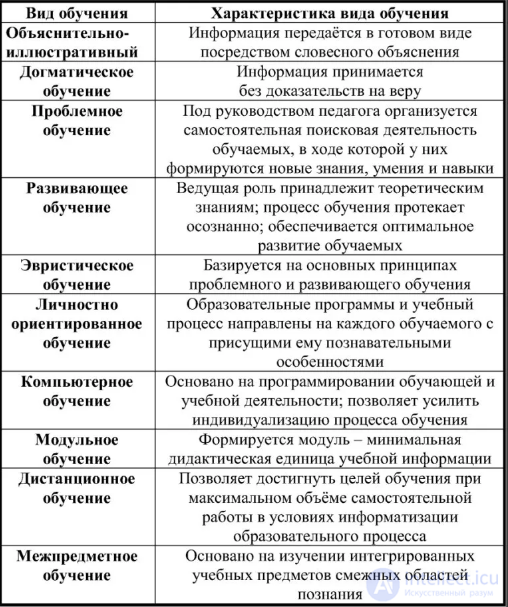
  • A) programmed instruction
  • B) reproductive instruction
  • C) problem-based instruction
  • D) differentiated instruction

60 Tests with Answers — Pedagogical Psychology, with Hints

36. The highest level of problem-based instruction is characterized by:

  • A) the ability to solve complex problems
  • B) the independent formulation of the problem and the search for its solution
  • C) the emergence of a cognitive need
  • D) a fast pace of mastering the course material


37. Which of the following does not belong to the main psychological-pedagogical principles of L.V. Zankov's system of instruction:

  • A) the principle of accessibility of instruction
  • B) the principle of the development of all students
  • C) the principle of the leading role of theoretical knowledge in instruction
  • D) the principle of studying the program material at a fast pace


38. In L.V. Zankov's concept of developmental instruction, a high level of difficulty in instruction is defined by:

  • A) a large volume of course material
  • B) independent study of the course material
  • C) knowledge of the essential connections between phenomena
  • D) the need to memorize a large amount of information


39. According to which psychologist should the mastery of knowledge that is general and abstract in nature precede students' familiarization with more specific and concrete knowledge:

  • A) M.V. Gamezo
  • B) A.V. Petrovsky
  • C) V.V. Davydov
  • D) A.M. Matyushkin

40. According to V.V. Davydov, the scientific-theoretical type of thinking is characterized by:

  • A) mastering logical forms
  • B) the formation of substantive generalizations
  • C) mastering a large sum of knowledge
  • D) the ability to express one's thoughts clearly


41. A person's predisposition to educational influences is denoted by the term:

  • A) personal growth
  • B) upbringability
  • C) upbringing level
  • D) self-education

42. The direction of psychology that recognizes external influence on a person's behavior as the main factor in upbringing:

  • A) psychoanalysis
  • B) cognitivism
  • C) Gestalt psychology
  • D) behaviorism

43. From the standpoint of the activity-based approach, educational influence should be directed primarily at:

  • A) the volitional sphere of personality
  • B) the motivational-need sphere of personality
  • C) the emotional sphere of personality
  • D) the cognitive sphere of personality

44. Representatives of humanistic psychology believed that educational influence should be exercised by purposefully influencing:

  • A) the pupil's behavior
  • B) the environment surrounding the pupil
  • C) the pupil's consciousness
  • D) the pupil's system of motives

45. Recognizing a child's right to exist as they are, recognizing the value of their personality and its respect regardless of achievements, development, position, or abilities, constitutes the psychological essence of the following principle of upbringing:

  • A) the principle of subjectivity
  • B) the principle of objectivity
  • C) the principle of acceptance
  • D) the principle of non-violence


46. A method of psychological influence addressed to the ward's consciousness and logic:

  • A) suggestion
  • B) persuasion
  • C) emotional contagion
  • D) imitation

47. The spontaneous mechanisms of personality formation (according to Yu.B. Gippenreiter) include all of the following, except:

  • A) the acceptance and adoption of social roles
  • B) identification
  • C) the shift of motive to goal
  • D) self-awareness

48. The founder of the theory of collective upbringing is considered to be:

  • A) K.D. Ushinsky
  • B) L.S. Vygotsky
  • C) A.S. Makarenko
  • D) A.V. Sukhomlinsky

49. The teacher is the most significant figure for the child:

  • A) in preschool age
  • B) in early school age
  • C) in adolescence
  • D) in youth

50. In terms of upbringing, the most effective is considered to be:

  • A) traditional instruction
  • B) problem-based instruction
  • C) programmed instruction
  • D) dogmatic instruction

51. The structure of pedagogical activity includes all of the following components, except:

  • A) constructive
  • B) communicative
  • C) organizational
  • D) perceptual

52. The selection and organization of the content of educational information, the design of students' activity and one's own pedagogical activity, constitutes the essence of the following pedagogical function:

  • A) organizational
  • B) constructive
  • C) communicative
  • D) gnostic

53. According to psychological research, no direct link has been found between the success of pedagogical activity and the following factor:

  • A) the teacher's length of service
  • B) the teacher's age
  • C) the teacher's sex
  • D) all of the listed factors

54. The ability to penetrate a student's inner world, psychological observancy, and the like, constitute the essence of:

  • A) didactic abilities
  • B) academic abilities
  • C) communicative abilities
  • D) organizational abilities

55. V.A. Krutetsky called the teacher's abilities connected with conveying educational information to students and forming active, independent thinking:

  • A) organizational-communicative
  • B) organizational-perceptual
  • C) didactic
  • D) personal


56. Professional changes in a teacher's personality are considered negative deformations in the event that these changes:

  • A) manifest in the process of organizing educational work
  • B) are condemned by other people
  • C) impede business and personal interaction across various spheres of activity
  • D) require devoting a great deal of time and attention to the work.


57. The ability to establish personal contact with each of the students is most characteristic of:

  • A) the teacher-communicator
  • B) the teacher-organizer
  • C) the subject-teacher
  • D) the teacher-intellectual

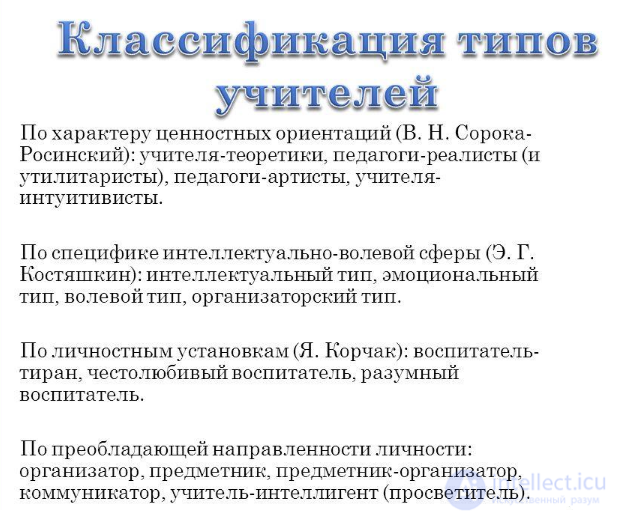
The personality structure of the "Organizer" type is made up of qualities such as exactingness, organization, strong will, and energy.
The "Subject teacher" is characterized by observancy, professional competence, and a striving for creativity. Given the existing connections, there is a high likelihood of an intermediate "subject teacher-organizer" type existing as well, combining the characteristics of both of these types. It is possible that its distinction from the "subject teacher" would be a stricter focusing of students on the subject and the organization of their activity specifically within the bounds of subject knowledge. This makes it possible to differentiate it from the "pure Organizer," whose main line of activity lies in the sphere of extracurricular work.
The personality structure of the "Communicator" type is made up of qualities such as sociability, kindness, external attractiveness, and high moral standards. Emotionality and behavioral flexibility, which are closely linked to these qualities, may also be included here.
The "Intellectual" type is characterized by high intelligence, general culture, and unconditional morality. This last quality, in essence, serves as the connecting link between these types. This confirms that an intermediate type is found, conventionally the "intellectual-optimist," possessing pronounced qualities of both types. There probably exist intermediate types formed along different lines of teacher typology, based on subject knowledge, for example, "subject teacher-communicator," "subject teacher-enlightener." At the same time, the probability of an "intellectual-organizer" appearing is very low, although in theory a combination of these types is possible as well.
Of the indicated types of teachers (communicator, subject teacher, organizer, and intellectual), each has its own methods, mechanisms, and channels for conveying educational influences.
Thus, the "communicator" teacher is distinguished by extraversion, low conflict-proneness, benevolence, a capacity for empathy, and a love of children. They realize their educational influences on the basis of compatibility with the student, seeking points of contact in personal life. Naturally, these influences will produce the greatest change precisely in this "everyday" behavior of the student.
For the "subject teacher", a rationalist firmly convinced of the necessity of knowledge and its significance in life, it is more characteristic to educate the student by means of the subject being studied, by changing their perception of the scientific picture of the world, drawing them into work in a club, and so on.
The "organizer" teacher, often a leader not only among the students but also within the whole teaching staff, mainly conveys their personal characteristics in the course of conducting various extracurricular activities. Therefore the result of their influence is most likely to be found in the sphere of business cooperation, collective engagement, discipline, and so on.
The "intellectual" teacher, or "enlightener," distinguished by principledness and adherence to moral norms, realizes themselves through highly intellectual enlightening activity, bringing students morality, spirituality, and a sense of freedom.
60 Tests with Answers — Pedagogical Psychology, with Hints

58. The following is not a function of pedagogical evaluation:

  • A) planning
  • B) teaching
  • C) controlling
  • D) educating

59. The situation that, in B.G. Ananiev's opinion, has the most negative effect on a ward's activity and well-being:

  • A) constant negative evaluation
  • B) absence of evaluation
  • C) an abundance of positive evaluations
  • D) indirect negative evaluation

60. The style of pedagogical leadership considered most effective when working with adolescents:
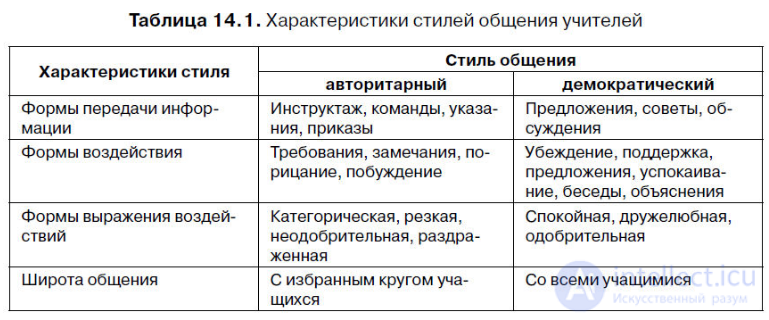
  • A) democratic
  • B) permissive
  • C) inconsistent
  • D) authoritarian

60 Tests with Answers — Pedagogical Psychology, with Hints


Correct answer options


Question no.


Answer


Question no.


Answer


Question no.


Answer


Question no.


Answer


1


C


16


C


31


C


46


B


2


C


17


D


32


A


47


D


3


A


18


A


33


C


48


C


4


B


19


A


34


D


49


B


5


A


20


B


35


C


50


B


6


C


21


D


36


B


51


D


7


B


22


D


37


A


52


B


8


B


23


D


38


C


53


D


9


C


24


A


39


C


54


C


10


B


25


C


40


B


55


C


11


C


26


B


41


B


56


C


12


D


27


D


42


D


57


A


13


C


28


A


43


B


58


A


14


D


29


C


44


B


59


B


15


A


30


B


45


C


60


A


Criteria for evaluating test results in the course of educational psychology


Number of points


Performance

(% correct answers)


Grade


from 60 to 52


from 100 to 86 %


5


from 51 to 42


from 85 to 70 %


4


from 41 to 30


from 69 to 51 %


3


less than 30


less than 50 %


2

See also

  • [[b7324]]
  • [[b7347]]
  • [[b8014]]
  • [[b8015]]
  • [[b8016]]
  • [[b8017]]

See also

Comments

Марина 01-09-2022
Мне понравилось, что тесты сопровождаются подробными ответами, что помогает лучше понять материал и научиться применять его на практике.
Александр 08-05-2022
Этот тест очень интересный и информативный, и я бы рекомендовал его всем педагогам, которые хотят улучшить свои навыки.
Ольга 14-02-2022
Психология играет очень важную роль в педагогике, и этот тест помогает лучше понять, как она может быть применена в классе.
Иван 31-12-2021
Я использовал этот тест в своей работе и заметил, что он помог мне лучше понимать своих студентов и эффективнее обучать их.
Марина 15-07-2021
Этот тест очень полезен для педагогов, чтобы понимать, как ученики учатся и как помочь им в их образовательном процессе.

To leave a comment

If you have any suggestion, idea, thanks or comment, feel free to write. We really value feedback and are glad to hear your opinion.
To reply

Lectures and tutorial on "Pedagogical psychology"

Terms: Pedagogical psychology