
Lecture
Это окончание невероятной информации про посттравматическое стрессовое расстройство.
...
correlated with their temperament. Pavlov distinguished various types of post-traumatic reactions:
At present, PTSD has been better studied in domestic and laboratory animals, but it is also observed in wild individuals. The cause of PTSD in an animal can be severe physical pain, loss of freedom or separation from conspecifics, loss of the mother in infancy[182], cruel treatment, surgical interventions with insufficiently effective anesthesia, involvement in a road accident[183], or the need at a young age to constantly fight for food with stronger members of the group. Separation from or conflicts with conspecifics are especially traumatic for animals that live in organized groups and have a long lifespan, such as elephants, cetaceans, and primates. A traumatized animal may become anxious or aggressive, pay no attention to what is happening around it, or react very intensely to touch. The post-traumatic state can negatively affect the animal's physical health and even shorten its lifespan[182]. A dog that has experienced trauma may become anxious and hypervigilant, fear situations reminiscent of the traumatic event, and follow its owner relentlessly, never taking its eyes off them[183]. However, renewed contact with conspecifics or caring attention from people can reduce PTSD symptoms in the animal[182]. At present, PTSD in animals is not considered an official diagnosis in veterinary practice[183].
PTSD occurs less often in animals that play the role of prey in the wild ("primary consumers"). This is apparently because, since these animals often find themselves in life-threatening situations, they have a natural mechanism for neutralizing the post-traumatic state if the animal manages to survive after an attack by a predator[184].
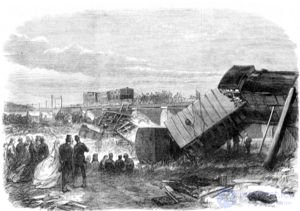
Descriptions of psychological disorders resulting from trauma have existed in literature since ancient times, for example in the story of Gilgamesh, in the Iliad, and in the Saga of Gisli[185]. Shakespeare, in his tragedies, mentioned symptoms associated with psychological trauma[186]. Johann Wolfgang von Goethe, a witness to the Battle of Valmy, described in his memoirs the symptoms of depersonalization and derealization that arose in him as a result of this event[187].
In 1865 Charles Dickens became a victim of the railway disaster at Staplehurst. Dickens showed presence of mind and helped other victims[188]. Nevertheless, after the event the writer developed post-traumatic symptoms[17], which did not disappear until his death, which occurred five years later, on the anniversary of the disaster (June 9)[188].
Erich Maria Remarque described post-traumatic symptoms in the novel "All Quiet on the Western Front"[189].
Researchers suggest that in J. R. R. Tolkien's novel "The Lord of the Rings", the main character, Frodo, after returning from Mordor shows clear signs of PTSD (a depressive state, flashbacks, painful sensations in a long-healed wound, a look as if the character were seeing something "far away from here", anxiety even in a safe home environment, a feeling of "emptiness and darkness inside", an inability to return to his former way of life, a sense of irreversible change in his own personality, a feeling of estrangement from the surrounding world, with the symptoms becoming very intense each year on the anniversary of the trauma or when visiting places reminiscent of the events). This may reflect the personal experience of the writer, one of the representatives of the "lost generation", who may have experienced "shell shock" and other traumatic events during the First World War. Tolkien describes Frodo's condition as "incurable", and indeed, at the time the novel was written there were no effective methods for treating PTSD[190].
In Kurt Vonnegut's novel "Slaughterhouse-Five, or the Children's Crusade", real events are viewed through the lens of PTSD in the protagonist — a war veteran[191].
The severe psychological consequences of the Vietnam War became one of the factors that shaped the generation of American "New Hollywood" directors[192]. By the 1980s, American cinema had already produced several dozen landmark films about "Vietnam syndrome (". As for domestic cinema, according to the philologist E. N. Gracheva, in Soviet films, even if a character returning from war had psychological problems, they were always resolved by the end (for example, in the film "Rabochiy posyolok", 1965). In contrast, films about veterans of the Afghan and Chechen wars made during the perestroika period show irreversible changes in the character's personality as a result of the trauma experienced and their inability to build normal relationships with people who lack military experience[193].
Часть 1 Post-Traumatic Stress Disorder (PTSD)
Часть 2 Description of the main symptoms - Post-Traumatic Stress Disorder (PTSD)
Часть 3 Cognitive behavioral psychotherapy for PTSD - Post-Traumatic Stress Disorder (PTSD)
Часть 4 Possible problems and ways to solve them - Post-Traumatic Stress
Часть 5 In culture - Post-Traumatic Stress Disorder (PTSD)


Comments