
Lecture
It is known that in order to write a word correctly, it is not enough to analyze its sound-letter composition; awareness of the sequence of sounds in the word is also necessary. Maintaining the required sequence of sounds when writing a word represents one of the most significant difficulties in the initial development of the writing skill in children. A lesion or dysfunction of the posterior frontal regions of the cortex of the left hemisphere of the brain leads precisely to these defects in writing. The process of writing individual letters presents no difficulty in this case. Unlike other forms of writing impairment, difficulties arise when writing a syllable or a word. The basis of these defects is a disruption of the mechanism of switching from one letter to another (or from syllable to syllable, from word to word).
The central mechanism underlying efferent motor agraphia is a disruption of the kinetic organization of the motor aspect of oral speech and defects in the timely denervation of the preceding and innervation of the subsequent speech act or act of writing, which leads to pathological inertness of stereotypes in oral and written speech. This mechanism leads to defects in switching from one sound (word, sentence) to another in the process of oral speech and from one sign to another — in written speech. The disruption of the switching process is the central defect in efferent motor agraphia. In the clinical picture of agraphia, this defect manifests itself in a whole series of errors in writing, up to its gross disintegration.
If the patient retains the ability to write, writing becomes extremely slow and deliberate; the handwriting changes, letters become angular and are often written separately; not infrequently letters become either enlarged or small (macro- and micrography). Already at the level of the word, writing reveals perseverations of preceding letters (or words). In the gross form of perseveration, writing becomes completely impossible and is replaced by the writing of individual letters, syllables, or part of a word. Even ideogrammatic writing (name, surname, the city in which the patient lives, the names of close relatives, etc.) proves difficult and contains many errors. The main error is perseveration. Next in order after this error, and as a consequence of the disintegration of the patient's awareness of the internal scheme of the word and the sequence of letters in it, are transpositions of letters in a word, omissions of letters denoting vowel sounds or consonants in a cluster, repetition of the same syllable (word), failure to complete words (which is related to the impairment of writing as a successive process), and others. Patients experience considerable difficulty not only in writing words but also in laying them out with letters from a cut-out alphabet.
Efferent motor agraphia occurs within the neuropsychological syndrome of efferent motor aphasia, impairments of dynamic praxis, defects in the process of speech comprehension, reduced comprehension of word meanings, and a defect in understanding their sense. The disruption of the semantics of oral speech is also reflected in the state of written speech and is one of the types of difficulty encountered in restoring written speech. The second type of difficulty is a gross disruption of the syntagmatic aspect of speech, the structure of the phrase and its grammar. Agrammatism in this form of aphasia appears in gross forms, which also underlies the difficulties of restoring written speech.
The characteristic feature of the psychological picture of a writing impairment is a disruption of the internal scheme of the word and the sentence, of the awareness of the sequence of letters in the word (of words in the sentence). A word and a sentence do not consist of separate sounds (words), but presuppose a certain internal scheme within which words stand in complex syntactic and grammatical relations. In patients with this form of agraphia, awareness of the complex relations of words within a sentence is disrupted; they lose awareness of those dynamic relations among words owing to which it is not the word but the sentence that becomes the unit of meaning and sense. These patients find it difficult to construct "in the mind" the scheme of an entire grammatical construction, to arrange and connect individual words into sentences.
In gross cases of impairment, this contingent of patients lacks all forms of writing except ideogrammatic writing. Even in copying, which is the most preserved skill, these patients make many errors; the process of copying itself takes on the character of expanded, conscious, letter-by-letter writing, with patients pronouncing each sound and syllable aloud as they do so.
In teaching writing to younger schoolchildren, these defects of switching from one letter (syllable, word) to another often underlie their difficulties in forming the skill of writing. Special attention should be paid to perseveration in writing when teaching children to write, since it is related as a whole to the structure of the word and phrase and has a negative effect on the writing of words, phrases, and text, and in general delays the development of written speech. It should be remembered, however, that children rarely show errors of only one type. Usually the mechanisms of the difficulties in forming or of impairment of writing in children with developmental delay and other forms of abnormal development are complex. And such characteristics of writing as deliberateness, consciousness, and expandedness, which are symptoms of writing impairment in efferent motor agraphia, are in children a normal stage in the process of formation and development.
Methods of restoring writing in efferent motor agraphia
Restorative training in writing breaks down into a number of stages, each of which has its own tasks and methods, but all of them are directed toward restoring the normal process of writing and written speech. The central task and goal is the restoration of analytic writing: awareness of the sequence of sounds and letters in the word and its role for awareness of the meaning of the word.
At the first stage, work proceeds from the whole word, from its meaning, to its letter composition — this is the synthetic method. Work is carried out as follows: the patient is presented with pairs or triads of object pictures whose names differ only in the order of the letters in them, and this is precisely what leads to their different meanings. Under each picture lies a word made up of letters.
The patient's first task:
a) read the pairs of given words,
b) match them to the picture,
c) show what the difference between these words is,
d) copy these words in pairs,
e) write them from memory. For example: магнолия — Монголия (magnolia — Mongolia), ток — кот (tok, "current" — kot, "cat"), вор — ров (vor, "thief" — rov, "ditch"), горб — гроб (gorb, "hump" — grob, "coffin"), etc.
Second task:
a) rearrange the letters in the given words so as to produce a different word with a different meaning,
b) explain the difference in the spelling of the words,
c) copy them,
d) write them from memory. For example: дар (dar, "gift"), кот (kot, "cat"), трос (tros, "cable"), etc. (the corresponding pictures lie in front of the patient).
After working with the synthetic method (from the whole — to the part, from the meaning of the word — to its structure), one can move on to the analytic method, which is directed at the conscious analysis of the composition of the word. Work proceeds according to a program consisting of a series of sequential operations:
1) element-by-element pronunciation of the word;
2) a quantitative analysis of the word (counting and recording the number of sounds in the word with the help of external means — an abacus, sticks, etc.);
3) constructing a diagram of the word on the basis of the analysis performed (a letter-by-letter and syllable-by-syllable diagram) П->П->П; П—»П-»П—>П;
4) sequential filling in of the diagram with the corresponding letters.
The psychological essence of this method of word analysis using materialized aids lies in the fact that the entire process of writing a word (and later a sentence) is externalized, becomes the object of conscious activity, while the card-tokens and arrows represent, in materialized form, the structure of the word and the sequential connection of the letters in it. Consolidation of the analytic skill of writing words is achieved through a series of exercises: a) analyzing a given word by syllables and letters (first with support from the corresponding picture and the written word, then from the picture alone, and later — analyzing words by ear), b) analyzing words that are close in phonetic structure and serial organization but different in meaning (рак — акр (rak, "crayfish" — akr, "acre"), ров — вор (rov, "ditch" — vor, "thief"), etc.), c) completing unfinished words, d) filling in letters or syllables omitted from a given word (the Ebbinghaus method), e) composing and writing a word from given syllables presented out of order (ра, та, бо, ка, etc.).
At the next stage, training moves on to composing words by rearranging letters (the method of verbal games). The patient is given a word, from the letters of which he must compose as many other words as possible (for example, from the word "типография" (tipografiya, "printing house") — тип (tip, "type"), граф (graf, "count/graph"), гриф (grif, "vulture/stamp"), тигр (tigr, "tiger"), пирог (pirog, "pie"), графит (grafit, "graphite"), etc.). Close in psychological essence to this method is also the method of composing words based on a single syllable or the root part of words (for example, the syllable "пар" (par, "steam") is given — паровоз (parovoz, "locomotive"), пароход (parokhod, "steamship"), парник (parnik, "greenhouse"), напарник (naparnik, "partner"), etc.).
These methods are directed at analyzing the word on a morphological basis and ensure the restoration of awareness of the connection between the sequence of letters in a word and its meaning (корт — крот (kort, "court" — krot, "mole"), мор — ром (mor, "pestilence" — rom, "rum"), мол — лом (mol, "pier" — lom, "crowbar"), кот — ток (kot, "cat" — tok, "current"), три — тир (tri, "three" — tir, "shooting range"), etc.). Words found in this way, analyzed from the point of view of the sequence of letters in the word, are written down by the patients, the corresponding pictures are located, are captioned from memory under these pictures, and at the end of the work — are written to dictation. This method works well with children in the form of a "word game," and it is better if the session is conducted with a group of children (two or three), which allows a whole series of group methods to be applied — competition, mutual assistance, collective work on errors, encouragement, etc., which enhance the effectiveness of the verbal method itself.
All these and a number of other methods stimulate the patient to analyze the sequence of letters in a word, restore his awareness of its connection with the meaning of the word, and teach him this analysis. By fixing the patient's attention on the structure of the word, on the significant role of a stable sequence of letters, they thereby become an effective means of eliminating the underlying defect. At the first stage of training, patients usually master a broad system of auxiliary aids and use them independently in writing words and short phrases that are simple in structure. A number of requirements are placed on the selection of material used in teaching writing (verbal, pictorial): frequency, phonetic complexity, and length of the word — all these parameters of the word must be gradually made more complex. The whole broad system of supports, as well as of operations, must be gradually reduced with the help of the teacher, i.e., certain operations must be gradually eliminated from the step-by-step action — those that at this stage are already more automatized than others and can proceed at an internal level, without being pronounced aloud. For example, one can drop the first operation (pronouncing the word), later — the second, and so on, thereby transferring all the operations to the internal plane of execution.
Methods of restoring the writing of a phrase
After patients have restored the ability to write a whole series of words — simple and complex, of high and low frequency, long and short — they move on to the second stage of training, the task of which is the restoration of phrase writing. A phrase, as is known, does not consist of independent words but presupposes an internal scheme within which the words stand in complex syntactic and grammatical connections and relations. In efferent motor aphasia and agraphia, patients show an impairment of knowledge of these relations, which manifests itself in syntagmatic defects when writing a phrase: it is difficult for the patient to construct "in the mind" the scheme of an integral grammatical construction, to arrange and connect the individual words within the sentence, and this constitutes the central defect of writing at the level of sentences and texts. Work on restoring the writing of a phrase presupposes, above all, teaching the patient oral speech, the ability to construct sentences of particular grammatical constructions.
The restoration of the structure of a phrase, both in its pronunciation and in writing, is aided by the following system of methods. The method of composing picture phrases consists in rearranging a series of pictures depicting separate objects, actions, and objects of action. After composing a phrase from the pictures, the patient must choose the appropriate endings for each word within the phrase. Let us give an example. In front of the patient lies a series of pictures depicting: a woman, a man, washing, cutting, reading, combing one's hair, a newspaper, a book, a comb, etc. He is given the task — to put together one sentence from the pictures, to find the corresponding picture for each word that enters into the sentence, the needed ending, to pronounce the resulting phrase, to write it down, to think up a new similar phrase, to write it down, etc.
Semantic construction of the phrase is later replaced by a phrase schema consisting of the corresponding questions to the words of the phrase, which helps restore "a feel for language," "a feel for the structure of the phrase" (who? what? —> is doing what? —> what? (with what? whom? to whom?). The patient first fills in the given schema with the needed pictures, and later with words bearing the corresponding case endings. And this "system of methods" ends with the method of parsing the phrase by parts of the sentence and by parts of speech, by independently posing questions to each picture and recording accordingly the sentence thus composed.
Another defect that makes phrase writing difficult remains the difficulty of switching, i.e., perseveration. As for the methods of eliminating perseveration in writing, the main ones are: the method of slow pronunciation during conscious writing of words and phrases; the method of "pausing" in writing, which involves increasing the pauses between the writing of each word of the phrase. These pauses can only be realized through their materialization, the role of which lies not only in carrying out pauses when writing individual elements (syllables, words), but also in switching the patient's attention from writing the preceding element to another kind of activity. In this case, in the intervals between writing the elements of the phrase (words), the patient is asked to carry out some other brief operation, for example to find, among the cards lying in front of him, the number corresponding to the ordinal number of the word he has written, or to choose, among three (no more) object pictures, the one whose name he is to write next, etc. The action of writing the phrase will in this case consist of a series of heterogeneous operations: writing a word —> choosing a number (picture) —» writing the next word —» a simple arithmetic operation —> writing a word, and so on. Gradually, the filling of the pauses with extraneous operations is replaced solely by pictures corresponding to the words, or pictures denoting verbs, and after work on this program one can move on to the stage of slow, conscious writing of phrases.
This and a number of other similar methods make it possible to overcome perseveration in writing not only a phrase but also a text. The methods of eliminating perseveration in the restorative training of writing may vary, but they must meet two requirements — an increase in the pauses between elements of the phrase and the switching of the patient from one type of operation to another within the limits of a single action — the writing of a phrase or a text. The methods of work described lead to the effective restoration of writing in efferent motor agraphia.
In children with defects in the dynamics of writing, manifested in perseveration of preceding letters (words) owing to defects in switching from the innervating act to the denervating one, essentially the same general principles of restorative training are used — from the general to the particular, meaningfulness of the work, and so on. But this work must be conducted after (or in parallel with) work on the motor function of the child's hands and body — on restoring mobility, dexterity, speed, and other characteristics of movements and object-related actions, and, most importantly, on their capacity for switching from one action to another. For these purposes, methods of singing, drawing, classifying objects, arranging objects (figurines, etc.) in a certain order, and moving the hands in a certain order, among others, are useful.
At all stages, as a "warm-up," the musical method, or the method of singing, is useful. The children sing their favorite song together with the teacher. Then they work on this song and carry out a series of sequential operations:
1. The teacher and the children sing together (in full, or one verse) a song familiar to them (for example, "A Little Fir Tree Was Born in the Forest..." or "May There Always Be Sunshine, May There Always Be Mama...")
2. After this, they draw the objects (objects, phenomena) that are sung about in the song, taking into account every line of the song without fail.
3. While drawing, the corresponding line is sung, and the whole verse is illustrated in this way.
4. Then the word composition of each line is analyzed (лес — [в лесу] — [родилась] — елочка (les — [v lesu] — [rodilas'] — yolochka, "forest — [in the forest] — [was born] — little fir tree")).
5. Together with the teacher, the corresponding words are placed under each picture.
6. The children sing the line while looking at the pictures and the corresponding words.
7. Later, after 5—7 such sessions, the pictures are removed and only the words remain.
8. The children look at the words and sing the verse.
9. Then they listen to this verse from a tape recorder.
10. They sing and look at the written words at the same time.
11. Then all the words are removed, and the children sing and listen to the verse and choose, from among 6—7 different words, those that they drew, sang, and heard.
The psychological essence of this method lies in actualizing the most firmly consolidated melodies and their connection with particular image-representations and with particular spoken words. These connections are externalized with the help of singing and drawing, which makes it possible to link them with the image of the written word: melody + object image + spoken word + written word. Work on the melodics of the word and its semantics is an important method in this work, one that creates a meaningful basis for writing and actualizes all possible connections of the word. This method should be applied at all stages of restorative training in writing and in all forms of agraphia.
The drawing method. In this case, children are given the task of drawing figures that differ from one another, initially placed far apart. Then these figures are brought closer together (for example, —»-»-» + -4 Z) and arrows are placed between them that indicate (materialize) the dynamic connection between the figures ( А ->->-» +Z ... +Z ; штш -ьт-ьш-ып etc.)- In parallel with (or after) the exercises indicated, it is useful to carry out tasks involving the sequential laying out of object pictures (by model), figurines, etc.
After such a preparatory stage, one can move on to teaching the writing of whole words. Children can write a letter to someone, but they can also write "for themselves" and "to themselves." A child's interest can be aroused not only in writing whole phrases and texts, but also in writing individual words, if these words are included in the child's system of relations, and the work on writing individual words is given meaning. In teaching the writing of individual words, the path from the whole to the part is more effective, i.e., from the phrase —» to the word —» to the letter. The child cannot yet write a phrase, but it is given to him in the form of a simple narrative picture, under which, on separate cards, are written the words of the phrase corresponding to the picture, except that in this phrase the word on whose writing the teacher is working has been omitted. This word the child must: a) find among three words lying in front of him, b) insert it in the blank space, c) write it from memory, d) carry out a sound-letter analysis of this word, e) write it separately, etc. This contextual method can be used at all linguistic levels: writing a letter — through the word, a word — through the phrase, a phrase — through the text, using in the process the "method of the omitted element," on whose writing work is being carried out, followed by a sound-letter analysis of the composition of the word.
After work using the contextual method, it is useful to work on the analysis and writing of individual words outside of context (the analytic method), but included in the child's system of relations (words denoting liked and disliked objects, phenomena, things, etc.) and in a meaningful system (according to the situational or categorical principle of word association, for example, dog, cat, cow, or dog, doghouse, bone). Before writing a word, it is necessary to carry out its semantic analysis, to establish all its possible connections and meaning, to name the word from the picture, to tell about the object — what it is made of, what it is for (where it grows, etc.), to name the word again, i.e., to introduce the word into a context that is meaningful, significant, and familiar to the child. After this, the corresponding letters (or syllables) are found and inserted into the given schema (м о—> л о—>ко (m o —> l o —> ko, forming молоко, "milk")). The word is then copied, written from memory, and inserted into a sentence from which it is missing (a cow gives ...; on the table there are ...; a ... is flying across the sky).
Instruction in the writing of words is undertaken at the next stage, and only after work at the stage from sentence —> to word has been completed can one move on to work on the writing of syllables and letters. At the final stage of training, it is again necessary to return to the formation of phrase writing: using a narrative picture, the method of composing sentences from given words (written on cards), the method of filling in the blanks in a text, etc.
Throughout all this work directly concerned with restoring writing, i.e., at all its stages, work must also proceed on rhythm (walking, tapping out the structure of the word and phrase), on drawing series of rows of figures, on switching, in drawing, from a series of one kind of figure to drawing another row of figures. All these and similar exercises must form the background against which the work on forming writing is conducted. There exists a whole further series of methods, techniques, and exercises, but it should be remembered that all of them must be directed at restoring the dynamics of the motor processes and the dynamics of writing, and that the whole of the work must proceed through meaning, through context, and from the whole to the part, which is one of the general principles of restoring (or forming) writing in children.
Analysis of the dynamics and methods of restoring writing in efferent motor agraphia
Let us give an example of the dynamics of the restoration of writing in efferent motor agraphia.
Patient K. (30 years old, a bookbinder, 7 years of schooling) had a sarcoma-like arachnoendothelioma removed from the left and premotor region; the tumor had grown from the falx and was located predominantly parasagittally. In the patient's neurological status, right-sided hemiparesis, efferent motor aphasia, agraphia, alexia, and a mild concentric narrowing of the visual fields were noted.
The neuropsychological examination conducted after the operation established a most severe disturbance of oral speech of the efferent motor aphasia type, accompanied by a gross impairment of writing and reading. These defects of oral and written speech occurred against a background of preserved phonemic hearing and good comprehension of speech addressed to the patient. Difficulties in comprehension arose whenever the patient heard rapid speech.
By the start of training, the patient completely lacked independent writing. Nor could the patient write to dictation: having written 1—2 letters of the dictated word, he would refuse to write further. The patient wrote individual letters correctly, both independently and to dictation. Copying was somewhat more preserved, but even here the patient could write correctly only by copying letter by letter and pronouncing the word element by element. The main errors in the patient's writing were: omission of vowels and consonants in clusters, transposition of letters and omission of whole syllables from the middle of a word, and failure to complete words. The process of writing was extremely expanded, externalized in all its operations.
The patient's training in the hospital lasted 2 months. First of all, the patient was taught the writing of individual words with the help of a method of becoming aware of and retaining the order of sounds in a word. This was the task of the second stage of training in writing, which began against the background of a certain active vocabulary already available to the patient, of actualized semantic characteristics of words, their polysemy, and an understanding of the connection between the meaning of a word and the order of letters in it, among other things. The work began with the writing of simple words. The main techniques at this stage of training were composing words from the letters of a cut-out alphabet and element-by-element pronunciation of the word.
In gross cases of writing impairment, relying on pronunciation alone proves insufficient. In these cases, the action can only be carried out on condition that a sequential series of operations is performed, which makes the writing of a word an extremely expanded, externalized process. At the beginning of training, our patient took from 3 to 5 minutes to write each word: he pronounced each syllable of the word (often returning to it), tapped out the rhythmic structure of the word with his hand (or foot), laid out the required number of tokens corresponding to the number of syllables, then pronounced each sound within the word, found the corresponding letter, and so on. This expanded analysis of the composition of the word ended with his copying it, writing by tracing. In doing so, he often resorted to visual support based on the oral image of the sound.
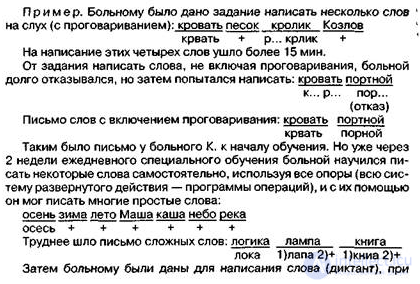
this he was not permitted to use the cut-out alphabet. In this case, the number of errors and the time taken to write increased:

From the protocol it is evident that excluding one of the operations from the program greatly complicated the process of writing, which indicates the necessity of carrying out all the operations in sequence.
Gradually the patient's writing action became shortened: he pronounced the word only by syllables (having dropped letter-by-letter pronunciation), almost eliminated reliance on his fingers in the quantitative analysis of the word's composition, and his pronunciation became shorter (without repetitions). As a result, the speed of writing increased.
By the end of the second week of training, the patient had mastered the method of writing individual words and began to use it independently. The method (program) itself was significantly reduced. The patient wrote many words while pronouncing them in a whisper.

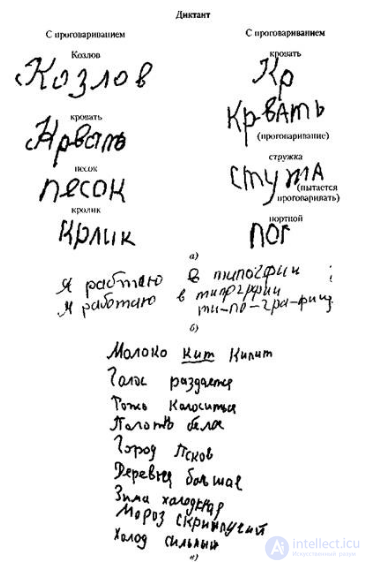
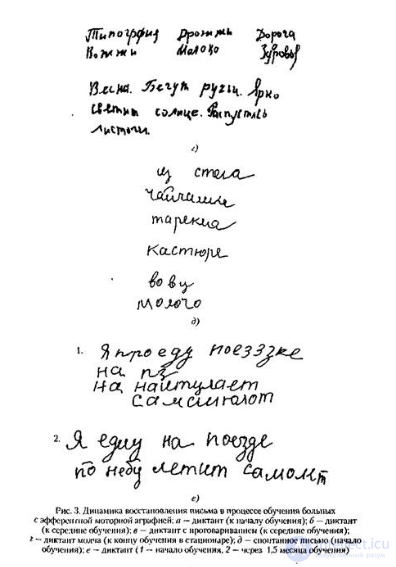
After the patient's evident success, he began to be taught to write whole phrases. Work on the phrase proceeded in parallel with work on restoring oral speech. By the end of the 2nd month of training, the patient could write short dictations. For example: «Autumn. The leaves have turned yellow. It is raining. There is mud underfoot. There are threatening clouds in the sky.» He wrote simple words almost always silently by this point; when writing more complex words he resorted to whispered speech, and in difficult cases he invariably resorted to pronouncing aloud. This last method was not the only one of the remaining external supports in writing. In lengthy dictations or ones difficult in composition, or in independent writing, the patient resorted not only to pronunciation but also to counting the sounds with his fingers or with a graphic schema. In doing so, his writing was almost error-free. We were unable to achieve automatization of the writing skill at the level of "in the mind," although the process of writing became significantly more reduced in the composition of the auxiliary operations it included and proceeded more quickly. Whereas at the beginning of training the patient had required 15 minutes to write four words, and 12 minutes for a phrase consisting of three words, by the end of training the patient could write 30 words in 15 minutes, and could write 4—5 sentences of three words each in 12 minutes. The illustration shows the dynamics of writing in the course of the patient's training (Fig. 3).

Comments