
Lecture
Methods for restoring the understanding of the composition of number
A brief psychological analysis of the disorder of the concept of number and counting in lesions of the parietal regions of the left and right hemispheres of the brain points to a connection between this disorder, on the one hand, with defects of spatial representations, and on the other — with defects in the systemic character of perception and representations. The latter defect manifests itself equally in intellectual operations (in counting), and, in lesions of the left hemisphere, in speech as well.
Indeed, in semantic aphasia, in whose syndrome primary acalculia as a rule occurs, in lesions of the parietal regions of the left hemisphere the central defect is an impairment in understanding complex logico-grammatical structures, i.e., an impairment in understanding the meaning carried not by individual words, but by words that have entered into certain connections, into a system, whereas decoding the meaning of individual words outside a system of complex relations remains accessible to the patient. Fundamentally the same factor — an impairment of understanding due to defects in the systemic relations of elements — is also found in the counting function of this group of patients. This is manifested above all in an impairment of awareness of the composition of number and its place-value structure, while individual digits can still be recognized, as can the meaning of numbers with a simple place-value structure.
By restoring the understanding of the meaning of number and the ability to operate with it, we thereby promote the restoration of more complex processes — the processes of the systemic perception of number. Teaching counting in these cases must proceed together with overcoming not the sensorimotor defects of speech, but that level of it which is connected with the encoding and decoding of complex systemic verbal connections, above all syntagmatics rather than paradigmatics.
It is important to note that training in counting and counting operations should be carried out with all patients with lesions of the parietal systems of the brain, even with those who do not immediately show defects in counting operations. During examination they can often solve simple problems given to them, and sometimes even complex ones (with carrying over a ten). These abilities may be related to the preservation of many skills consolidated and automatized in past experience. However, a detailed neuropsychological study of the state of counting and counting operations in the course of training shows that the remaining abilities are unsystematic, fragmentary, and that the general structure of the patients' counting activity turns out to be impaired. These impairments manifest themselves in an increase in the time patients require to solve problems, in a large number of errors and their specific character, in the inclusion of speech (vocalizing) in the process of solving, in the instability of the skill of solving arithmetic problems, in the complete inaccessibility of mental arithmetic without visual support, and so on. These and other symptoms already point to the need for restorative training of patients in counting.
As noted above, on the basis of lesions of the parietal and parieto-occipital regions of the cerebral cortex, a primary breakdown of the concept of number arises; awareness of the interaction of numbers within the decimal system and understanding of the dependence of the magnitude of a number on its place-value structure or on the position of the number in space are impaired, and all of this leads to an impairment of counting operations.
Methods for restoring counting in parieto-occipital acalculia must be aimed above all at restoring the concept of number, i.e., such components of it as the composition of number and its place-value structure. For this purpose the following methods of restorative training are used. In cases of the most severe acalculia, patients sometimes show an impairment of awareness of the connection between a concrete quantity and the abstract number denoting that quantity. In such cases, restorative training is best begun precisely with practicing the understanding of the quantitative meaning of number. These impairments occur fairly often and are characteristic of patients who, alongside local lesions, also have general cerebral disturbances. This defect is especially common in children of primary school age. Here a variety of methods are useful, which ensure understanding of the correspondence between numbers written on cards and the corresponding quantity of real objects. Effective in this case are the method of the concreteness of number and the method of acting with number. Their use promotes the restoration of awareness of the quantitative characteristic and the internal composition of number. To this end, the system of the ten, the concept of the complementary number is practiced with the patient.
The method is implemented by means of the technique of breaking a number into parts and the technique of named numbers.
Procedure. The patient is given the task of dividing a certain quantity of objects lying in front of him (for example, 6) into 2 equal parts (3 each). Next to the given quantity of objects lies a card on which the number denoting it, 6, is written, and a stack of cards on which other numbers from the first ten are written. The patient must find the card with the number corresponding to the quantity of each half (3) and place it next to the corresponding quantity. The patient then writes down in the notebook the number 6 as 3 sticks + 3 sticks. The patient is then asked to divide the same quantity of objects into 2 unequal groups — one group larger, the other smaller. The same series of operations is repeated again, constituting the program of the action being practiced: a) the given quantity is split into two groups; b) the corresponding numerical designations are found; c) the two numbers found are compared and checked against the original number 6; d) the result of the comparison is recorded in the notebook next to the first entry, and so on. These entries look as follows: 6 p. = 3 p. and 3 p.; 6 p. = 4 p. and 2 p.; 6 p. = 1 p. and 5 p. (where "p." stands for "sticks").
These actions for analyzing the composition of number at the object level must be carried out with numbers not only of the first ten, but also of the second, and sometimes the third. Work on the awareness of the composition of number with reliance on real objects is carried out only within the first ten. Analysis of the composition of number within subsequent tens is carried out only with the abstract number.
Technique: a card with a given number lies in front of the patient; he must select all possible variants of numbers that make up the given number, using the corresponding cards. A series of such operations makes it possible to restore in the patient an awareness of the number itself, its composition, and the ability to operate with number without reliance on real objects. This series of operations must be carried out with all patients who have parietal or parieto-occipital acalculia, even in the absence of visible gross defects of counting.
In order to restore any action, in particular the ability to operate with the composition of number, it is important and necessary not only to find adequate methods and techniques of training, but also to create the necessary conditions for the interiorization of a mode of action set from outside. Interiorization is not a simple shifting of this or that HMF into the internal plane of consciousness, but the formation of this internal plane (A.N. Leontiev). In the internal plane, external activity reveals actions that are not present in the external one, i.e., in the internal plane a transformation of activity takes place. It is precisely for this purpose that we reconstruct the internal structure of the action and bring it out into the open in the form of a series of successive operations. Then we gradually shift the mode of performing the action being practiced from the level of the material form of the action (actions with objects) to the materialized level (first the recording of the results obtained, and later work with cards on which digits are written), then to the level of loud speech (the given number is broken down into the possible combinations of numbers making it up only in oral speech), then this action is shifted to the plane of whispered speech, and later — of speech "to oneself." Only this form and content of the work can bring success in the restoration of counting, including the understanding of the composition of number.
The defect described is often accompanied by an impairment of the naming of numbers, occurring either in the syndrome of amnestic aphasia, in which case the patient forgets the names of numbers, or in the syndrome of afferent motor aphasia — in which case the patient cannot find the corresponding speech (motor) formulation of the number and of operations with it. Therefore, in parallel with the restoration of understanding of the scheme of the ten, work must be carried out on the naming of number. The work set out above already contributes to some degree to the restoration of the naming of numbers, but since this defect is often gross and persistent, special attention must be paid to overcoming it, and special methods must be applied.
For example, for this purpose the method of correlating the name-word with a number of the natural series can be used, in which ordinal counting is employed — in order to isolate individual name-words for numbers (in the process of counting through the natural series of numbers) with simultaneous correlation of the name-word with the designation of the number, which makes it possible to create the necessary conditions for consolidating the number — word (name) connection. In some cases the method of linking the optical image of the number with the first letter of its name proves effective. These letters, in turn, are introduced into certain words that are emotionally close and familiar to the patient. For example, the name of the number 7 is often restored by linking the image of the number 7 with the letter С (1 — С), and of the number 8 with the letter В etc. (Table 1). At the same time it is desirable to introduce the isolated sound-letters С, В into words close to the patient, for example: С — Sasha — son, В — Vera — wife, etc.
Table 1. Practicing the naming of numbers of the first ten (the method of engrams)
Digit |
Corresponding letter |
Word close to the patient |
Extraction of the 1st sound of the word |
Naming of the digit |
Digit |
1 |
Е (E) |
Елена (Elena, wife) |
е (e) |
е... единица (edinitsa, "one") |
1 единица (edinitsa, "one") |
2 |
g |
Дима (Dima, son) |
д (d) |
Д... два (dva, "two") |
2 два (dva, "two") |
3 |
т (t) |
Таня (Tanya) |
т (t) |
т... три (tri, "three") |
Зthree |
4 |
ч (ch) |
человек (chelovek, "person") |
ч (ch) |
ч... четыре (chetyre, "four") |
4 четыре (chetyre, "four") |
7 |
С (S) |
Сеня (Senya) |
с (s) |
с... семь (sem', "seven") |
7 семь (sem', "seven") |
8 |
В (V) |
Витя (Vitya) |
в (v) |
в... восемь (vosem', "eight") |
8 восемь (vosem', "eight") |
9 |
g |
дочка (dochka, "daughter") |
д (d) |
д... девять (devyat', "nine") |
9 девять (devyat', "nine") |
The restoration of the naming of numbers of the second and third tens is an independent task, and its solution is connected with the restoration of the perception of spatial relations, since the cause of this impairment is most often defects of spatial perception (Table 2).
Table 2. Practicing the naming of numbers of the second ten
Number |
Composition of the number |
Formation of the name |
|
11 |
10+1 |
10 + 1 десять - на - один (дцать) (ten - na - one (-teen) — "eleven") |
11 <— один-на-дцать (odin-na-dtsat' — "eleven") |
15 |
10 + 5 |
10 + 5 дцать - на - пять (-teen - na - five — "fifteen") |
15 пять-на-дцать (pyat'-na-dtsat' — "fifteen") |
Table 3. Generalized scheme for the naming of number
1st ten |
2nd ten right — left <— |
3rd ten left — right — > |
4th ten left — right — > |
1 — один (odin, "one") |
11=1+ 10 один-надесять (дцать) (odin-nadesyat' (-dtsat') — "eleven") |
20 + 1=21 двадцать один (dvadtsat' odin — "twenty-one") |
30 + 1=31 тридцать один (tridtsat' odin — "thirty-one") |
2 —два (dva, "two") |
12 = 2 + 10 две-на-дцать (dve-na-dtsat' — "twelve") |
20 + 2 = 22 двадцать два (dvadtsat' dva — "twenty-two") |
etc. |
3 - три (tri, "three") |
13 = 3 + 10 три-на-дцать (tri-na-dtsat' — "thirteen") |
20 + 3 = 23 двадцать три (dvadtsat' tri — "twenty-three") |
|
4 — четыре (chetyre, "four") |
14=4+10 четыр-на-дцать (chetyr-na-dtsat' — "fourteen") |
20+4=24 двадцать четыре (dvadtsat' chetyre — "twenty-four") |
|
5 — пять (pyat', "five") |
15-5 + 10 пять-на-дцать (pyat'-na-dtsat' — "fifteen") |
20 + 5 = 25 двадцать пять (dvadtsat' pyat' — "twenty-five") |
|
6 — шесть (shest', "six") |
16=6+10 шесть-на-дцать (shest'-na-dtsat' — "sixteen") |
20 + 6 = 26 двадцать шесть (dvadtsat' shest' — "twenty-six") |
|
7 — семь (sem', "seven") |
17=7 + 10 семь-на-дцать (sem'-na-dtsat' — "seventeen") |
20 + 7 = 27 двадцать семь (dvadtsat' sem' — "twenty-seven") |
|
8 — восемь (vosem', "eight") |
18=8+10 восемь-на-дцать (vosem'-na-dtsat' — "eighteen") |
20+8 = 28 двадцать восемь (dvadtsat' vosem' — "twenty-eight") |
|
9 — девять (devyat', "nine") |
19=10+9 девять-надцать (devyat'-nadtsat' — "nineteen") |
20+ 9 = 29 двадцать девять (dvadtsat' devyat' — "twenty-nine") |
|
10 — десять (desyat', "ten") |
10+ 10 = 20 два-дцать (dva-dtsat' — "twenty") |
10+ 10+ 10 = 30 три -дцать (tri-dtsat' — "thirty") |
The patient is offered a scheme that contains the rule for forming the name-word of a number and the direction in which the naming of a compound number proceeds (Table 3). The table gives a series of operations and their sequence, which the patient must perform before naming the given number. The program of actions presented in the table consists of an expanded series of operations that constitute a way of actualizing the naming of number. Gradually, in the course of training, this way is reduced in its composition of operations, is interiorized by means of a gradual shifting of the action from one level to another, higher one, and becomes the patient's own possession. After training, the patient independently 'continues to use this method successfully.
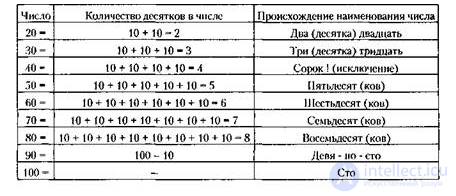
The table is practiced in parts, first its first part, then the second, third, and fourth. Practicing the names of numbers within each ten proceeds throughout in comparison with the naming of numbers of the following ten. In these patients, understanding of the names of numbers denoting tens is often very difficult. The restoration of the naming of tens likewise proceeds by way of disclosing the content of the composition of the number reflected in its "name." For example, the scheme for practicing the understanding of the name of the number 50 looks as follows: 50 = 10 + 10 + 10 + + 10 + 10 = 5 х 10 = пять десят (ков) (pyat' desyat (kov) — "fifty") (Table 4).
Table 4. Practicing the naming of tens
Methods for restoring the place-value structure of number
The most persistent and frequently occurring defect in parieto-occipital acalculia is an impairment of understanding of the place-value structure of number. Special attention is therefore paid to this defect in restorative training. Work on restoring the names of numbers within the first hundred helps to restore an understanding of the existence of two place values — tens and units. Patients begin to understand that a two-digit number within the first hundred always consists of tens and units, which is reflected in the naming of the number. In addition, they master the general rule for naming numbers, which points to the fact that reading (naming) a number always begins with the higher place value and proceeds toward the lower one (cf. 25, 35...95). Patients master the scheme for naming numbers of the second ten, which has the reverse direction — from the lower place value to the higher one (cf. 19, 15, etc.) — as an exception to the general rule for naming numbers. The connection between the name of a number and its place-value structure is used at first to restore an understanding that every compound number consists of different place values, which is reflected in its name.
The method of correlating the name of a number with its place-value structure helps to restore an understanding that all place values are reflected in the name of a number, that each place value has its own name, and finally that the name of a place value reflects its magnitude and its position in the place-value grid. For example, in 125, 100 is greater than 20, and 20 is greater than 5. This work necessarily proceeds together with restoring the patient's understanding of the quantitative interdependence of place values. For this purpose a series of exercises is carried out, by means of which the quantitative content of a number and the quantitative relations between its place values are disclosed. Using this method, a large number of various exercises are carried out that help the understanding of the connection between the place-value structure of a number and its name, and with the quantitative aspect of the whole number and of its individual place values.
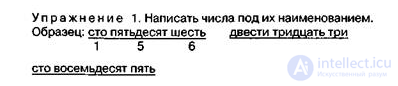
Exercise 2. Write the names of the given numbers.
Exercise 3. Reconstruction of a number. Given: one hundred fifty-six. From the three given words: a) write the possible variants of numbers by permuting the digits (516, 165, etc.), b) write their names, c) write all the numbers obtained in a row in order of increasing magnitude (in order of decreasing magnitude), d) explain how and why the magnitude of one number differs from another.
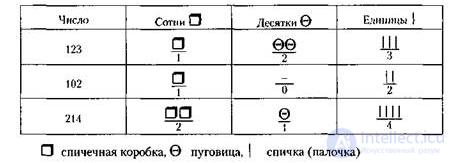
These exercises lead to the possibility of working directly on restoring the place-value structure of number. Here one can use methods, known in the literature, for teaching children the place-value structure of number and operations with numbers (V.V. Davydov, 1957, 1958, 1967; N.N. Nepomnyashchaya, 1957, 1960). The main task of these methods is to teach the patient an understanding of the transition of one place value into another and of their quantitative interrelations. The first two or three sessions (no more) are conducted with reliance on real objects (the so-called stages of the materialized form of action). Unlike teaching in children, for our patients this stage of the work is needed only as a visual means of actualizing preserved knowledge about the structure of number, rather than for a lengthy and sequential process of teaching this, as is the case with children. Over the course of several sessions the patient works on independently breaking down a given quantity of objects (sticks, matches, etc.) assigned to him into place values, relying in doing so on knowledge of how many and which units go into each place value. For example, the patient is given 15 sticks and the task — to break them down into tens and units. The patient sets aside 10 sticks to the left and 5 to the right. He replaces the ten sticks with a cardboard square, which will from then on denote one ten, and moves 5 sticks up to it, which denote the units; after this the patient names the given number and writes it down in the notebook, and in the place-value grid writes out the expanded scheme of its construction:

The patient performs the same series of operations with numbers of the second ten as well. The patient is given any numbers of the second ten (25, 28, etc.), and he must unfold their quantitative content in the same way: set aside 2 tens of sticks to the left, separately from one another, then replace them with two cardboard squares, move the remaining quantity of units up to them, make the corresponding entries, and so on. After the constructed pattern of a two-digit number has been firmly mastered, exercises with a three-digit number are carried out, i.e., with a number consisting of three place values. Here counting proceeds directly by tens. By this time patients usually already know that 100 consists of 10 tens. Therefore, instead of the required quantity of sticks ("units"), they first place 10 squares on the left, together denoting a hundred, and then replace them with a matchbox, into which all 10 squares are placed. And from this moment the box denotes 1 hundred, or 10 tens. When given the task of composing the number 123, patients place 1 matchbox denoting the hundred, 2 buttons denoting the tens, and 3 matches (sticks) denoting the units (Table 5).
Table 5. Restoration of the place-value structure of number
These exercises are very useful, but not much time should be devoted to them. After the general principle of the construction of a number has been mastered, one must move on directly to working with the number without reliance on its quantitative aspect, for which the place-value grid is used.
The method of the place-value grid includes a number of techniques and exercises that help master and consolidate the action or mental process being restored. The goal is to restore an understanding of the place-value structure of number. Techniques of preliminary work on a number outside the place-value grid:
1) analysis and breakdown of given numbers by place value outside the place-value grid,
2) the technique of filling an empty place (place value) in a number, i.e., the technique of restoring an understanding of the meaning of zero,
3) the technique of permuting digits within the same number to obtain new numbers,
4) the technique of comparative analysis of the numbers obtained (place-value and quantitative).
After the acquired skills have been consolidated, one can move on to working with the place-value grid itself. Here too the most varied exercises are possible. For example, entering given numbers into the place-value grid, strictly adhering to place values. Understanding of the relations among place values within a number is greatly helped by exercises in which the patient is given the same digits (or a single one), which, by being entered into the place-value grid, are turned into a number and, each time, into a different one (in its quantitative essence) depending on the place they occupy in this grid. For example, the patient is given two digits — 1 and 2. He enters them into the grid and names the numbers obtained. Empty cells are at first left unfilled, and a dash is placed. Then work proceeds on the meaning of zero in a number; an understanding is developed of the quantitative essence of zero as an indicator of the absence of a quantity in some place value (105; 150). And after this, the dashes (small lines) in the numbers are replaced by zero (Table 6).
Table 6. Restoration of the place-value structure of number
Hundreds of thousands |
Tens of thousands |
Units of thousands |
Hundreds |
Tens |
Units |
Number |
1 |
2 |
12 |
||||
1 |
2 |
_ |
120 |
|||
1 |
- |
2 |
102 |
|||
1 |
- |
2 |
_ |
— |
_ |
102000 |
With the help of these techniques and exercises, the patient's awareness of the dependence of the value of a number on its place in the place-value grid, i.e., in space, is restored, and an understanding of the meaning and place of zero in the notation of a number is likewise restored. This knowledge is consolidated in a whole series of exercises in which the patient is again required to analyze the place values of a given number, again outside the place-value grid. For this the patient must carry out the following tasks: a) name the place values of which a given number consists, b) point out at random where the tens, thousands, units, etc. are in a given number, c) form a two-digit number or any other compound number, d) name the place value omitted in a given number (1 -595, 1-5, -6, etc.), e) write the given numbers 25, 384, 108, 10590 one under another in a column and read the number, etc.
There exist still many varied methods, techniques, and exercises for restoring an understanding of the place-value structure of number, but the principle underlying the construction of the methods is one and the same. What is characteristic of all these methods is a common orientation toward restoring the patients' awareness of the dependence of the value of a sign (number) on its place in space.
Thus, the work we have described for restoring counting and counting operations includes teaching patients: a) understanding of the composition of number, the interdependence of numbers, their systemic character and integrity, b) the naming of numbers, c) understanding of the connection between the name and the place-value structure and the quantitative aspect of number, d) understanding of the place-value structure of number itself and of the dependence of the magnitude of a number on its position in space. All this leads to the restoration of the concept of number and creates the basis for restoring computational operations.
Methods for restoring counting operations
An impairment of the concept of number cannot fail to lead to defects in counting operations, since the performance of the arithmetic operations of addition, subtraction, multiplication, and division requires knowledge of the place-value structure of number, of the scheme of the ten, i.e., the ability to complement one number with another within the ten, and so on. For the correct course of the counting process, the preservation of spatial representations of the direction of subtraction and addition is also necessary. In patients of the group described, counting operations are impaired precisely in connection with defects in both of the above-mentioned links in the structure of arithmetic operations.
Teaching patients counting operations requires lengthy, directed work and begins already during the work on restoring the concept of number. Here patients, as we have seen, are taught to break a number down into its constituent parts (the composition of number), and to complement a number within the ten. At this same stage patients are also taught a conscious attitude toward the place-value structure of number, and an understanding of the place and meaning of zero. All of this creates the necessary conditions for restoring counting operations.
Special training of patients in counting (performing arithmetic operations) is best begun with the simplest and least impaired operations, first within the first ten, then the second. Addition and subtraction operations are carried out without carrying over a ten, and multiplication and division are performed on the simplest single-digit and two-digit numbers. This work takes 3—5 sessions. The difficulties of restorative training with the use of various creative methods and techniques begin when patients are taught subtraction and addition with carrying over a ten. The operation of addition or subtraction within a single ten is simple in its composition, consisting of a single operation (cf.: 10 - 2 = 8, 15 -5 = 10, 15 + 2 = 17, 23 - 3 = 20, etc.), as are operations with "round" numbers (10+ 10, 20- 10, 50-40 + 10). The same arithmetic operations with numbers requiring carrying over a ten are more complex in their mathematical and psychological composition: they include several operations. A study of the counting skills of patients in this group has shown that what is impaired in them above all is precisely the ability to perform these arithmetic operations, which require an analysis of spatial schemas. These patients are not always able consciously to break an arithmetic operation down into its constituent operations. Overcoming this defect is the main task of the next stage of training. By this time patients must already know the scheme of the ten and be able to break a number down into its constituent parts, and be able to round numbers to the nearest ten (cf.: 18(+2) = 20; 12(-2) = 10). Work on restoring the operations of "rounding" numbers must be carried out before this stage of training, since when solving arithmetic problems that require carrying over a ten, they act as concrete links in the structure of the solution.
There are different ways of rounding a number to a ten. Therefore, a number of sessions must first be devoted to the patient's actualizing "his own" way. To this end the patient is taught different ways of rounding, and from the effectiveness of performance (more accurate counting, less time expended, confidence in the actions, etc.) one can judge which way is more accessible to the patient (or the actualization of his own way).
For example, 15-7. 1st way: 7 = 5 + 2 (rounding to 5), 2nd way: 7 + 3 = 10 (rounding to 10). The work must be begun with the help of the method of restoring the composition of number (see above), using the technique of comparing the magnitude of numbers.
Task. Indicate which number is greater or smaller (place the corresponding sign): 8 ... 10; 7 ... 10; 10 ... 6; 20 ... 17; 15 ... 20, etc. The technique of quantitative evaluation of the difference between numbers (the same numbers are given). Given: 8 and 10. Performance by the patient: 8 < 10. Question: by how many units? "By 2"; given: 20 and 17; 20 > 17. By how many units? "By 3". The technique of rounding a number. Task: round the number 17 to 20. Operation: 17 + 3 = 20.
At this stage the work must be carried out only with numbers and at the speech level.
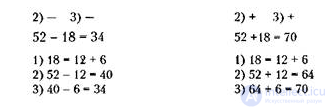
After teaching the patient the concept of number and the concrete operations of "rounding" numbers, one can move on to work on the patient's awareness of the step-by-step solution of an arithmetic problem. By this time the patient already understands, thanks to the skill practiced earlier, that when performing operations with numbers that require carrying over a ten, the second number (the subtrahend or addend) must be broken down into two numbers making it up (by rounding), which are then successively entered into the corresponding operations that make up the content of the arithmetic operation. Proceeding from this understanding, patients are taught to break an arithmetic operation down into successive operations — first at the verbal level: the patient, together with the teacher, and then independently, writes out the program of operations: a) round the number, b) subtract (or add) one part of the number, c) add (or subtract) the second part of the number. The program is then carried out. An example is given: 52 - 18. The patient performs all the operations according to the verbal program, carrying out each operation while at the same time saying aloud: a) "I round the number 18 to 20. 18(+2) = 20; b) now I must subtract the number obtained, this is one part of 18(+2) = 20; 52 - 20 = 32; c) and now I add the second part of the number 32 + 2 = 34."\
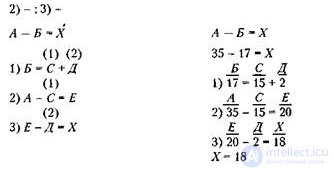
No less effective is teaching a way of solving such problems, which requires patients to have the ability to equate the units of the subtrahend (or addend) with the units of the minuend (or the first addend). Then the composition of the operation takes on the following form.
At the top a reminder is written: in the second and third operations one must subtract or add:
Teaching the solution of arithmetic problems in addition and subtraction with carrying over a ten should begin with the maximally expanded action, with simultaneous loud vocalizing of the solution and reliance on external means — diagrams, notes. Later, after this form of the action has been consolidated, one can move on to the gradual reduction of the action by removing the first operation from the written record and shifting it to the level of loud speech, i.e., this operation is not written down but only spoken aloud. Later the second, and then the third operation, are shifted to the level of loud speech, and all the operations are spoken aloud by the patient but are not written down. In the same way, gradually and successively, the arithmetic operation is shifted to the level of whispered speech, and then to the level of performing it "to oneself."
In cases of difficulty, all the operations (or some of them) should again be shifted to the level of loud speech, and sometimes even to the materialized level of carrying out the solutions (writing down the operations).
The method described makes it possible to create in the patient a way of solving arithmetic problems (or of counting) which, owing to the gradual reduction of the internal composition of the action and its shifting from one level to another, becomes the patient's own possession. The process of restoring counting operations, as we wrote above, is best begun with clarifying the individual ways of performing arithmetic operations characteristic of each patient. Establishing the ways of performing arithmetic operations that patients used before their illness, and which should represent stereotypes consolidated in past experience, is a necessary moment in training, since the use of an old, consolidated way is always more effective than the creation of a new skill.
Teaching a new way of solving arithmetic problems should be resorted to only in cases where it has not been possible to identify the former stereotypes. In the practice of training one often has to deal with the fact that a patient's old, personal way of solving is recalled in the course of, and as a result of, teaching him a new way of performing computational operations. The actualization of the former skill not only does not hinder training but, on the contrary, creates more favorable conditions for the creation, not of a concrete, but of a generalized way of performing computational operations.
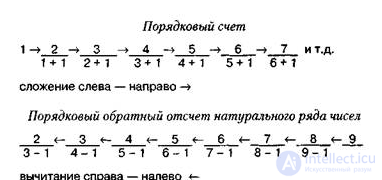
In parallel with restoring the general scheme for solving arithmetic problems in addition and subtraction with carrying over a ten, work must proceed on restoring awareness of the direction of counting, the ability to analyze the spatial schemas of counting. The patients' loss of direction in counting often leads to the fact that, having subtracted one part of the rounded subtrahend from the minuend, they become confused and often do not know what to do with the remaining part of the subtrahend — whether to subtract it or add it. Our studies show that in some patients the operation of addition is experienced as an operation directed forward (i.e., to the right >). It is possible that this understanding is connected with an awareness of the construction and reading of the natural series of numbers, which gradually increases from left to right, and whose notation likewise proceeds from left to right. The operation of subtraction is associated in them with a notion of movement in the opposite direction (to the left), toward the decrease of numbers in the natural series.
For restoring awareness of direction in counting operations (in calculations), taking into account, or specially developing, these spatial representations of the operations of addition and subtraction proves not to be without use. To this end patients first practice the schematic depiction of the direction of the operations of subtraction and addition. These records look as follows. The natural series of numbers — the process and direction of obtaining the next number in the natural series.
In addition, in the process of restoring arithmetic operations it is useful, from the point of view of taking into account the defect described, to make use of rounding the units of the subtrahend (or the second addend) to the units of the minuend; then it is easier for patients to grasp that in both the first and the second operation one must subtract. To facilitate mastering the principle of solving arithmetic problems, a general scheme — a table should be written on a card, with the necessary operations marked at the top.
The operations of multiplication and division likewise need to be restored. And here the general methodological principle is the breaking down of the integral, collapsed act of multiplication into its constituent operations, with subsequent reduction and interiorization of the action and automatization of its performance. For this, patients are taught to become aware of the internal content of the operation of multiplication through solving problems by the expanded method of addition: 1) 15 = 5 + 5 + 5 = the five is repeated 3 times = 5*3 = 15; 2) 15 = 3 + 3 + 3 + 3 + 3 = five times 3 = 5x3=15.
Such patients are taught division on the simplest numbers, likewise by means of unfolding the content of the operation of division. Patients are given a concrete scheme of division: 15:5= 15-5(1) = 10- 5(2) = 5-5 = 0, hence, 15:5 = 3.
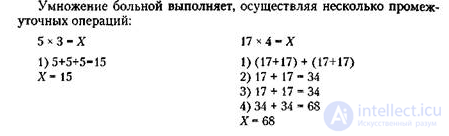
Later this action is gradually reduced, the written record of the intermediate operations is removed, and each operation is replaced by vocalizing. It is precisely this expanded way of multiplying that helps the patient once again become aware of the content of the multiplication table and master it. The transition to multiplying (and dividing) large numbers is possible only after these counting processes and the multiplication table have been firmly mastered, but not simply memorized by rote, after an awareness of the interdependence of these two arithmetic operations, and after the restoration of the ability to check the results of multiplication by division and vice versa.
This section has described impairments of the structure of counting and counting operations that arise from lesions of the parietal and parieto-occipital regions of the cortex of both the left and the right hemispheres of the brain. The differences consist only in the absence of an impairment of the naming of numbers in patients with lesions of the cortex of the right hemisphere. The main directions have been outlined, and only some concrete methods of restorative training for this type of acalculia have been described. Below we turn to the analysis of concrete case observations.
Analysis of the dynamics and methods of restoring counting in primary acalculia
Patient B. (case history No. 34365, 40 years old, with higher education, profession — teacher) suffered a circulatory disturbance in the system of the left middle cerebral artery. By the time restorative training began, the patient presented a syndrome of semantic aphasia, residual elements of afferent motor and sensory aphasia, disorders of spatial praxis and gnosis, and acalculia, predominantly parietal.
In this patient, what attracted attention first of all was a gross impairment of the concept of number. The patient perceived each number as a single, indivisible whole; he completely lacked an understanding of the internal composition of number, and could not answer the question of which numbers made up a given number presented to him, even within the first ten. Understanding, and consequently the construction, of different variants of combinations of different numbers (or of the same numbers) that invariably lead to one and the same final number (for example, 5 = 1 and 4, 4 and 1, 2 and 3, 3 and 2, etc.) was completely inaccessible to him.
Before restorative training, counting by tens (10, 20, 30, 40, etc.) was also completely inaccessible to the patient; he completely lacked the ability to break round numbers down into tens. The patient did not understand, for example, that the number 20 is two tens, and that the number 30 means three tens, etc. In this patient, understanding of the systemic structure of numbers, of their internal connection and interdependence, was completely impaired, and the ability to operate with the abstract number had likewise broken down. He could still perform certain of the simplest operations with concrete (object) numbers and understand, for example, that 5 apples is 3 apples and 2 more apples, or 4 apples and one more apple, but an awareness that the number 5 is 4+1 or 3 + 2, i.e., that it can be represented as a combination of two or three other abstract numbers, was inaccessible to the patient, which points to an impairment of operating with number as a sign. He retained only fragmentary, unsystematic knowledge about number and certain automatized skills — the ability to operate with numbers within the first, and sometimes the second, ten, predominantly with concrete (object) numbers. The impairment of the concept of number in this patient was further aggravated by speech difficulties, manifested both in defects of the acoustic perception of number and in motor-kinesthetic difficulties in naming it.
Recognition and naming of number, despite the absence of the mnestic and optic defects of number perception found in the patient with occipital acalculia (see above), was in this patient likewise defective, but because of speech disorders. The patient constantly confused, both in recognition and in naming, such numbers as шесть (shest', "six") and семь (sem', "seven"), двенадцать (dvenadtsat', "twelve") and двадцать (dvadtsat', "twenty"), девять (devyat', "nine") and десять (desyat', "ten"), шесть ("six") and четыре (chetyre, "four"), семь ("seven") and четыре ("four"), сорок (sorok, "forty") and семьдесят (sem'desyat, "seventy"), etc. He experienced practically insurmountable difficulties of differentiation, in both speech perception and speech production, with such pairs of numbers as 2-20, 2-12, 2-200, 8-18, 8-80, 8-800, 20-18, 20-80, 12—18, and others. Differentiated perception of such combinations of sounds as два (dva, "two") (in двадцать), две (dve, "two," fem.) (in двенадцать, двести), во (vo) (in восемнадцать, восемьдесят, etc.), as well as дцать (-dtsat') (in двадцать, тридцать, etc.) and надцать (-nadtsat') (пятнадцать, девятнадцать etc.), was inaccessible to the patient. Consequently, the evaluation of numbers could not fail to be impaired.
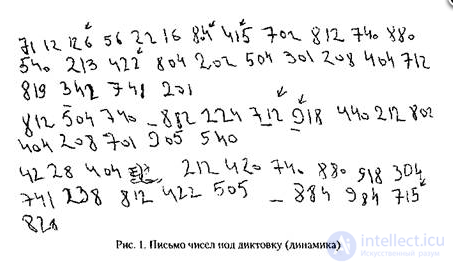
This defect in recognizing, naming, and evaluating numbers was based not only on the speech factor but also on impaired understanding of the place-value structure of number. The patient constantly confused numbers of the second ten with other numbers. For example, he might confuse the number 15 with 50 and vice versa; instead of 19 the patient might name and write 900 or 90, instead of 13 — 30, instead of 16 — 60, etc. However, he also made many errors caused solely by defects of the place-value structure of number. Thus, for example, the patient wrote the number 110 as 10010, and the number 156 as 10056, and often refused altogether to write the given numbers. Grasping the meaning of and reading such pairs of numbers as 71 and 17, 42 and 24, etc. presented an insurmountable difficulty for him. The patient read the number 140 as 104. Patient: «One hundred four, but I don't know this zero». 108 — «one hundred... one hundred... and again I don't know this zero» (Fig. 1).
Naturally, given such an impairment of the concept of number, i.e., given the impaired understanding of the composition and place-value structure of number, with a complete absence of understanding of the meaning of zero, the operations of calculation could not remain intact either. In our patient the multiplication table turned out to be completely impaired. The automated, abbreviated method of multiplying single-digit numbers, consolidated through past experience, had disintegrated. The conscious operation, and the understanding of its inner content, had disintegrated and become impaired. The patient could not replace the abbreviated form of multiplication, for example 15 = 3 x 5, with the expanded form 15 = 3 + 3 + 3 + 3 + 3, which constitutes the inner composition of the operation of multiplication. This defect in turn led to a complete failure to understand the operation of division and its connection with multiplication. Thus, even in the course of training the patient could make errors indicating a complete breakdown of the operations of division and multiplication. Given the task of multiplying 3 by 6 (3 * 6 =) with subsequent verification of the result by division, the patient proceeded as follows: 3x6= 18, verification 3:6= 19, or 4 x 9=36, verification 4 :36 = 9. This attests to the complete disintegration of operations with abstract number, to a disruption of the structure of counting, its systemic character, and the interconnectedness and interdependence of counting operations. Matters were no better for the patient with the operation of subtraction. Subtraction without crossing a ten was in principle accessible to the patient (10 - 5, 15 - 5, 28 - 8, etc.), but calculations that crossed a ten presented enormous difficulty for him, which was linked above all to defects of spatial perception. Thus, solving the example 27 - 9, the patient, after rounding 9 up to 10, deliberated for a long time over where to put the extra unit — whether to add it or subtract it (27 - 10 = 17; 17 + 1 or 17 - 1) — and uncertainly wrote: 27 - 9 = = 16. Many other arithmetic examples were solved in the same way (53 --28 = 23,34- 17 = 12, etc.).
Sometimes the patient performed calculation operations correctly by chance, but he could not independently evaluate the result of his actions, since verification likewise required performing operations that were beyond his ability (for example, 34 - 15 = 19, verification 19+15 or 34 - 19, etc.). The time taken to perform all such operations was very long. Thus, performing three simple tabular division operations (of the type 72 : 8, 63 : 7, 56 : 8, etc.) took on average, before training, 7 min. 45 sec. Solving a single example of the type 68-17 took on average 2,5 min.
A more in-depth and detailed study of the impairment of calculation operations, already in the course of training, showed that in this patient, as in other patients suffering from this form of acalculia, the understanding of the inner content and structure of the operation of subtraction or addition (crossing a ten), consisting of a series of interconnected sequential operations, disintegrates; we shall dwell on this in more detail below.
The main task of restorative learning in this case became the restoration of the concept of number (i.e., awareness of the place-value structure of number, its inner composition, the interaction of numbers, the integrity of number), as well as the restoration of calculation operations. The training comprised three stages. In the first of these, training was aimed at restoring the naming of numbers and their recognition, together with the restoration of an understanding of the relationships among the different numbers that jointly make up a single whole number.
After the relative restoration of these actions it was possible to move on to restoring awareness of the place-value structure of number, which was the task of the second stage of training. Only after this, at the third stage of training, was it possible to work on restoring the structure of calculation operations. Naturally, different methods of restoration were applied at each stage in accordance with the tasks set.
Training of the patient was conducted for an average of 10 weeks a year. The first 1,5 months of training were aimed mainly at restoring speech functions: from the onset of the illness the patient had presented severe afferent motor and sensory aphasia along with elements of acoustic-mnestic aphasia, and the work focused on overcoming speech defects and defects of understanding and pronouncing the natural sequence of numbers within the first ten. As a result of the sessions the patient acquired the ability to correctly lay out the natural sequence of numbers from 1 to 10; he already recognized some numbers of this ten by ear and named them, but the naming proceeded only from the sequence and was unstable.
Excerpt from the protocol
The patient is given cards with digits written on them and is asked to arrange them in order. The patient worked slowly, moved his lips, but performed the task correctly. He is then given the number 8 and asked to name it.
Patient. (Looks at the whole row of numbers, tries to name them one after another.) Один... это... как... д...д..ы...а...два... (pause) — "One... this... how... d-d-y-a...two..." — no, I can't.
Teacher. And what is this numeral called? (6 is given.)
Patient. Это... это... с... с... ш... нет... семь, по-моему, не знаю. — "This... this... s... s... sh... no... seven, I think, I don't know."
Teacher. Name this number. (9 is given.)
Patient. (Moves his lips, tries to say something, and cannot.) No, I can't.
Teacher. (A row of numbers is laid out in front of the patient and he is asked to find the dictated number.) Show me where the number one is.
Patient. (Points correctly.)
Teacher. Where is five?
Patient. П... п...(Points correctly.)
Teacher. Eight?
Patient. В... во... (Points to 2.)
Teacher. Nine? (Points to 10.) Eighteen? (Points to 12.) Six? (Points to?.) Four? (Points to6.)Three? (Points correctly.)
Then the patient is given the numbers of the second ten and asked to name them. None of the patient's attempts succeeded — he could not name a single number.
The protocol shows what difficulties arose for the patient both in naming numbers and in recognizing them by ear. As subsequent sessions showed, these defects were the result not only of speech disorders but also of primary disorders linked to defects in the concept of number and its connection with quantity. This was revealed in special experiments that excluded speech: the patient was given a written number and asked to place next to it the corresponding number of sticks, and conversely, if he was given a certain number of sticks, the patient had to find the number corresponding to that quantity. The operation of relating quantity to its name was preserved in the patient only within the first ten. Finding the number corresponding to a given quantity (or vice versa) within the subsequent tens was practically inaccessible to him.
Let us give an example. The patient is given the numbers 2, 5, 8, 9, 10 and is asked to place under these numbers the corresponding number of sticks. The task is performed correctly, although the time taken significantly exceeded the norm. For a given quantity of sticks (3, 4, 6, 9) the patient likewise found the corresponding numbers. The patient was then given the numbers 12, 21, 34. For the number 12 the patient placed 8 sticks; for the number 21, after lengthy deliberation, he placed 13 sticks, and was dissatisfied with his result. Asked whether he had performed the task correctly, he answered that he did not know, but that it was most likely incorrect. Subsequently he refused such tasks.
Such was the state of the counting function in the patient at the start of training. Training began with special work on restoring the naming of number. The naming of numbers was restored with the help of engrams, which we
продолжение следует...
Часть 1 3.2. Methods of Restoring Counting in Lesions of the Parietal and Parieto-Occipital Regions of the
Часть 2 - 3.2. Methods of Restoring Counting in Lesions of the

Comments