
Lecture
Acalculia (Greek negating prefix ἀ- and Lat. calculō — "I count" ) — a neuropsychological symptom manifested in an impairment of counting and counting operations due to a lesion of various areas of the cerebral cortex.
Described by the Swedish pathologist F. Henschen. It arises from a lesion of specific areas of the cortex of the dominant hemisphere of the brain (due to hemorrhage, tumor, or brain injury). In acalculia, patients confuse graphically similar digits (6 and 9, IX and XI), write, for example, 1048 as 1000 and 48, and are unable to perform oral and written counting operations. Acalculia is often combined with sensory aphasia.
In people with savant syndrome, the opposite phenomenon has been described — hypercalculia — extremely high mathematical ability , and with additional training those prone to hypercalculia can become phenomenal calculators.
Most people suffering from acalculia retain
but do not understand the principle of place value, and do not operate with generalized quantities
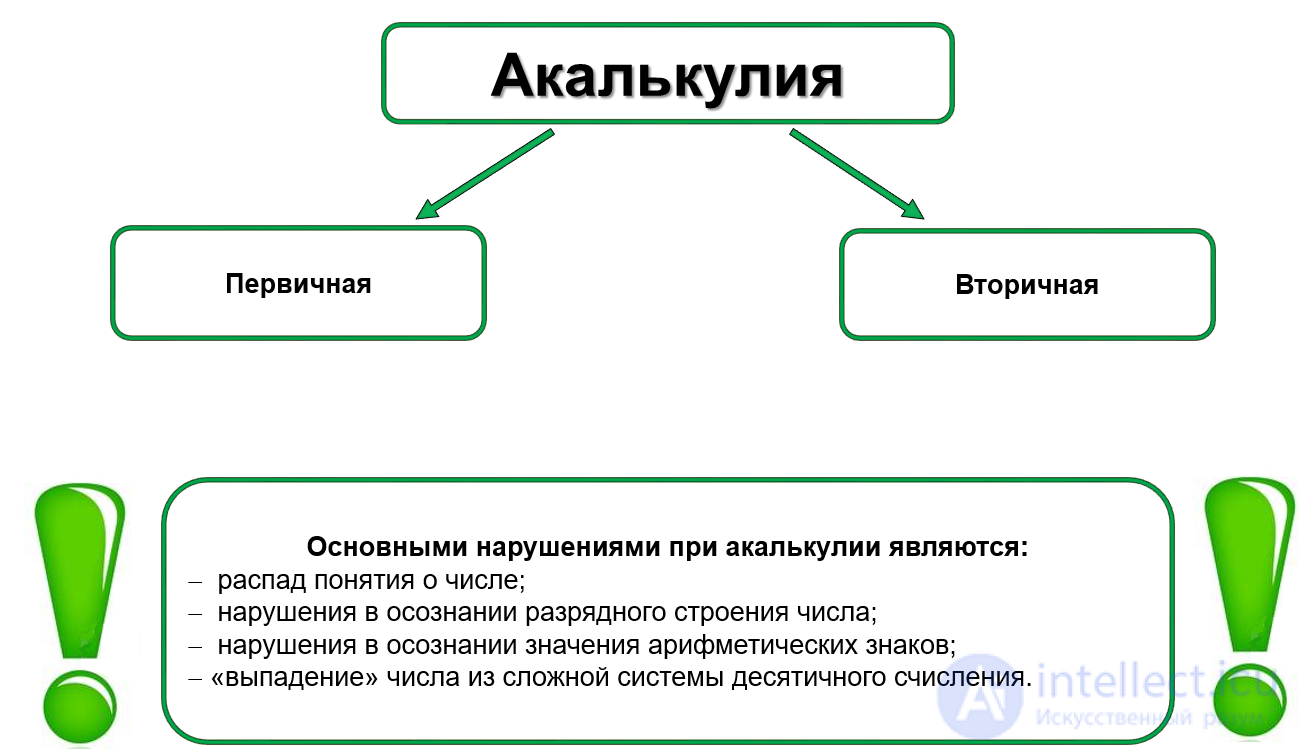
Primary acalculia is associated with a disturbance in understanding the place-value structure of numbers, difficulties in the counting operations themselves, failure to distinguish arithmetic signs, and so on; it appears as a symptom that is autonomous from other disorders of higher mental functions; it is traced to a lesion of the parieto-occipito-temporal areas of the cortex of the left hemisphere and manifests itself in impaired understanding of spatial relations.
Secondary acalculia is part of the structure of a neuropsychological syndrome, that is, it can arise in connection with other disorders of higher mental functions (agnosia, aphasia, amnesia) or with a general disturbance of goal-directed intellectual activity
In this chapter we turn to an analysis of parietal and parieto-occipital acalculia, which, unlike all the forms of acalculia described above (except the frontal one), is specific and primary. This is its main form, in which counting and counting operations are disrupted in an essential respect.
The factor (mechanism) underlying this form of counting impairment is defects of spatial and optic-spatial gnosis. It is known that in contemporary psychology, physiology, and neurology, each type of perception is regarded as the result of the work not of a single analyzer system but of several, at different levels of organization (P. K. Anokhin, N. A. Bernstein, A. R. Luria, H.-L. Teuber, A. V. Zaporozhets, V. Mountcastle, C. G. Phillips, and others). These and a number of other researchers regard perception as a functional system, and this is especially true of spatial perception, in which an entire system of brain zones is involved
Spatial perception is carried out by the tertiary zones of the posterior parts of the brain, located at the border between the occipital, temporal, and postcentral (parietal) regions of the left hemisphere of the brain, and they constitute the zone of overlap of the visual, auditory, vestibular, and cutaneous-kinesthetic analyzers. Their center is formed by fields 39 and 40 (according to Brodmann). These zones are formed only in humans and come into operation by age 7 or later. Only the joint activity of these analyzers creates, already in the child (by the end of the first year of life), the ability to orient oneself in the surrounding space. For a fuller reflection of spatial relations, the joint work of these analyzers alone proves insufficient. Further development of the perception of space proceeds in the direction of the lateralization of perception and the awareness of the body schema: the person begins to perceive space and themselves within a system of geometric coordinates. In external space, "left" and "right", "above" and "below" begin to be felt and distinguished. This development of spatial and somato-spatial sensation and perception begins to come under the marked organizing influence of speech — the concepts of "left" and "right", "in front" and "behind", and so on, appear.
Naturally, this complex system of interaction among various analyzers can become disrupted as soon as any one factor drops out of it. The most complex forms of pathology of spatial perception appear with lesions of the late-forming areas of the brain (Brodmann's fields 39 and 40), and they manifest themselves not only in defects of the concrete perception of space and the relations of specific objects within it, but above all in an impairment of spatial concepts, as well as in defects in the semantic and structural processing of the information received. Patients with lesions of the inferior parietal and parieto-occipital areas of the brain are unable to combine separate pieces of information into a whole. This same syndrome also includes defects in orientation within the system of spatial coordinates and primary impairments of counting.
In this case, counting is impaired most severely and substantially. This problem takes on particular significance in children, since in them, with focal brain lesions or with brain underdevelopment, an impairment or lack of formation of visuospatial and somato-spatial functions is one of the most frequent and grossly pronounced symptoms (FOOTNOTE: L. S. Tsvetkova, 1972; E. G. Simernitskaya, N. Yu. Chentsov, 1985, et al.). The point is that by the time schooling begins, these tertiary zones have not matured in all children, and spatial and somato-spatial perception has either not yet formed or has only just begun to form, whereas the concepts of "left" and "right", the sensation of the left and right sides, the understanding of the changing spatial relationships of objects relative to one another, and so on — all of this serves as a necessary condition for the formation of the process of counting.
Thus, a lesion of the parietal and parieto-occipital areas leads to primary acalculia, and in this case the central mechanism of the impairment of counting, the concept of number, and computational operations is an impairment of spatial and quasi-spatial perception, of the perception of the system of spatial coordinates. In this case, both the semantic and the structural processing of information are disrupted, and defects arise in combining elements into a whole.
The main symptoms of the counting impairment in primary acalculia are: an impairment of the concept of number, defects in the awareness of the internal composition of a number and of the relationships among numbers (for example, 25 is 20 and 5; 15 and 10; 5, 5, 5, 5 and 5, etc.), an impairment in understanding the place-value structure of a number and the dependence of its quantitative essence on this structure, of the meaning of arithmetic signs, an impairment in the direction of counting, and others.
With a lesion of the parieto-occipital areas of the cortex of the left hemisphere of the brain, acalculia can, in addition, also manifest itself at a higher level and proceed as part of the syndrome of semantic aphasia, associated with defects in logico-grammatical and other operations. All of this together creates the basis on which patients with parietal acalculia develop a narrowing of the connections and relationships among numbers. In the minds of this group of patients, numbers acquire a concrete character; they, as it were, drop out of the system of numbers and are perceived by the patients in isolation.
Below, we will briefly dwell on the psychological and neuropsychological analysis of individual aspects of the function of counting.
It is precisely in parietal acalculia, unlike other forms of counting impairment, that not only computational operations suffer, but the very concept of number itself. In these patients, the meaning of number disintegrates; it is often perceived merely as a mechanical combination of digits, outside the place-value grid of the meaning of each digit. That is why they often judge the number 98 to be larger than the number 105, and cannot answer the question of which of the two numbers — 45 or 54 — is larger. They find it difficult (and in some cases impossible) to complete the task of composing a given two- or three-digit number from digits written on cards. Assessing numbers that contain zeros presents a particular difficulty. For example, patients write the dictated number 1005 as 105, and write the number 10505 sometimes as 1005, sometimes as 155 or 1550. These patients often confuse place values and therefore cannot assess the value of numbers made up of the same digits but differing in quantitative value. Thus, assessing numbers such as 5074 and 5704, or 4003 and 3004 (which is larger?), is usually beyond these patients' abilities, which means that their perception and understanding of the meaning, of the significance of the order of digits within a number for determining its quantitative aspect, is impaired.
A careful analysis of the counting function, most effective in the process of restorative learning, shows that in patients of the group under discussion, understanding of the place-value composition of a number is impaired to a greater or lesser degree, regardless of its quantitative essence. At best, these patients can operate with a concrete quantity expressed in named numbers, whereas operations within an abstract number prove largely inaccessible to them. Some of them can answer the question — "how many three-ruble notes are there in 9 rubles?" or "how many times is 5 rubles contained in 10 rubles?" and so on, but they cannot cope with a task requiring them to decompose the number 15 into its constituent numbers (15 = 5 + 5 + 5, or 15 = 5 x 3, or 15 = 7 + 8). No less difficult for this group of patients is breaking down a round number into tens and grasping the number of tens making up that number. Thus, understanding a notation such as 60 = 10 x 6 is not always accessible to them; they cannot expand it on their own, thereby revealing the content of the original number 60 (60 = 10 + 10 + 10 + 10 + 10 + 10, or 60 = 30 + 30, etc.). It is precisely this impairment in finding the mathematical relations of numbers to one another that results in our patients being unable to find the required arithmetic sign in the examples given to them without an indication of the operation, which, however, could be found from the relation of the numbers to one another. For example: 102 = 5 102 = 20 102 = 8 102 = 12
The symptoms presented show that a lesion of the parietal areas of the cortex on the left leads to a dropping-out of number from the system; the complex interdependence and mutual conditioning of numbers within the complex but unified system of decimal notation is disrupted. However, what seems most important to us is that with a lesion of the TPO zone (temporalis-parietalis-occipitalis — the temporo-parieto-occipital zone), number is disrupted as a model, as an abstraction separated from the object. The lower level — the objectified number — remains accessible to the patients (operations with named numbers — 5 trees, 100 rubles, 2 kg, etc.). But number, in our view, as an objective characteristic of the world of objects, is not only separated from objects through computational operations, but also becomes a model of number, thanks to which humankind was able to master, historically and genetically, the concept of number, which has no object-related characteristics, but only a positional, place-value characteristic of its magnitude. It is precisely this characteristic of number, and number as a model, that are disrupted with a lesion of the TPO zone.
Naturally, impairments of the concept of number cannot but affect the state of counting operations, since these three processes — awareness of the composition of a number, awareness of the mathematical relations of individual numbers in the course of arithmetic operations, and the place-value structure of number — are closely interconnected. In these patients, all types of arithmetic operations are impaired — addition, subtraction, multiplication, and division. In mild cases of counting impairment, the operation of addition suffers the least. In cases of severe counting pathology, however, addition is already impaired within the first ten. In these patients, the schema of a ten is not actualized, counting by groups disintegrates, and they are forced to switch to a system of counting one by one, relying on their fingers. Thus, given the task 2 + 4, they do not form a representation of the schema of a ten, of its composition, and so they are forced to add one at a time. Even greater difficulties arise in calculation that crosses over a ten, where the ability to orient oneself in the direction of counting is also required.
The same difficulties, but even more pronounced, are also found in the operation of subtraction. In severe cases of counting impairment, defects appear already in subtraction within the first ten: counting by groups is replaced by counting one by one. And here, just as in the operation of addition, the patients fail to form the necessary schemas of a ten that had been consolidated by past experience.
The most pronounced defects of counting, characteristic of primary acalculia, appear in subtraction operations that cross over a ten. These operations, as is known, require the conscious engagement of the place-value structure of a number, the performance of at least three operations, and the retention in mind of intermediate results, as well as knowledge and stability of the direction of counting. Thus, the subtraction 45-18 can be carried out in various ways, depending on individual experience, but in any case this computation requires the sequential performance of three operations: 1) rounding — 18 - 15 + 3; 2) 45 - 15 = 30; 3) 30 - 3 = 27 (or 45 - (20 - 2) - (45 - 20) + 2 = 25 + 2 = 27). In both cases, the intermediate result (3 in the first case and 2 in the second) must be held in mind, and, very importantly, the direction of the operation must also be held in mind: after the first subtraction, one must then either add (+) or subtract (-) the intermediate number. It is not by chance that in the clinical picture of impaired counting operations, patients most often make errors in these operations connected either with defects in understanding the place-value structure of a number, or with defects in the awareness of the direction of counting. Thus, patients, subtracting, for example, 17 from 54 - often obtain 43 instead of 37 in the end, since the remaining number 3 is added by them instead of subtracted as required.
The same disintegration of counting schemas consolidated by experience and automatized is also found in the operations of multiplication and division, where a firm understanding of the composition of a number is most necessary. To understand that the number 75 is 3 times greater than the number 25, one must know that the number 75 can be decomposed into three equal numbers, 25: 75 = 25 + 25 + 25. This process of expanding a number into its constituent numbers, with the subsequent abbreviation of the record of the number's composition, is most often profoundly impaired in patients of the group under discussion; even the multiplication table, consolidated in their past experience, often turns out to have disintegrated. The former form of table-based counting, as an automatized and abbreviated method of counting, is restored in these patients only with great difficulty, and in many cases is not restored at all. Training creates a method of expanded, table-based counting.
In division operations, patients experience the same difficulties. Primary acalculia is often complicated by acoustic-mnestic defects arising from a lesion of the parieto-temporal systems of the brain. And then, to the counting difficulties already mentioned, are added further defects in retaining the necessary information in short-term memory and a reduction in the span of perception.
And finally, the counting deficits described may be aggravated by speech disorders, which often occur within the same syndrome as primary acalculia and take the form of afferent motor and semantic aphasia. Patients with severe deficits in the motor aspect of speech experience excessive difficulty already in the simple naming of numbers. They can name, neither spontaneously nor by repetition, any number that is even slightly complex from a speech standpoint. Particular difficulty is caused by the names of numbers that begin with opposing sounds. For example, the number 7 (семь, sem', "seven") may be named by these patients as 6 (шесть, shest', "six") and vice versa, and the number 4 (четыре, chetyre, "four") inevitably appears in a series alongside the numbers 7 and 6, etc. (шесть, семь, четыре — six, seven, four). They find it very difficult to recognize by ear and to name numbers such as двадцать (dvadtsat', "twenty") — двенадцать (dvenadtsat', "twelve"), девяносто (devyanosto, "ninety") — девятьсот (devyatsot, "nine hundred"), двенадцать — восемьдесят (vosem'desyat, "eighty"), двадцать — восемьдесят, and others. These patients find it especially difficult to differentiate the names of these numbers when they are presented in pairs. In the consonant cluster «дв» (dv), the sound «д» (d), which is difficult for them, typically disappears: in searching for the needed combination of sounds (dv), both when spontaneously naming the given numbers that begin with these sounds and when recognizing them by ear (when the numbers are dictated, accompanied by a whispered repetition of the word heard), the consonant cluster «дв» is replaced, for them, by the sound «в» (v), which is simpler for them. The sound «д» is not consciously registered or actualized by the patients within this combination. This is precisely why, in patients with parietal acalculia, we constantly encounter the substitution of the numbers 2, 12, and 20 by 8, 18, and 80. These substitutions are found both in the naming of numbers and in recognizing them by ear.
Other errors in numbers, which are rooted in speech difficulties, are likewise explained by motor (kinesthetic) speech deficits. Thus, patients find it difficult to differentiate the meanings expressed by the words девяносто (devyanosto, "ninety") and девятьсот (devyatsot, "nine hundred"). Differentiating the sound combination «ян» (yan) — «ят» (yat) is an extremely difficult task for patients with motor-kinesthetic speech deficits. No less difficult a task for them is differentiating the vowel pairs а—е (a—e), е—а (e—a), е—о (e—o), and others (две... два...о...е...сорок — семьдесят / dve... dva... o... e... sorok — semdesyat, "two... two... o... e... forty — seventy"), etc. If afferent motor aphasia is complicated by acoustic deficits, by deficits of phonemic hearing (mixed forms of speech disorder are not uncommon in the clinical picture of focal brain lesions), then recognition by ear and the spontaneous naming of numbers, and consequently counting operations, turn out to be even more grossly impaired.
Incorrect recognition and naming of numbers leads to their incorrect notation and to errors in calculation, which, with prolonged work by patients with numbers, can cause a complete estrangement from numbers, expressed not only in words but also in digits. As a result, any operations with numbers become impossible.
It is precisely in this connection that defects are often found in reproducing such consolidated speech series as the multiplication table. The disintegration of speech-motor skills (пятью пять — двадцать пять, "five times five — twenty-five", etc.) leads to errors not only in reproducing the multiplication table, but also to deficits in operations with numbers that are incorrectly designated in speech (пять... пять... это вот и пять... два... два... во... восемьдесят... пять..., "five... five... this is here and five... two... two... eigh... eighty... five..."). Within this same syndrome of speech disorders, deficits in naming numbers of a mnestic nature are also frequently encountered. Amnesia for numbers may occur either together with amnestic aphasia, or even with afferent motor aphasia. The estrangement of the meaning of words of a kinesthetic nature (observed in afferent motor aphasia) not infrequently leads to gross amnesia for numbers. Restoration of speech usually leads to a parallel restoration of the naming of numbers. It should be noted, however, that the speech defects described, which make the process of counting and counting operations difficult, and sometimes entirely impossible, are persistent and require special attention in restorative learning.
The impairment of arithmetic operations is not limited to motor and acoustic speech deficits. Parietal acalculia, as is known, often occurs within the syndrome of semantic aphasia. How is this fact reflected in the state of counting operations? Oral counting operations, or those embedded in the verbal context of an arithmetic problem, suffer first and foremost. If the patient is given the task 30 : 2 = in written form, they perform it relatively easily. But if this task is given to the patient orally: "divide thirty by two" (literally "тридцать на два", "thirty onto two"), difficulties immediately arise in understanding the phrase "thirty onto two". The patient: "How am I to understand this — onto two — one, two, like that?... No, I don't understand what I'm supposed to do." The same task, formulated in another form, becomes even less accessible to the patient's understanding. The teacher: "Find out how many times greater the number thirty is than two." In these cases, the underlying basis of the deficits in counting operations is an impairment in understanding the grammatical structure of speech; overcoming the speech deficits creates the conditions for the correct performance of the counting process. Such is the general psychological, clinical, and neuropsychological picture of the impairment of counting with a lesion of the parietal and parieto-occipital areas of the brain.
A brief psychological analysis of the impairment of the concept of number and of counting with a lesion of the parietal areas of the dominant hemisphere indicates a connection between this impairment, on the one hand, with defects of spatial concepts, and, on the other hand, with defects in the systemic character of perception and concepts. This latter defect manifests itself equally in intellectual operations, in particular in counting and in speech.
Indeed, in semantic aphasia, within the syndrome of which primary acalculia typically occurs, the central deficit is an impairment in understanding complex logico-grammatical structures, that is, an impairment in understanding the meaning and sense carried not by individual words, but by words that have entered into definite connections, into a system, whereas decoding the meaning of individual words outside a system of complex relations remains accessible to the patient. Essentially the same factor — an impairment of understanding due to a disruption of systemic organization, of the systemic relations among elements — is also found in the counting function of this group of patients. This manifests itself above all in an impairment of the awareness of the composition of a number, of its systemic character and place-value structure, while the ability to recognize individual digits, as well as numbers of simple place-value structure, remains possible. By restoring the meaning of number and the ability to operate with it, we thereby promote the restoration of more complex processes — the processes of the systemic perception of number.
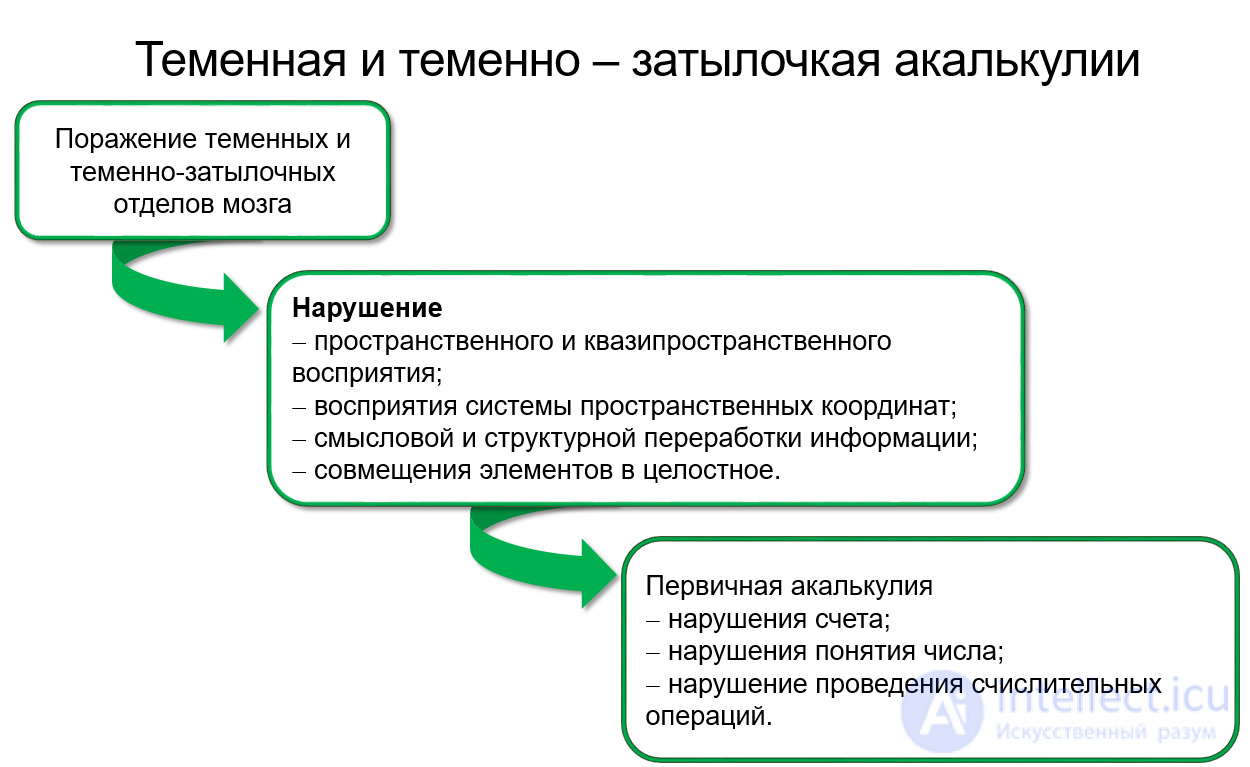
Parietal and parieto-occipital acalculia is a lesion of the parietal and parieto-occipital areas of the brain.
Impairment of
- spatial and quasi-spatial perception;
- perception of the system of spatial coordinates;
- semantic and structural processing of information;
- combining elements into a whole.
Let us sum up. Clinical picture. When counting is examined in these patients, their complete inability and helplessness in performing all tasks is immediately apparent. They cannot name two- or three-digit numbers, since they cannot make sense of the place-value structure of a number, or answer the question of how many, for example, tens (units, hundreds, etc.) are in a given number (for example, 12, 225, etc.). They cannot perform a single computational operation (addition, subtraction, etc.), especially in examples that cross over a ten (25 - 7 = , etc.). The patients become upset, understand their difficulties, and assess them adequately. Their activity is active, orderly, and goal-directed. Neuropsychological syndrome. Parietal and parieto-occipital (primary, true) acalculia occurs within a syndrome of spatial and visuospatial disorders, spatial agnosia, agraphia, alexia, not infrequently semantic aphasia, and sometimes amnestic aphasia as well. The symptoms have been described in detail above; the main ones are:

Comments