
Lecture
The next subgroup of speech agraphias (its sensory forms) — sensory (or acoustic-gnostic) and acoustic-mnestic agraphia. These forms of writing and written-speech impairment likewise occur within the syndrome of the corresponding forms of aphasia, which differ from one another in every respect — in their mechanisms (factors), clinical and psychological picture, and neuropsychological syndromes. The same differences are observed in these forms of agraphia.
In describing the psychological content and structure of writing, we noted that written speech is carried out through the interaction of a number of HMFs. In the sensory forms of agraphia, the processes of acoustic perception are impaired owing to defects of phonemic hearing (sensory agraphia) and a reduction in the span of acoustic perception together with impairment of auditory-verbal memory (acoustic-mnestic agraphia). Structural impairments are found in these forms of agraphia as well, but in different links. In the first case — in the link of sound discrimination, in the second — in the link of operative auditory-verbal memory and in the link of the span of perception.
Sensory agraphia
It is known that for the normal course of the writing process it is above all necessary to have clear, constant perception of the phonemic structure of the language, which creates the necessary prerequisites for correct sound-letter analysis of the word. Impairment of phonemic hearing inevitably leads to impairment of sound-letter analysis and of the process of sound discrimination.
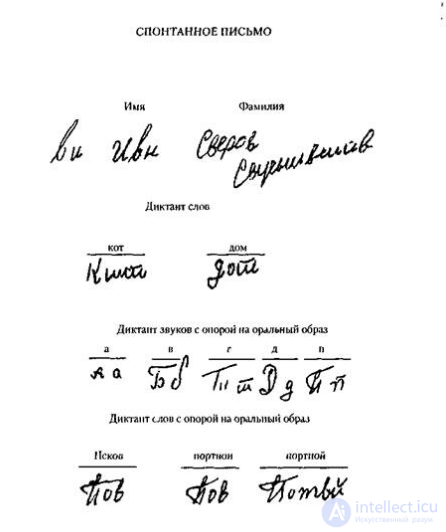
Sound-letter analysis is carried out on the basis of the sensorimotor mechanism of acoustic perception of speech sounds. Correct perception of a sound is possible only when phonemic hearing is preserved (or, in children, fully formed). It is known that a phoneme is not a sound — it is only one of its essential components, the one that carries meaning, sense. The acoustic distinctiveness of a phoneme lies in the fact that one and the same sound, in different positions and in different combinations, may take on different acoustic forms (soundings), yet remains one and the same phoneme carrying one and the same meaning, i.e., it always fulfills its sense-discriminating role. Patients have difficulty perceiving and understanding phonemes because of their differing sounding depending on positional placement within the word (for example, «кит» (kit, "whale"), «окно» (okno, "window"), «ток» (tok, "current")). It is therefore important that adult patients retain (and that children develop) not merely the perception of phonemes but of their positional soundings. It is impairment of phonemic hearing that underlies the defects of sound discrimination in sensory aphasia and agraphia.
In the clinical picture of sensory agraphia, writing is found to be either completely disintegrated or grossly impaired. In these cases the patient cannot write independently, still less to dictation, a single sound-letter or combination of them, not a single word. Ideogrammatic writing may remain preserved, but even this is not always available. In cases of a less pronounced degree of impairment, these patients' writing abounds in literal paragraphias, with sounds substituted by the patient according to phonemic features. The most frequent substitutions are: of oppositional sounds (б — п [b — p], к — г [k — g], г — х [g — kh], х — к [kh — k], д — м [d — m], д — л [d — l], and others); of soft sounds for hard ones (ль — л [l' — l], ки — кы [ki — ky], and others); of similar vowels (о — у [o — u], а — ы [a — y], е — э [e — e], и — е [i — e], and others).
The central mechanism of sensory agraphia is impairment of the acoustic perception of speech, of phonemic hearing. The central defect is the practical disintegration of all kinds of writing and, above all, of writing to dictation.
In the psychological structure of writing, the sensorimotor level of organization of this process is impaired in the link of sound discrimination, and the linguistic level is secondarily impaired, all of its sublevels — of sound, word, sentence, text. The psychological level of the organization and implementation of writing (intention, purpose, motives) remains preserved. The control functions over writing are also impaired, but not as a kind of purposeful activity, rather secondarily, owing to defects of phonemic hearing and also to impairment of the operation of matching sounds and letters.
Neuropsychological syndrome. Sensory agraphia occurs within the syndrome of sensory aphasia, i.e., within the syndrome of impairment of oral expressive and impressive speech. In sensory agraphia the following are impaired: writing to dictation (dictations, note-taking of what is heard); independent writing; copying (this is relatively more preserved, but is also impaired: the automatized method is replaced by the conscious process of letter-by-letter copying, and not infrequently by mere tracing).
Methods for the restoration of writing in sensory agraphia
The basic principle of instruction in this case is the path of using the preserved analyzers — visual, kinesthetic, and speech-motor — as supports for restoring the basic prerequisites of writing. The creation of a new afferent system based on the interaction of the preserved analyzers has an effective influence on the restoration of the impaired function. In the course of the dynamics of reverse development, the residual capacities of the acoustic analyzer are gradually brought into the work in order to normalize the writing function to the extent possible.
The central task of restorative learning in sensory agraphia is the restoration of clear awareness of each individual sound, the ability to isolate it from the whole sounding word, i.e., the restoration of the conscious analytic-synthetic process of writing. This task is common to both the restoration of writing and the restoration of oral speech in sensory aphasia, and the work of restoring these two functions is carried out in parallel. Given correctly structured instruction, the reverse development of these two forms of speech successfully influences each other.
At the first stage of instruction for patients with sensory agraphia, the task of restoring perception of individual speech sounds is not set, nor is the restoration of writing envisaged. Work at this stage is carried out with extensive use of the preserved general semantic sphere. All efforts here are directed toward reviving the semantic sphere, toward restoring the patient's ability to listen to and hear speech, to isolate and recognize first whole texts, then whole sentences from these texts, and later — the ability to carry out verbal instructions and to pick out individual words from the given text.
At this stage the task is to disinhibit, to revive the semantic component of oral and written speech, i.e., work proceeds on actualizing the semantic level of speech.
Methods of instruction at the first stage:
The chip method (strips of paper, sticks, etc.) is aimed at restoring auditory attention, listening to speech, and quantitative analysis of the composition of the text (how many sentences the text played from the tape recorder consists of). The patient's task is to listen to the text and carry out its quantitative analysis. The following operations are performed:
a) listening to the text,
b) laying out chips according to the number of sentences heard,
c) listening to the text,
d) laying out the corresponding number of chips in order, taking into account short sentences (short strips of paper) and long ones (long strips of paper), etc.
The semantic method:
a) listening to the text,
b) selecting the picture that corresponds to the text (out of three),
c) dividing the content of the picture into semantic parts (into sentences) with a pencil,
d) picking out individual objects (their names) and their relations,
e) drawing lines connecting some elements of the picture with others.
The method of assembling sentences (speech). After the patient has mastered instruction by the second method, they are offered:
a) to find object pictures and assemble individual sentences from them so that together they form the content of the story picture on which they were working,
b) to compose an oral phrase.
The method of drawing speech (sentences):
a) listen to the text,
b) carry out a quantitative analysis of the text (lay out the number of chips corresponding to the number of sentences in the text),
c) draw one (or two) separate sentence(s) corresponding to the text.
The method of correlating a word or sentence with the patient's action or gesture (pick up the pencil; draw a house; close the window, etc.).
These and a number of other methods lead to the restoration or disinhibition of the semantic basis of speech, of its quantitative characteristics, to its comprehension, to the restoration of the ability to hear speech and to understand the general sense and general content of the text.
The next task — the restoration of the capacity for generalized analysis of heard speech. To this end the patient is given an instruction (task) — to listen carefully to the word, understand it, recall everything associated with the object denoted by this word, and carry out, point by point in sequence, the program set before him.
Program No. 1 (disinhibition of the semantics of speech)
1. Listen to the sentence.
2. Find the picture (out of three).
3. Say (lay out the sticks) how many words are in the sentence.
4. Listen to the sentence once more (the same sentence is given).
5. Say whether this is the same sentence, or a different one?
6. Listen to the sentence (a different sentence is given).
7. Find the picture.
Program No. 2 (introduction of the word into semantics)
1. Listen to the word (sentence).
2. Recall everything about this object.
3. Find the corresponding picture.
4. Listen to the word once more. Is this the same word or a different one? (variants should be provided here).
As a rule, reading is also impaired in this group of patients, so each point of the program is read aloud by the instructor while the patient follows the text with his eyes (thereby carrying out "inner reading").
At the second stage of instruction, work begins with teaching the patient to know and name several letters, since in the severe form of sensory agraphia knowledge of the alphabet, of its letters, is often lost. After several of the most frequent letters have been mastered, the main task of this stage is addressed: patients are taught to recognize sounds by ear, but the work on differentiated perception of sound proceeds through the word by the method of correlating the sounding word with the corresponding picture and with the graphic representation of that word. At this stage, recognition of sounds and their correlation with the corresponding letters is practiced, but only through the word, its semantic content.
Program No. 3 (connection of the letter with the meaning of the word)
1. Listen to the word (one of the words practiced under Programs No. 1 and No. 2 is given).
2. Find the picture.
3. Find the written word (a choice of three words written on cards).
4. Copy out this word.
5. Underline the first letter.
6. Name it and write it.
Under this program, work is carried out on 5—10 words.
Program No. 4
1. Find the words you have been working on.
2. Find the first letters of these words (a choice of three letters for each word), write them down.
3. Think of a word beginning with this letter, write the word.
At this stage prolonged work is required (no fewer than 10—15 sessions); the result should be quick and independent selection of the word, the letter, understanding of the connection of the letter with another word, and the writing of frequent letters and several words.
Programs No. 5 and 6 are aimed at the restoration of the actual process of sound discrimination itself. They make use of visual-acoustic links anchored in semantics, and of visual-acoustic-kinesthetic links.
Program No. 5
1. Listen to the sound.
2. Now listen to the word that contains this sound.
3. Look at this letter in the written word, underline it, write it, name it.
4. Listen to this sound once more.
5. Find this letter in the word once more.
6. Take this letter — feel it with your fingers, look at it, listen to its name.
7. Close your eyes, find this letter by touch (a choice of 3 letters).
8. Write it, write it once more from memory, listen to it and write it again.
Program No. 6
1. Find the picture whose name begins with this letter (one of the already mastered letters is named).
2. Name it.
3. Listen to its name and look at it.
4. Listen, look at the letter, and write this letter.
5. Listen once more and write (at the same time), write it from memory, listen once more and write it.
This last operation is aimed at examining the restoration of the ability to transfer the action.
As a rule, work on every letter is not needed. Mastery of a group of letters, of their soundings, and of their connection with meaning leads to an independent expansion of the store of knowledge and to the restoration of the method of recognizing the sound-letter. This process occurs through our use of the interaction of analyzer systems (at the psychophysiological level), the interaction of perception of different modalities, and its inclusion in semantics. It might seem that we are using simple methods — operations, actions, yet taken as a whole these programs permeate the entire hierarchical structure of sound recognition and of its connection with the word and with the naming of the sound and the word. This is precisely what underlies their effectiveness.
An entire series of exercises serves to consolidate the connection between the sound and the corresponding grapheme: a) selecting the sought-for letter from a cut-out alphabet, b) writing the letter in a notebook, c) underlining it in a given text and writing it in a notebook, d) selecting real objects (or pictures) whose name begins with the sound-letter being practiced, and writing it, e) filling in the missing places in a word, and others.
The restoration of differentiated and constant perception of speech sounds becomes the subject of specialized instruction only at the third stage of instruction, when work begins on the restoration of writing proper. First the patient is taught knowledge of the letter, i.e., its naming, recognition by ear, by means of specific methods described by us in other works (A.R. Luria, 1948; L.S. Tsvetkova, 1961, 1962, 1970). During this period of instruction, the method of feeling three-dimensional letters is applied: on hearing the sound, the patient finds the needed letter, feels it with the fingers, writes it down, and then places it under the appropriate card whose name begins with this letter, and so on. The work proceeds according to the scheme: sound —> feeling the letter —> writing the letter, i.e., on the basis of kinesthetic and optical-motor skills. At this stage of instruction, tasks are also set concerning the restoration of analytic writing through the restoration of generalized perception of sounds.
One such method is orienting the patient toward the positional relations of sounds within the word, which creates the prerequisites for restoring generalized perception of sounds. The patient is taught to discriminate not pure sounds — for example, Т, Д, К, Г (T, D, K, G), etc. — but all possible variants of their soundings (cf.: Т [T] — ТЕ [TE] — ТИ-ТО [TI-TO] — ТЮ [TYU] — ТУТА [TUTA] — ОТО [OTO] — АТУ [ATU], etc.). Teaching practice shows that patients who have learned to isolate and recognize a given sound in a specific combination with one or two other sounds often fail to recognize it in all other combinations. For this reason, at all stages of instruction the patient is oriented not toward the perception of an isolated sound, but toward the whole system of sound relations within the word. This is why one of the most important tasks of teaching the patient to write at the fourth stage is the restoration of the capacity for sound discrimination within the word and, on this basis — the restoration of the writing of whole words. An effective technique here is to bring out into the open the quantitative and qualitative structure of the word — the word-scheme method. Verbal material: first simple words, then words in which one and the same sound has a different positional sounding (ТОН [ton, "tone"], ТИП [tip, "type"], ТАЗ [taz, "basin"], ТЕНЬ [ten', "shadow"], etc.). The patient is given a picture depicting an object (a phenomenon, an action) whose name is a simple word consisting of one or two syllables. Under the picture a ready-made quantitative scheme of the word is given (in the form of small squares or dashes). The patient first listens to the name of the object, then repeats it. Only after this does he begin to isolate each sound making up the word, using for this a mirror, the oral image of the sound, and so on. He writes each isolated sound in sequence into the corresponding square; gradually the words analyzed by the patient become more complex. In time the patient begins to analyze the composition of the word independently, from the qualitative side as well.
This method consists of a series of sequential operations: a) listening to the word, b) repeating it, c) isolating the first sound with the support of a mirror, d) the oral image, e) isolating the next sound, f) writing each sound in the corresponding cell, g) correlating the sound with the letter, h) writing the letter from memory. The method presupposes the use of materialized means as an external support and is one of the effective ways of restoring the writing of words. A significant role here is played by materialized supports — the picture with the depicted object helps to hold the whole word in mind, the word on which the analytic work is being carried out, while the small squares (the quantitative scheme) help to fix the sounds already isolated by the patient, separating the part of the word already analyzed from the part that still has to be subjected to analysis. Gradually this expanded method of word analysis is reduced through the dropping out of one or another of the materialized means.
With the aim of normalizing the course of the writing process, the defective acoustic analyzer is later brought into the work. For this, various exercises in sound discrimination using a tape recorder are included: dictations of sounds and words are useful, with subsequent comparison of the written and the sounding word, analysis of the errors found, their written practice, and so on. Only after maximal success has been achieved in restoring the processes of sound discrimination, the ability to write letters and words (relying on the preserved kinesthetic sensations and optical-motor coordinations), does one move on to the restoration of oral and written speech.
Thus, the method of restoring writing in sensory agraphia is aimed at overcoming defects of phonemic hearing and creating ways of carrying out the process of sound discrimination by means of a specific system of methods that makes use of preserved afferentations from other analyzer systems (kinesthetic, kinetic, visual, cutaneous-kinesthetic), and relies on the semantics of the word. The most effective methods and techniques are articulating aloud during the analysis and writing of words, the oral and kinesthetic (feeling) methods of sound analysis, work on the sense-discriminating role of phonemes, and conscious control of all operations.
After lengthy restorative instruction of patients in writing (of words, letters, the process of sound discrimination, i.e., analytic writing), one can move on to teaching written speech (the writing of phrases and texts). At this fifth stage of instruction we again return to the methods that were used at the first stage. These tasks are now carried out on a different basis: the patients already know and write letters and words, they have a sufficient passive and active vocabulary, topics. The task therefore consists in composing a phrase with its subsequent writing down. Various methods can be applied here:
1) the method of inserting missing words into the phrase,
2) the method of composing a scheme of the phrase based on its sounding, i.e., to draw small squares whose number corresponds to the words heard, to fill in the squares with the words heard relying on pictures, etc.;
3) the method of composing a phrase according to a given scheme (relying on a story picture or an object picture: (who? (what?) -> is doing what? —> what? where?);
4) the method of composing phrases from given words (written on cards);
5) the method of transforming the phrase by replacing some words with others: across the sky flies (an airplane),
-"- -"- (a bird), " -"- -"- (a balloon), " -"- (clouds float),
(across the sea) -"- (ships) etc.; this method requires reliance on story pictures;
6) the method of completing sentences (relying on story pictures);
7) the method of finding errors in given phrases (finding mismatched words, errors in structure, etc.).
As can be seen, all these methods are aimed at restoring the structure of the phrase and its semantic connection with the words. After these tasks have been mastered, one can move on to restoring the capacity for written speech, i.e., to the writing of texts. The best topics here are letters (to relatives, friends), drawing up a plan of one's work for the next day, addressing the instructor with written requests, wishes, and the like. The restoration of written speech proceeds especially effectively in group sessions, in the process of cooperation and mutual assistance. And in the restoration of written speech the methods are built from the whole to the particular. In cases of severe impairment of written speech, work on restoring independent writing can be begun with simpler forms of writing — with dialogue, with captions under story pictures.
The dialogue method. Dialogue presupposes the presence of an answer — of the structure of the answering phrase and its verbal composition. For example: 1. What is the weather like today? — Today the weather is good. 2. And what else can the weather be like? —
The weather can be bad, so-so. 3. What significance does the weather have for a person? — For a person the weather is very important. For clothing, for mood. Further on, this topic can be "played out," turning it into a story — first oral, and then written as well.
The method of captioning a series of story pictures. The sentences captioned under each picture are then combined into a written story. Later the pictures are gradually removed (one at a time), and the last phrase (then the second-to-last, and so on) has to be written either on the basis of remembering the sentences written earlier (which is worse), or on the basis of remembering the general content (which is better). Instruction by this method ends with the independent writing of a story on the topic of the mastered series of story pictures.
After this, one moves on to more complex forms of independent writing: summary writing (based on a story picture), composition (letters, etc.).
The summary-writing method. The patient is given the task — to describe the story picture lying in front of him by way of sequentially carrying out operations:
1. Think through the content of the picture — what and about what is being said here.
2. Write a story of three or four sentences the way it comes to your mind. Do not worry about the precision of the spelling of the words.
3. Now divide the picture into parts and compose one sentence for each of them, say it, find the needed words (a choice from cards with words written on them).
4. Write the sentence. And work in this way on each sentence
5. Read it. Think about what needs to be corrected, added.
6. Underline the key words in each sentence.
7. And now write the story once more based on this same picture. It need not be the same as it was.
8. Compare both written stories. Find the difference.
9. Close the texts and write the story once more based on this picture. Such work on the writing of a text, from the image-representation — to the semantic content —> to its written record —» to variants of the written record makes it possible to restore free, unconnected writing of texts. The principles of this program can also be used in teaching the writing of letters, descriptions of one's own thoughts, and requests addressed to the instructor. All these kinds of writing are more complex, since they are compositions, i.e., the most voluntary form of written speech.
The restoration of written speech proceeds at a higher level of its organization — the psychological level, which also engages the semantics of speech, at which motives, intentions, and interests are formed and realized, the general organization of activity is carried out, and the semantic component of oral and written speech is formed. The difficulties of written speech consist, as we wrote above, above all in the absence of an interlocutor and the impossibility of using metalinguistic means (gesture, intonation, etc.) and others. We therefore propose: to begin the restoration of independent written speech with work on dialogue, in which two interlocutors take part, then to move on to polylogue (in group sessions), in which several people take part, and only after this can one move on to composition, at first collective, and later — individual.
Psychologically it is important that in the methods applied the emphasis be placed on the sense, the content of what is to be written, on its meaning for the patient, but not on grammar and spelling (!). This principle is one of the most important requirements for the tasks and methods of restoring written speech and for the instructor applying these methods.
On the question of methods for restoring (or forming) writing in children. In children of early school age, the formation of writing at the first stage must likewise address two tasks: 1) teaching children to listen to and hear speech, restoring auditory-verbal attention, and 2) forming the semantics of speech — of the word, the sentence, the text. The basic strategy at this stage of instruction is the same — the restoration of writing from the whole to the part. If we speak of the structure of written speech, then the work should proceed from the psychological level —» to the linguistic —> and to the sensorimotor levels.
At the first stage it is necessary to develop motivation and interest in writing. And in this case the most effective is the play method and all its variants.
The play method. "Recognize and say what is sounding?" Various object sounds are given from the tape recorder — the whistle of a steam engine, the ringing of a tram, rain, the hissing of a snake, the buzzing of a fly, the cawing of a crow, etc. The children (preferably 2—3 people) must find the corresponding object pictures and reproduce the sound. Then they find the words written on cards denoting the objects making these sounds, and place them under each picture. In this way ten to twenty words are mastered.
The method of correlating the initial letter with the word and the picture. Procedure: the same sounds are given again. The child: a) finds the corresponding picture, b) finds the word-name of each picture, c) isolates the first sound-letter in the word, d) finds it in the cut-out alphabet, e) draws the picture and writes the initial letter of its name, f) sorts the pictures and letters into different groups, g) selects new pictures for each group, beginning with this letter.
This is the initial stage, at which only the first steps toward letter-by-letter analysis of the word are taken, from sound —» to object —> to word —» to letter. In further work it is necessary to return once more to listening to object sounds. Task: 1. Answer who (what) is doing it.
Instructor. The snake — hisses: sh-sh-sh, and the fly?
Patient. It buzzes: zh-zh-zh.
Instructor. The steam engine?
Patient. It whistles: u-u-u.
Instructor. The tram?
Patient. It rings: z-z-z.
2. After each answer, find the corresponding letter (ж [zh], г [g], etc.) and place it next to the corresponding object picture (змея [zmeya, "snake"] — з [z]).
3. "Read" each sentence (for example, picture (steam engine) — г [g].; patient: the steam engine whistles).
4. Draw these sentences.
5. Find the corresponding words.
6. "Read" each drawing.
7. Read each sentence.
8. Copy it out.
9. Write it from memory.
10. Tell what objects were being discussed and what they are doing.
11. Write the words denoting the actions of each object (answer the questions: who (what)?, what is it doing?)
After lengthy semantic work on the writing of whole words and sentences, one can move on to the following methods:
The Ebbinghaus method (words with missing letters). The same words already practiced are given, but now with letters missing. The task — to insert the missing letter, read the word, copy it out.
The method of correcting errors (visual). The same words are given, written with errors. At first the errors should involve sound-letters that are far apart from each other, with a gradual transition to oppositional sounds (for example: корот(в)а, мор(л)око [instead of корова — "cow", молоко — "milk"], etc., and later — г(к)орова, молог(к)о, etc.). The task — to find the erroneous letter and replace it with the correct one. The same method, but in an auditory variant: words are presented from the tape recorder, both correct and with errors. The task: to listen to the sounding words, simultaneously look at the written word (reading it silently) and at the picture, find the error, and replace one sound with another. Write down the word as it sounded, and the correct variant.
This method gradually leads the child toward work on distinguishing similar phonemes, i.e., toward work on the formation of phonemic hearing. To this end it is necessary to substitute oppositional phonemes more often in the sounding words (торога, дорока /дорога, "road"/; солото /золото, "gold"/; дорт /торт, "cake"/).
The "Guess" method. Words made up of three-dimensional letters lying on the table are given, sounding from the tape recorder. Task: the child must feel each letter and "read the word" (i.e., say what word is made up of these letters). After this, the same word is given, but with an error: by the method of feeling, the child must find the error and replace it with the correct letter. In this case the child listens to the word, feels the letters that make it up, reads (articulates) it, i.e., the process of sound discrimination proceeds on the basis of the interaction of the acoustic, cutaneous-kinesthetic, and speech-motor analyzers. In addition, the semantic level is also engaged in these actions and operations, since instruction proceeds on the material of familiar words.
The semantic-analytic method is aimed at restoring the process of sound discrimination and phonemic hearing on the basis of the meaning of the word. Words are presented by ear that are close in sound composition but different in meaning. Understanding and knowledge of the connection between the sound-letter and the meaning of the word are restored. Procedure: a word sounds, the child finds the picture and places it in one pile. Another word sounds, differing by one sound; the child must find the corresponding picture and place it in another pile (for example: кот — год [kot — "cat", god — "year"], дом — том [dom — "house", tom — "volume"], крот — грот [krot — "mole", grot — "grotto"], класс — глаз [klass — "class", glaz — "eye"], etc.). After this, write down the words heard, underline the difference in the sounds.
The conditioned-reflex method (picture-based). Task: to find the picture corresponding to the word heard, and place it next to the corresponding letter with which the sounding word begins. Procedure: in front of the child on the table lie the letters К [K], Г [G], Д [D], Т [T], Б [B], П [P], and others, spaced apart from one another. A word sounds, and the child listens, looks at the pictures, after which he chooses the needed one (out of three) and places it in the corresponding group.
All the methods described, and a number of others, lead to the formation of the process of sound discrimination and phonemic hearing and, most importantly, to the restoration of the understanding of the connection between the meaning of the word and the letter, of their interdependence. Instruction proceeds from semantics to the sound-letter, and from the whole — to the part.
At the next stage, instruction proceeds to analytic writing proper. This instruction is the opposite of that which was conducted at the first stage, i.e., it proceeds in the direction from the sound-letter to the word.
The method of sound-letter analysis of the word. The child is given two sounds (by ear). He must find the corresponding letters and then all the words that contain these letters (the written words lie on the table), write down these words, analyze the sound composition of the words (show each letter according to its sounding), write the word down again — copy it, write it to dictation, find the corresponding picture.
The structural method. Procedure: a) a word sounds, b) the child counts the number of sounds, c) draws the quantitative scheme of the word (П->П—>П—>П), d) fills in the squares in the scheme of the word with the needed letters. All analytic work necessarily proceeds with the inclusion of oral speech (articulating whole words and individual sound-letters aloud).
These first two stages are the most important in the restoration of writing in children. Correctly conducted work will make it possible to form in the child the process of sound discrimination, phonemic hearing, auditory-verbal attention, understanding of the close interconnection between the meaning of the word and the sound-letters that make it up, and the ability to write words voluntarily, consciously, analytically. After this one can move on to the formation of the writing of words, sentences, and texts, which has its own methods of restoration and its own particular features.
The words whose writing is being taught should be selected according to semantic, categorical, or functional features. In this case the writing will be restored not of separate words, but of interconnected ones belonging to one semantic field, which will subsequently serve as a basis for the writing of phrases as well (for example: airplane, person, city — a person flies by airplane to another city; raspberry, strawberry, currant — berries — grow in the garden, etc. — a situational connection). Such methodical work leads, on the one hand, to the restoration of written speech on the basis of semantics, and, conversely, to the formation of semantic fields on the basis of written speech, on the other.
For lack of space we were unable to describe the entire methodology and, in particular, the methods for restoring the writing of texts. However, the work described underlies the restoration of the writing of texts. It is useful to teach the writing of texts in group sessions, where it is easier to develop motivation and arouse interest in writing. Such kinds of written speech as letters home, to a friend, and compositions on any topic are useful here; these provide good conditions for organizing creative written speech.
In summing up, it must be said once again that the main task of restorative instruction in writing in sensory agraphia is the restoration of phonemic hearing and of the process of sound discrimination. And the main direction of the methodological development is work proceeding from semantics to sensorimotor function and from the whole — to the part; it is important to approach writing as a creative process.
Analysis of the dynamics and methods of restoring writing in sensory agraphia
We shall briefly describe the dynamics of the restoration of writing in sensory agraphia.
Patient B., 37 years old, higher education, suffered an acute disturbance of cerebral circulation in the territory of the left middle cerebral artery; he developed right-sided hemiplegia with pronounced impairment of muscle-joint sensitivity, apraxia, and total aphasia. Restorative instruction continued (with interruptions) over a period of two years.
By the beginning of the sessions the patient showed first total, and then severe, sensory aphasia. His oral speech was impaired owing to the instability of the sound images of words, perseverations, and extraneous verbal associations. There was much paraphasia in his speech. Impressive speech was also severely disintegrated: the phenomenon of alienation of word meaning was clearly expressed. Reading and writing were affected in the patient in the most severe way — these processes were practically absent in him. The patient did not recognize a single letter: he could not name them, still less find the letter corresponding to a given sound; he carried out any writing task in the form of several inadequate graphic marks. Any kind of sound analysis of the word was inaccessible to the patient. He could not answer the questions: "How many sounds are in the word "дом" [dom, "house"] (or "кот" [kot, "cat"], "рак" [rak, "crayfish"], etc.)? "What sounds make up this word?" And of course, he could not write a single letter if given a sound dictation.
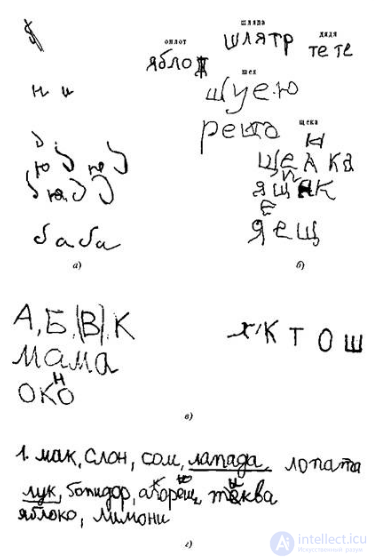
Later, when in the course of instruction the patient had already learned to recognize some sounds and represent them with the corresponding letters, he began to have difficulty differentiating sounds close to one another both in their place of origin and in their phonemic features: he wrote "п" [p] instead of "б" [b], "д" [d] instead of "т" [t], "т" [t] instead of "н" [n], etc. Writing words to dictation presented a particular difficulty for him. He wrote slowly, painstakingly groping by articulating aloud for the needed articulemes and sounds and recalling their graphic representation. Thus he wrote "яблод" instead of "оплот" [oplot, "bulwark"], "шлятр" instead of "шляпа" [shlyapa, "hat"], "шуею" instead of "шея" [sheya, "neck"], etc. Writing these three words took him 15 minutes. Such was the state of the patient's writing at the start of the sessions.
The restoration of writing proceeded from its complete disintegration. In order to teach the patient to write again, it was necessary first of all to restore in him the recognition of certain words as wholes, the recollection of their meaning and of the role of the objects denoted by these words in people's lives and in his own life, and to restore his personal, meaningful attitude toward words. Therefore, at the 1st stage, work proceeded on disinhibiting and actualizing the semantics of speech, the semantics of each word — its meaning, sense, and objectal reference. In this case a system of methods was used:
1) classification of object pictures (free and directed),
2) selecting pictures according to their functions,
3) categorical and situational classifications.
Work proceeded at first on 10 pictures (the semantics of the words was clarified: bread, milk, goat, dog, horse, cart, hay, person, book, airplane). Later another ten words were added. In the course of this lengthy work, when choosing the needed picture the patient always listened to and heard their names (from the tape recorder), but his attention was not directed to the sounding of the words; it was background. After a certain amount of knowledge of these words and of the attitude toward them had been restored, they were included in "picture sentences." For example, the picture "person" was combined with the picture "book" (person — book); here the patient also had to choose one of three pictures lying to the side — a person reading, a person eating, a person running. When the correct picture was chosen, the sentence resulted: person + person is reading + book. Having practiced several such picture sentences, we thereby restored the understanding of the interaction of words in speech, their polysemy and interconnection, and the role of these objects and words in people's lives.
After this, the patient was taught to combine picture-words with the written word and the sounding word.
At the 2nd stage we moved on to work on restoring knowledge and naming of a specific group of letters, using the practiced pictures and words. To this end, painstaking and complex work was carried out to teach the patient sound discrimination, first of individual sounds, then of sounds within a word. Over the first 20 sessions the patient mastered knowledge of almost all the letters and sounds. He named the letters correctly, and he recognized the sounds and found the letters corresponding to them. However, naming a letter or recognizing a sound was expanded and conscious. After this, 3 months of work were devoted to sound discrimination within the word and to restoring the writing of words, applying the programs described above and a whole series of other methods.
The method of isolating sounds in a word not sequentially, but at random. After the word is presented to the patient by ear, he is asked: what is the first sound in the word? what is the fifth sound in the word? what sound comes after А [A] in the word маска [maska, "mask"] (каша [kasha, "porridge"], гараж [garazh, "garage"])? what sound comes after Б [B] in the word горбушка [gorbushka, "crust"] (злоба [zloba, "malice"], обед [obed, "dinner"])? etc. These exercises were now carried out only at the level of speech aloud, without reliance on external materialized means, which at the start of instruction by this method had been represented by a picture, by paper squares fixing the word and its quantitative composition. All these working methods helped the restoration of sound discrimination within the word. At the start of instruction this was aided by the externalized quantitative characteristic of the word (the squares), the word itself denoted by the picture that helped the patient hold the needed word in mind, overt speech, and the oral method of pronunciation.
What do materialized means provide, what is their psychological significance? The materialized means used in instruction helped: a) to fix the sound isolated by the patient by ear, by means of the oral image and articulating aloud, b) to hold in mind the entire sound image of the word at the moment of isolating one sound, c) to separate off the part of the word that has already been analyzed from the part that still has to be subjected to analysis. Subsequently, the shortening of the process of writing the word takes place through the dropping away of the materialized means of word analysis and the transfer of the action to another level of its realization. By the end of the 3rd stage of work, the patient should be able to count the number of sounds in a word mentally, without using a picture for this, but holding the word in mind by ear, and to write it independently, using only articulating aloud and a mirror. In work on sound discrimination we often used a method that we call auditory control by comparison with a standard. The exercise proceeds as follows. The instructor pronounces a word, a healthy person sitting nearby repeats it — sometimes correctly, and sometimes deliberately with errors. The patient must compare the second sounding word with the given standard and judge whether the word has been repeated correctly or incorrectly; in the latter case he must find and explain the error. The patient is allowed to watch the instructor's lips while doing this. At first the work is made easier for the patient in that he is asked not to name the error, but to point it out using the letters of the cut-out alphabet. For example, the word "огурец" [ogurets, "cucumber"] is pronounced. It is repeated — "огурец". The patient must say "correct." A second word is given — "банка" [banka, "jar"], and it is repeated as "батка." The patient must show, in the cut-out alphabet — "Т" [T] was said, but "Н" [N] is needed. After these exercises one can move on to the tape-recorder method, in which the additional support — the oral means of sound recognition ("lip-reading") — is removed.
After work on the acoustic analysis of the word, it is recommended that these words be analyzed element by element and written down. Special attention must be given to the patient's errors and to their explanation. These exercises are introduced only toward the end of the 3rd stage of instruction, when the patient can already, in principle, work at the level of speech aloud without an extensive system of material supports. They are used with a view to bringing the defective acoustic analyzer into the work on sound discrimination. As a result of this work good results were obtained: the patient could write, both independently and to dictation, any words, even ones difficult in their composition. However, the writing of difficult words proceeded only in the wake of articulating them aloud. Simple words, on the other hand, the patient could write by ear, though slowly and while articulating them to himself.
After the results achieved, we gradually moved on to the writing of the phrase. This work was closely bound up with the restoration of oral expressive speech. The difficulties this patient had with writing a phrase consisted mainly of defects in the construction of the sentences the patient composed, as well as of difficulties in holding them in mind. Special attention was given to the semantic disturbances in the patient's oral and written speech. It was specifically necessary to work on the patient's understanding of such grammatical forms as gerundive and participial constructions, on the understanding of tense and gender, and on the case agreement of words within a sentence. The work was conducted not by school methods, but by explaining the actual real relations existing between objects and phenomena, and the expressions of these relations were written down using the corresponding words, by way of repeated readings of texts and the semantic analysis of the corresponding sentences. Without restoring knowledge of the rules of formal grammar, a series of exercises was carried out on the active transformation of one form of a word into another, relying on the semantic side of the word and the phrase.
This work is possible only on the basis of work already carried out earlier to restore the ability to pose questions to any word in a sentence, conducted in the restoration of oral speech.
After instructing the patient over the course of 2 years, a good restoration of writing was achieved. The patient traveled the path from the complete disintegration of writing to its restoration within the bounds of the practical ability to write dictations, summaries, compositions, letters, i.e., both writing and written speech were restored in him.
Such is the method of restoring writing used in cases of sensory agraphia, constructed in such a way as to compensate for defective auditory analysis by means of specific methods. Leading in the instruction is the method of programmed instruction, in which a whole system of psychologically significant methods, techniques, and exercises is used. The chief among them are the methods of introducing the word into semantics, of articulating aloud during writing (kinesthetic), the oral method of analyzing the sound-letter composition of the word (visual-kinesthetic), the semantic method that helps restore phonemic hearing, and others.
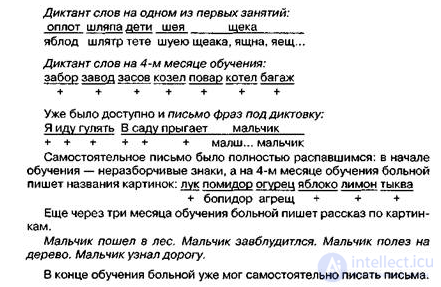
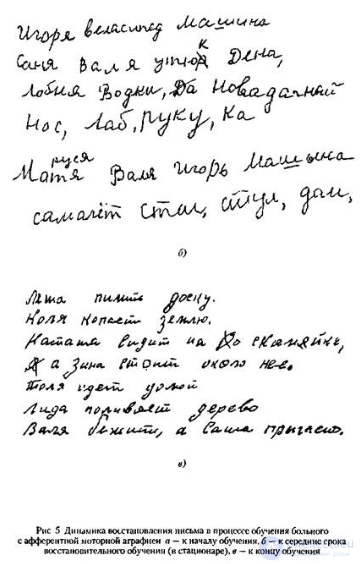
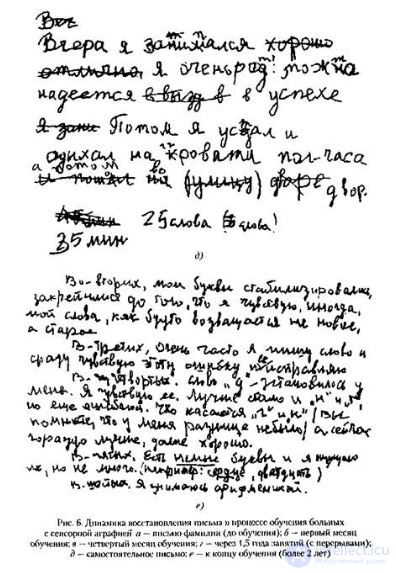
In instruction, extensive use was constantly made of a broad system of external means that facilitate the restoration of the operation of word analysis by unfolding and bringing outward the process of sound analysis, which normally represents a compressed, automatized form of action proceeding "in the mind." Thanks to these means, the process of sound discrimination is transformed into an overt, unfolded action. However, in the course of restoring the function of writing, the need for some supports, and then for others, gradually falls away. Some supports drop away by themselves, others are artificially inhibited so as to speed up the automatization of the process of writing. For example, feeling the cheeks and larynx when pronouncing voiceless and voiced sounds, sensing the stream of air when pronouncing hissing and whistling sounds, feeling three-dimensional letters, dermolexia, and others may be necessary components of writing at the 1st and at the start of the 2nd stage. But already by the middle of the 2nd stage the need for these means falls away. At the 2nd and 3rd stages there are their own external supports, which likewise fall away as unneeded in the course of instruction. Owing to the "dying away" of these external means, the act of writing is shortened, begins to proceed more quickly, and with practice becomes automatized, approaching ordinary writing in its results, but differs from the latter in its structure in that the newly restored process of writing, even at the end of instruction, continues to display features of a new, reorganized functional system. The leading role remains with vision, articulating aloud, and the semantics of speech. The illustration shows the dynamics of writing in the course of the patient's instruction (Fig. 6).
Nonspecific forms of agraphia
Let us turn to a brief description of one more form of sensory agraphia, one that is frequently encountered in the clinic of brain lesions but has not received sufficient study. Many researchers deny the existence of this form of aphasia altogether, and still more so of the corresponding agraphia. We are speaking of acoustic-mnestic agraphia, which arises with a lesion of the 2nd temporal gyrus of the cortex of the left temporal zone. This is a special type of aphasia1 and agraphia, bound up with the particular features of the morpho-physiological structure of this zone of the brain. In this form of agraphia, the higher level in the organization of writing is impaired — the level of written speech, and not of writing as a skill. (Footnote: Tsvetkova L.S. Aphasia and Restorative Learning. Moscow: Moscow State University Press, 1988).
In the objective clinical picture of this agraphia, what first attracts attention is the voluntariness and consciousness of the act of writing, its slowness, its de-automatization. The patient's subjective sense of being unable to write is also significant. Patients complain that they have lost the ability to write, explaining this by saying that they "remember nothing," "cannot write as they used to," "are constantly thinking about how and what to write," "do not remember the words," and so on. Objectively this shows up in attempts to write that end in incomplete words, unfinished phrases, and so on. Although it is evident that they have no motor or sensory difficulties, and the analytic approach to writing is preserved — they can write a given word, stopping partway through it or through part of a phrase, refusing to write further. To dictation, these patients can write individual sounds and syllables, words, sometimes phrases, but only after prolonged writing of words and phrases in parts. Independent writing is completely inaccessible to this group of patients.
In the neuropsychological picture of the impairment, this form of agraphia occurs within the syndrome of acoustic-mnestic aphasia, i.e., with symptoms of impairment of the span of acoustic perception, with the replacement of simultaneous perception by successive perception, with impairment of the naming of objects, with defects of repetition of speech, and others.
In the psychological picture, impairment of perceptual images and images-representations, as well as of the images of symbolic signs, comes to the fore. Acoustic perception is also severely impaired in terms of the narrowing of its span, while other kinds of perception, attention, purposefulness, and the organization of verbal and general behavior, and the motives for written speech, remain preserved.
The process of writing itself is characterized by consciousness, voluntariness, slowness, and errors of a particular type: a) incompleteness of words in their writing (in independent writing and in writing to dictation), b) substitution of one part of the word for another. All this takes place against a background in which the sensorimotor organization of writing is preserved, but the span of acoustic perception is impaired, and there occurs a detachment of the sign (the letter) from its image-representation. The patients operate only with symbols (not signs), detached from their content. This same defect shows up in oral speech as well, when patients pronounce words correctly but do not understand their meaning and sense. This phenomenon also occurs in written speech: patients do not always understand what they have written and read, and cannot always translate oral speech into written speech.
The central mechanism of the impairment of writing in this case is, in our view, impairment of the span of perception, a mismatch between the sign and its meaning, and impairment of the images-representations.
The central defect is impairment of written speech as the higher form of writing.
The restoration of writing in this form of agraphia is aimed above all at overcoming the narrowing of the span of perception. Here the method of breaking down the word (phrase, text) into parts accessible to the patient's perception has proven highly effective. Before writing the word (phrase), it is first broken down into parts, each of which the patient repeats several times and writes down, and so for each part of the word; then the word is written as a whole, independently, and then by ear. In this way the writing of 20—30 words is mastered.
Example. The word "самолет" [samolyot, "airplane"] sounds (+ picture)
1) sa-mo-lyot
2) samo-lyot
3) samolyot
a) sa mo lyot samo lyot samolyot
repetition
b) sa mo lyot samo lyot samolyot
c) sa mo lyot samo lyot samolyot
writing
d) sa mo lyot samo lyot samolyot
Once more, independent writing of the word "самолет" to dictation.
Exercises: a) inserting the missing practiced word (samolyot) into various phrases
продолжение следует...
Часть 1 5.4. Sensory Forms of Agraphia: The Impairment and Restoration of Writing
Часть 2 - 5.4. Sensory Forms of Agraphia: The Impairment and Restoration

Comments