
Lecture
Subitizing is the rapid, accurate, and confident judgment of number performed for a small number of items. The term was introduced in 1949 by E. L. Kaufman et al., and derives from the Latin adjective subitus (meaning "sudden"), conveying the sense of immediately grasping how many objects are in a visual scene when the number of items present falls within the subitizing range. Judgment of quantity for larger sets is called either counting, if there is enough time, or estimation, if there is not.
The accuracy, speed, and confidence with which observers make judgments about the number of items depend decisively on the number of items to be enumerated. Judgments made for displays consisting of roughly one to four items are fast, accurate, and confident. However, once more than four items must be counted, judgments are made with decreasing accuracy and confidence. In addition, response time increases sharply, with an additional 250–350 ms added for each additional item on the display beyond four.

Although the increase in response time for each additional item on the display is 250–350 ms per item beyond the subitizing range, there is nonetheless a noticeable, though smaller, increase of 40–100 ms per item within the subitizing range. A similar pattern of reaction times is found in young children, although with steeper slopes for both the subitizing range and the counting range. This suggests that there is no limit as such, if it is defined as the number of items that can be immediately apprehended by the cognitive processes, since additional costs are associated with each additional item enumerated. However, the relative differences in the costs associated with enumerating items within the subitizing range are small, regardless of whether they are measured in terms of accuracy, reliability, or response speed. Moreover, the values of all these measures differ markedly within and beyond the subitizing range. Thus, although there is no such limit, there do appear to be genuine differences in the way the visual system processes a small number of items (i.e., roughly four or fewer items) compared with a larger number of items (i.e., roughly more than four items).
A 2006 study showed that subitizing and counting are not limited to visual perception but also extend to tactile perception, where observers had to name the number of stimulated fingertips. A 2008 study also demonstrated subitizing and counting in auditory perception. Although the existence of subitizing in tactile perception has been questioned, this effect has been replicated many times and can therefore be considered robust. The subitizing effect has also been obtained in tactile perception in congenitally blind adults. Taken together, these findings support the idea that subitizing is a general perceptual mechanism that extends to auditory and tactile processing.
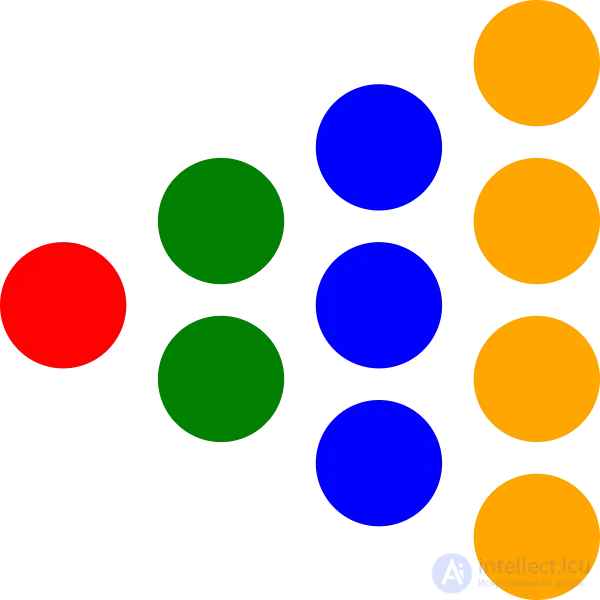
Try counting the circles of each color in the picture. As you do this, you instantly know the answer as soon as you see them in front of you. And this works for a number of items to be counted from one to four or five. This phenomenon is called subitizing (from the Latin subitus — sudden).
Subitizing manifests itself in the fact that determining the number of items within the subitizing range (1–4) takes 50–100 milliseconds per group, while beyond that range it already takes 250–350 milliseconds. And the more items there are, the more time is required and the higher the percentage of erroneous estimation (if a fast count is needed).
As with chronostasis, subitizing extends to other senses as well — to hearing and touch. It is fairly easy to quickly name the number of objects in one's hand if it falls within the range of one to four and lies within the resolution of touch (if you press on the skin at points, then from a certain distance two touches will be perceived as one).
A number of experiments have been conducted to study subitizing, in one of which subjects were asked to count the number of afterimages: in a dark room, several objects arranged in a row were illuminated by a flash. In this way, the subjects could not simply move their eyes from one to another in order to count them. In the course of the experiments, it was established that subitizing and counting most likely rely on different mechanisms.
It is possible that the skill can be developed, and that one can learn to instantly perceive ("subitize") more items than the usual range. Researchers have not reached a unified opinion on this matter, despite the fact that there are people who can instantly count up to 10–12 items.
As the origin of the term "subitizing" suggests, the sensation associated with making a numerical judgment within the subitizing range is a sensation of immediate awareness of the displayed elements. When the number of objects presented exceeds the subitizing range, this sensation is lost, and observers typically report an impression of shifting their point of view across the display until all the presented elements have been counted. Observers' ability to count the number of elements on a display can be limited either by rapid presentation followed by masking of the elements, [14] or by requiring observers to respond quickly. Both procedures have practically no effect on enumeration within the subitizing range. These methods can limit observers' ability to count items by restricting the extent to which observers can sequentially shift their "focus of attention" [15] onto different elements within the display.
Atkinson, Campbell, and Francis [16] demonstrated that visual afterimages can be used to achieve similar results. Using a flash to illuminate a row of white discs, they were able to produce intense afterimages in dark-adapted observers. Observers had to verbally report how many discs had been presented, both 10 seconds and 60 seconds after exposure to the flash. Observers reported that they could see all the discs presented for at least 10 seconds, and could see at least some of the discs after 60 seconds. Unlike simply displaying images at 10- and 60-second intervals, when they are presented as afterimages eye movements cannot be used to count them: when subjects move their eyes, the images move as well. Despite the long period of time available to count the number of discs presented, when the number of discs presented exceeded the subitizing range (i.e., 5–12 discs), observers made consistent errors in counting under both the 10-second and 60-second conditions. In contrast, within the subitizing range (i.e., from 1 to 4 discs), there were no errors in either the 10- or the 60-second conditions. [17]
Work on the enumeration of afterimages supports the view that different cognitive processes are at work in enumerating elements within and beyond the subitizing range, and as such raises the likelihood that subitizing and counting engage different brain circuits. Nevertheless, functional imaging studies have been interpreted as supporting both separate [18] and common processes. [19]
Clinical evidence supporting the view that subitizing and counting may involve functionally and anatomically distinct areas of the brain comes from patients with simultanagnosia, one of the key components of Bálint's syndrome. [20] Patients with this disorder suffer from an inability to correctly perceive visual scenes, and an inability to localize objects in space by looking at them, pointing to them, or verbally reporting their position. [20] Despite these dramatic symptoms, such patients are able to correctly recognize individual objects. [21]Importantly, people with simultanagnosia are unable to enumerate objects beyond the subitizing range, either failing to count certain objects or, alternatively, counting the same object several times. [22]
However, people with simultanagnosia have no difficulty enumerating objects within the subitizing range. [23] The condition is associated with bilateral damage to the parietal lobe, a region of the brain associated with the spatial shifting of attention. [18] These neuropsychological findings are consistent with the view that the process of counting, but not subitizing, requires active shifting of attention. However, a recent study has called this conclusion into question, finding that attention also influences subitizing. [24]
Another source of research into the neural processes of subitizing compared with counting is research using positron emission tomography (PET) on normal observers. Such studies compare the brain activity associated with counting processes inside (e.g., 1–4 items) for subitizing and outside (e.g., 5–8 items) for counting.
Such research finds that, within both the subitizing range and the counting range, activation occurs bilaterally in the occipital extrastriate cortex and the superior parietal lobule / intraparietal sulcus. This has been interpreted as evidence that common processes are engaged. However, the existence of additional activations during counting in the right inferior frontal region and the anterior cingulate cortex has been interpreted as suggesting the existence of distinct processes during counting, associated with the activation of regions involved in shifting attention. [
Historically, many systems have attempted to use subitizing to determine complete or partial quantities. In the twentieth century, mathematics teachers began applying some of these systems, as shown in the examples below, but often switched to more abstract color coding to represent quantities up to ten.
In the 1990s, it was shown that infants three weeks old can distinguish between 1–3 objects, that is, can subitize. [22] A more recent meta-study, summarizing five different studies, concluded that infants are born with an innate ability to distinguish quantities within a small range, which increases over time. [25] By age seven, this ability increases to 4–7 items. Some specialists claim that with training, children can correctly subitize more than 15 objects. [ citation needed ]
The presumed use of the yupana, the Inca counting system, placed up to five counters in connected trays for calculations.
In each place value, the Chinese abacus uses four or five beads to represent units, which are further subdivided, and one or two separate beads that symbolize fives. This allows multi-digit operations, such as carrying and borrowing, to be performed without subitizing beyond five.
European abacuses use ten beads in each register, but usually divide them into groups of five by color.
The idea of instant recognition of quantities was adopted in several pedagogical systems, such as Montessori, Cuisenaire, and Dienes. However, these systems only partially make use of subitizing, attempting to make all numbers from 1 to 10 instantly recognizable. To do this, they encode quantities by the color and length of the rods or beads that represent them. Recognizing such visual or tactile representations and associating quantities with them requires mental operations different from subitizing.
One of the main applications is the grouping of digits in large numbers, which makes it possible to determine magnitude at a glance rather than by counting. For example, writing one million (1000000) as 1,000,000 (or 1.000.000, or 1 000 000) or one (short) billion (1000000000) as 1 000 000 000 (or other forms, such as 1,00,00,00,000 in India), makes reading significantly easier. This is particularly important in accounting and finance, since an error in a single decimal digit changes the amount by a factor of ten. This can also be found in programming languages for literal values; see Integer literal § Digit separators.
Dice, playing cards, and other gaming devices traditionally divide quantities into subgrouped clusters with recognizable patterns. The behavioral advantage of this grouping method was scientifically investigated by Ciccione and Dehaene, [26] who showed that counting performance improves if the groups contain the same number of elements and the same recurring pattern.
A similar application consists in dividing binary and hexadecimal representations of numbers, telephone numbers, bank account numbers (e.g., IBAN), social security numbers, license plates, etc., into groups of 2 to 5 digits, separated by spaces, periods, dashes, or other separators. This is done to support completeness checking of the number when comparing or re-entering it. Such a practice of grouping characters also makes it easier to memorize large numbers and character structures.
There is at least one game that can be played online to self-assess one's ability to subitize. [27]

Comments