
Lecture
Frontal acalculia is a disorder of counting caused by a lesion of the frontal systems of the brain.
This section presents an analysis of frontal acalculia, which some authors still regard as nonspecific. Our own experimental and theoretical studies of recent years have shown that this form of acalculia is not unambiguous. This is due to several causes, including the existence of different variants of frontal syndromes. It seems to us that at present this form of acalculia can be considered both specific and nonspecific — depending on the lesion of one or another zone of the frontal region of the brain.
The frontal region of the cerebral cortex occupies more than a third of the entire mass of the cortex in humans. Together with the inferior parietal region, the frontal lobes are the most complex and, historically, the most recent formation of the cerebral hemispheres. This region also differs from the others in that it has the most delicate structure and the most diverse and numerous systems of connection with other regions of the brain. They mature later than the other parts of the brain and constitute special zones whose mode of operation and functions also differ considerably from all other zones of the brain.
The frontal region consists of three large parts, distinguished by their structure, connections, and functions. Within it one can identify the premotor areas (Brodmann fields 6 and 8), which are secondary fields of the motor analyzer, the prefrontal convexital areas (fields 9, 10, 11, and 45), and the mediobasal, or orbital, areas (fields 11, 12, 32, and 45), which have the closest connections with the limbic region of the brain. It is important to note that this division is not accidental; each of these areas has its own anatomical structure and functions, distinct from the other parts of the frontal region. This is also evidenced by lesions of these areas of the brain, which lead to different functional changes.
Modern anatomy assigns the frontal areas to the tertiary areas of the brain, which are characterized by the fact that they are formed at the latest stages of ontogenesis, have a complex structure, and, most importantly, possess a great many systems of connection, through which the frontal lobes can regulate the general state of the cerebral cortex and the course of a person's mental activity. They take direct part in the organization of human behavior, play a significant role in regulating cortical tone, and "are the apparatus that ensures the formation of stable intentions that determine the conscious behavior of a person". (FOOTNOTE: Luria A.R. Fundamentals of Neuropsychology. Moscow, 1973. P. 196).
The primary functions of the frontal lobes are the programming, regulation, and control of the course of all of a person's mental functions. Given the structure and functions of the frontal lobes and their crucial role in carrying out higher mental functions, it is not hard to see that their lesion will lead to impairment of all the higher forms of organization of conscious activity, and above all to impairment of intellectual activity (IA).
A lesion of the frontal lobes of the brain leads to a change in a person's mental activity, to a disturbance of behavior that in some cases manifests itself as a decrease in activity, and in others — as a tendency toward impulsive, uncontrolled acts. These disturbances also affect the course of intellectual activity.
Counting, as one type of IA, is impaired by lesions of the frontal lobes of the brain. In the literature one often encounters the opinion that these brain lesions give rise to a nonspecific, secondary disturbance of counting. Our experimental data give grounds for considering "frontal acalculia" a considerably more complex disturbance, in which both primary and secondary disturbances of counting occur, depending on the factors (mechanisms) that underlie each variant of the frontal syndrome. Therefore "frontal" acalculia cannot be attributed entirely to the nonspecific forms described above. Here we encounter a complex "knot" of counting disturbance, proceeding as a disturbance of IA.
In recent years, in Russian studies of the psychology of thinking (A.V. Brushlinsky, V.P. Zinchenko, A.M. Matyushkin, and others), the productive process was singled out as the functional-genetic unit of the thinking process, characterized: "... a) by its results, as the subjective discovery of the unknown ....; b) by its initial stage, evoked by the cognitive motivation arising in a problem situation; c) by its central link, appearing as a specific form of the subject's exploratory cognitive activity". (FOOTNOTE: Matyushkin A.M. K probleme porozhdeniya situativnykh poznavatelnykh potrebnostey [On the problem of the genesis of situational cognitive needs] // Psikhologicheskie issledovaniya intellektualnoy deyatelnosti [Psychological studies of intellectual activity], ed. O.K. Tikhomirov. Moscow, 1979. P. 30.)
If one considers, from these positions, the understanding of the place-value structure of number, the concept of number as a combination of cardination and ordination, and counting operations as a series of strictly sequential operations, each of which has its own place and role within the integral arithmetical act, then it becomes clear that this type of IA cannot remain primarily intact in patients with a frontal syndrome. Individual operations in this group of patients may remain intact, but the structure of the activity as a whole is disturbed in solving any tasks, including counting operations and other operations with numbers.
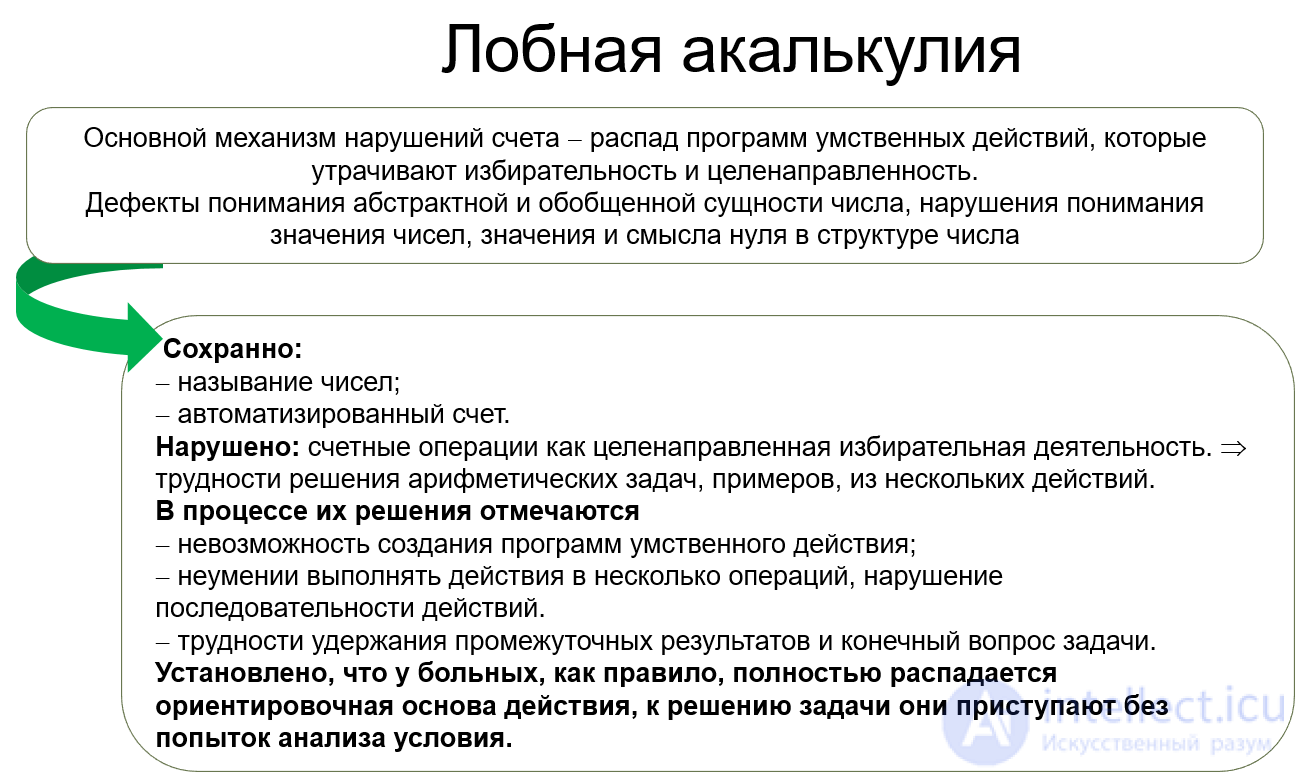
The entire activity of these patients suffers from a lack of motive, intention, cognitive activity, purposefulness, and goal-setting in the process of carrying out a task (for example, composing a given number from individual digits, reading a number consisting of several classes and place values, finding the composition of one or another number — from which numbers the same number can be made, etc.). All of these deficits are characteristic above all of a lesion of the prefrontal convexital zones of the frontal lobe, which leads to a primary impairment of the concept of number, but on different grounds than in primary parietal acalculia. In patients with a "frontal syndrome", the concept of number is impaired owing to deficits in understanding the abstract and generalized essence of number, an impairment in understanding the significance of numbers, and the significance and meaning of zero in the structure of number and in counting operations. These impairments proceed against a background of primary preservation of the positional-place-value principle of the construction of number, based on the intactness of spatial perception in these patients.
In patients of this group, recognition and naming of simple numbers remain intact, and the processes of automated counting remain preserved (the multiplication table, addition and subtraction within the first ten, etc.). Number and counting operations are impaired in them as a purposeful, selective activity; these impairments manifest themselves in the instability of the task, in deficits of active orientative-exploratory activity, in the creation of a program of activity and action, in the simplification of the program of action (sometimes in inert stereotypes), and, finally, in the impairment of comparing the effect with the initial data, i.e., in the impairment of control. These counting deficits are found above all in solving arithmetical problems consisting of several links and requiring a sequence of operations, retention of intermediate results, and comparison of the results obtained with the input data. Impairment of these components of IA leads to impairment of the counting function with full preservation of visual, acoustic, and spatial gnosis, as well as of speech.\
A completely different picture of counting impairment is found in lesions of the basal and mediobasal parts of the frontal lobes of the brain, which, as is known, lead to significant changes in the emotional sphere of the patient's behavior, without greatly affecting the course of his intellectual processes. Deficits of IA arise on the basis of impulsivity and manifest themselves in an impairment of the orientative basis of the action owing to a decrease in attention. Here no primary impairments are found either in counting operations and actions with number, or in the concept of number. Errors arise from a disturbance in the dynamics of the course of nervous and mental processes in the direction of their acceleration, of impulsivity, and from deficits of inhibitory processes. In patients of this group, recognition and naming of simple numbers remain intact, and the processes of automated counting remain preserved (the multiplication table, addition and subtraction within the first ten, etc.).
In lesions of the posterior frontal systems of the brain counting impairments usually occur within a syndrome of pronounced speech and motor perseverations, which are the result of a disturbance in the dynamics of mental processes, in the inertness of their course. Finally, impairments of IA and, in particular, impairments of counting can arise in the syndrome of a lesion of the posterior frontal parts of the brain (and above all the posterior frontal parts of the dominant hemisphere). Operations for solving intellectual tasks can here acquire a deautomatized, expanded character. A lesion of this area of the brain leads to increased inertness of the stereotypes that arise, which complicate the course of thinking. In cases of massive lesions of this region, all these phenomena of deautomatization, inertness of stereotypes, and inactivity are manifested especially clearly in the speech sphere, which further impairs IA. The patient distorts the task, perseverates the data (numbers, the name of the operation, etc.). These counting deficits, which most often arise together with efferent motor aphasia, do not affect the structure of counting, but perseverations and echolalia impede the performance of this function and can sometimes lead to gross impairments in counting operations.
The "frontal" syndromes described above are what give rise to the specific impairments of counting and counting operations. Counting impairments in patients with different variants of the frontal syndrome manifest themselves in different forms, but all of them are characterized by a primary impairment of the concept of number (the structure of number and its place-value structure) and of counting arithmetical operations, though on different grounds than in parietal acalculia. This applies especially to lesions of the polar parts of the frontal zone of the brain. Patients of this group can formally compose a given number from combinations of other numbers, but when their activity is organized from outside, they can also decompose a number into a series of combinations of other numbers (cf. 15 = 5 and 10; 10 and 5; 9 and 6; 6 and 9; 7 and 8, etc.); reading multi-digit numbers is accessible to them, but likewise only when their actions are organized from outside.
Although these operations with numbers can formally be performed, in this group of patients impaired is not only the organization and control of the activity, but also the understanding of the meaning of the interaction of numbers, their internal composition, and the systemic character of number. And this is a primary impairment of counting, but it rests on different mechanisms than in parietal acalculia:
Counting operations are also not primarily preserved in these patients: they do not understand the essence of arithmetical operations, the system of mathematical relations between numbers. They have no difficulties with the spatial schemas of counting, but understanding and comprehension of these operations are impaired. Counting impairments here are heterogeneous in character: in some cases they rest on phenomena of inertness of stereotypes and perseveration, inactivity in the course of higher mental processes; in others — a disturbance of attention and impulsivity; and in a third group — the main factor in the counting deficits may prove to be a gross disturbance of the motivational side of the activity, and instability of goals and intentions. The general picture of counting impairment in this group of patients manifests itself as follows.
In carrying out tasks involving the composition of a given number from all possible combinations of other numbers, some patients (with lesions of the posterior frontal parts) as a rule name a limited number of possible combinations of numbers. Active exploratory activity is here replaced by stereotyped activity: the patients repeat the same combinations of numbers, and some of them, on their own, without stimulation from the instructor, cannot perform the task at all. Prompting the method of obtaining a number from other numbers (using the four arithmetical operations) does not lead to the desired result, and the patient's use of some one operation (addition or subtraction, multiplication or division) often becomes an inert stereotype that the patient cannot overcome on his own. Patients with markedly pronounced impulsivity can, as a rule, perform this task only with the participation of an instructor who restrains the impulsivity. Such patients work unsystematically, jump from one operation to another, and their combinations of numbers are marked by chaos. In patients with impaired purposefulness in their actions, with instability of intentions and deficits in the system of selectivity of connections, many extraneous numerical combinations inadequate to the task arise in performing these tasks.
In reading multi-digit numbers, peculiar deficits of awareness and understanding of the place-value structure of number also appeared. The errors that arose here were of various kinds. They could be related either to a fragmentary understanding of the complex number, or to a simplification of the complex program, or to inertness of stereotypes and speech perseveration, etc. Particular difficulties in reading numbers were found when the number was presented without division into classes (by means of dots or blank spaces; cf. 12051 and 12.051). The most frequent error among all patients was the omission of an entire class when reading a number, especially when that class contained zeros (153556000).
Counting operations, as a complex purposeful activity, are impaired in these patients owing to deficits in retaining the task, a disturbance of orientation within it, a disturbance of the sequence of counting operations, deficits in remembering the intermediate links within the integral act of counting activity, an absence of the need to compare the results obtained with the initial data, and a failure to understand the essence of the mathematical relations between numbers (hence a frequent failure to understand the meaning of the arithmetical sign). Counting operations in these patients can remain relatively intact, especially in cases where they were sufficiently well established in the patient's past experience. This preservation is revealed especially clearly in the performance of those arithmetical operations that do not break down into a series of sequential operations and can be performed according to a well-established scheme. Such operations include subtraction and addition without crossing over a ten, and even multiplication and division within the multiplication table. Operations whose performance breaks down into a series of intermediate links, however, may prove to be significantly impaired. Impairment of counting operations here is revealed above all in a failure to retain intermediate links, in the impossibility of returning to earlier, previously performed intermediate operations, and in the replacement of the necessary active operations by the passive repetition of inert fragments of the operation, etc. Let us give the corresponding examples.
Patient Sh. (case history No. 43119, 47 years old, with a secondary technical education) underwent an operation for the removal of an intracerebral tumor of the left frontal lobe. The patient showed disturbances in behavior and a decrease in critical awareness of his own condition. He is purposeful in his activity; there are disturbances in the system of selectivity of connections. The concept of number is impaired.
In performing a task in which the patient is required to decompose a given number into all possible combinations of numbers, the patient gives a limited series of combinations, does not move on his own from one combination of numbers to another, and uncontrolled, extraneous associations of numbers surface. The patient remembers the instruction, but it does not regulate his activity.
Excerpt from the protocol
The patient is given the number 32000451.
Patient. Three hundred thousand four hundred fifty-one.
Instructor. Really? Patient. What, isn't that right? Is it 320? Well, yes... Three hundred twenty thousand four hundred fifty-one.
Instructor. Did you read the number correctly?
Patient. Yes.
The patient (reading the number 200344): 200... 2 thousand 344 rubles.
Instructor. Where did you get rubles from?
Patient. That's what I think.
Instructor. Read the number carefully again.
Patient. 20 thousand 344.
The fragmentary perception of the three zeros created a hypothesis about thousands, from which the patient cannot detach himself and which he continues to reproduce inertly when reading other numbers, without attempting to control his actions. The creation of certain conditions, however, that strengthen the patient's orientation within the conditions of the task and remove the inertness of stereotypes, leads the patient to an understanding of the composition of the number and to the correct performance of the task. These deficits were removed by dividing the written number into classes and by regulating the reading of the number on the part of the instructor (35.053.176). The patient also failed to cope with writing numbers in a place-value grid; here a tendency appeared to assimilate the writing of the number to its pronunciation, i.e., to its verbal form (cf.: the patient writes the number 25 in the place-value grid as 20 and 5), which may indicate a primary impairment of the process of understanding and, in particular, of the understanding of the place-value structure of number.
Counting operations also proved to be impaired in the patient. An investigation of the patient's awareness of the mathematical relations between numbers showed that an understanding of these relations was in principle accessible to him, but on his own he proved unable to select the needed sign (operation) from among several possible alternatives. Thus, the patient was asked to insert the needed arithmetical signs in the following examples: a) 10...2 = 20, b) 10...2 = 5, c) 10...2 = 8, d) 10...2 = 12. He could not perform a single one of these tasks on his own; after a prompt he correctly placed the sign in the second example, but then transferred it to the third example as well; after his error was pointed out he corrected it, but again could not find the needed sign in the fourth example; after further stimulation and explanations he finally solved all four examples correctly.
The simplest counting operations within the multiplication table are performed correctly by the patient; he can also correctly solve complex examples, but this requires the creation of certain conditions that strengthen his orientation within the conditions of the task, that make it possible to reinforce the intermediate link in the counting operations, and to retain the goal of the entire task.
In examples of the type 88 : 8, 44 : 4, stereotyped errors inevitably arose: 88 : 8 = 10, 44 : 4 = 10, etc. The patient solves examples involving subtraction with regrouping across a ten as follows. The example given is: 35-17.
Patient. Half of 35 will be 17.
Instructor. How did you get 17?
Patient. I divided it in half.
Instructor. But what do you need to do?
Patient. Subtract 17 from 35.
Instructor. Well, go ahead and subtract.
Patient. That's what I'm saying, 17.
Instructor. Subtract the number 17 in parts.
Patient. 35 minus seventeen will be half.
Instructor. Solve it step by step.
Patient. 30 minus 10 will be 20, no, 25, how much more to subtract... 7, so 25... 13 remains.
Instructor. How much will you get in the end?
Patient. 13.
The patient solves the example (63 - 7) as follows: 63 minus 3 will be 60, 60 minus 4 will be 66. He solves another example (42 - 8) as follows: 42 minus 8 will be 46. Etc.
We have presented an illustration of counting impairments arising primarily, on the one hand, from a disturbance of attention, gross deficits of orientative-exploratory activity, an absence of a general strategy in actions and of control, from a disturbance of the selectivity of connections and their replacement by uncontrolled, extraneous associations, i.e., symptoms characteristic of lesions of the prefrontal convexital parts of the frontal systems. On the other hand, we clearly see an impairment of the process of understanding, an impairment of the comprehension of one's own actions: the actions are performed in isolation from thought and often proceed as senseless.
A somewhat different picture of counting impairment opens up to us in lesions of the basal parts of the frontal systems. In this case, the counting deficits proceed considerably more mildly and are more easily overcome. The cause of the deficits arising in this case is a disturbance of orientation within the task, a failure to retain the task, etc., arising as a result of impulsivity and instability of attention. The process of counting is not substantially impaired in this case. Let us give an example.
Patient B. (case history No. 35070 and 37434, 44 years old, higher education) underwent an operation for removal of a tumor that had invaded the entire cortex of the lower parts of the left frontal region. The tumor extended into the anterior horn of the lateral ventricle, spreading to the pole, and with its posterior end extended into the anterior parts of the temporal lobe.
As a rule, the patient did not experience serious difficulties in solving two-term arithmetical examples of any complexity; she counted quickly and correctly. Only occasionally did errors appear in her, based either on impulsivity or on the inertness of stereotypes that had once arisen. However, after her attention was drawn to the erroneousness of her actions, the patient corrected the errors on her own.
Excerpt from the protocol
Thus, she quickly and correctly solved a two-term arithmetical example in addition: 15 + 18 = 33. However, in the next example, involving subtraction (35 - 17), the patient inertly continued to add, replacing the subtrahend 17 with the former addend 18.
Instructor. Quickly work out how much it will be if you subtract 17 from 35.
Patient. 35 minus 17 will be... 43.
Instructor. How did you get 43?
Patient. Oh, no, 53.
Instructor. Repeat the example.
Patient. 35 + 18.
The impulsivity characteristic of this patient's activity often led to a simplification of the solving of examples, to assimilation, etc. Thus, in solving the subtraction example (45 - 19), the patient arrives at the answer 34. Analysis of the solution to this example indicates a simplification of the program of the action.
Excerpt from the protocol
Instructor. Tell me how you are solving the example.
Patient. How... 45 - 19... will be 34.
Instructor. Why?
Patient. What do you mean, why?
Instructor. What do you do first?
Patient. 45 - 10 will be 35, 35 minus 9 equals... Ah! It will be 24.
Instructor. Why?
Patient. Well, obviously.
Instructor. Solve it in parts.
Patient. 35 - 5 = 30...30 minus however much is left...4 ... 34.
Instructor. Pay closer attention.
Patient. Well, of course, 26.
The most pronounced deficits in the dynamics of counting operations were found in solving examples with a composition of three (or more) terms. Solving such examples requires remembering a series of intermediate links and returning to a result obtained earlier. To solve such examples correctly, a preserved stability of attention and purposefulness in one's actions, activity, and the ability to switch from one link of the action to another are necessary. These processes proved to be impaired in the patient, and the deficits of counting operations were the consequence of this.
The greatest difficulty for this patient was presented by the task of serial sequential subtraction or addition. The patient was asked to count down sequentially from 100 by 7s.
Excerpt from the protocol
Patient. 93... from 93 subtract 1... 80... 80... well, let it be 87» (pause)
Instructor. Are you counting?
Patient. I'm counting... so, 94 minus 7... and I should get... I don't know how much it should come out to.
The patient is offered help — two minus signs are written on a card (1] - 2] -). It is further explained to the patient that the number 7 must be subtracted in parts each time.
Instructor. Count from the beginning.
Patient. 100 - 7 = 93, 93 minus 7... will be 84.
Instructor. Look at the card.
Patient. Well, I'm subtracting... 3, 90, and then minus 4 will be 86... now 79... now 72... now... now 70 and then...
Instructor. Look at the card.
Patient. Minus... however much that is...5... 75...
Instructor. Really?
Patient. 65. Etc.
The examples given show that this patient does indeed have a counting impairment. However, the character of the course of the counting process itself and the character of the errors that occur in this patient's counting differ fundamentally from the character of the counting impairment in patients with lesions of the prefrontal and parietal zones of the brain. Patients of this group experience no difficulties either in the awareness of number, or in the assessment of its place-value structure, or in the process of counting down itself. In this case, counting is impaired secondarily, owing to deficits in the dynamics of the process. At the psychological level, this deficit manifests itself in symptoms of a disturbance of general behavior and activity: in impulsive, uncontrolled actions, in a disturbance of the programming of the activity and its purposefulness, and others. However, these symptoms are secondary; they are not related to a primary impairment of IA, as we saw in patients with lesions of the prefrontal convexital parts of the frontal zones of the brain. Here, management of the dynamics of the process and restoration of the inhibition of impulsive actions are necessary, and this will be sufficient to obtain the correct course of the counting process. Elementary help from the instructor, aimed at strengthening the patient's orientation within the conditions of the task, as well as the transfer of the process to the level of conscious awareness, lead to the correct performance of counting operations.
A lesion of the posterior frontal parts of the brain leads to a disturbance in the dynamics of mental processes, manifested in the pathological inertness of stereotypes that have once arisen, in deficits of switching, and in perseverations. Marked aspontaneity and signs of pathological inertness, especially clearly expressed in speech and thinking, aggravate the counting impairments and make them difficult to overcome. In these cases, the development of special methods of restorative training in counting, adequate to the nature of the impairment, is required. Patients of this group have difficulty coping with a task requiring them to compose a given number from other numbers; as a rule, they inertly reproduce two or three variants of combinations of numbers that have surfaced.
Thus, patient T. (case history No. 43391, 40 years old, an economist, with an arachnoendothelioma removed from the posterior frontal region) was able to perform the task, but the number of combinations of numbers she gave proved small, and she inertly reproduced the same combinations.
Excerpt from the protocol
Instructor. Compose the number 10 from other numbers; you may use any arithmetical operations for this.
Patient. 5 and 5; 3, 3, 3 and 1; 4, 5 and 1; 4, 5 and 1.
Instructor. What do you need to do?
Patient. Compose the number 10 from other numbers... Compose the number 10... Compose the number 10... (While repeating the instruction, the patient did not proceed to the action.)
Instructor. Compose the number 24. Find as many variants as possible of the numbers of which 24 can be composed; that is your goal.
Patient. Your goal... Your goal... 24, first, 24... second, 24 multiplied by 24...
Instructor. What is the goal, then? What number do you need to compose?
Patient. 24.
Instructor. Go ahead and compose it.
Patient. 24 times...24 and 1 two... No, that's not it... 24 and 4... no, that's not it... (refusal).
In reading multi-digit numbers — perseverations that the patient cannot overcome on her own. The patient reads the number 48220401 as 48 thousand, 220 thousand, 401 thousand.
Along with the correct solution of examples involving regrouping across a ten (24 + 32 = 56; 62 - 20 = 42), the patient replaced the correct solution with perseverations: 35 - 17 = 18; 45 - 29 = 28; 45 - 29 = 49, etc.
The counting deficits are found especially clearly in the performance of tasks that proceed under conditions of maximum mobility of the computational operations, for example in a task in which the patient is required to subtract sequentially from 100 by 7s, or to add by 7s starting from 5. The difficulties of this operation lie above all in the fact that counting here is subordinated to internal conditions that constitute a constantly changing, dynamic field.
we see a difference in the clinical, neuropsychological, and psychological pictures of counting impairment in lesions of different zones of the frontal systems. Naturally, the methods of restoring counting in the prefrontal, basal, and posterior frontal syndromes will also be different. They will likewise differ from the methods of restoration used in other forms of acalculia, since in all these cases the mechanisms (factors) of the counting impairment are different.
Let us briefly sum up the results. Lesions of the frontal zones of the brain, like lesions of the parieto-occipital areas, lead to impairment of counting and counting operations. In contrast to the existing view of a secondary counting impairment in lesions of the frontal zones of the brain, our study allows us to conclude that, in lesions of the frontal systems of the brain, there is a primary impairment of counting — of the concept of number and of counting operations. This deficit is manifested especially clearly in lesions of the prefrontal convexital parts. In this case, the semantic component of counting is impaired, along with the understanding of the structure of number and the dependence of the magnitude of number on the positional principle. All these deficits occur within a syndrome of impairment of the personality and of motivation, on the one hand, and of the breakdown of the structure of IA, on the other. In this syndrome, orientative-exploratory, searching activity is grossly impaired and is replaced by habitual patterns, and the planning of counting activity is also impaired. The entire activity of the patients in this case is unpurposeful, unregulated, and uncontrolled. It is within this syndrome that deficits arise in the concept of number, its composition, the understanding of the interaction of numbers within a single number, and the understanding of the essence of arithmetical signs and of operations with them. Let us briefly clarify the clinical and neuropsychological picture of counting impairment in different variants of "frontal" acalculia.
In the clinical picture of the impairment, the counting deficits manifest themselves in some cases in impulsive actions of the patients, in others — in slowness and difficulty in switching from one type of action to another, and in a third variant — in "field behavior" that has nothing in common with the task (for example, the task is to solve the arithmetical example: 9 + 5 = ; the patient looks around and says: "Ah, that means 9 chairs, but there aren't nine here... one, two, three... only three"). Children with insufficiency of frontal lobe function are also distracted from the task: they begin to draw, or get up and walk around the room, etc. All behavior in the situation of performing the task is inadequate, and the patients are uncritical of their own actions.
The neuropsychological picture of the impairment. Counting impairments occur within a syndrome of impairment of the activity, of its purposefulness, regulation, and control, of impairment of the motives and needs underlying behavior, together with an absence of organization of the activity and a breakdown of the regulating role of speech. Factor — impairment of the selectivity and purposefulness of the activity. Symptoms: a) an inability to perform independent actions with numbers, without external guidance; b) a failure to understand the interrelation of numbers within the composition of a number; c) a narrowing of the range of connections of number, i.e., a decrease in generalization and an impairment of the concept of number; d) impairment of counting operations; e) the dropping out of intermediate links in counting operations; f) the surfacing of extraneous associations; g) perseverations. Recognition and naming of digits and simple numbers, the multiplication table, addition and subtraction within the first ten, and automated operations remain preserved.
The psychological picture of a disorder of counting due to lesions of the frontal zones of the brain is characterized above all by an impairment of the voluntary level at which this process unfolds. The involuntary level of counting, especially of computational operations, is often preserved, which frequently leads to the erroneous conclusion that the ability to count and to perform counting operations is preserved in these patients, whereas in fact, as our experimental data show, only the skills are preserved; conscious and meaningful operations with numbers are grossly impaired.
In the field of problems concerning the restoration of human mental activity, methods for restoring higher mental functions, including counting, in patients with lesions or dysfunction of the frontal lobes of the brain are the least developed. The same applies equally to the state of methods for restoring HMF in children with underdevelopment (delayed maturation, etc.) of the frontal systems of the brain. This is particularly true of childhood acalculia. This area of restorative learning requires theoretical and experimental study.
Here we shall describe the methods that we developed experimentally and that have undergone extensive practical use. Our methods satisfy a number of requirements and conditions. The first and most important requirement for methods of restorative learning in patients with frontal syndrome is their effect on the organization of the patients' general behavior and their behavior in the learning situation. The second requirement concerns the correct formulation of the tasks of restorative learning. The third requirement presupposes the use of methods adequate to the structure and mechanism of the acalculia, and the fourth concerns the content of the methods, their psychological essence.
Practice in teaching this group of patients has shown that the most effective approach in these cases is the programming of the patients' Activity, which is at the same time the leading Method. The psychological essence of this method consists in the fact that the program: a) divides the integral action into its constituent operations; b) externalizes this structure of the action; c) renders the action voluntary and conscious.
The first condition of restorative learning appeals to the personality of the patient and his emotional-volitional sphere. This means that all types of work, the solving of any tasks and assignments, must begin with the establishment of contact with the patient, with ascertaining (and creating) the patient's interests and system of relations, with the creation of a motive for the activity and its being made meaningful by the patient. The second condition presupposes the skillful use of speech — the patient's own speech and the speech of the instructor. In some cases speech acts as the organizer and regulator of the patient's activity (and later also as a means of self-regulation), in others — speech fixes the performance of the task, linking speech with the patient's actions. But in some cases, namely with lesions of the posterior-frontal zones of the cortex of the right and left hemispheres, as well as of the medio-basal regions, speech may prove to be a hindrance, and the work must be carried out with speech excluded.
In contemporary psychology, thinking is considered in close connection with action, and vice versa. "At every step in life we see the transition of thought into action, and of action — into thought. These systems are not isolated from one another". (FOOTNOTE: Vygotsky L.S. Selected Works. Moscow: Publishing House of the RSFSR Academy of Pedagogical Sciences, 1956, p. 472.) An action refracted through the prism of thought — is already a different action, meaningful, conscious. This is a different, higher level of realization of the action. It is precisely this level in the structure of intellectual activity, in particular in counting, that is impaired in lesions of the frontal systems. As we saw above, it is this factor that underlies frontal acalculia, which must be taken into account in restorative learning.
The objectives of restorative learning for this group of patients are as follows:
1) restoration of the processes of understanding as a component part of thinking;
2) restoration not of formal operations and actions with numbers, but of conscious and meaningful ones;
3) restoration of the connection thought — action (and action — thought);
4) restoration not of isolated actions and operations with numbers, but of systemic ones, i.e., restoration of the understanding of the integrity of the arithmetical action and of the interconnection of the operations within the structure of the arithmetical action; for example, in the operation 35 - 17: a) 17 + 3 = 20, b) 35 - 20 = 15, c) 15 + 3 = 18, all the operations, the sequential performance of which leads to the solution of the task, are interconnected and constitute an integral formation, or a "system of operations";
5) restoration of the understanding of the sense and meaning of number.
Before beginning work proper on the restoration of counting, one should work on the organization of the patient's behavior, using for this not numerical material but pictorial and verbal material, and only afterward — numerical material. The methods of organizing the patients' behavior and activity are numerous and varied; we shall describe some of them. The method of classifying pictures (and words): a) according to given attributes, b) free classification. The nonverbal method of oppositions (opposites): the patient is given a picture (rain, night, etc.), and must find a picture with the opposite meaning. The verbal method of antonym words: the patient's task is to find antonyms for a given series of words (for example, fat — ...; clever — ...; rainy — ...; to sit — ... etc.). These methods contribute to the restoration of concentration and distribution of attention, to the understanding of the interrelation of objects, phenomena (or words) according to specific attributes, and to the organization and conscious performance of activity and its being made meaningful.
The method of organization, distribution, and concentration of attention. The patient is given a single stack of cards on which digits from 1 to 10 are written, together with a classification task: a) place the even digits on the left, the odd ones on the right; b) place 2 odd digits and 2 even digits on the left;
Next, another stack of cards is presented, on which numbers of the second and third tens are written (11, 12, 13, etc., 21, 22, 23, etc.), and a series of tasks is given for various kinds of classification of these numbers. F o r e x a m p l e: a) place the numbers of the 2nd ten on the left, and of the 3rd on the right; b) place one number from the 2nd ten, then the next from the 3rd, alternately, and so on; c) find and place the numbers 11 and 21, and say how these numbers differ, etc.
The Schulte table. This table makes it possible to carry out a variety of exercises with patients involving numbers. For example: a) find and successively point out the numbers from 1 to 25 (for children, from 1 to 10 or 15) and, conversely, — from 25 to 1; b) find and point out the even numbers; c) find and point out the odd numbers; d) point out all the numbers that are greater than (less than) 10, etc. These and other exercises activate the patients' engagement with numbers, foster interest in working with them, restore voluntary attention and its distribution, etc. With children, this method (working with the Schulte table) is best carried out in a group (2—3 children), giving a variety of "game" tasks: "One child points with a finger to all the odd numbers, and the other, right after him, to all the even ones", or "One points to the red numbers, and the other — to the black ones". After this, the following task is given: "The first child must name the numbers that the second child pointed to, and the second child — the numbers that the first pointed to", and so on.
All these, and a number of other similar methods and techniques, contribute to:
In children, these methods also work toward restoring knowledge of numbers and their sequential order. All these methods and exercises are applied at the / stage of training and are aimed at the actualization (disinhibition) of general knowledge about number.
At Stage II one can move on to solving the special tasks of restoring counting, and above all — to restoring the understanding of the composition of number and of the interrelation of numbers with one another. In this case it is good to use the method of programmed restorative learning of the composition of number with patients. As material one can again use the Schulte table and numbers written on cardboard cards, and as techniques — the operations of addition and subtraction. Work with the patients is conducted according to programs consisting of a series of sequential operations written on a card and lying in front of the patient on the table. The procedure for conducting the session requires: a) gradual, conscious, and sequential reading, followed by the performance of each operation after reading it; b) return to the operations performed, verification of their performance; c) repetition.
After joint practice on the first written program, an attempt is made to transfer the patient to working with the program by means of loud oral speech, reproducing and performing the operations from memory, and at the end — at the level of inner speech, i.e., "to oneself". After this, they move on to the next program, which addresses different tasks. Instruction: I will read, and you listen attentively, and then perform the task I have read, then repeat the task and perform it again. Below are given several programs of operations with numbers.
Program No. 1
Program No. 2
After repeated work on these programs, once the patients' understanding and conscious awareness of the operations have been confirmed, one can move on to the next program.
Program No. 3
After working through these operations with the Schulte table, it is good to carry out a series of exercises with numerical cards on which the same digits are written that the patient has already worked with. Task: 1) Find the numbers from which the sum 3 (7, 11, 15, etc.) can be obtained. 2) From what other numbers, if added together, can the same sum be obtained? Find these numbers, add them, write them down; check whether everything is correct; repeat. 3) Carry out other (all possible) operations with these numbers; check whether everything has been done correctly.
Carry out the same work on restoring the understanding of the composition of number by means of subtraction.
Program No. 4
10.Point out what numbers the number 9 consists of. And so on. It is necessary to vary the operations with numbers, but in such a way that the patient performs all the operations voluntarily, actively, and consciously. The table in this case fulfills a number of tasks: a) it serves as a visual support for operations with numbers; b) it removes the involvement of memorization; c) it fixes and concentrates attention; d) it externalizes the internal composition of a number and the connections of numbers with one another.
After prolonged work with materialized visual supports (the table, cards with numbers, etc.), one must gradually move on to working in terms of oral speech, and necessarily with the same numbers already worked with in the preceding programs. After this, one can move on to operations with other numbers (beyond the first ten). Then the Schulte table is replaced by numerical cards, with the help of which various operations with digits and numbers are performed with the aim of restoring the understanding that each number is an integral whole and consists of a series of other numbers connected with one another, which constitutes its internal composition.
In one stack of cards within the patient's field of view are the digits from 1 to 10, in another — numbers from 10 onward. The patient is given the task — to make up the number 25, finding the numbers needed for this. A model is given: 5 = 3 and 2; 4 and 1; 1,1,1,1. The task is — to find the composition of other numbers. It is necessary to work extensively and for a long time with varied techniques for numbers in order to restore the understanding of number, its composition, and the interaction of numbers.
These methods of work are preparatory to restoring the concept of the place-value structure of number, since this characteristic of number is also impaired. Patients experience great difficulty when a series of operations with a number must be performed consciously and voluntarily, taking its place-value structure into account. Patients can sometimes involuntarily write a number correctly under dictation, yet consciously writing a number into a place-value grid, placing each component in its corresponding place, presents difficulties for them, as does the reading of numbers consisting of several classes and places. Nor are they able to assess the quantitative aspect of a number if it contains zeros, etc. (see the examples above). Underlying these difficulties, as we have already written, is not a disorder of spatial perception but an impairment of the understanding of the significance of the spatial composition of number, that is, the dependence of the quantitative aspect of a number on its spatial, place-value structure. Patients can operate with such numbers at the involuntary level (adding, subtracting), but they cannot understand the place-value structure of number. Therefore, in this case too, as with primary parietal acalculia (which we shall discuss below), it is necessary to work on restoring the patients' understanding of the place-value structure of number, overcoming in doing so not spatial defects but impairments of behavior and of the thinking process. The work must be carried out at the voluntary and conscious level within the structure of activity. Below we shall describe some methods.
The method of analyzing the place-value structure of number. Work begins with the numbers of the 2nd ten. In front of the patient there should be cards with the digits from 1 to 9, cards with the numbers of the second ten (11, 12, 13, 14, etc.), and a program. The program must be written in large letters, with the key words indicating the operation to be performed highlighted. The patient must learn to work with the program independently, with the corrective and stimulating help of the instructor.
Program No. 1
Part I
Part II
Program No. 2
Program No. 3
1. Write down the composition of the numbers 10,12,35,11,55 according to the model (10 = 1 ten 0 units, 48 = 4 tens 8 units).
The method of analyzing the place-value structure of number. Work begins with the numbers of the 2nd ten. In front of the patient there should be cards with the digits from 1 to 9, cards with the numbers of the second ten (11, 12, 13, 14, etc.), and a program. The program must be written in large letters, with the key words indicating the operation to be performed highlighted. The patient must learn to work with the program independently, with the corrective and stimulating help of the instructor.
Program No. 1
Part I
Part II
Program No. 2
Program No. 3
1. Write down the composition of the numbers 10,12,35,11,55 according to the model (10 = 1 ten 0 units, 48 = 4 tens 8 units).
2. Write them down in the table (see the model).
Tens |
Units |
1 |
0 |
3. Write into this table the numbers 48, 56, 77, etc. (a table is given, or drawn in the notebook, but now without a model).
4. Check your work. Did you do it correctly?
5. Write the number 55 in the table. Say which 5 is greater — the first or the second, and why?
6. Make fifty out of 5. Write it down, and now write it down in the table, and now write 5 in the table, and now 55.
7. Explain the composition of each number. What places does it consist of? What does the 0 denote?
With this program, adult patients and children fairly quickly master the composition of number, begin to understand its place-value character, and the significance of the place-value structure of number in counting operations. At first the work is done jointly with the instructor: a) the instructor works with the table, explaining his actions; the patient repeats all the instructor's actions (the joint mode of work); b) later the instructor gives a number (for example, 35) and writes (or places a card with) one number in the tens place, while the patient writes the units.
After prolonged cooperation with the patient, the instructor transfers the patient to independent activity, in which he must strictly perform all the operations of the program. Subsequently the programs are mastered by the patient, and are reduced in the number of operations, many of which drop out (i.e., are already performed "in the head" and become automatized). Similar work is carried out on all the places and classes, moving gradually through them.
Restorative learning for children is conducted according to these same programs (or variants of them), but the program is read by the instructor,
продолжение следует...
Часть 1 2.3. Frontal Acalculia: Diagnosis and Treatment
Часть 2 See also - 2.3. Frontal Acalculia: Diagnosis and Treatment

Comments