
Lecture
In this section we shall dwell in more detail on the analysis of the methods and dynamics of the restoration of writing in one of the forms of non-speech agraphia — optic agraphia, which is difficult to overcome and is frequently encountered in children.
The central task of restorative learning of writing in optic agraphia consists in restoring constant and generalized image-representations of objects, letters, and numbers, as well as restoring fine differentiated object perception and letter perception. In optic agraphia the main defect is insensitivity to the micro-features that distinguish the shapes of different letters and that endow a letter with its own designation (just as the phoneme, in acoustic perception, performs a meaning-discriminating role both in the perception and in the writing of words). Therefore all methods of restorative learning must be directed toward restoring sensitivity in visual perception to these micro-features. Generalized perception of letters remains preserved (at the lowest level of generalization — global perception of the sign). This is why the errors in optic agraphia are substitutions of some letters for others that share a general, global similarity. The task is to restore differentiated perception of letters, and for this one must work on their analytic perception, with the subsequent restoration of generalized perception. This is the general task of restorative learning of writing in optic agraphia. The specific tasks are:
1) restoring constant and generalized image-representations of objects, letters, and numbers;
2) restoring fine differentiated perception of the image-representations of objects and letters;
3) restoring the actualization of the generalized image of the letter-grapheme.
At the 1st stage of training it is useful to work not on distinguishing letters, but on distinguishing objects (object pictures) that are close in outward appearance but far apart in meaning (for example, lemon-orange-tangerine, tomato, apple, watermelon, melon, etc.), using the following methods.
The classification method. Classification is carried out first by semantic feature, then by shape, then by common features, and finally by distinctive features.
The verbal-analysis method. The patient is asked to answer the questions: Why are these objects in one group? Why are these objects in another group? The patient must explain and show.
The copying method. First the patient is asked to copy objects that are far apart in outward shape, then ones that are close in shape. After the copying, a verbal analysis is carried out (content, function, what they are made of, what they are used for, etc.), and then an analysis of shape — in what respect they are similar and different.
The drawing method. The patient is asked to draw certain objects: a) draw fruits (only similar ones), b) draw fruits (only dissimilar ones). He is then asked to note what is common and what differs, and in what respect they are similar and dissimilar in outward appearance.
The method of completing given objects. A series of unfinished images of objects (fruits, vegetables, furniture) is placed in front of the patient, and he is asked to complete the drawing to form a specific object. At first the object is named to the patient (complete a lemon), and then only the instruction is given — to complete the drawing into a whole object and name it. Or he is asked to draw in the main part that makes it distinct from another object. For example, one might give a drawing of a lemon (with the upper part and the bumpy texture left undrawn), of an orange (given the shape of a lemon, and the patient must see the difference and draw it correctly), complete a chair into an armchair (the patient himself must indicate the distinguishing features), complete a fish into a whale, and so on.
After the preparatory "semantic" stage of work on isolating the essential features of objects, one can move on to work on restoring the perception and actualization of the image of the letter (second stage). The most effective methods for restoring the optical image of a letter, as well as the fine differentiated image-representation of letters that are similar in their shape (Н, П, И), are the methods of "construction" and "reconstruction" of the letter. Training is first carried out at the level of the material form of the action: from a folding letter given to him (wooden, plastic, or cardboard), the patient assembles all the other letters that are possible.
The method of directed reconstruction of a letter. The patient is given the instruction: "In front of you lies a letter (for example Р) and several sticks, circles and other elements. Your task is to make the letters В, Ф, Б, Ь out of the letter Р. To do this you must reconstruct the given letter: add some detail to it or remove an extra one. This is like playing with a construction set". (A sample of the work of reconstructing a letter is given.) The patient works first together with the instructor, then independently. After assembling each new letter, the patient must feel it, name it, and write it down; after this he must write it again from memory; an analysis is then carried out of all the letters written down: what they have in common and how they differ (for example, Р — Ь, В, Ф, Б).
The method of undirected (free) construction of a letter. This is based on the free actualization of the image of a letter. In this case the patient is given the task of making all the letters possible out of the given elements and details (circles, sticks — short and long, etc.), but no starting letter is specified.
After a series of successive operations that draw on kinesthesia (feeling with the hands), articulation, hearing, and also on verbal conscious analysis of the construction of the letter, the patient is asked to carry out these same operations, but now at the materialized level, using the method of completing (finishing writing) a given letter. And finally, at the end of the second stage of training, the patients, now at the level of representations ("in the mind"), carry out the whole series of operations with the given letter and orally list and write all the letters that can be constructed from the given letter by reconstructing it or constructing it from elements. Patients are able to carry out these actions only after their knowledge of the letters of the alphabet has been relatively restored, since this method is aimed at restoring the capacity for fine differentiation in the optical perception of a letter. These sessions are conducted systematically and over a long period of time.
The method of conscious comparative verbal analysis of the structure of letters. In this case the patient must find on his own, among the letters laid out in front of him, those that are similar in outward appearance and explain in what respect they are similar and in what respect they differ.
The ideogram method. Patients memorize the shape of many letters through a verbal semantic characterization of their construction or through a similarity to some object. For example, the letter О is remembered as a small circle or a zero, the letter С as a semicircle, the letter Ж — a big six-legged beetle, the letter М — a metro (subway) sign, and so on.
The semantic (meaning-based) method. Instruction: a) write (or copy) words (for example, молоко [moloko, "milk"] and музыка [muzyka, "music"]), b) underline the identical letters, c) write them, d) think of and write words that contain these letters. After this work, dictations of handwritten letters can be conducted.
The method of a group of words beginning with one letter. When writing, this letter needs to be set apart. Training is conducted using corresponding object pictures. In the lesson the names of several objects, the meanings of these words, and their connections are learned. All the words (names of objects or actions) begin with one letter (the one learned in that lesson). The words are written in a column as follows:
Then another group of pictures is presented, depicting objects whose names begin with a different letter that is close to the first in its optical features, and these words are also written down:
л(ошадь) (loshad', "horse") л(опата) (lopata, "spade") л(едник) (lednik, "glacier") |
л(инза) (linza, "lens") л(упа) (lupa, "magnifying glass") л(уна) (luna, "moon") |
In the next lesson the patient is presented with the pictures mixed together, and he must sort them into two groups, marked on the table with the letters М and Л. These exercises are recommended to be conducted with all letters, making the combinations of letters more complex and increasing the volume for simultaneous comparison. This work on the visual differentiated perception of letters and on writing them, relying on the meaning of the word, is similar to the work on restoring differentiated acoustic perception.
The auditory method of actualizing the image of a letter. A word is played from a tape recorder. The patient: a) hears the word, b) repeats it, c) finds the picture corresponding to the word, d) carries out a sound analysis of the word — how many sounds are in the word, which sound is first, second, and so on, e) finds by feel the first sound-letter, f) writes it down, g) finds the second letter, places it next to the first, and so on, h) reads the word, i) copies it, j) writes it from memory. This method draws on the preserved tactile-kinesthetic and auditory sensations and images of the letters. Bringing these connections into the work creates a basis for the actualization of the visual image of the letter.
Gradually, as the ability to recognize letters improves, training begins for restoring knowledge of handwritten letters. In this case ideogram writing is used (surname, first name, etc.). On this basis, initial work begins on restoring the image of the handwritten letter and its connection with the printed one. After several letters have been mastered, dictations of the most common first and last names can be conducted, as well as dictations of high-frequency words — names of objects that are most familiar to the given patient. After this one can move on to writing individual handwritten letters, but only within a word.
Repeated writing of dictations of first and last names and of familiar words beginning with one letter or another helps restore its optical image through: a) the preserved motor image of the letter, b) its connection with certain well-established meanings that arise in connection with the writing of words that have been consolidated in the patient's past experience. The method of comparing printed and handwritten letters is quite effective, along with a verbal analysis of their similarities and differences, and writing graphemes to dictation (Аа — Ла, Рр — and so on).
In the work of restoring knowledge and writing of handwritten letters, the written method of letter reconstruction is also useful. Procedure for carrying out the method: printed letters are given in written form, and under each letter the patient must add the missing element of the letter to complete it in handwritten form.
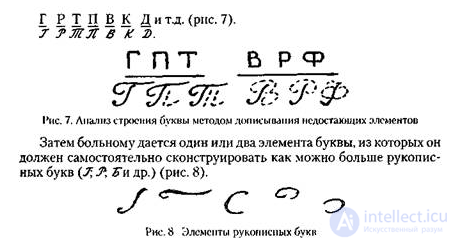
While reading a text, the patient is asked to find and underline the letters being practiced, or letters that resemble one another, or letters corresponding to given handwritten ones, and so on. After certain successes have been achieved, that is, when the patients can already find many letters of print (and handwriting) on their own and can write them to dictation, they move on to learning all the letter designations of the given grapheme.
All the described methods, related to the construction and reconstruction of a letter, pertain not only to the restoration of writing in its optic impairment, but also to the restoration of reading, impaired in the same (optic) link. Work on restoring writing in patients with optic agraphia is usually carried out as a single complex together with the restoration of reading.
The task of the third stage of restorative learning is to consolidate the optical image of the handwritten and printed letter, but now no longer in isolation, but within a word, where all the letters are combined with one another and therefore require the finest optical analysis in writing and reading. Work on analyzing the structure of a letter within a word promotes the restoration of a generalized and, at the same time, constant optical image of the letter. For this purpose the analysis of the structure of a letter (this applies especially to handwriting) should be carried out not in isolation, but within a word. The method of verbal analysis in comparing optically similar letters is often used here. For the comparative analysis one should select words that include letters that are close in their optical shape and that are most difficult for patients (for example, двор [dvor, "yard"], дрова [drova, "firewood"], доброта [dobrota, "kindness"], подарок [podarok, "gift"], колесо [koleso, "wheel"], здоровье [zdorov'e, "health"], соловей [solovey, "nightingale"]).
Great importance is given at this stage of training to the writing of individual letters and whole words relying on the motor image of movement — "writing" letters and words in the air with the hand, writing with the eyes closed (the method of actualizing the motor image of the letter).
The described forms of agraphia, occurring within the syndrome of impaired visual and visuospatial perception of image-representations, are encountered fairly often in the clinical presentation of brain lesions and require their skilled recognition and adequate methods for overcoming the central defects.

Comments