
Lecture
Это продолжение увлекательной статьи про посттравматическое стрессовое расстройство.
...
desire to take revenge on him or to humiliate him (which in some cases may be expressed in outbursts of anger);
PTSD leads to a state of chronic overexcitation of the autonomic nervous system. This causes symptoms such as sleep problems, irritability (up to outbursts of anger), hypervigilance regarding potential threats (in extreme cases resembling paranoia). Because of the heightened reactivity of the nervous system, the patient may involuntarily flinch or even jump upon hearing an unexpected noise[66].
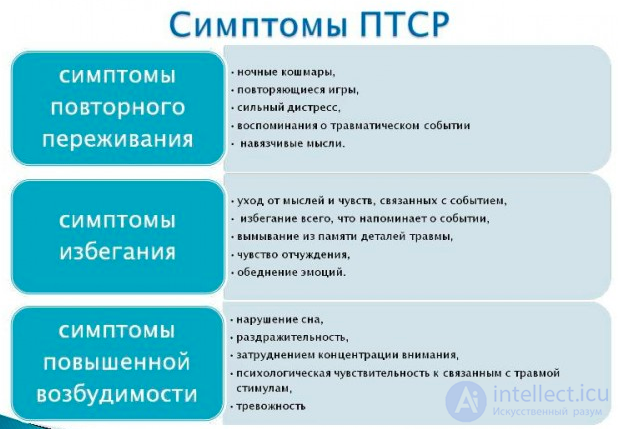
Pathological re-experiencing, also called the "flashback effect", is a memory of the traumatic event that suddenly (often for no apparent reason) resurfaces, with the patient experiencing the sensation that the event is happening to him or her at that very moment[67]. During flashbacks associated with traumas experienced in childhood, an adult may feel as though his or her body has become small and weak, as a child's body is[68]
This symptom is very characteristic (flashbacks are observed in almost all persons suffering from PTSD)[69] and is, moreover, one of the most severe and frightening in the clinical picture of PTSD. Patients are often embarrassed to talk about flashbacks: they are ashamed that memories evoke such intense fear in them.
Flashbacks may take the form of visual images, sounds, smells, and tactile and taste sensations that occurred at the moment of the trauma. Sometimes the patient experiences only one type of flashback, but often they occur simultaneously, creating a complete, very realistic, and frightening picture of the traumatic event. Flashbacks are usually activated by external stimuli (visual, auditory, tactile, gustatory, etc.) that resemble the event (triggers). A reminder of the traumatic event evokes severe negative emotions in the individual who experienced the trauma. In particular, smells are a very powerful trigger for the onset of flashbacks[70].
When a flashback occurs, the following outward signs may be observed, which do not occur during ordinary memories:
In PTSD, nightmares are similar to flashbacks: they create a sense that what is happening is real and evoke intense fear. However, whereas flashbacks accurately reproduce fragments of the event, dreams may take a symbolic form that only distantly resembles what occurred at the moment of the trauma. Moreover, the content and form of flashbacks do not change over time, whereas in dreams a blending of memories of the trauma with memories of something that happened recently may occur. For example, a nightmare may contain scenes from a film watched the day before, if an associative link was formed at the subconscious level between the scene from the film and the traumatic event. Nightmares disrupt sleep: the individual wakes up in fear or tries not to fall asleep, fearing the onset of nightmares[72].
In PTSD, nightmares are characterized by a "photographic" reproduction of past events. For this reason, patients suffering from sleep disturbances are asked about the content of their dreams; PTSD is suspected when very vivid and plausible nightmares are present. During sleep, a patient with PTSD may make various movements, and upon waking from a nightmare may be agitated, frightened, may scream, attack his or her partner in bed, or grip them tightly[54].
Post-traumatic disorder can lead to the occurrence of dissociative symptoms. The term "dissociation" refers to a defense mechanism (or its result) by which a coherent set of actions, thoughts, attitudes, or emotions becomes separated from the integrated psyche of the personality and functions independently. In this case, two or more mental processes can coexist independently of one another[73]. One of the results of this defense mechanism is that when a patient enters a state of dissociation, his or her pain sensitivity decreases. Most patients with PTSD do not show significant dissociative symptoms. According to research findings, their presence correlates with traumatic childhood experience. It has also been noted that the presence of dissociative symptoms leads to a higher risk of suicide in PTSD[74].
The dissociative symptoms of PTSD are divided into three groups:

There are several types of dissociative symptoms:
1. Dissociative amnesia: the inability to recall some piece of information in the absence of any memory disorder[75].
2. Dissociative fugue (from the Latin fuga — "flight"), which is expressed in the occurrence of motor excitation against the background of a twilight state (undressing, running, and so on). The period spent in the twilight state is usually short, but it can last many hours and is usually forgotten by the individual[78]. In some cases, the individual may leave his or her place of residence, forget his or her past life, and consider himself or herself to be a different person.

3. Derealization — the individual perceives what is happening to him or her as something strange, supernatural, or even unreal. The duration of this state can vary. It usually arises in a state of intense stress and can cause severe fear. During derealization, the individual perceives reality in a detached way; it evokes no emotions in him or her. However, the experience of losing the sense of reality can be so frightening that it intensifies the individual's anxious state. Patients usually describe the sensations of derealization in the following terms:
4. Depersonalization — this symptom resembles derealization, but relates not to the external but to the internal world of the individual. It is expressed in the loss of the sense of one's own identity. The person remembers the events that happened to him or her, but has no internal sense of having taken part in what occurred. Sometimes it seems to him or her that he or she does not exist in reality, or is a character in a film. The individual may also develop a sense that he or she does not control his or her own behavior and statements. Bodily sensitivity and emotional response to external stimuli may decrease. Like derealization, this experience can be frightening and, in turn, intensify the person's estrangement from himself or herself[76]. In an experimental study, when reading aloud a description of the traumatic event, patients with the symptom of depersonalization did not show an accelerated heart rate (as usually happens with anxiety), but rather a slowed one. The subjects explained that at that moment they "disconnected" from their bodies so as not to feel fear, and it seemed to them that everything was happening in a dream or that they were outside their own bodies[74]. However, objective study shows a relative preservation of emotional activity, thought processes, and the capacity for perception at the level of the sense organs[73].
This symptom is a common post-traumatic reaction. The individual tries to avoid everything that might evoke intense negative emotions in him or her (for example, fear, sadness, or shame). Avoidance may relate to:
All this means that, although avoidance provides short-term relief from inner discomfort, in the long term it intensifies the problems associated with post-traumatic disorder. Moreover, a consequence of avoidance is that the individual becomes increasingly sensitive to stressors, and as a result has to avoid an ever-growing number of triggers. Eventually, avoidance can become the individual's main activity. In addition, in order to work out avoidance strategies the individual is forced to constantly think through the aspects of the trauma experienced[79].
These emotions are quite characteristic of PTSD. Sometimes the individual is ashamed of his or her anger, regarding it as an emotion unacceptable from the standpoint of his or her moral values. Suppression of anger occurs especially often in cases where post-traumatic anger is very intense: it seems to the individual that if he gives free rein to his emotions, his anger will manifest itself in a frightening and destructive form, or that those around him will condemn or reject him. Restraining anger can lead to various kinds of pain symptoms and psychosomatic illnesses. In addition, the individual begins to avoid everything that might reactivate the emotion of anger in him, and this aggravates the avoidance symptoms described above.
On the other hand, some patients perceive anger as an emotional reaction that is more acceptable than fear, shame, tears, or an admission of one's own weakness and helplessness. In such a case, they tend to become aggressive in situations that activate any other negative emotion[80].

Post-traumatic shame has little in common with normal shame — an emotion that helps a person adhere to moral norms and socially accepted rules. In PTSD, shame serves no useful social function. This shame prevents the individual from feeling compassion toward himself or herself and sometimes even creates in him or her the sense that he or she is no longer a full member of the human community[81]. Sometimes shame can be a form of psychological defense against a feeling of helplessness: by blaming himself or herself, rather than the actual person responsible for what happened, the individual maintains the illusion that he or she had the potential ability to control events. The individual's belief that he or she is to blame for the misfortunes that befell him or her also helps him or her preserve the belief that the world is just and that everything that happens in the world is reasonable. In addition, this allows him or her not to experience aggressive feelings against the actual culprit[82].
Intense post-traumatic shame more often arises in the case of repeated psychological traumas, especially in childhood. But even a single traumatic event can, for various reasons, evoke a feeling of shame:
Shame relates to a threat of the social type; it is connected with the fear of being rejected by one's own group. Fear of this type can be very strong; it is instinctive and arose in the course of evolution — even in the relatively recent past, rejection by the group meant death for a person, and the loss of status or the sympathy of group members reduced the chance of receiving help from the group.
A feeling of shame evokes a sense of constant fear and an inability to feel safe even after the traumatic episode has ended. The person also feels incapable of coping with a similar situation or its consequences, should a situation of this type arise again in the future. All this sustains and intensifies the other post-traumatic symptoms. As a result, shame becomes the cause of various types of defensive behavior[83].
There are 2 forms of shame:
In a post-traumatic state, both of the above forms of shame can coexist in a person for a long time.
In the case of internal shame, the following reactions are possible:
In the case of shame about the opinions of other people, the predominant fear is that of hearing critical remarks directed at oneself. There may also be concerns that, in the event of close contact, the people around the person will guess what happened to him or her, or realize his or her inability to cope with post-traumatic symptoms. For this reason, the following often occur:
All these types of defensive behavior, being maladaptive, evoke even greater shame about oneself, which in turn intensifies the tendency toward defensive behavior[83].
In PTSD, a decline may appear in the ability to experience positive emotions and such feelings as love. Such people are described as cold, unfeeling, uncaring. This can lead to the breakup of a marriage and to instability in one's personal life[84].
According to research findings, patients with PTSD show[54]:
| Symptom | frequency |
|---|---|
| headaches and a feeling of weakness in various parts of the body | 75 % |
| nausea, chronic pain sensations in the region of the heart, in the back, dizziness, a feeling of heaviness in the limbs, numbness in various parts of the body, a "lump in the throat" | 56 % |
| difficulty breathing | 40 % |
In children and adolescents, more often than in adults, PTSD causes psychosomatic disorders, dissociation, aggression and self-aggression, and eating disorders. Regressive behavior (a return to behavior characteristic of an earlier age) and learning difficulties may also be observed. Trauma can leave its mark on the child's further development and even on the formation of certain character traits[86], with a risk of personality disorder arising. The younger the child, and the less formed his or her character was before the trauma, the higher this risk[87]. A symptom of PTSD specific to children is the reenactment of the trauma in repetitive play or drawings, withdrawal into an imaginary world, and intense attachment to transitional objects[88]. Under the influence of trauma, some children mature faster, which shows itself in greater independence or in more rapid intellectual development[89]. It is hypothesized that in girls, eating disorders (anorexia and bulimia) may be a protective form of behavior after experiencing sexual violence, since the girl is afraid of being sexually attractive[90].
A person suffering from PTSD gradually begins to use various conscious and subconscious coping strategies to reduce the intensity of post-traumatic symptoms. Of all these strategies, only behavior aimed at solving the problem is adaptive (. All the other strategies listed below only worsen the patient's situation and lead to the appearance of new symptoms:
In most cases (except for mildly expressed forms of PTSD), other mental disturbances (called comorbid) appear at one stage or another[77]:
A distinctive feature of PTSD is a high degree of comorbidity. This was one of the reasons that, for a long time, PTSD was not regarded as a separate nosological entity, since many of its symptoms resemble the clinical picture of other disorders[95].
Statistics on comorbid disorders in PTSD[96].
| Comorbidity | Men | Women |
|---|---|---|
| No comorbid disorder | 12 % | 21 % |
| One comorbid disorder | 15 % | 17 % |
| Two comorbid disorders | 14 % | 18 % |
| Major depressive disorder | 48 % | 49 % |
| Dysthymia | 21 % | 23 % |
| Alcoholism | 52 % | 28 % |
| Substance abuse | 35 % | 27 % |
| Generalized anxiety disorder | 17 % | 15 % |
| Panic disorder | 7 % | 13 % |
| Social phobia | 28 % | 28 % |
| Phobia | 31 % | 29 % |
Most often, a trigger is part of the traumatic experience: a child crying, the noise of a car, objects flying low over the ground, being at height, an image, a text, a television broadcast, and so on. For victims of violence (psychological, sexual, physical), a touch, a word, even an invitation on a date, or any reminder of before the act of violence or of the period of the violent actions, can become a trigger.
Listed below are the most common triggers:
Triggers can provoke the appearance of post-traumatic symptoms, such as flashbacks, intrusive thoughts, and nightmares. Sometimes a trigger has only a distant connection with the traumatic event. As PTSD progresses, post-traumatic symptoms can be activated even by a neutral stimulus[102]. .
The diagnosis of PTSD is established in accordance with the criteria of the DSM-5 manual given above[103].
Special questionnaires and tests can be useful for refining the diagnosis and assessing the intensity of PTSD symptoms[104]. As for possible malingering, research findings indicate that satisfactory results are given by the Minnesota Multiphasic Personality Inventory (MMPI), which includes a "lie scale" and a "correction scale" (for detecting aggravation and simulation of symptoms)[105]. Attention should also be paid to the following possible signs of malingering:
There exists a program that recognizes PTSD from characteristics of the patient's voice, in particular from less clear speech and a "lifeless", metallic timbre. It is hypothesized that PTSD causes negative changes in the areas of the brain responsible for emotions and for muscle tone, which affects the tone of the voice[107].
In the differential diagnosis of PTSD, criteria are taken into account that distinguish PTSD from disorders having similar symptoms:
Unlike these disorders, PTSD has the following important features:
Diagnosing PTSD is complicated by possible malingering of symptoms. The reasons for malingering may include, for example, the desire to:
According to research, satisfactory results in detecting malingering are provided by the Minnesota Multiphasic Personality Inventory (MMPI), which includes a "lie scale" and a "correction scale" (for detecting aggravation and simulation of symptoms)[105].
By severity, the following types of PTSD can be distinguished:
Treatment of PTSD should employ a collaborative approach using a variety of methods of correction and support. It is important to observe the following principles:
The World Health Organization recommends applying the following methods of PTSD therapy first:
Research shows that psychotherapy, particularly cognitive behavioral therapy, can be effective in treating PTSD. For many methods of therapy there is currently no evidence of effectiveness, but this does not mean that they do not work; the lack of evidence — is simply a consequence of the fact that they have not been subjected to rigorous scientific testing[118].
In most cases, the main goal of therapy is to eliminate PTSD symptoms. However, sometimes attention is directed first to symptoms and behavior associated with comorbid disorders (for example, addictions or suicidal problems). Sometimes it is necessary to work on stress associated with present-moment problems that may cause further deterioration of the patient's condition or prevent therapy from beginning. In some cases, family members and other people significant to the patient must be included in the therapeutic process if problems in the relationship with them adversely affect the manifestation of PTSD symptoms[119].
The choice of type of treatment therapy should be made taking into account the patient's needs as well as his abilities and preferences. In addition, it is necessary to take into account the potential difficulties and side effects of treatment[120].
A combination of different therapeutic methods is often used in PTSD. This is due to the complexity of the phenomenon of PTSD as a disorder manifesting simultaneously at the psychological, biological, and social levels[121]. Psychotherapy for PTSD may continue from several months to several years[122].
In PTSD, the effect of SSRI-group antidepressants, which reduce anxiety and make it easier for the patient to begin the process of psychotherapy, has been best studied[123]. In PTSD, the goal of using antidepressants is to reduce not only depression, but also obsessive-compulsive symptoms, intrusive thoughts and anxious-phobic experiences, outbursts of anger, and cravings for alcohol. The advantages of antidepressants include the low risk of abuse of these drugs and of developing dependence, which is of great significance in PTSD[116]. In addition, SSRI-group antidepressants cannot be used for suicide by taking large doses. They are prescribed for a period of not less than 12 weeks and are often used in chronic PTSD for 12—24 months. Discontinuation of the drug should be gradual (over 3 months) in order to avoid the return of symptoms[124]. If, during treatment with SSRI-group antidepressants, some PTSD symptoms persist, the following medications may prove effective[124]:
| Residual symptoms | First-choice medications | Second-choice medications |
|---|---|---|
| Psychopathological re-experiencing, hypervigilance | risperidone, valproic acid, topiramate, lamotrigine, phenytoin | quetiapine, olanzapine, gabapentin, carbamazepine |
| Depressive symptoms | lithium preparations, mirtazapine, clomipramine, clonidine | olanzapine |
| Insomnia | trazodone, gabapentin, quetiapine, prazosin | cyproheptadine (, benzodiazepines |
| Nightmares | valproic acid, gabapentin, prazosin, olanzapine, topiramate | |
| Irritability, aggressiveness | valproic acid, risperidone, topiramate, phenytoin, olanzapine | gabapentin, carbamazepine |
Here, tranquilizers reduce anxiety, anticonvulsants and mood stabilizers reduce nervous excitation and panic anxiety (they may be prescribed if medications of another type have proved ineffective), and antipsychotic drugs help reduce nervous excitation and feelings of anger[123]. However, none of the medications listed cures PTSD; the drugs only help to temporarily control the symptoms[125].
There are some preliminary indications that, for patients whom other types of treatment have not helped, psychotherapy combined with the use of MDMA may be effective, although further research on this question is needed[126][127]. This substance enhances the state of awareness and clarity of perception, and also reduces anxiety, allowing the patient to activate the traumatic memory without excessive neurophysiological activation of the body and without experiencing agonizing emotions. However, MDMA is a powerful psychoactive substance and may have dangerous side effects if used outside a therapeutic context[128]. It should also be kept in mind that the MDMA used in this type of therapy is not the equivalent of the drug ecstasy — it is a pure form of the substance, produced under strictly controlled conditions[129].
Propranolol inhibits the action of norepinephrine (the neurotransmitter responsible for the consolidation of memories in long-term memory). One study found that taking it immediately after a traumatic event reduces the severity of PTSD symptoms and may prevent the disorder from arising[130]. In addition, it is known that a memory undergoes reconsolidation in long-term memory ( within a few hours after the individual recalls that memory. Taking propranolol at this moment can reduce the negative emotional impact of already existing memories[131].
Glucocorticoids may be useful when prescribed for a short period of time to prevent neurodegenerative processes that may arise under the influence of stress[132].
The World Health Organization recommends prescribing antidepressants in cases where psychotherapy methods have proved ineffective or cannot be applied for some reason. Antidepressants may also be prescribed to patients whose PTSD is accompanied by depressive symptoms of moderate to high intensity. It is not recommended to prescribe antidepressants to children and adolescents suffering from PTSD. Benzodiazepines may be prescribed for a short term and in exceptional cases (benzodiazepines are often prescribed without sufficient necessity) for sleep disturbances, if sleep problems interfere with normal daytime functioning. It is not recommended to prescribe benzodiazepines to children and adolescents for the treatment of insomnia. It is not recommended to prescribe benzodiazepines to patients suffering from depression due to the loss of a loved one[117].
Physical activity, including sports (if there are no medical contraindications), helps the patient to distract from negative experiences and to restore self-respect and a sense of control[133]. The practice of martial arts (for example, aikido, jiu-jitsu, taekwondo) and team sports involving competition help to express anger in an acceptable form. Relaxing yoga asanas, tai chi, and qigong are methods of relaxation in movement[134]. Autogenic training and progressive muscle relaxation can be useful for correcting muscle tension, sleep disorders, increased excitability, irritability, and anxiety. Activating exercises of autogenic training can reduce avoidance of trauma-related stimuli, improve concentration, and eliminate feelings of depression, hopelessness, uselessness, a sense of reduced energy, lack of interest in anything, and lack of motivation[135].
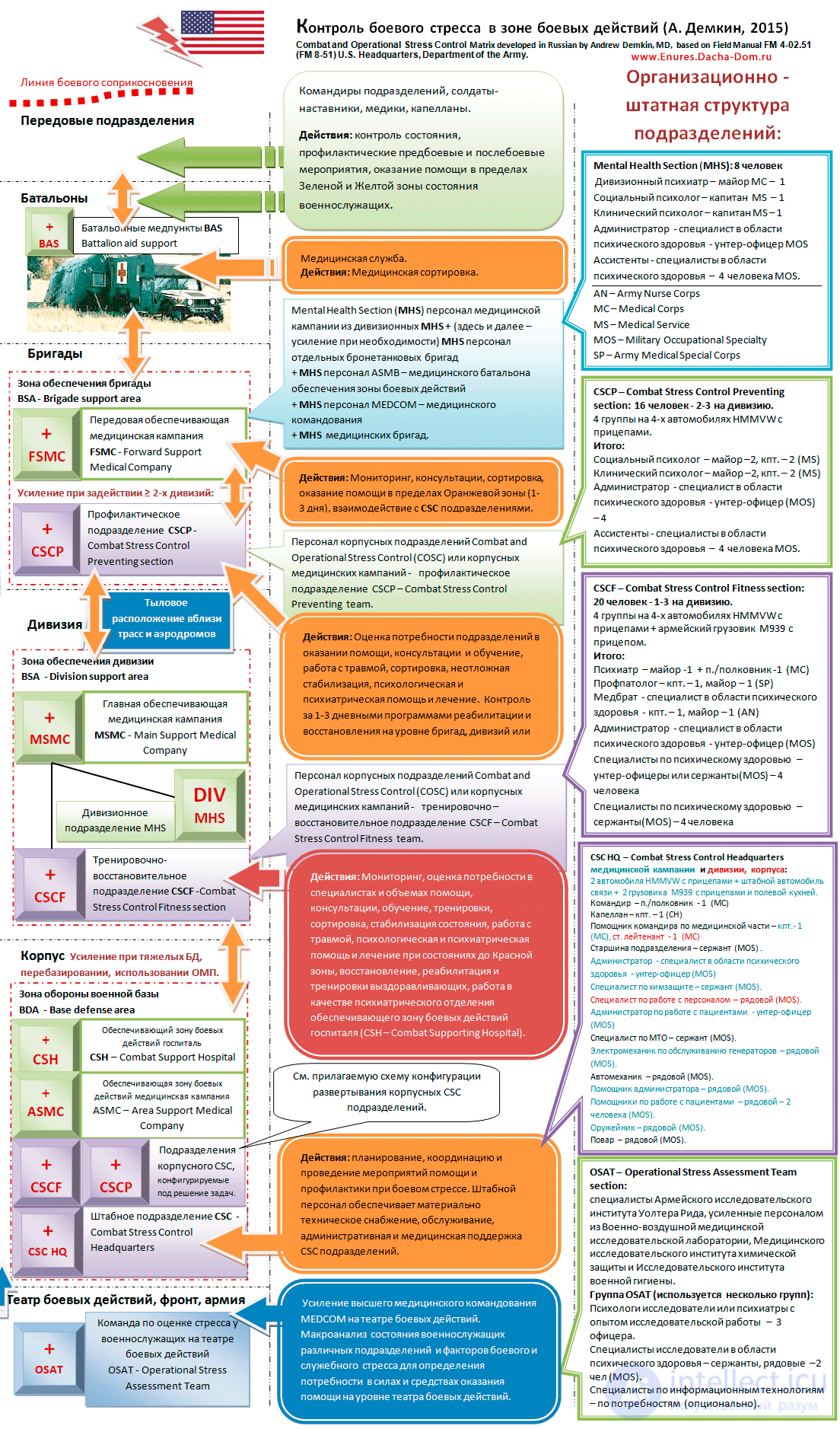
The system of providing aid to US Army service members with maladaptive combat-stress reactions
In the early post-traumatic period (acute phase), it is possible to begin informing the affected person about the possible reactions that arise during and after traumatic events. It should be explained that these are normal mental reactions, with emphasis on the fact that they will disappear as recovery progresses. It is not advisable to ask the affected person to recount what happened over and over again; discussions of the trauma are appropriate only if the person himself wishes it[19]. Emotional support and advice are also necessary so that the affected person can move on to concrete actions to solve the problem. Even if these actions occur on an automatic level, this gives the affected person a sense of control and reduces the intensity of emotional reactions. In conversation with the affected person, one can help him activate pleasant or, at the very least, neutral memories of his past, especially of his personal achievements, in order to give him the strength and confidence to cope with the problem[20]. To assist in this direction, one can ask the affected person questions about what he is able to do now (for himself or for others) and what should be done first[19]. At this stage, irritability and even aggressive behavior may appear in the affected person, but if the person has thereby become able to solve his own problems independently, this can be considered a certain amount of progress in overcoming the trauma[20].
In this period, work is carried out with memories of the trauma and with delayed post-traumatic reactions[21]. Therapy for PTSD is a lengthy process; it may continue for several years.
Horowitz (Horowitz, 1998) identified five stages of the reaction to a traumatic event. Each stage corresponds to a particular goal of psychotherapy:
| Stage 1. Prolonged stress state as a result of the traumatic event. | Bring the event to an end or remove the client from the stress-inducing environment. Help the client make decisions and plan actions (for example, in removing him from the environment). |
| Stage 2. Manifestation of unbearable experiences: surges of feelings and images; paralyzing avoidance and numbing. | Reduce the amplitude of the states to a level of tolerable memories and experiences. |
| Stage 3. Becoming stuck in an uncontrolled state of avoidance and numbing. | Help the client re-experience the trauma and its consequences, and also establish control over the memories. When a memory appears, help the client structure and express the experience. As trust in the relationship with the client grows, ensure further working-through of the trauma. |
| Stage 4. Ability to perceive and endure memories and experiences. | Help the client work through his associations and the cognitions and emotions related to them, concerning the self-image and the images of other people. Help the client establish a connection between the trauma and experiences of threat, the pattern of interpersonal relationships, the self-image, and plans for the future. |
| Stage 5. Ability for independent working-through of thoughts and feelings. | Work through the therapeutic relationship. Conclude the psychotherapy. |
In most cases, the main goal of therapy is to eliminate PTSD symptoms. However, sometimes attention should first be directed to symptoms and behavior associated with comorbid disorders (for example, addictions or suicidal problems). Sometimes it is necessary to work on stress associated with present-moment problems that may cause further deterioration of the patient's condition or prevent therapy from beginning. In some cases, family members and significant people must be included in the therapeutic process if problems in the relationship with them adversely affect the manifestation of PTSD symptoms.[22]
The choice of type of treatment therapy should be made taking into account the patient's needs, as well as his abilities and preferences. It is also necessary to take into account the potential difficulties and side effects.of treatment.[23]
A combination of different therapeutic methods is often used in PTSD. This is connected with the complexity of the phenomenon of PTSD as a disorder that manifests simultaneously at the psychological, biological, and social levels.[24]
The therapeutic approach depends on the severity of the PTSD:
продолжение следует...
Часть 1 Post-Traumatic Stress Disorder (PTSD)
Часть 2 Description of the main symptoms - Post-Traumatic Stress Disorder (PTSD)
Часть 3 Cognitive behavioral psychotherapy for PTSD - Post-Traumatic Stress Disorder (PTSD)
Часть 4 Possible problems and ways to solve them - Post-Traumatic Stress
Часть 5 In culture - Post-Traumatic Stress Disorder (PTSD)


Comments