
Lecture
Alexia (from Ancient Greek ἀ- — a negating particle and λέξις — word) — reading impairments that arise when various regions of the left-hemisphere cortex (in right-handers) are affected, or an inability to master the process of reading. Alexia is often combined with a loss of the ability to write (agraphia) and a speech disorder (aphasia). Depending on the area of the cerebral cortex affected, several forms of alexia are distinguished.
Alexia occurs in two main forms: "pure alexia" (or "alexia without agraphia") and "alexia with agraphia". "Pure alexia" develops with damage to the medial surface of the occipital lobe, which interrupts the connections of the visual cortex with the left (dominant) temporo-parietal region. Usually these are lesions located behind and below the posterior horn of the lateral ventricle. In "pure alexia" visual acuity is normal in most patients, although quadrantanopia or complete hemianopsia may occur. Non-verbal stimuli (any other objects and faces) may be recognized normally.
"Alexia with agraphia" is characteristic of damage to the convexital surface of the occipital lobe, closer to the temporal lobe, and manifests not only as a reading impairment but also as writing defects, which is most often found in patients with various forms of aphasia.
For the normal course of reading, what is above all necessary is the preservation of clear visual images of letter signs and the ability to relate the optical representation of a letter to its acoustic and speech-motor characteristics. A disruption of this link in the complex structure of the reading process inevitably leads to its breakdown. A reading impairment due to defects in the optical analysis and synthesis of letter signs occurs with damage to the parieto-occipital and occipital regions of the left hemisphere.
Optic alexia often occurs within the syndrome of optic agnosia or optic-spatial disorders, and not infrequently within the syndrome of optic-mnestic disorders. This form of reading impairment differs radically from all forms of alexia that occur within the syndrome of speech disorders: optic reading disorders occur, as a rule, against a background of preserved speech.
Two types of this form of alexia are known — verbal and literal. The central defect in literal alexia is the breakdown of the clear meaning of individual letters. In the clinical picture: patients with this form of alexia recognize letters with difficulty, confuse them by optically similar features, incorrectly perceive their spatial orientation, or fail to recognize them at all. There are frequent cases in which the correct perception of an individual letter within a word is disrupted by the presence of neighboring letters. In this case the perception of letters within handwritten words is especially severely disrupted, where all the letters are merged together by intermediate hairline strokes.
In the psychological picture, errors of letter perception consist in the impossibility of extracting their specific features that distinguish a letter from any other. This results in the letter losing its meaning. The psychological mechanism of this defect consists in the fact that the synthetic perception of graphemes and the visual extraction of their essential (signal) features are disrupted, as a result of which letters either lose all meaning for the patient altogether, or their recognition becomes unstable. In mildly expressed forms of optic alexia, only a slight "noising" of the perceived sign (letter, drawing) is enough — giving the letter a stylized character, crossing it out, writing two letters superimposed on one another, etc. — and then recognition of the letter becomes impossible.
The second type of optic alexia is verbal (or simultaneous) alexia. In these cases the perception and recognition of individual letters is not disrupted; all the difficulties arise when reading words. The patient correctly reads all the letters in a word but cannot combine them into a unified whole, failing to recognize the word and grasping only a separate part of it (usually the root), and substitutes a guess about its meaning for actually reading it. Such a reading defect is a consequence of a disruption in the simultaneous organization of optic material.
Optic alexia often also occurs with the involvement of disrupted speech processes. In that case, difficulties in relating the letter sign to its sound characteristic come to the fore: the patient loses the meaning of the letter, forgets its name, confuses the names of letters that are close in optic appearance. The grapheme in this case breaks down as a concept, as a result of the complex speech organization of optic material. A disruption of the interaction between speech and visual perception leads to so-called optic-mnestic alexia, in which the central defect is amnesia for letters and words while reading. A detailed study of alexia, and above all of this form of it, was carried out by B. G. Ananyev and Zh. I. Shif. They studied reading errors and carried out their classification. B. G. Ananyev pointed out defects in the perception and recognition of similar letters in optic alexia (и — и, ц — и, щ — ш and others), and defects in the perception of spatially oriented letters (е — э, в — д and others).
Zh. I. Shif showed that the basis of most errors in optic alexia is the simplification of a letter as a result of its assimilation to another (б — о — а; р — д — у; г — ч; н — п — т — ш). In this author's works it was shown that in optic alexia both the processes of recognizing letters and words with reliance on their sound and naming them without this reliance are equally impaired. As for optic-mnestic alexia, here a significant predominance of naming errors is found, while recognition of letters and words by ear proceeds with fewer errors. In these forms of alexia, "guessing" reading often occurs. The causes of guessing errors here lie in defects of optic perception or in a disruption of the speech organization of mnestic experience. In our own works, interesting data were also obtained regarding the question of the influence of context on the process of reading, its speed and accuracy in the optic forms of alexia. It turned out that as the influence of context increases, the number of errors decreases and the reading speed increases, i.e., the disrupted process of optic perception improves significantly under the influence of context, and the whole reading process acquires a meaningful character; a loss of meaning leads the patient to reread it for verification. These data are of great importance, above all, for the development and practical application of the most adequate methods of restorative reading instruction.
The methods of restoring reading for all the described types of optic alexia are fundamentally the same, since they are aimed at overcoming defects in the optic perception of the sign. However, the methods used in instruction also have substantial differences, related to the noted varieties of the disruption of letter and word perception in optic alexia.
The central task of restorative reading instruction, whose disruption occurs within the syndrome of object (and letter) agnosia, as well as of optic-spatial disorders, is the restoration of the generalized perception of letter signs, on the one hand, and of the process of fine differentiation of letters similar in their construction, on the other. At the first stage of reading instruction, extensive work is carried out for this purpose on restoring the perception of an individual letter and its recognition. The work begins with restoring the ability to recognize letters that are far apart in their optic form (С — Н, А — В and others). Recognizing a letter and differentiating it from another is achieved through the sequential performance of a series of operations. The patient is given a letter; he tries to recall and reproduce its motor image by "writing" it with his hand in the air without vision taking part in the process. He then writes this letter in a notebook, finds it among several other letters, feels it and compares it with other letters (visually and kinesthetically), names the required letter, finds it and underlines it in a text, underlines the most frequently occurring words familiar to him that begin with this letter, and so on. This ability is consolidated through a series of exercises.
From the analysis of the construction of letters that are far apart in their optic form, the patient is led to the method of detailed analysis of letters that are close in their structure (О — С, К — В, Ж — К). In parallel, the method of verbal analysis of the construction of the compared letters is also applied, with the identification of what is common and what differs in their form. This analysis is reinforced by feeling the corresponding letters, finding them among others by touch with the eyes closed, and exercises in which patients answer the question of what must be done to turn the letter Б into the letter Р, or the letter В into Р, and so on. They then move on to instruction using the method of construction and reconstruction of the letter, which makes it possible to restore the generalized image of the letter sign (the methods are described in Chapter 6).
At the second stage of instruction, they move on to restoring the reading of syllables and words based on the knowledge of letters gained at the first stage. At first, the reading of syllables and words relies on the method of writing the letter in the air (the motor image of the letter), which helps to find its meaning, to recognize it, and also on the oral image of its pronunciation. The recognition of letters and whole words while reading (especially in handwritten texts) is aided by the method of reading colored words, in which each letter in a word is written in a different color. Colored letters make it possible to separate them from one another more clearly, and reliance on color serves as an additional afferentation that promotes the differentiation of letters within a word.
The task of the third stage of instruction is the restoration of the accuracy and speed of reading. Here the whole system of methods ensuring a positive influence of context on the accuracy and speed of reading is used. Words are selected with a high level of context (familiar words, high-frequency words, lines from poems, etc.). However, the method of a high level of context should be used with caution, since it can lead to guessing reading and become an obstacle to the restoration of analytic reading.
The noted methods, aimed at creating conditions for the differentiated perception of letter signs, ensure the restoration of a clear, constant, and generalized image of the letter, which promotes the restoration of reading and its automatization. In optic-mnestic alexia the method of voiced reading, which makes use of the preserved recognition of written letters and words by their sound, may prove effective. These data also point to the benefit of using, in the instruction of patients, the context of words and sentences and their frequency of occurrence in the language. These and other instructional methods can have a substantial influence on the restoration of full-fledged reading. Let us give an example of optic and optic-mnestic alexia.
Patient K., 43 years old, 6 years of education. The patient had an arachnoendothelioma removed from the parieto-occipital region — sagittally. In the neuropsychological picture of the HMF disorder there were noted disorders of spatial gnosis and praxis, optic acalculia, optic agraphia and alexia, and elements of semantic aphasia. It was within this extensive parieto-occipital syndrome that the patient's reading impairment of the optic and optic-mnestic alexia type occurred. Of the 40 letters presented to the patient for reading, she read 17 incorrectly. Errors of an optic and optic-mnestic nature occurred in 42% of cases. Recognition of letters by ear, i.e., the relating of a sound to a letter, remained practically undisturbed.
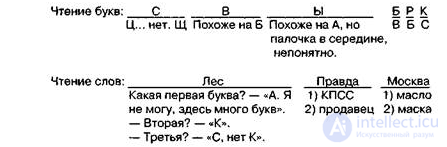
Sometimes optic alexia manifests itself only in a slowing of the pace of reading, i.e., in a de-automatization of the process. Reading acquires a voluntary character, becomes analytic and syllable-by-syllable, and then "guessing" reading stands out especially clearly. In this case, context significantly influences the speed and accuracy of reading: an increase in the role of context leads to a decrease in the number of errors and an increase in reading speed. A decrease in the level of context, in turn, gives the opposite result.

Comments