
Lecture
Patient B., 40 years old, higher education. Diagnosis: a tumor was removed from the left temporo-occipital region. Neuropsychological examination revealed a symptom complex of the occipito-parietal and posterior temporal regions of the brain: defects of spatial perception, optic-gnostic disorders, a symptom of impaired naming in speech, and severe alexia and agraphia of the occipital (optic) type. Let us give an example illustrating the patient's reading at the start of training.
Text: А Вера искала орехи хорошо. (A Vera iskala orekhi khorosho — "A. Vera looked for nuts well.") The patient's reading: А...В... е... ра... ис... м... исма... немала о...ри... ре... хо... до... до... р... доро... шшш... о... до... ро-шо (A...V... ye... ra... is... m... isma... nemala o...ri... re... kho... do... do... r... doro... shhh... o... do... ro-sho). The reading was hesitant, letter-by-letter, with literal paralexias. The latency period for recognizing and naming a letter was long. Total reading time 2 min 5 sec, number of words five.
Analysis of the errors allowed us to identify the letters most difficult for the patient to perceive and recognize, and their substitutions, which proved to be consistent for her. Let us give a list of the most frequent substitutions.
All this was the cause of the impairment of the act of reading. Let us give an example.
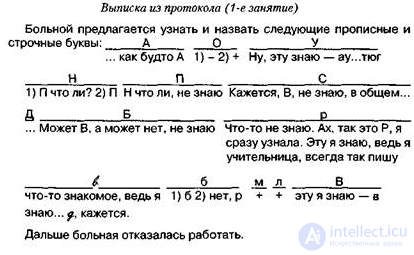
For the purpose of restoring the optical images of the letters and their meanings, we used kinesthetic sensations (the method of tactile exploration of three-dimensional letters), the motor image of the letter (the method of "writing" the letter with the hand in the air, on the table), and the level of speech was also engaged — the method of articulating aloud. Gradually the patient mastered the program set for her, the sequential completion of which led to recognition of the letter. At the beginning of the sessions, the patient's reading was an expanded process, relying on a series of external supports.

Later, reading became even clearer, which made it possible to move on to work on automatizing the process. We were faced with the task of finding means that would help speed up eye movements while the volume of visual perception remained the same. For this purpose we used the "moving text" technique. The patient was given a text consisting on average of 20 words, written on a paper tape attached to a moving drum (kymograph). The set speed of the text's movement evidently was the condition that contributed to the organization and acceleration of eye movement and, consequently, to the acceleration of the reading process. The number of reading errors gradually decreased as well. Let us give a corresponding example.

By the end of training, the patient showed significant restoration of differentiated optical perception of letter signs, comprehension of the meaning of the grapheme, and restoration of relatively fluent reading with a minimal number of errors. Whereas at the start of training the patient read a text of five words in an average of 2—3 min. and made about three errors while doing so, by the end of training, in the same amount of time (2—3 min.), the patient read aloud on average 55 words of simple text, 41 words of complex text, making four errors (the simple text consisted of high-frequency short words and simple unextended sentences; the complex text included long words and sentences that were long and complex in structure).

Comments