
Lecture
In the previous sections we described four groups of possible forms of alexia: alexia arising on the basis of impairment of optical perception, forms of alexia arising within the syndrome of speech disorders, a reading impairment associated with defects in the system of eye movements, and a reading impairment occurring within the system of impairment of goal-directed activity. In the first two groups of alexia, for different reasons, one and the same link in the structure of reading is impaired — the link providing sound-letter analysis. As for the remaining links — the generation of adequate meaning-based hypotheses, and the comparison of the hypotheses that arise with the initial data (control) — in all these forms of alexia they turn out not only to be intact, but reliance on them is one of the possible routes for restoring reading. The level of comprehension, too, may remain relatively intact and can likewise have a positive effect on restoring reading. Study of the level of comprehension has also shown the significant positive role played by context in restoring analytic reading.
The situation is somewhat different with the reading impairment that arises in acoustic-mnestic aphasia. In this case reading is impaired owing to defects in the link that provides the span of perception and the retention of the volume of verbal material. This leads predominantly to impairment of the level of comprehension in reading, but not of the sensorimotor level that provides the "technique" of reading. However, the intact links — sound-letter analysis, hypothesis generation, control, orienting activity, motivation — exert a positive compensatory influence on comprehension of what is read.
Of great interest is yet another form of alexia, in which the level of comprehension in reading may also turn out to be impaired. This form of alexia, as we wrote above, arises with lesions of the frontal lobes of the brain. However, the cause of this impairment is no longer defects in the link of retaining the volume of verbal material, or in the link of sound discrimination, and so on, but defects in the links within the structure of activity that provide for the organization of reading as an activity, that provide the motives for the activity and the orienting-investigative actions, and that form the strategy of reading, which involves the generation of adequate meaning-based hypotheses and controlling actions.
It is known from the literature that these links in the structure of activity are provided by the frontal lobes of the cerebral cortex, and if they are impaired, then reading, too, as one of those forms of mental activity that requires organization, programming, and control of its course, will be impaired. Naturally, the presence of defects in these links can turn the process of genuine reading into an uncontrolled web of inadequate guesses, extraneous associations, inert sets, and so on. The literature on this question, and our own experimental data, confirm this position.
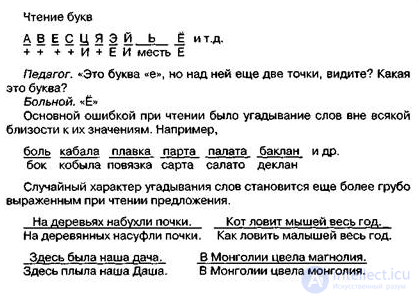
Analysis of the reading errors of patients with a "frontal syndrome" has shown that the impairment of reading may be based either on impairment of selectivity in the system of semantic connections, or of the visual perception of the letter (pseudoagnosia), or on pathological inertness leading to stereotyped patterns in reading, or on impaired concentration of attention. The absence of motives for the activity and of the need to check one's own actions does not lead to correction of errors, but leads instead to guessing, which, unlike all the previous forms of alexia, proceeds outside of context, and the guesses are not meaning-based but random in character. If all the preceding forms of "guessing" reading were a consequence of impairment of sound-letter analysis or of defects of auditory-verbal memory, then "guessing" reading in the frontal syndrome is a consequence of the breakdown of higher forms of activity. The differing nature of "guessing" reading requires, as we have already seen above, differing ways of overcoming it. The methods of restoring reading, in turn, point both to its origin and to the mechanism of "guessing" reading. Thus, whereas "guessing" reading of an optical, acoustic, or kinesthetic nature cannot be overcome simply by fixing the patient's attention on the erroneousness of his reading, guessing in frontal alexia can often be checked by an external organization of the activity of reading as a goal-directed activity, by fixing the patient's attention on his errors, on the need for checking, and so on.
A study of the influence of the level of context on the process of reading in patients with lesions of the frontal systems of the brain has shown that context has no effect on their process of reading: the speed of reading texts with a high level of context does not increase, and the number of errors does not decrease. Let us give some excerpts from the protocols.
Patient G., 56 years old, with 7 years of schooling, underwent surgery for a brain tumor. During the operation, an intracerebral cyst of the left frontal lobe was opened.
Examination of the reading of individual letters revealed errors based on unstable attention. Individual letters were perceived by him globally, while the "micro-features" that are often the essential feature of a letter distinguishing it from another, similar letter, went unnoticed by him. By focusing the patient's attention on these details of the letter, correct naming (reading) of the letter can be achieved.

The patient's reading
Once we spent the night high up in халори (khalori — a nonsense paralexic misreading). We took along Grandfather's rubber pillow, and at dawn we set out on it beyond the edge of the прежних кувшиновых (prezhnikh kuvshinovykh — a paralexic misreading) to catch fish. At the bottom of the lake, decayed leaves плоем бежали (ploem bezhali, literally "ran in a ploem" — a letter-level paralexic misreading, plausibly of слоем лежали, "lay in a layer") in a thick mass, and snags floated in the water.
Analysis of the patient's reading and the nature of his errors showed that, despite the absence of primary defects in reading and the primary preservation of the sensorimotor level, comprehension of what was read turned out to be impaired in the patient. This was revealed in special experiments in which the patient was required to find pictures corresponding to the content of sentences and of a text. In these experiments the patient was unable to perform the task; each time he selected pictures not according to the meaning of the sentence (or text), but according to individual words within it. The process of understanding the text was fragmentary in character; the patient could not assess the meaning of the whole, but established only a direct connection between the meanings of individual words and the corresponding elements in the picture.
The data obtained allow us to conclude that a lesion of the left frontal lobe can lead to an impairment of reading as an activity, despite the preservation of the analytic-synthetic operations of reading. Here the level of comprehension is impaired, but no longer owing to defects in the link of sound-letter analysis or short-term memory, but in the link of meaning-based hypotheses and control. These links, in turn, prove to be defective owing to impairment of the higher forms of the patient's behavior and, in general, of goal-directed activity. Restorative learning in these cases must be aimed at organizing the patient's behavior at the moment the process of reading is taking place: at creating motives for the activity, and at organizing orienting-investigative activity, strategy, and control.
An important task in organizing restorative learning of reading for patients with the frontal syndrome is shifting reading from an involuntary to a conscious and voluntary level of the reading process. In this case the "frame" method, described by us above, may prove useful. The frame makes it possible to render the process of reading conscious, to engage attention, and to organize voluntary reading. At first there should be one, and then two, words inside the frame, and gradually a whole sentence should be inside the frame; the frame should be moved from word to word (or from sentence to sentence) by the instructor, then jointly with the patient, and later the patient must independently measure off segments of the text for the frame and move it along the text. Later the frame should be replaced by a ruler, which likewise performs the role of organizing reading.
Also effective is the method of reading with reliance on narrative pictures. The sequence of operations in this case should be as follows: 1. Divide the narrative picture into meaningful parts.
2. Tell about (or say one phrase about) the first part of the picture.
3. Find the corresponding part in the text and underline it with a pencil.
4. Read it. And so on.
This program of operations is aimed at restoring the patient's activity by concentrating his attention: on the text, on orienting activity, on operations of comparing the text and the pictorial representation of the information contained in the text, on shifting the process of reading to the voluntary level, and so on.
An effective method is the method of captioning narrative pictures with subsequent reading of one's own notes, as well as the method of finding and reading missing words in a sentence (and later — finding and reading missing sentences in a text). In this case the patients read the text and insert into it the missing word (sentence), choosing the correct one from three written on cards lying in front of him, and after that read the text in full.
The method of error-finding makes it possible to concentrate the patient's attention on the sensory side of reading. The patient is given a text with errors. These may be incorrectly written words — literal and verbal substitutions, an incorrect grammatical structure of the sentence, and so on. Any variants are possible here; the main thing is that this text should fix and concentrate the patient's attention on the process of reading and on its correctness. A number of other methods can also be used, but all of them must be aimed at organizing the patient's behavior and activity, at organizing the process of reading.
We have described the syndrome and the methods of restorative learning for patients with the frontal syndrome in the case of a lesion of the prefrontal convexital zones of the left frontal lobe. However, reading can also be impaired with a lesion of the posterior regions of the left frontal lobe. In this case the reading impairment will proceed within a syndrome of inactivity and inertness of mental activity. The most frequent errors will be stereotyped patterns in reading, inert repetition of preceding words and sentences (texts), and so on. Therefore, in the process of instruction in this case, other methods are needed, methods that must be aimed at restoring the dynamics of the reading process and that act to overcome inhibitory processes.
Such are the main forms of alexia that arise with lesions of the cortex of the left hemisphere, and the main methods of overcoming it. Each form of alexia has its own structure and a corresponding system of methods for restoring reading. In all cases of its impairment, the restoration methodology provides for the creation of a new functional system based on intact analyzers, which provide additional afferentation from them, as well as for the use of intact forms of activity.
To sum up, the following can be said. Impairments of reading in local brain lesions were described by many researchers — neurologists, psychologists, and psychiatrists (Wernicke, Dejerine, Oltuszewski, Wolpert, and others) as far back as the nineteenth century. The clinical picture of alexia was most precisely described by V. Oltuszewski (1898), who, on the basis of clinical symptoms, distinguished five forms of alexia (isolated, associative, independent, word "deafness," and word "muteness").
A correct approach to studying and understanding alexia is connected with new conceptions in psychology of the formation and structure of the reading process. Contemporary psychology views this process in connection with speech, on the one hand, and with the process of perception, on the other. Reading, at different stages of its formation, is an analytic-synthetic process; at later stages it takes on a more complex character.
Reading has a definite strategy, determined by eye movement, that solves specific tasks: a) running ahead along the text (anticipation), b) returning backward (comparison of hypotheses, control, which is provided by progressive and regressive eye movements). Such a reading strategy creates the conditions for a more precise understanding of what is read and for an increase in the speed of the process.
The psychological structure of reading consists of at least two interacting levels — the sensorimotor and the semantic. The sensorimotor level consists of several links that provide: a) sound-letter analysis in the process of reading, b) the span of perception and the retention of information in working memory, c) the formation of meaning-based hypotheses, d) comparison of the hypotheses that arise with the actual material. These operations create the conditions for forming accurate comprehension at the semantic level. The main task of the reading process is comprehension of the written message.
The formation of reading proceeds in close interaction between the processes of speech and perception. The interaction between the process of perception and speech (its expressive and impressive sides) is extremely complex, especially in the period when reading is being formed or is impaired. A full-fledged act of reading is, above all, anticipatory reading, in which the interaction of the processes of perception and comprehension reaches a complete and indissoluble unity in which the main role belongs to comprehension. Many authors have noted the great role played by context in the accuracy and speed of reading and in correct comprehension.
As for the impairment of reading, it arises with a lesion of any area of the brain that forms part of its cerebral basis, which leads to the emergence of various kinds and forms of alexia. Alexia, like agraphia, is divided into two kinds — speech-related and non-speech-related — and several forms. Speech-related alexias occur within the syndrome of the corresponding forms of aphasia and agraphia (motor — afferent and efferent, sensory — the sensory and acoustic-mnestic forms of alexia). Within the syndrome of optical and optic-spatial agnosia, the optical forms of alexia occur — optical, optic-spatial, and optic-mnestic. All these forms of alexia can be of two kinds — literal, in which reading is impaired at the level of the letter, and verbal (simultaneous), in which patients cannot combine individual letters into a word or syllables, although they can recognize and name them.
The central mechanism of optical alexia is impairment of visual gnosis, as a result of which the central defect arises — impairment of the perception of the letter, of the isolation of its essential details (micro-features). This is the source of the patients' inability to read letters and words correctly. Restoring the differentiated perception of letters is the central task of restorative learning in optical alexia.
The central mechanism underlying optic-spatial alexia is likewise defects of gnosis, but now of optic-spatial gnosis. These defects lead to the impossibility of correctly perceiving spatially oriented letters. The central task of restorative learning here is overcoming the defects of optic-spatial perception.
The central mechanism of optic-mnestic alexia lies in the sphere of impairments of the speech organization of visual perception, which interacts closely with speech. The central defect in this form of alexia is impairment of recalling the name of each letter. Recognition of these letters is more intact than their naming. Restorative learning in this case is aimed at restoring the interaction of speech and visual perception.
In the speech-related forms of alexia, the phenomenon of "guessing" reading not infrequently arises, manifesting itself especially vividly in sensory alexia. The mechanism of this phenomenon lies in the sphere of the interaction of perception and comprehension, as well as in the interaction of such characteristics of speech as meaning and sense. Impairment of accurate perception under the anticipatory reading strategy is compensated for by the process of comprehension, but in the absence of accurate perception of letters (or sounds), guesses arise about what has been read, and the sense, rather than the precise meaning of the word, is guessed at. The mechanisms of "guessing" reading differ — defects of the process of sound discrimination (sensory alexia), defects of the narrowing of the span of perception (acoustic-mnestic alexia). In order to restore the true process of reading, this phenomenon must be overcome by: a) shifting the process of reading to a conscious, expanded, operation-by-operation mode, b) applying methods that limit the eyes from running ahead along the line, c) restricting (with subsequent expansion of) the strategy of anticipatory reading.
In all forms of alexia, the general strategy for overcoming it is to overcome the mechanism of the impairment.
1. Ananyev B.G. Restoration of functions in agraphia and alexia of traumatic origin // Scholarly Notes of Moscow State University. 1947. Issue 2.
2. Afanasyev V.T. Fundamentals of Philosophical Knowledge. Moscow, 1968.
3. Bein E.S. Restoration of Speech in Patients with Aphasia. Moscow, 1982.
4. Boguslavskaya B.A. Individual Differences among First-Graders in Mastering the Skill of Reading. Author's abstract of candidate's dissertation. Moscow, 1966.
5. Brudny L.A. Comprehension as a Component of Reading // Problems in the Psychology and Sociology of Reading. Moscow, 1986.
6. Brudny A.A. On the Problem of Text Comprehension // Study of Speech-Thought Activity. Alma-Ata, 1974.
7. Valgard S.L. Essays on the Psychology of Reading. Moscow, 1931.
8. Vygotsky L.S. The Development of Higher Mental Functions. Moscow, 1960.
9. Gadamer H.-G. Truth and Method. Moscow: Progress, 1988.
10. Yegorov T.G. Essays on Teaching Children to Read. Moscow, 1953.
11. Yegorov T.G. The Psychology of Mastering the Skill of Reading. Moscow, 1953.
12. Zimnyaya I.A. Semantic perception of a speech message // Semantic Perception of a Speech Message. Moscow, 1970.
13. Leontiev A.N. Problems in the Development of the Mind. Moscow: Moscow University Press, 1974.
14. Leontiev A.N. Activity. Consciousness. Personality. Moscow: Politizdat, 1975.
15. Luria A.R. Higher Cortical Functions in Man. Moscow, 1969. 16. Luria A.R. The Fundamentals of Neuropsychology. Moscow: Moscow University Press, 1973.
17. Tsvetkova L.S. Restorative Learning in Local Brain Lesions. Moscow: Pedagogika, 1972.
18. Tsvetkova L.S. Impairment and Restoration of Reading // Problems of Aphasia and Restorative Learning. Moscow: Moscow University Press, 1975.
19. Tsvetkova L.S. (ed.). Problems of Aphasia and Restorative Learning. Moscow: Moscow University Press, 1975 and 1979.
20. Tsvetkova L.S. Aphasia and Restorative Learning. Moscow: Prosveshchenie, 1988.
21. Tsvetkova L.S. Neuropsychology and Restorative Learning. Moscow: Moscow University Press, 1990.
22. Tsvetkova L.S., Ulanovskaya I.M. On the question of the impairment and restoration of reading in alexia // Dynamic Reading and Rational Work with a Book. Novokuznetsk, 1979.
23. Ulanovskaya I.M. Impairment of the Comprehension of Written Speech in Patients with Alexia: Candidate's dissertation. Moscow, 1982.
24. Elkonin D.B. An Experimental Analysis of the Initial Stage of Teaching Reading. In: Problems of the Psychology of the Learning Activity of Younger Schoolchildren. Moscow, 1962.
25. Elkonin D.B. How to Teach Children to Read. Moscow, 1976.
26. Jakobson R.O. Selected Works. Moscow: Progress, 1985.
27. Morton J. The effects of context, on the visual of reading, eye movements and eye-voice span // The Quart. Journ. of Exper. Psychol. 1964. Vol. XVI. P. IV.

Comments