
Lecture
With the use of the described method, good restoration of writing was obtained in the optic form of its impairment. Let us give an example.
Patient B. (40 years old, higher education) had an intracerebral tumor (astrocytoma) removed at the junction of the parieto-occipito-temporal lobes on the left, growing into the inferior horn of the lateral ventricle. In the neurological status of the patient, complete right-sided hemianopsia was noted. In the neuropsychological status distinct optic-gnostic disorders and marked defects of spatial perception were noted, along with a gross reading defect due to an impairment of the optic perception of letters: the patient incorrectly perceived their spatial orientation, confused letters on the basis of similarity of optic configuration, as a result of which her reading was letter-by-letter in character, with a mass of literal substitutions of the optic type. Distinct writing defects likewise proceeded along the optic and optic-mnestic type. All these symptoms occurred within a syndrome of amnestic aphasia and against a background of a preserved personality.
In the clinical picture, what drew attention was the preservation of the perception and repetition of all sounds and words, and distinct difficulties in searching for the letters corresponding to the sounds, i.e., the motor image of the letter was preserved, while the visual one was impaired. She could "write" the image of a letter in the air with her hand, but could not write or find the needed letter in a cut-out alphabet. The process of writing in the patient proceeded very slowly. In order to write any word, she thought long and painfully over the writing of each letter, and nevertheless made many errors — optic substitutions of letters. At the beginning of the sessions, the patient did not notice her errors. Even when reading a word she had written, she would read the word she was supposed to have written, rather than the one that actually resulted. For example, the patient was supposed to write the word «город» (gorod, "city") — she writes «годод» (godod), but reads «город» (gorod), or she writes «бадепьс» (badeps), but reads «варенье» (varenye, "jam").
At the beginning of training, writing in the patient was practically absent; writing one word took from 3 to 5 minutes, since she thought for a long time about the graphic form of each letter of the word given to her. In the process of writing, the phenomenon of the estrangement of the meaning of a letter frequently appeared in the patient. Thus, she was given the task of writing the word «дорога» (doroga, "road"). The patient writes the first two letters with difficulty, and then says: «До-ро... ро... р...р... р... что такое р... Ничего не понимаю... нет... я все забыла» (Do-ro... ro... r...r... r... what is r... I don't understand anything... no... I've forgotten it all) (refusal).
Copying was preserved in the patient, but likewise required a great deal of time (fig. 9).
In restorative learning, the greatest effect was obtained in work relying on the preserved motor function of the hands, and also through the use of the method of conscious verbal comparative analysis of the structure of letters. The patient memorized the configurations of many letters by using conventional designations given to her by the instructor. For example, she would recall the letter О (O) only after being prompted that it is a little circle, and the letter Ж (Zh) — a beetle, etc. Later, once the patient had mastered these conventional designations, before writing the letter О (O) she would say «это кружок» (eto kruzhok, "this is a little circle"); correspondingly, she called the letter С (S) «север» (sever, "north"), the letter Р (R) — «палочка и кружок сверху» (palochka i kruzhok sverkhu, "a stick with a little circle on top"), and the letter Ь (the soft sign) — «палочка и кружок снизу» (palochka i kruzhok snizu, "a stick with a little circle at the bottom"), etc. Only after this could the patient write the letters correctly.
In the first sessions, the writing of individual letters was made up of a multitude of operations. Before writing the proposed letter, the patient first had to find it among other three-dimensional letters, then feel it with her hands, after which she would find this letter in the cut-out alphabet, name it, compare it with one similar to it in configuration, then "write" this letter in the air with her hand, and only then write it down in the notebook. Without all these auxiliary aids, the patient could not immediately write a single letter.
After a month of daily sessions, the patient began to name almost all the letters. But she still could not name the letters not mastered in the sessions: Я (Ya), Ы (Y), Л (L), К (K), М (M), П (P), and the handwritten р, з, л, к (r, z, l, k). She still continued to confuse the handwritten б (b) and д, (d) and the printed В (V), С (S), and К (K). Later, once the patient had become significantly better oriented in the letters and their meanings, it became possible to move on to teaching the writing of words; work on individual letters continued through the word. After three months, the patient came to write individual short words well, i.e., quickly and with a minimal number of errors; she rarely made errors in letter dictations and could differentiate letters close in optic similarity, but only with the help of conscious verbal analysis of their structure.
At the start of restorative learning, the patient's most frequent substitutions were the following: В (V) - Ш, X, С; Э – С.(Sh, Kh, S; E – S)
By the end of training such defects had become significantly fewer. The patient mainly made the following substitutions: д (d) — р (r), в (v); р (r) — д (d); в (v) — д (d); В (V) — К (K); ы (y) — ъ (hard sign); с (s) — к (k). Restorative learning of writing in this case led to satisfactory
results. The methods,
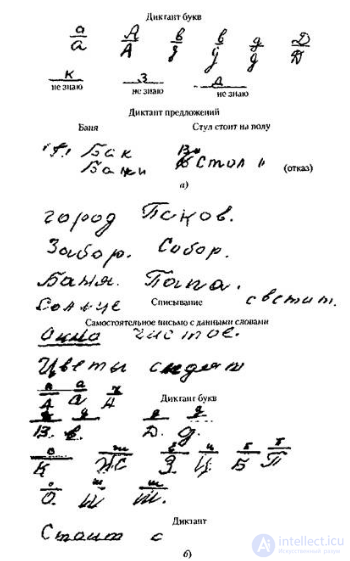
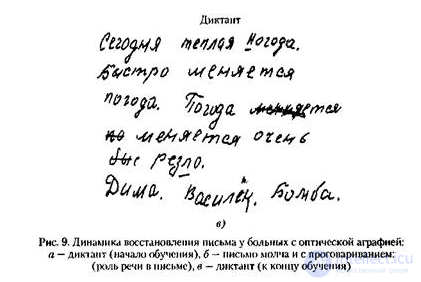
used in the work, corresponded mainly to the defect of writing and thereby contributed to the gradual restoration of the process of writing. By the end of the third month, the patient could write texts independently and to dictation, but the process of writing was considerably slower than normal, proceeded under conscious control, and literal optic substitutions still remained (see fig. 9, b, v).
So then, we have described various forms of writing impairments arising as a result of local lesions of the cerebral cortex, and the difficulties in the formation of writing and written speech in children. Some of them occur within the syndrome of aphasic disorders, others — within the syndrome of optic and optic-spatial disorders of the image-representation of a letter and of the difficulties in its realization. Depending on the topography of the lesion, either the sound analysis of the word, or the internal articulatory schemas of the word, or the correlation of a sound with its graphic representation, or the awareness of the sequence of sounds in a word may be impaired. The structure of the writing impairment depends on which link's impairment underlies the breakdown of the function. Each of the forms of agraphia has its own mechanisms of impairment, distinct from the others, and its own regularities of unfolding. Writing, in breaking down, leads to a disruption of the smooth, automatized flow of the process of writing. The patient cannot perform "in the head" the necessary operations that make up the structure of the process of writing.
Depending on the form of the agraphia, different methods of restoring writing are applied. However, common to the method of restoring writing is the necessity of creating conditions for conscious activity in the patient. The impaired operations of writing, at the beginning of training, must be the object of the patient's awareness and external actions. The mediation of the process of writing by external materialized supports, and the maximal unfolding of the process, is the most correct path of restorative learning. The method must provide for such modes of work as are capable of maximally mobilizing the functioning of the preserved analyzers and their interaction, and mobilizing all the preserved HMF and the personality of the subject.
Writing can be restored in the best way only in the process of the patient's conscious activity. The affected operations of writing, at the beginning of training, must be the object of the patient's consciousness and external actions. The mediation of the process of writing by external material and materialized supports, and its maximal unfolding, is the most correct path for the restoration of writing.
An analysis of the dynamics of the reverse development of writing in the course of training convincingly shows that the restoration of writing proceeds from a maximally unfolded form of the action, mediated by a broad system of external supports, toward its gradual contraction. The latter occurs owing to the gradual (natural and partly artificial) dying-off of one or another means employed at the beginning of training and forming part of the composition of the act of writing. The contracted action is now performed at a different level of the structure of writing and of its automatization. It is performed more quickly and without the use of external supports, but with the obligatory participation of overt speech. Reliance on articulation remains necessary even in good cases of the restoration of writing. Complete automatization of the restored function of writing, its translation into the plane of an internal mental action, cannot be achieved in the practice of restorative learning.
REFERENCES
1. Ananyev B.G. Restoration of functions in agraphia and alexia of traumatic origin // Scientific Notes of Moscow State University. 1947. Issue 2.
3. Anokhin P.K. Biology and Neurophysiology of the Conditioned Reflex. Moscow: Meditsina, 1968.
4. Bruner J. The Process of Education. Moscow, 1962.
5. Vallon L. The Psychological Development of the Child. Moscow: Prosveshchenie, 1967.
6. Vygotsky L.S. The Development of Higher Mental Functions. Moscow, 1960.
7. Vygotsky L.S. Imagination and Creativity in Childhood. Moscow, 1967.
8. Vygotsky L.S. The History of the Development of Higher Mental Functions. Moscow, 1983.
9. Galperin P.Ya. Toward a Study of the Intellectual Development of the Child // Voprosy Psikhologii. 1959. No. 1.
10. Davydov V.V. Types of Generalization in Instruction. (Logical-Psychological Problems of Constructing School Subjects.) Moscow, 1972. 11. Egorov T.G. Essays on Teaching Children Literacy. Moscow: Publishing House of the RSFSR Academy of Pedagogical Sciences, 1950.
12. Egorov T.G. Essays on Teaching Reading and Writing. Moscow, 1953. 1,3. Iaprip V.A. The Development of Writing. Moscow, 1961.
11. Zhinkin N.I. The Development of Written Speech in Pupils of Grades III — VII // Izvestiya of the RSFSR Academy of Pedagogical Sciences. 1956. Issue 78.
15. Kaufman O.P. On Optic Agraphia // Wartime Neurology. Moscow, 1949.
16. Klychnikova Z.I. Psychological Features of the Perception and Understanding of Written Speech: Abstract of Candidate's Dissertation. Moscow, 1975.
17. Critchley M. Aphasiology. Moscow, 1974.
18. Leontiev A.A. Speech Activity // Foundations of the Theory of Speech Activity. Moscow, 1974.
19. Leontiev A.N. On the Social Nature of the Psyche // Voprosy Filosofii. 1961. No. 17.
20. Leontiev A.N. Problems of the Development of the Mind. Moscow: Moscow University Press, 1974.
21. Leontiev A.N. Activity. Consciousness. Personality. Moscow: Politizdat, 1975.
22. Luria A.R. Essays on the Psychophysiology of Writing. Moscow, 1956.
23. Luria A.R. Higher Cortical Functions in Man. Moscow: Moscow University Press, 1969.
24. Luria A.R. Fundamentals of Neuropsychology. Moscow: Moscow University Press, 1978.
25. Lyaudis V.Ya. The Structure of Productive Educational Interaction // Psychological-Pedagogical Problems of Teacher-Student Interaction. Moscow, 1980.
26. Lyaudis V.Ya., Negure I.P. Psychological Foundations of the Formation of Written Speech in Younger Schoolchildren. Kishinev: Shtiintsa, 1983.
27. Nazarova L.K. Individual Differences among First-Graders in Mastering Spelling. Moscow: Publishing House of the RSFSR Academy of Pedagogical Sciences, 1960.
28. Tolstoy L.N. Who Should Learn to Write from Whom: Should Our Peasant Children Learn from Us, or We from the Peasant Children // Pedagogical Works. Moscow, 1948.
29. Tsvetkova L.S. Restorative Learning in Local Lesions of the Brain. Moscow: Pedagogika, 1972.
30. Tsvetkova L.S. (ed.). Problems of Aphasia and Restorative Learning. Moscow: Moscow University Press, 1975 and 1979.
31. Tsvetkova L.S. Aphasia and Restorative Learning. Moscow: Prosveshchenie, 1988.
32. Tsvetkova L.S. Neuropsychology and Restorative Learning. Moscow: Moscow University Press, 1990.
33. Elkonin D.B. The Development of Speech in Preschool Age. Moscow: Publishing House of the RSFSR Academy of Pedagogical Sciences, 1956.
34. Drieman G.H.L. Differences Between Written and Spoken Language // Acta Psychologica. 1962. No. 1-2.
35. Rodari G. Grammatica della fantasia. Introduzione all'arte di inventare storie. Torino, 1973.
In me the word precedes the sound. (In me prius est verbum, posterior vox).
Saint Augustine
Speech created man, literacy — civilization.
D.R. Olson

Comments