
Lecture
Impairment and restoration of the counting function in lesions of the occipital cortex
In local brain lesions, various forms of impairment of the counting function are inevitable. Counting may become impaired when any link of its structure is defective, and the form of the breakdown depends on which of the structural elements is affected. Therefore impairments of counting are possible with lesions of almost any area of the brain, and restoration of the counting function is directly linked to distinguishing specific and nonspecific forms of acalculia.
The visual agnosias or amnesias for numbers that are frequently encountered, as well as impairments of the verbal designation of numbers occurring within a syndrome of either mnestic, or acoustic, or speech-motor disorders, although they do affect the state of the counting function, nevertheless do not touch the main core of the psychological structure of number and counting operations. Among the nonspecific forms of acalculia we note four forms: sensory, acoustic-mnestic, optical, and conditionally frontal, in which counting is impaired, but not primarily — rather owing to secondary mechanisms of disturbance.
Diagnosing optical acalculia is associated with a number of difficulties. First, it can be confused with primary — spatial — acalculia; second, optical acalculia rarely occurs in pure form, more often proceeding as optic-spatial acalculia, which in its clinical picture approaches primary acalculia, but is based on more complex, mixed mechanisms. Arriving at a correct diagnosis requires great skill in conducting a neuropsychological analysis of the defect and isolating the factors, knowledge of which is necessary both for making a topical diagnosis and for developing adequate approaches and methods of restorative learning.
Optical acalculia arises with lesions of the occipital regions of either the left hemisphere (more often) or the right. In lesions of the occipital systems of the brain there is no such gross breakdown of the concept of number; awareness of the connections and relations among numbers is preserved; counting operations, too, turn out to be less affected. In this form of acalculia the main defects lie in the process of number perception — optical, and sometimes optic-spatial, disorders as well, in connection with which this group of patients experiences specific difficulties related to the differentiated perception of the optical structure of number, i.e., they cannot assess the value of, or name, numbers that are close in their configuration (cf.: 3 and 8, 7 and 1, 2 and 8, 4 and 1, etc.). Defects of optical recognition of numbers that differ from one another only in the spatial arrangement of individual elements are not uncommon (cf.: 6 and 9, 3 and 5, 66 and 96, etc.), as are defects in evaluating numbers denoted by Roman numerals (cf.: IX and XI, IV and VI, etc.). This form of acalculia usually occurs within the syndrome of optical object agnosia, and less often — optic-spatial agnosia.
If, alongside purely optical defects, optic-spatial errors are also found, even if minor (in evaluating numbers whose values differ only in the spatial arrangement of elements: 3 and 5, 6 and 9, XI and IX, etc.; in counting operations — errors of spatial origin; or, when asked to arrange a series of digits sequentially from left to right (1, 2, 3, etc.) and, conversely, from right to left (9, 8, etc.) — errors or delays in performing the task), then in these cases what occurs is not pure optical, secondary acalculia, but a mixed — optic-spatial form. In this form of acalculia there are no gross primary defects of the concept of number, of its psychological content, or spatial defects in counting off numbers in calculating operations, but nevertheless
these symptoms are still possible, and then acalculia takes on a complex, composite form. In this case the topical diagnosis will indicate not only a lesion or dysfunction of the occipital zones, but also the involvement of pathology in the parietal regions of the cortex of the left hemisphere, or dysfunction of the vestibular apparatus. All this calls for a different methodological approach to restorative and formative learning.
A different picture is found in children with lesions or underdevelopment of the occipital zones of the brain; as a rule, this group of children shows gross impairments of object gnosis, defects in actions with objects, in understanding of the surrounding world of objects, and impairments of speech. Within this syndrome, secondary impairments of counting and counting operations will also occur, caused by the defects described, as well as by disturbance of activity in the link of general behavior, immaturity of personality, and so on. Therefore the methods for restoring counting in children are fundamentally different from the methods for teaching counting to adult patients with local brain lesions.
To sum up, we note the following.
The clinical picture is characterized by difficulties in differentiating, evaluating, and naming numbers and digits that are close in configuration. This defect leads to difficulties in calculating operations. Sometimes optical difficulties in recognizing digits and numbers are compounded by defects of spatial perception of numbers and their evaluation.
Neuropsychological picture. Here the syndrome of optical disorders comes to the fore — optical agnosia, agraphia, alexia, as well as symptoms of optical estrangement from the meaning and sense of the digit. The main factor in the impairment of counting is impairment of the differentiated visual perception of the digit. In this case, the following symptoms are most often found: impaired recognition of the digit and the number; difficulties in differentiating digits that are close in configuration; substitution of one digit for a similar one; defects in isolating the essential features of a digit; equating the features of similar digits (example: two digits are given — 3 and 8 — and to the question, "What is the distinguishing feature of the digit 3, and of the digit 8?" the patient answers, "They are the same"). Estrangement from the meaning of the digit, its failure to be recognized, arises from defects of visual perception and of isolating essential features. The syndrome of optical acalculia includes both impairment of naming the digit and the number (secondary), and impairment of calculating (counting) operations due to the defects indicated.
Psychological picture. This form of acalculia is a consequence of impairment of the processes of visual (visuospatial) perception. In this case the perceptual image of the digit is impaired, but its image-representation is preserved. Estrangement from the meaning of the digit and errors of naming arise from defects in isolating its essential features, while the global perception of the perceptual image and the image-representation of the digit remain intact.
The picture of optical acalculia described above, its syndrome, symptoms, and mechanism of impairment, have allowed us to develop methods of restoring counting that are adequate to the mechanism of the defect, the main idea of which is rational restorative learning.
Scientific foundations of restorative learning
Before turning to an analysis of the specific methods of restoring counting in optical acalculia, let us dwell on the scientific foundations and theoretical principles of restorative learning, adherence to which leads to success.
Restorative learning rests on a number of fundamental principles developed by Russian psychologists and neuropsychologists. Instruction must take into account the differing structure of the impairment of HMF, including counting, and its dependence on the topography of the brain lesion and on the factor underlying the disorder. In this connection a differentiated approach to restoring the affected functions is necessary.
Before beginning instruction, one should:
1. Study the defect — its mechanism, (factor); for this it is qualified, i.e., the factor and the primary, central defect are isolated on the basis of a neuropsychological — qualitative — analysis of the defect. A simple description of the clinical picture of the impairment will be of little help here.
2. Find the link in the psychological structure of the process that has been impaired. For this one must know the structure of the process under normal conditions, which will make it possible to identify the link that needs to be restored, and those intact links in the structure of counting or counting operations on which one can and should rely in instruction.
3. Know the genesis of counting and counting operations, the process of their formation, and their interaction with other HMF. The supports in instruction should be those HMF with which the counting function interacts both in ontogenesis and in the process of its realization. Thus success in overcoming a defect in the link of visual perception of a digit can be achieved by including in the system of recognition of the sign (digit) the kinesthetic motor sensations that once (in ontogenesis) took part in forming the child's concept of number and that, in the adult, have receded into a reserve fund of afferentations, or by including the digit being studied in an arithmetic operation or in the act of ordinal counting, and so on. Reliance on the intact components of the structure of counting, on material and materialized forms of action, and the broad use of forms of activity that are intact and most firmly established in past experience, are the most important principles of restorative learning for patients with local brain lesions.
4. Use such a most important principle of restorative (or, in children, formative) learning as reliance on the patient's personality, taking account of his knowledge and intellectual experience, and reliance on his emotional-volitional processes. Successful restoration of functions is possible only through an effect on the patient's personality, his motives, and interests, and above all it is necessary "...to restore activity and direct his activity." (FOOTNOTE: Leontiev A.L., Zaporozhets A.V. Restoration of hand movement after military trauma. Moscow, 1945. P. 6.)
Since all HMF, including counting, are formed in object-related activity, and the acquisition of knowledge and skills proceeds through the subject's own activity, restorative learning must rely on the principles of organizing patients' activity, object-related activity. This is especially important when the patient's activity is impaired (or not yet formed) and needs to be organized. Organizing the activity of patients — both adult and child — is one of the most important principles of restorative learning.
For the purpose of organizing activity and activating it, it is recommended to use the highly effective method of programmed learning, i.e., learning that is controlled from outside through the interaction of two, three, or more people. The programs consist of a series of sequentially performed operations. The operations are written on a card lying in front of the patient, or are read aloud to the patient by the instructor in sequence. Performing these operations leads to restoration of the impaired link in the structure of counting, and subsequent work with the programs is reduced in the number of operations, moving from the material (object-related) level to the internal level of performance "in the head." By the end of instruction using the programs, the patient performs the impaired action independently. The psychological essence of such programs lies in the fact that they reveal the content of the patient's activity (or actions), i.e., they answer the question of what needs to be done (in order, for example, to recognize a digit, or name it, or carry out an arithmetic operation) and indicate the route and means, answering the question of how to do it. Another most important principle used in restorative learning is the principle of interaction and mutual influence between the instructor and the learner. The best results of restorative learning are achieved by "dividing the impaired function between two" (or, in group sessions, among 3–5 people).
Let us emphasize that targeted restorative learning must be preceded by a detailed study of the structure of the defective function.
Methods of restorative learning of counting in optical acalculia.
The central task of teaching counting and counting operations in optical acalculia is to restore clear and differentiated perception of the configuration (shape) of the digit and its written form, the generalized and constant nature of the perception of the digit, and to restore the image-representation of the digit and of numbers. For this it is recommended to use the methods we have developed, which rely on intact proprioceptive and kinesthetic sensations, on the motor basis of writing numbers, and on actions with numbers and digits.
In all forms of acalculia, work must begin with practical actions with objects, designating their quantity, and only after that should one move on to actions with numbers and digits. The following methods are highly effective for this purpose.
The method of object counting, which consists in counting all the objects lying on the table or present in the room and calculating their total number, after which the corresponding number is found (among those written on cards) and written down.
The method of acting with numbers (digits), which consists in performing ordinal counting relying on written numbers, composing a given number from digits written on cards, and so on.
The method of solving problems, which consists in giving the simplest problems of the type: "The housewife bought 3 kg of fruit and 2 kg of vegetables. How many kg in total did the housewife buy?" The problems should be gradually made more complex.
In the methods listed and in some others, the digit and the number serve as the object of action with them. The psychological essence of these methods lies in the fact that the object (focus) of attention here is not the digit or the number, but the action of recounting, counting, adding (or subtracting) objects, and so on. It is useful to apply these methods not only at the beginning of instruction, but at every session throughout the whole period of instruction. The main characteristic of these methods — the action, the activity with numbers — must be preserved, while the tasks should change and become more complex as instruction progresses. Let us dwell on the analysis of specific methods.
The method of the motor image of the digit. Procedure (program of operations): the name of the digit is pronounced aloud; it is required: to quickly "write" it in the air with the hand (motor memory, motor image of the digit) with the eyes closed; b) to find this digit among three digits lying on the table — with the eyes closed, by touch; c) to feel it with the fingers; d) to name it; e) to copy it; f) to write it from memory. Prolonged work on the sequential performance of all the operations of this program makes it possible to restore the act of recognizing and naming the digit. Gradually the number of operations decreases, and the act of identifying the digit becomes more abbreviated and less voluntary owing to the interiorization of some operations.
This method, and a number of others similar to it, rely on the joint work and interaction of the kinesthetic, auditory, and visual analyzers, and make use of the voluntary level of speech (the verbal form of recording operations, naming the digit, perceiving its name by ear). Afferentations from this system of analyzers in the course of performing the operations arise in response to these stimuli and create a new functional system for perceiving and recognizing the digit. Thus this method uses a number of supports on intact analyzers for the purpose of creating a new functional system, as well as on shifting the action to the most firmly established and involuntary levels (the motor image, etc.) and to voluntary speech.
The method of digit reconstruction includes techniques for reconstructing the given digit itself and for deriving from it a series of other digits. For example, the digit 3 is given, along with a set of elements (semicircles, circles, sticks, etc.); the task is to complete the given digit, first into any digit, and later into a specific, assigned one. This system of techniques concludes with a verbal comparative analysis of the structure of the resulting digit and the original one (a general description of the configuration of the digits being compared, including identifying the similarities and differences, and isolating the essential element in each digit). The practiced methods of digit recognition are consolidated in such exercises as digit dictation of signs that are close to or far from one another in their optical image, underlining what is common and what is different in given digits, recognizing a digit by the method of touch, naming and writing down a given number (digit), and incorporating the numbers being practiced into object-based counting operations and other actions with them.
These and a number of other methods are not used in isolation but are included in a system of methods aimed at restoring a generalized, differentiated, and stable image of the digit (work with constructive tasks — Kohs blocks, the Link cube, work on any visual constructive tasks, drawing spatially oriented diagrams, work on understanding "right" and "left," and on fine visual analysis of the perception of objects and various geometric shapes). Techniques for constructing objects (animals, etc.) out of their component parts, or for completing a given object with a missing part, accompanied by feeling each part of the object and the object as a whole, are also very useful. The methods listed are aimed mainly at restoring the visual images of digits and their names by relying on intact kinesthetic and auditory afferentations, with speech playing an organizing role. Neuropsychological analysis of these methods shows the important role played by the use of intact analyzers — acoustic, motor, and cutaneous-kinesthetic (feeling the digits) — as well as by the various psychophysiological levels of the organization of counting — the speech level, the sensorimotor level, and the semantic level.
The method of digit construction differs from the preceding one (the method of reconstruction) in that the patient is offered various elements from which he must construct a digit: either from a model, or verbally — from the spoken name of the digit — and subsequently by his own choice, i.e., from the image-representation. In the latter case the task consists in constructing a digit from elements cut out of wood, plastic, or cardboard (the texture and shape of which must be readily felt by the hand). After the task is completed, the correctness of its performance is checked, together with a comparative verbal analysis of the constructed digit by answering the questions: which other digit it resembles, which it does not, and why.
It is not uncommon for defects of the optical perception of numbers to be accompanied by amnesia for their names. In these cases, instruction should include reliance on speech — making use of children's verses and songs preserved in the patients' speech experience that contain the names of numbers: "Раз, два, три, четыре, пять, вышел зайчик погулять" (Raz, dva, tri, chetyre, pyat', vyshel zaychik pogulyat' — "One, two, three, four, five, the little rabbit went out for a walk"), "Раз, два, три, четыре, пять, я иду искать" (Raz, dva, tri, chetyre, pyat', ya idu iskat' — "One, two, three, four, five, I'm coming to look"). Reading such verses or singing such songs is accompanied by the corresponding designations of the numbers. The dates of nationwide holidays are also used very successfully ("1 мая — великий наш праздник" [May 1 — our great holiday], "1 сентября — в школу, детвора" [September 1 — off to school, children], "8 марта — день особый" [March 8 — a special day], etc.). The oral ordinal counting that has been preserved, recited with reliance on visible numbers, likewise contributes to restoring the names of numbers.
The method of the game "digit lotto". The program implementing the method consists of the following operations: digits and numbers are pronounced aloud; the patient carries out: a) the search for the digit heard (with the eyes closed) by means of feeling and selecting the needed digit from three given to him; b) the search for the corresponding cell (matching the auditory image of the digit with the visual one). At first the game is played on a small scale (one card) and each time with a choice from only three tokens; later the scale is increased.
The same role is played by the method of working with the multiplication table, where it remains intact in patients, and by the method of matching verbal formulations, firmly established in the patient's past experience, with the corresponding representations of numbers. For example, the patient, together with the instructor, recites the multiplication table for the number 5 in sequence: "Five times one is five, five times two is ten... five times five is twenty-five..." At first the phrases and the arithmetic notations are matched as wholes (five times five — 5 x 5 = 25), and later the patients are shifted to matching the phrase element by element with the corresponding elements of the arithmetic notation: five (5) times five (5) = twenty-five (25). At the next stage the multiplication table (its verbal form) is given to the patient out of order, and he must find the arithmetic notations that correspond to the given verbal formulation. Once this system of techniques has been mastered, one can move on to other techniques. Thus the patient must find the needed verbal designation ("two times two") for a given arithmetic expression of multiplication of numbers (for example, 2x2). These techniques, too, are first carried out in sequence and then out of order.
The methods described are aimed mainly at restoring the perception of the optical image of the digit and its name, relying on the intact kinesthetic and auditory analyzers and drawing on intact forms of speech activity. All the work is carried out under conscious control. The correct, sequential use of these means, given conditions for the interiorization of the given methods of number recognition, makes it possible to restore a generalized and differentiated perception of the optical structure of number.
Below we shall dwell on an analysis of the methods and the dynamics of the restoration of counting in a specific case of impairment of counting due to a lesion predominantly of the occipital region of the left hemisphere of the brain.
Analysis of the dynamics and methods of restoring counting in optical acalculia.
In patient R., case history no. 34285, a tumor of the tentorium was removed; the cyst extended beneath the cortex of the inferior parietal lobule. Neuropsychological examination revealed the presence of a temporo-parieto-occipital syndrome: acoustic-mnestic aphasia, elements of semantic aphasia, literal optical agraphia and alexia, and parieto-occipital acalculia.
Defects of optical perception of signs (letters, digits) were manifested in substitutions of optically similar signs, in defects of perception of their spatial orientation, and also in an increase in the time needed to recognize signs. Thus the patient took 9 seconds to recognize (read) the number 896 ("Eighty-six... no, that's not it!... eighty-nine... eight hundred sixty-six... no, maybe eight hundred ninety-six, is that it? But I'm not sure"). The number 750 was read as 739, the number 5350 — as 585, and so on. She read the number XI as 51 (then as IX), the number XII — as 15, and so on.
Calculating operations were impaired owing to a breakdown of knowledge of the multiplication table. The automated process of reproducing the multiplication table had been replaced by a voluntary act. Thus she performed the multiplication operation 3 x 7 as follows: "Three times seven is twenty-eight... No, what am I saying... three times seven equals... it seems... eighteen... Oh, I've forgotten everything?!" Subtraction was impaired because of defects in spatial representations and in the place-value structure of number. She performed the task of subtracting 18 from 45 as follows: "So, forty-five minus ten... first it will be thirty-five, and now subtract seven." To the instructor's question, "Why seven? Where did you get that number from?" the answer that followed was, "Well, we already subtracted the one, didn't we?" The instructor's remark, "But that was one whole ten," caused confusion: "Then what should I do next? (Pause). Still, I think it's like this: forty-five minus ten is thirty-five, thirty-five minus seven... no, I don't know."
Restorative learning in such cases proceeds in the direction of correcting the defects of optical and optic-spatial perception. Instruction of the patient began with restoring differentiated visual perception of numbers, since improvement of the process of perceiving the configuration of the digit is the foundation for restoring the process of recognizing and naming the number. Work was first carried out on distinguishing numbers that are far apart in their optical configuration. To this end the patient was trained to perform sequential series of operations that ultimately led her to the correct answer. The patient was orally given a number from the first ten, which she had to "write" in the air with her hand; after that she wrote it down in her notebook and found the same number among other numbers written on cardboard cards. After these operations she was asked to select, by touch (with her eyes closed), the number being practiced from among 3-4 numbers given to her, and to name it. Let us give an example.
Excerpt from the protocol
Instructor. Close your eyes. Imagine how the number three is written, what it looks like. Quickly "write" it in the air with your hand.
Patient. There... (writes it correctly). My hand writes by itself, but I can't figure anything out.
Instructor. Write it once more. Good. Now quickly write this same number three in your notebook.
Patient. I've forgotten how three is written.
Instructor. Close your eyes, quickly write the number in the air again.
Patient. Ah, like this. (Quickly and correctly writes the number 3.) There... this is three, three. And here's three. (The patient successfully distinguished it from the numbers 2, 7, 4, 6, written on cards lying in a stack.)
Instructor. Now what needs to be done?
Patient. Find the number by touch. There. (Hands over the needed card, having chosen it from among the same numbers 2, 7, 4, 6, which differ greatly in their form from the number 3.)
Instructor. Look and see whether you performed the task correctly. Patient (looks at the digit). Correct.
After this the number 3 is subjected to verbal analysis; it is noted that the main thing in it is the two semicircular parts joined at only one point. The semicircular lines can be replaced with broken (angular) lines, but the number of parts and their joining at one point remain unchanging elements of this digit. The patient is then given the same series of numbers, but with the inclusion of several stylized "threes". The patient must identify all the "threes" and explain what is similar and what is different.
Instructor. Find the number 3 among these numbers. Patient. Here (3), here, here... no, but I don't know these. The patient is then given the natural sequence of numbers from 1 to 10 with the three omitted. She finds the place of the missing number and names it correctly, finds it, feels it, and writes it in red in the written row of digits.
This whole sequential series of operations is performed by the patient with respect to other numbers of the first ten as well, in the recognition of which she has difficulty. After working through the optical perception of individual numbers, the method of verbal comparative analysis of digits that are close in structure was applied. First the digits were compared in pairs: 2 and 8, 3 and 8, 9 and 6, 4 and 1, 1 and 7, etc. Then several digits were compared with one digit close to them in graphic form. For example, the digit 8 is given, with the task of finding digits that are similar to and different from the eight. Performance of the task: similar — 8 (3, 5, 2, 6), different — 8 (4, 1). In the next task, two digits are given.
Instructor. Here are two digits — 2 and 8. Tell me what they have in common. To do this, begin writing the number 2 slowly. (The patient slowly copies the number, and as soon as she has drawn a curved line, the instructor stops her.)
Instructor. Now write the number 8.
The patient begins to write, and again the instructor stops her as soon as the same line has been drawn.
Thus, by means of slowly copying the numbers, the main, common part of the two digits being practiced was identified. Then, using a red pencil, the patient added the missing parts of these two digits, thereby marking the difference in the elements of their optical structure.
In parallel with the techniques and exercises for restoring the optical images of numbers, special work was carried out to restore their naming. In working with this patient it proved sufficient to apply the method of isolating the name of the number during ordinal counting. These exercises are carried out as follows. Instructor. Lay out the numbers from 1 to 10 in sequence. (The patient performed the task correctly.) Now name them, also in sequence. (The patient correctly named all the numbers.) Now name them in pairs.
Patient. One, two.
Instructor. Stop. Name the first digit.
Patient. One.
Instructor. What is the second one called?
Patient. One, two.
Instructor. Say the first digit to yourself, and the second one out loud.
Patient (whispered the word "one"). Two, two, two. Two and one. And this is one, two... no, one. Two. Two and one.
In subsequent exercises, the names being practiced were consolidated.
Instructor. What does a person have only one of? A nose, for example — is there one?
Patient. Yes, one nose, one mouth, one forehead, один голова (odin golova — "one head," with incorrect masculine agreement instead of the correct feminine одна), один тело, одно тело (odin telo, odno telo — "one body," first with incorrect agreement, then self-corrected to the correct neuter form). Two... two hands, two legs, two eyes, two ears.
Instructor. Look at the picture, listen to me carefully, and repeat after me. (The patient reads the verse and accompanies her reading with illustrations):
There is one nose. That's one.
And there's a pair of eyes, just like yours.
One and two.
And look at the little jacket:
Three buttons are sewn on it.
One, two, three.
Well, and there are five fingers
I can count them.
One, two, three, four, five. And so on.
Verses like these were memorized, and along with them the names of the numbers surfaced as well. The patient was then given exercises in which she was required to draw in her notebook any objects, one at a time, two at a time, three at a time, and so on, depending on the numbers being practiced. The number of objects drawn had to be indicated by the number and its name (for example, 3 — three). Already by the fourth session the patient recognized and named all the numbers within the first ten. Difficulties remained only in distinguishing the optically similar numbers 8 and 3.
Excerpt from the protocol
The instructor asks the patient to find the numbers he names — two, eight, five, three, four, one, five, six, and so on. The patient performed the task without error. A slight delay occurred in choosing the digit 2 — the patient hesitated over which digit to take, 2 or 8. The patient was then given numbers that she had to name. The patient named all the numbers correctly, making only one mistake:
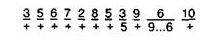
After the patient's recognition and naming of numbers within the first ten had been relatively restored, work with numbers of other tens presented no particular difficulties. The patient learned this over the course of the next 5–7 sessions.
Excerpt from the protocol
The patient was asked to compose (from cards with digits written on them) the numbers given orally by the instructor. The patient coped relatively well with the task.

After the ability to recognize and name numbers had been restored, it was possible to move on to special work on restoring awareness of the place-value structure of number. This defect was manifested in the patient mainly when reading complex numbers, and especially numbers with zeros. Understanding the composition of numbers of the first class — the class of units — presented no particular difficulty for the patient. Gross errors appeared in evaluating numbers made up of place values from the first and second classes: the patient understood the place values of units, tens, and hundreds, and knew their position and relationship, but the place values of the second class — thousands, tens of thousands, and hundreds of thousands — were beyond her understanding.
Excerpt from the protocol
The patient is given the number 385. It is named by the instructor. The patient is required to indicate the place of the units, the tens, and the hundreds. The patient performed this task correctly. Then the patient is given the number 12465 and the same task. The patient was unable either to name the number or to find the required place values from its name.
Patient. I do know the units — that's at the end... but why are there units here again (2 units of thousands)... I don't understand what you're saying.
Awareness of the place-value structure of the written number was restored in the patient only with difficulty over the whole period of instruction. By the end of instruction, however, the patient already understood the meaning of zero in a number, knew the place values of the second class, and could correctly write and read any number made up of two classes. However, the patient did not have a complete understanding of the internal relationship between classes and place values. The knowledge she acquired in the course of instruction was somewhat formal.
Instruction began with restoring an understanding of the relationships among the place values within the first class. For this, the patient performed a series of operations that made it possible to understand the internal composition of a number. The patient was given a number from the first ten. She had to place beside it the corresponding number of sticks. She was then given a two-digit number within the second ten. She had to replace it with the required number of sticks. Next, 10 sticks (a ten) were replaced by a button, and so on. These operations helped the patient realize that each successive place value is 10 times greater than the preceding one.
Sessions were then conducted using the place-value structure of number. The patient had to enter each number being practiced into a diagram — each number in its own place. Difficulties arose here at the beginning of instruction: the patient might enter the whole number in the place belonging to a single place value. A mediated system of notation was then used: the given number, represented by corresponding objects — buttons (tens) + sticks (units), or, for a three-digit number, matchboxes (hundreds) + buttons (tens) + sticks (units) — was drawn into the diagram in this way, after which the required number was written underneath.
The parallel inclusion in the work of ordinary arithmetic operations with numbers familiar to the patient — division, multiplication, addition, subtraction — helped her become aware of the place-value structure of number. By this period of instruction, operations with numbers began to proceed with significantly fewer errors, without special work aimed at restoring them. Exercises performed using real money proved very useful for restoring an understanding of the place-value structure of numbers and of operations with them. With the help of these exercises the patient acquired a good grasp of the meaning of the place values, for example, that copper coins are units, silver coins are tens, and rubles (up to 10 rubles) are hundreds.
The patient was given problems to solve that were close to real-life situations. For example, she was asked to calculate the total cost of purchases supposedly made by her in a grocery store: "One kilogram of grain costs 35 kopecks. You bought 0.5 kg of this grain. 1 kg of butter costs 3 rubles 60 kopecks; you bought 200 g. How much money did you spend? You had 3 rubles. How much money do you have left?" and so on. Problems of this kind were included in the instruction program mainly at the end of sessions and were given against the background of knowledge about number and operations with it that had already been restored. However, the use of this kind of exercise in the middle of instruction was not without benefit either: past experience and a familiar situation often help restore counting skills. By the end of instruction the patient coped relatively easily with all the necessary operations with numbers.
Excerpt from the protocol
The patient was shown numbers for naming them. She correctly named all the numbers: 5221051026 8 2144 and so on.
+ + + + + + +
The patient was then asked to compose numbers from individual digits written on cards. She, too, performed this task with only two mistakes.
96 82 105191014510579696 etc. + + 103 + + + 79966
The task in which the patient was required to break down the numbers 138 and 10520 into place values, she also performed correctly: 138 = 1 hundred, 3 tens, 8 units. 10520 = 10 thousand, 5 hundreds, 2 tens, no units — zero.
Over two months of instruction the patient learned to distinguish, in visual perception, numbers that are close in optical structure. Errors in naming numbers were also overcome. Counting operations with numbers likewise became accessible to the patient. However, the process of recognizing and naming a number, as well as counting operations, proceeded slowly, and the patient often resorted to an expanded form of activity.
The case described of the restoration of the counting function can serve as an illustration of the methods for restoring counting in mildly expressed parieto-occipital acalculia with predominantly optical disorders.

Comments