
Lecture
Methods of restoring writing in afferent motor agraphia
Let us examine the neuropsychological and psychological pictures of the writing impairment observed with lesions of the lower parts of the retrocentral region of the left hemisphere, often accompanied by afferent motor aphasia and agraphia. It is known that in order to write a word correctly, and still more a series of words, it is not enough to clarify its sound characteristics or the position of the sound in the word; it is also necessary to clearly differentiate the sounds by their kinesthetic bases, by the place and manner of their formation, since covert articulations necessarily take part in the act of writing. In afferent motor agraphia, owing to impairments of speech kinesthesia, the articulatory boundaries between sounds close in place of origin are lost. The central mechanism of the writing impairment in afferent motor agraphia consists precisely of defects of kinesthetic sensations, which lead to an impairment of fine articulatory movements and to the impossibility of clearly differentiating sounds by their kinesthetic bases, which in turn leads to the main defect in writing — an impairment in the writing of individual sounds close in manner and place of formation (such as Б-П-М (B-P-M) — bilabial, occlusive; Ф-В (F-V) — labiodental, fricative, etc.).
Impairments of the kinesthetic mechanisms of speech lead to defects in the link responsible for forming articulemes, as a result of which patients "do not feel" (in their own words) the sounds they are supposed to write down. When attempting to write a dictated word or sound, the patient tries to pronounce it, but the impaired speech kinesthesia does not allow him to correctly repeat the sound he has heard, and therefore, in his own speech, some sounds are substituted for others. This defect leads to literal paraphasias in oral speech, and, in written speech, to literal paragraphias of the afferent motor type. A patient who has lost the internal schemas of articulation, despite the preservation of the acoustic and visual analysis of the word and of its successive structure, proves unable to write it correctly either to dictation or independently. In this case, too, the writing impairment appears most often in a gross form, but now on different grounds.
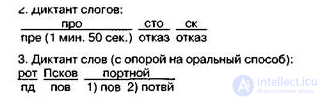
In the clinical picture of these writing impairments, the patient shows literal paragraphias. The most frequent errors are: a) substitution of some sounds for others close in place of origin, b) omission of consonants in clusters, c) omission of vowels in words, d) not infrequently there is also omission of whole syllables (or consonant clusters) from the middle of a word ("Пов" (Pov) instead of "Псков" (Pskov), "потвй" (potvy) instead of "портной" (portnoy, "tailor"), and the like). The mechanism of these errors is understandable: patients retain the ability to pronounce the general motor outline of a word on the basis of the preserved sound image of the word, while the sound composition itself is impaired. The most frequent and characteristic substitutions in this form of agraphia are substitutions among the following groups of sounds: Т-Д-Л-Н (T-D-L-N); М-В-Н (M-V-N); З-С-Ш-Ч (Z-S-Sh-Ch); В-Ф (V-F), and others. Many patients, instead of the word "стол" (stol, "table"), typically write "слом" (slom), or "снол" (snol), or "слон" (slon, "elephant"), while the word "момент" (moment) is written sometimes as "бомет" (bomet), sometimes as "мобел" (mobel); the word "снаружи" (snaruzhi, "outside") becomes "стдаружи" (stdaruzhi); the word "плавать" (plavat', "to swim") becomes "бнават" (bnovat), and so on.
In the psychological picture, impairments are found in the link responsible for sound discrimination, due to defects in the kinesthetic basis of writing. In this form of agraphia, practically all types of writing are impaired, except copying. Independent writing (composition, essay) and writing to dictation are especially grossly impaired. Writing proceeds deliberately and necessarily involves oral speech: patients cannot write a single letter without pronouncing it. It is precisely in this structural link — the formation of the articulation of a sound, its pronunciation and its separation from other sounds — that the close interaction of writing and oral speech is revealed, and it is here, too, that the position of psychology concerning the kinesthetic basis of speech is confirmed.
Afferent motor agraphia occurs within the syndrome of afferent motor aphasia, in which oral expressive speech is impaired by the same mechanisms, the defects of which negatively affect writing. Writing becomes a de-automatized and conscious process, and the writing impairment occurs together with a decline in comprehension of what has been written. However, unlike efferent motor agraphia, in this case the syntagma and the grammatical organization of the written sentence remain more preserved.
The main task of restorative training in this form of agraphia is the restoration of the process of sound discrimination, which will in turn lead to correct sound-letter analysis in writing and to the restoration of the articuleme. To this end, the work relies on the preserved acoustic and visual analyzer systems and on their interaction.
To restore writing, training is conducted at a conscious and deliberate level of its execution. All operations of writing letters, words, phrases, and text are carried out under the control of consciousness and with the involvement of external supports. In teaching writing to patients with sensory agraphia, as we shall see below, the leading role belongs to vision and to kinesthetic sensations — pronunciation, while the auditory analyzer is brought into the work later. In cases of impairment of the articulatory analysis of a sound, on the contrary, the auditory analyzer is engaged from the very beginning together with the visual one. However, even the defective speech-motor analyzer must be brought in immediately in these cases, but only within work that combines it with the sound and visual analyzers, since, as our practice has shown, pronunciation is one of the most necessary components of writing (A.R. Luria, L.K. Nazarova, M.N. Kadochkin, L.S. Tsvetkova, and others).
Since teaching writing always proceeds together with the restoration of oral conversational speech, maximal attention is given at the first stage to restoring the pronunciation of words. For this purpose, the patient's attention is switched from the articulatory, pronunciation-related aspect of the word to its semantic sphere, and use is also made of our own developed method of semantic and auditory stimulation in the pronunciation of the whole word (FOOTNOTE: Tsvetkova L.S. Restorative Training in Local Lesions of the Brain. Moscow: Pedagogika, 1972; Tsvetkova L.S. Neuropsychological Rehabilitation of Patients. Moscow: Moscow State University Press, 1985).
The transition to sound-letter analysis of the composition of the words being practiced occurs only after the patient has accumulated a certain passive and active vocabulary. The central task of training at the first stage is to teach the patient to pronounce whole words and to be able to isolate individual sounds from a word. The purpose of the act of writing during this period of training becomes the word, and not an individual sound-letter, which, as is known, carries no information and has no meaning for a person, since it is included neither in semantics nor in the subject's system of relations. Relying on the meaning of a word, or on its sense, when writing it down helps restore the graphic image of the word. We see that here, too, a strategy is applied that goes from the whole to the part and that includes the words being practiced within a system of semantic relations among words.
Teaching the writing of a word must take a number of conditions into account:
1) the selection of the word with regard to certain of its parameters: frequency (objective and subjective), phonetic complexity, length, and the semantics of the word (words are selected first from different semantic groups, and later — from close ones, or from a single field, for example, porridge, window, tree, etc., or tomato, milk, pear, etc., or tomato, cucumber, potato, beet, etc.);
2) work on the writing of a small number of words;
3) obligatory reliance on the semantics of the word, i.e., the connection of words with their meaning, their sense, and their object reference;
4) reliance on the object itself or on its image (a picture), together with the simultaneous sounding of the corresponding name-word, which ensures the fixation of the word, its meaning, and its sense.
The restoration of writing proper begins only at the second stage, with the writing of the word rather than the letter, and once words that the patient can pronounce begin to appear in his vocabulary. It is known that the restoration of oral speech, writing, and reading usually proceeds together, and the restoration of one form of speech affects the restoration of the others. However, teaching practice and our own special studies of the mutual influence of different forms of speech on one another in the process of reverse development have shown that in afferent motor agraphia there are certain regularities indicating a different role for different forms of speech at different stages of reverse development. And here it is necessary to recall the differences between oral and written speech in historical and genetic terms, and in their structure and functions.
Thus, the restoration of writing can have a negative effect on the restoration of a patient's oral speech if it is begun against a background of a complete absence of articulate oral speech and of any active or passive vocabulary whatsoever. How can this be explained? If we recall the characterization of written speech as a second degree of abstraction, it becomes clear that if the spoken word is absent (the first degree of abstraction), then the representation of the word is also absent, and consequently there is nothing to write, i.e., the second degree of abstraction of speech — the written word — is absent. Since writing is, to the highest degree, a deliberate act, while the restoration of oral speech begins with the revival of its involuntary level, the patient's attention must not be fixed on the pronunciation side of speech. Studies have shown that many patients can write only those words that are in their active vocabulary, (FOOTNOTE: Tsvetkova L.S. Aphasia and Restorative Training. Moscow: Prosveshchenie, 1988) i.e., only those of them that they are able to pronounce. Consequently, at this stage of training, the leading role belongs to oral speech (the accumulation of an active and passive vocabulary), which promotes the restoration of writing.
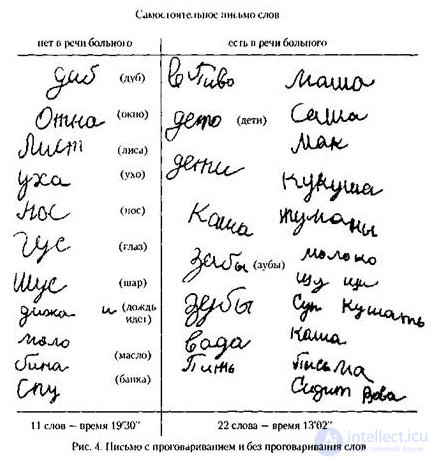
What significance can this position have for restorative training? It means that oral speech is primary and is one of the foundations of written speech. Therefore, one must first work on restoring the pronunciation of words and phrases, and only then on restoring their written form. Let us give an example. Patient R., with a most severe form of afferent motor aphasia and agraphia (a state following a gunshot wound: a lesion in the posterior frontal and inferior parietal regions of the left hemisphere), is given a dictation of words that were in his active vocabulary and words that he did not pronounce (see Fig. 3, d, e). These facts confirm the significance of speech kinesthesia in the act of writing: words that are not yet present in the patient's oral speech he analyzes and writes with great difficulty, making many errors, and most often refuses to write them at all.
Therefore, right from the very beginning of restoring writing in patients with afferent motor aphasia and agraphia, work is done above all on oral speech, on the ability to pronounce words while writing. Work on writing begins only once the necessary stock of oral-speech words has been accumulated. And only then does the writing of these words in turn begin to have a positive effect on the purity of their pronunciation and their consolidation in oral speech. Later, the reverse dependency sets in: writing (and reading) get ahead of the restoration of spontaneous oral speech and serve as supports for its restoration, positively affecting the growth of the active vocabulary and the speed and clarity of pronunciation of individual words and utterances. Therefore, at this stage the patient is taught to write the whole word, using for this purpose a series of sequential techniques (or operations) that make up the program of the patient's action, the sequential performance of whose operations leads to the writing of the word.
At this stage, when writing whole words, many errors may arise, to which, during this period of training, the patient's attention should not be drawn, so as not to shift him from the semantic level of writing to a deliberate sensorimotor one.
The first series of operations is directed at actualizing in the patient an attitude toward the word he must write, at evoking an image-representation of the content of this word, and at actualizing its semantics and all its possible connections with other words. The second series of operations is directed at the actual writing down of the word being practiced.
Program
1. Look at the picture and recall everything about this object: what it is for, what it is made of, whether you know it or not, how you feel about it, etc. Think about everything, recall it.
2. Imagine this object to yourself (the picture is removed).
3. Draw it.
4. If you can — say this word.
5. Listen to it (the teacher pronounces this word).
6. Repeat it.
7. Find it among the written words (a choice of three words).
8. Quickly write it down!
9. Once again, write it down quickly!
10. Look at the written word (a card with the word written on it is given and then removed).
11. Once again write it down quickly. Do not think about how to write it, but about what to write. As oral speech is restored and spontaneously occurring words appear in the patient's vocabulary, the ability to write not only words from the patient's active vocabulary is restored, but also words that are not yet in his active spontaneous speech.
After teaching the patient independent writing of words present in his active vocabulary, as well as to dictation, one moves on to teaching analytic writing — the writing of individual sound-letters, the isolation of letters from a word, and the writing of letters, etc. This stage of training is important, since practicing knowledge of individual letters and the ability to write them, and restoring the patient's ability to relate a sound to an articuleme (a pronunciation) and then to the corresponding letter, will subsequently help restore the speed and accuracy of writing.
Here another program of operations is useful, one that relies on the stock of pronounceable words already available to the patient. After working with the first program for one or two weeks, one can move on to restoring analytic writing. For writing, the same words that were worked on earlier and in which there were errors are taken, along with others present in the patient's active vocabulary, and the following program of actions is given.
Program
1. Look at the picture.
2. Find your word for this picture.
3. Listen to this word and look at how you wrote it.
4. Find the errors.
5. Correct them.
6. Write this word again.
7. Check whether there are errors.
8. Pronounce this word slowly, sound by sound, and look in the mirror — at how each sound is pronounced.
9. Pronounce the first sound, checking its pronunciation in the mirror.
10. Write it. (And so on with each sound of the word.)
11. Write this word again, clearly pronouncing each sound.
12. Check it. Copy it. Write it once more from memory.
At this (second) stage of the restoration of writing, various methods of working with a tape recorder are used with great effectiveness:
1) dictation of words with the speaker emphasizing the first sounds and the patient writing down these letters (for example, the speaker says "нога" (noga, "leg"), the patient writes "нога" and underlines the letter "н" (n)), 2) dictation of individual sounds relying on letters laid out in front of the patient (the patient listens —> sees —> writes), 3) dictation of sounds without reliance on letters.
The restoration of phrase writing proceeds in parallel with the restoration of oral expressive speech and depends on it to a large degree. The structure of the phrase in this form of aphasia is not grossly impaired, and the defects of writing continue to remain at the level of isolating sounds, at the level of writing individual words. Therefore, the effectiveness of restoring phrase writing depends on the effectiveness of overcoming the main defects in this form of agraphia, the defects of kinesthetic sensations and of the articuleme.
The main, and first difficulty in writing a phrase is still related to defects in the analytic writing of individual words, which remains a deliberate and expanded action requiring the patient's full concentration of attention. In connection with this, a second difficulty — a worsening of the memorization (or recall) of the content and lexical composition of the phrase — also arises. A third difficulty is the impressive and expressive agrammatism of the patients' oral speech, which is also present in the writing of the phrase and of the text, and which manifests itself above all in an impairment of agreement and government of words within the phrase.
It is especially difficult for patients to find the necessary inflections and to write them correctly, which is related, in particular, to the presence in some word endings of iotated sounds (-ей, -ий, -ая, -ый (-ey, -iy, -aya, -yy), etc.), which present difficulties for these patients in pronouncing them correctly, and hence also for writing them. Therefore, the methods for restoring the writing of the phrase provide for the elimination of these difficulties with the help of external materialized supports. Such supports are: a) narrative pictures, which externalize the content of the phrase and fix it, b) strips of cardboard (or any other cards), which ensure the materialization and fixation of the quantitative aspect of the phrase (the number of cards corresponds to the number of words in the phrase), c) letters of the cut-out alphabet, with the help of which the sound isolated through pronunciation is immediately designated (the needed letter is laid out).
Later, when the unit of work becomes not the letter but the word, the patient chooses the needed word from a series of words written on cards and lays it out under the corresponding picture.
The phrase is read through in its entirety by the patient and copied while it is pronounced aloud, then written from memory. As this method of writing phrases is mastered, the patient is taught to write the phrase with the help of a reduced number of supports. First the cards are removed (the patient replaces them by counting on his fingers), later the cut-out alphabet and the written words are removed as well, and at the end of the work on teaching the patient to write a phrase by the method of captioning a narrative picture, with the help of an expanded program consisting of a series of the sequential operations described, the narrative picture itself is also removed, and in its place the phrase is pronounced by the teacher (dictation), or the patient himself thinks up a sentence (independent writing).
Work on restoring the correct writing of word endings is likewise carried out with external support from object or narrative pictures and from various endings written on cards. When writing a phrase, the patient chooses the needed ending of a word (from among 3—5—7 given inflections). The method of written answers to questions is also used. The patient is given an object picture, which he names, and then answers a question in writing with a single word in the appropriate case.
E x a m p l e. The picture shows a knife.
Teacher, What is drawn in the picture?
Patient. A knife.
Teacher. Do you have a knife?
Patient. I don't have a knife.
Teacher. What do you cut bread with?
Patient. With a knife. And so on.
A number of exercises are also used in the work on restoring the writing of a phrase: filling in blanks (words) in a phrase, filling in missing sentences in a text, composing a letter to relatives with the support of questions, etc. The methods of work described and the corresponding procedure for their application lead to positive results in restoring writing in afferent motor agraphia.
Analysis of the dynamics and methods of restoring writing in afferent motor agraphia
Let us give an example illustrating the dynamics of the restoration of writing in a patient suffering from a gross form of afferent motor agraphia.
Patient S. (a tractor driver, 8 years of schooling) underwent an operation in which gross meningo-cortical adhesions in the region of the central gyrus on the left were separated. The neuropsychological examination, conducted after the operation, established the presence, in the patient, of a most severe form of afferent motor aphasia and agraphia, with a complete absence of all types of expressive oral speech, a gross impairment of oral praxis, a complete absence of writing — both independent and to dictation — with a most severe alexia, and (primary) acalculia. All this occurred against a background of preserved comprehension of speech addressed to him and preserved phonemic hearing.
By the start of training, the patient's writing was practically absent. He could not even write words that had become familiar idiograms — his own first name and surname, the name of the city in which he lived, the names of his wife and children. Dictation of words (and even of individual sounds) was a process inaccessible to him. He could write only a few letters independently, relying on the oral image (via a mirror). Let us give an example of the patient's writing at the start of training.
1. The patient is asked to write his own name. He refuses for a long time. After an insistent request, in the course of 3 min 30 sec he first wrote
Over the course of training, the patient traveled the path from a complete disintegration of all forms of writing to independent narration, composition, etc. At the beginning of training, the action of writing a word was extremely expanded in the composition of its operations. Before beginning to write words, extensive work was carried out with the patient to actualize the semantic characteristics of each word to be written, its polysemy, and its connection with an image-representation (object pictures, drawing, etc.). Only after this did work on the writing of words begin. The patient first listened to the needed word, repeating it as a whole, then broke it down into syllables (laying out the corresponding number of cards), then isolated each sound in the syllable, counted the number of sounds (laying out the needed number of cardboard squares). And only after this did he select the needed letters from the cut-out alphabet, all the while pronouncing each sound being sought, laying out the whole word, and then copying it (writing by tracing). In this way the patient learned to isolate sounds from a word and to relate them to a letter; the methods used in training helped overcome the defect in the internal articulatory schemas.
At the beginning of teaching the patient to write, he could write only those words that were in his oral speech and that he could pronounce in the course of writing. Where the patient could not pronounce a word, i.e., could not rely on the kinesthesia of the speech apparatus, correct writing proved inaccessible, and the oral image did not help either. Let us give some examples.
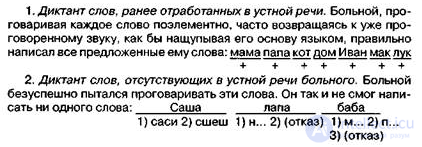
"ви" (vi), then "Ивн" (Ivn) (Иван, Ivan). He wrote his surname for more than 5 minutes, trying to pronounce something, feeling out the needed sounds with his tongue and lips: "сыров" (syrov), "сырыйвита" (syryyvita) (Сыромятников, Syromyatnikov).
The data presented point to the important role of pronunciation at the first stage of restoring writing. These data were obtained in all our patients suffering from afferent motor agraphia.
Later, as the patient's oral speech was restored, he acquired the ability to write words that had not been in his active oral speech but that he tried to pronounce (Fig. 4). After the patient had learned to write individual words freely and the action of writing had become relatively reduced and automatized, the patient began making his own attempts to write individual phrases, and tried to write a letter home.
Special work on restoring the writing of whole sentences was begun by the time the patient was already able to correctly
construct oral phrases of 2—3 words. The patient constructed the phrase correctly, but there was expressive agrammatism. The difficulty also lay in retaining the general sense of the phrase and its lexical composition. To overcome these defects, narrative pictures were used, which externalize the semantic content of the phrase to be written, along with all kinds of external supports (cards, sticks, etc.) that fix the quantitative aspect of the phrase. At first, the writing of each phrase took from 3 to 7 minutes, including pronunciation, use of the oral image, and the isolation and fixation of the number of words, etc.
The patient wrote individual words using only pronunciation. The writing of words within a phrase again required all the supports that had already fallen away. However, these difficulties were overcome, and after 8—10 sessions devoted specifically to work on phrase writing, the patient began to write considerably faster and relied only on pronunciation, rarely resorting to visual control.
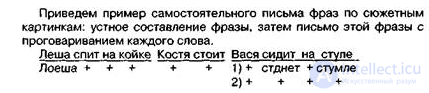
However, the skill of phrase writing remained unstable for a long time; difficulties in writing a phrase often arose owing to an inability to analyze the composition of a word, which in turn depended on the overall volume of material (the number of words) that the patient had to retain. In these cases, the patient again reverted to the expanded method of writing individual words, up to and including the use of the cut-out alphabet. The patient was given exercises for a long time on completing sentences with missing words (in writing), on composing sentences from given words, on independently writing short (2-word) phrases, etc. All this had a good effect on the final results of restoring the patient's writing. By the end of restorative training, the patient wrote not only individual sentences well but could independently write short compositions and letters.

Restorative training was conducted for 2 months, with 5 sessions per week.
Summing up, it should once again be noted that in this form of agraphia, too, writing and written speech are restored from the whole to the part, and necessarily with an understanding of the material that is to be written. At the preliminary stage, work is needed on the semantics of the spoken word (and later — the phrase), its meaning, its sense, its object reference, and the ability to classify object pictures (and consequently also the naming-words for these pictures) according to a situational or categorical criterion, etc.
Work on restoring (or forming) writing that has been impaired at the link of the kinesthetic analysis of sound and the formation of articulemes must likewise begin with the formation of oral speech — its pronunciation and semantic aspects. Teaching the writing of letters should be conducted through the word, through its semantics, just as the writing of words is taught through the writing of the phrase. The illustrations show the dynamics in the course of the patient's training (Fig. 5).

Comments