
Lecture
For a long time, researchers of writing avoided the question of its connection with oral speech. Thus, back in the 19th century, many of the classic figures of neurology regarded writing only as an optico-motor act, and its impairment as a disturbance of the connections between the visual center, the motor center of the hand, and the center for the formation of words (L. Lichtheim, C. Wernicke, 1874, and others). Later there arose the view that writing is a purely motor act, and it was localized by researchers in the middle sections of the premotor zone (Exner's Center, 1881). In our time (the 1940s—1950s), some researchers continued to regard writing only as a motor act and localized it within the premotor zones of the motor analyzer (Kleist, 1959; Nils von Meyendorf, 1941, and others). However, the overwhelming majority of contemporary researchers of writing point to its connection not only with movement and perception, but also with oral speech.
Contemporary Russian psychology approaches writing from fundamentally different positions and regards it as a complex, conscious form of speech and speech activity. We believe, however, that this understanding of writing is insufficient, and that it represents a considerably more complex psychic formation than merely one of the forms of speech. The psychological content of writing includes, besides speech, the processes of perception of different modalities — visual, acoustic, and spatial, and also the motor processes — of a kinesthetic and kinetic nature, the visual images-representations of letter signs, operative memory, and so on. The interaction of these psychic processes in the formation of writing is attested by the history of its development, and also by the disintegration of writing in brain lesions that cause impairment of a number of psychic functions, the interaction of which is the very basis on which writing is formed.
The complexity of writing and its heterogeneity are also revealed in comparative studies of writing and oral speech. These studies have shown that the processes of writing and of oral speech differ in many respects — in their origin, in their manner of formation and course, in their psychological content, and in their functions.
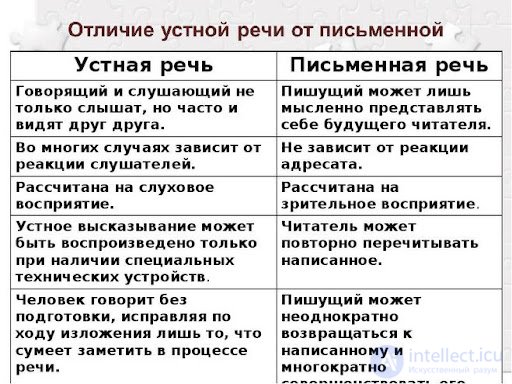
As for origin, it is known that oral speech arises in the child in the second year of life, while writing arises in the fifth to seventh. Oral speech is formed directly in the process of communication with adults, while written speech is formed consciously, in the process of conscious and voluntary instruction. The ways in which writing arises and develops appear, from the very beginning, as conscious actions, and only gradually does writing become automatized and turn into a smoothly flowing skill. In this it differs from oral speech, which is formed involuntarily and proceeds automatically. At the early stages of mastering writing, each separate operation is an isolated, conscious action; the writing of a word breaks down for the child into a series of tasks: to isolate the sound, to remember it, to designate it with the corresponding letter, to remember the letter, to write it. As the skills of writing develop, its psychological structure changes. Separate operations drop out from under the control of consciousness, become automatized, unite, and turn into a motor skill that subsequently provides for a complex psychic activity — written speech.
The clearest differences between oral and written speech are revealed in the psychological content of these processes. Oral speech is above all contextual, which is realized, first, in conversational speech given the presence of a shared situation, which itself creates the context within which the transmission and reception of information are simplified. Second, oral speech has a number of emotional-expressive means that help communication, a more precise and economical transmission and reception of information: superfixes — gestures, facial expressions, pausing — likewise create the contextuality of oral speech.
Third, in oral speech there is a whole series of non-formalizable means that depend on the motivational sphere and directly or indirectly represent a manifestation of activity — general and verbal. And finally, the motives for written speech also arise later, and they themselves are more abstract and intellectualized. Creating motives for writing in a child is extremely difficult, since the child manages perfectly well without writing.
Written speech is a special speech process; it is speech-as-monologue, conscious and voluntary. L.S. Vygotsky wrote that written speech, while having a close connection with oral speech, nonetheless in the most essential features of its development does not in the least repeat the history of the development of oral speech. "Written speech is also not simply a translation of oral speech into written signs, and mastering written speech is not simply the acquisition of the technique of writing" (FOOTNOTE: Vygotsky L.S. Thinking and Speech. Moscow: Publishing House of the Academy of Pedagogical Sciences of the RSFSR, 1956, p. 263). The resemblance between the two kinds of speech is external, symptomatic, but not essential. Written speech requires abstraction for its development; compared with oral speech it is doubly abstract: first, the child must abstract himself from sensory, sounding, and pronounced speech; second, he must move on to detached speech, which makes use not of words, but of representations of words. The fact that written speech is thought rather than pronounced represents one of the main distinguishing features of these two kinds of speech and a substantial difficulty in the formation of written speech.
Written speech has a number of psychological particularities: it is more voluntary than oral speech; even the sound form, which is automatized in oral speech, requires dissection, analysis, and synthesis when learning to write; the syntax of the phrase is just as voluntary as the phonetics.
Written speech is a conscious activity and is closely bound up with intention. Signs and their use are acquired by the child consciously and deliberately, in contrast to the unconscious use and acquisition of oral speech.
Written speech is "the algebra of speech, the most difficult and complex form of deliberate and conscious speech activity." (FOOTNOTE: Vygotsky L.S. Selected Psychological Investigations. Moscow: Publishing House of the Academy of Pedagogical Sciences of the RSFSR, 1956, p. 367). But just as algebra does not repeat arithmetic, but is a higher, abstract development of mathematical thinking that raises to a higher level the arithmetical thinking already formed earlier, so too written speech introduces the child to the very highest, abstract plane of speech, thereby restructuring oral speech as well. H. Jackson, the 19th-century English neurologist, regarded writing and the understanding of what is written as, in general, a manipulation of "symbols of symbols." According to L.S. Vygotsky, the use of oral speech requires primary symbols, while writing requires secondary ones. Furthermore, written speech is the most wordy, precise, and elaborated form of oral speech. In it one must find words and use them to convey what, in oral speech, can be conveyed by nonverbal means, by means of intonation, facial expression, and the direct perception of the situation. Also significant is the difference between oral and written speech in their relation to inner speech: whereas oral speech precedes inner speech in development, written speech is formed later, and on the basis of, inner speech. According to H. Jackson, written speech is the key to inner speech.
Written speech is very important in the development of the child's psyche. Its role in the psychic sphere of children is above all the formation of conscious and voluntary oral speech: the child begins to become aware of speech and to carry out speech tasks. Grammar and writing allow the child to rise to a higher stage in the development of speech. All these particular features of writing give grounds for supposing that it will be impaired more often and more severely, since it is a later and more complex function. And instruction in it at school will also be far from simple, moreover because, by the time instruction in writing begins, all the basic HMFs that form its foundation have not yet finished developing, and some of them have not even begun their development, so that the teaching of writing relies on immature psychic processes (L.S. Vygotsky, 1956).
Let us briefly sum up the comparative analysis of written and oral speech. Written speech:

Comments