
Lecture
We undertook a special experimental comparative study of the ability to count in two groups of patients — "frontal" and "parietal" — under more complex conditions, in which the patient was required to successively subtract one and the same number, or to alternate — now one number, now another — each time from the newly obtained minuend: 100 - 3 = 97 - 3 = 94... 100 - 3 = 97 - 5 = 92 - 3 = . The purpose of this study was, on the one hand, to clarify the psychological structure of the disorder of counting in lesions of the frontal and parietal systems of the brain, and, on the other hand, to develop corresponding methods for restoring counting in different forms of acalculia.
It is known that operations of this kind require the maximal mobilization of all the components of counting: stability of attention, orientation in the task, comparison of the results obtained with the initial data, on the one hand, and stability of the skill in specific computational operations — the skill of rounding numbers, retaining the direction of counting, etc. — on the other.
It is known from the literature that patients with lesions of the frontal lobes of the brain have no primary impairments of counting skills. They have no defects in understanding the place-value structure of number; they correctly carry out well-established operations of addition, subtraction, multiplication, and division. Their defects appear in performing tasks with more complex operations, in which there is a series of successive and interrelated links. Performing tasks of this kind requires stability, purposefulness, comparison of results with the initial data, retention of intermediate results, etc.
Our latest experimental-theoretical studies have shown that although this approach is on the whole correct, for the current level of development of neuropsychology it is somewhat simplified. The point is that studies of the state of intellectual activity in patients with frontal syndrome have shown fundamentally different (in terms of mechanisms) pictures of these disorders in lesions of different zones of the frontal region. Intellectual activity is most grossly and primarily impaired in lesions of the prefrontal parts of the brain, leading to impairment of the processes of generalization and abstraction, impairment of verbal senses and meanings and of non-verbalized senses, and impairment of the process of understanding as a component part of thinking. (FOOTNOTE: Tsvetkova L. S. The brain and intellect. M.: Prosveshchenie, 1995). Our experiments with counting have shown that it is impaired due to defects not only in the structure of the activity, but also in its psychological content — impairment of understanding, abstraction and generalization, due to impairment of the higher syntheses. Naturally, these defects cannot but lead to a primary impairment of counting as an intellectual activity. The specific defects of counting in patients with lesions of the frontal parts of the brain can appear most clearly in solving examples that represent a sequential system of operations carried out mentally.
An example of intellectual activity of this kind can be serial subtraction, either from 100 by 7, or alternately by 5, by 7, etc. Three series of experiments were conducted with each group of subjects — "parietal" and "frontal".
The task of the first series was to identify the main factor disrupting oral counting in these patients. For this purpose, the following tasks were proposed: to count aloud: a) from 100 by 7, b) from 100 by 3, c) from 100 by 13.
In the second series of experiments we attempted to identify which link of the complex structure of the operation of serial subtraction turns out to be impaired. For this purpose, in the experiment, the performance of first one link, then another, was successively externalized: first the condition of the task was given in written form, then the patient was allowed to write down the intermediate results, later — the sequence of counting operations was given ready-made, etc.
The task of the third series of experiments was to clarify the role of loud speech (vocalization) in counting operations. In this case, experiments were carried out with vocalization switched on and off in the course of performing the indicated series of arithmetic operations. As a result, the following counting impairments were identified in the patients of the groups studied.
Common to all subgroups of patients with frontal syndrome were defects in retaining the intermediate result, absence of a need to compare the results obtained with the initial data, and instability of the goal of the action.
The nature of the errors and the mechanism of their origin proved to be different. In the group of patients with impaired selectivity in actions, with defects of the orienting basis of the action, etc. (lesions of the polar, convexital parts), the impairments manifested themselves in an inability to inhibit extraneous associations; the deployed program of the action was replaced by a reaction of assimilation, and understanding of the operations being performed and of the activity as a whole was impaired. Counting activity proceeded at the lower, involuntary level. At the higher (voluntary) level, an impairment of the awareness of one's own actions and of their understanding was found. The time taken to perform the task ranged from close to normal to very long.
Patients with lesions of the basal parts of the left frontal lobe, owing to impulsivity in actions and instability of attention, made errors of the assimilation-to-a-visible-feature type, and omissions of the last operation (of two) in calculations involving crossing a ten. For example, 100 — 7 = 93; 93 - 7 = 90 (93 - 7 is broken down into two operations: 1) 93 - 3 = 90 and 2) 90 -4 = 86). The time taken to perform the computational operations differed little from normal, and sometimes exceeded it because of the errors indicated.
In patients with lesions of the postfrontal parts of the brain, this task clearly revealed defects of switching, manifested in perseverations. The inertness of the stereotypes that arose, underlying the counting impairment in these patients, manifested itself not only within different tasks (switching from one kind of task to another), but also within a single task (switching from one link of the action to another). In tasks requiring maximal flexibility of counting (alternately subtracting now a five, now a three, from a hundred), defects of switching and perseverations appear in their clearest form. Counting impairments in patients with postfrontal syndrome (left hemisphere) were sometimes complicated by perseverations in speech.
A completely different picture of the impairment was found in patients with lesions of the parieto-occipital parts of the brain. In this group, too, there were impairments in performing serial counting; however, the nature of the errors and the mechanism of their occurrence differ fundamentally from those of the "frontal" group of patients. They exhibited either a complete inability to perform the task orally, or errors arose that were connected, on the one hand, with a complete breakdown of understanding of the internal composition of the operations and their sequence in arithmetic actions, and, on the other hand, the performance of specific counting operations was hindered by spatial impairments. Hence both delays in performing the task and errors in counting arise. Thus, in the special experiments, the same errors and the same mechanism of their occurrence appeared as discussed above in the special chapter.
The difference in the structure of the counting impairment in the two groups of patients studied emerged especially clearly in those series of experiments whose task was to search for adequate methods of overcoming these defects. For this purpose, in the experiments, individual elements of the subtraction action were successively externalized. First the patient was allowed to write down the initial minuend, and had to perform everything else orally. In the subsequent experiments, the patient was allowed to write down the initial minuend and subtrahend, while the resulting difference, which became the minuend in the next operation, had to be kept "in the mind". And finally, in the last experiments of this series, all the given conditions, as well as the results obtained, were externalized. The results of the experiments were as follows.
It turned out that for patients with lesions of the frontal areas of the brain, a significant effect is produced only by externalizing all the given conditions (the minuend and the subtrahend) and the intermediate result of the subtraction (the difference). Externalizing only the condition of the task does not yield positive results. Relying on the externalized data of the condition and the intermediate results organizes the behavior of the patient in performing the task, and creates the conditions for the sequential performance of all the links of the counting operation. It should also be taken into account that this method of externalizing the entire structure of the computational operations and their sequence not only organizes the activity, making it conscious and visible, but also simplifies the operations themselves, the performance of which often requires only the preservation of computational skills. For example, the action 105-57 is a complex action with three operations: 57 —2 = 55, 105 - 55 = 50, 50 - 2 = 48. But even an action broken down into simple operations could not be performed independently by patients of the first (frontal) group, since here there are operations with large numbers, and all the operations are linked into a unified action with an understanding of the relationships between the numbers and the operations performed on them. It is precisely this link in the structure of counting (and in intellectual activity as a whole) that turns out to be impaired, and this leads to a substantial, specific, primary impairment of counting in patients with lesions of the prefrontal parts of the frontal zone of the left and right hemispheres.
Attention should also be paid to the question of the influence of speech on the course of counting in the group of patients with frontal, and above all with postfrontal, syndrome. Speech did not help this group of patients — it did not organize their activity or regulate it, and often it worsened performance of the task still further because of extraneous verbal intrusions, incorrect naming of numbers, etc. We have already noted that counting impairments in the group of patients with postfrontal syndrome are complicated by perseverations in speech. Excluding loud speech in the process of teaching these patients to count proved to be an effective and necessary condition for successful teaching.
For the group of patients with primary parietal acalculia the greatest effect was produced by the system of external supports that externalizes not the conditions of the task and the intermediate results, but the structure (the sequence of operations) of the arithmetic action and the direction of counting. Externalizing all the elements of the task did not lead to the necessary results. Moreover, unlike the patients of the "frontal" group, an indispensable condition for the effective restoration of counting in the "parietal" group of patients proved to be reliance on vocalization.
Let us turn to the analysis of the specific data of the study. Let us dwell in detail on the analysis of the mechanism of the counting impairment in the group of patients with lesions of the postfrontal parts of the left hemisphere. The data of the study of counting in the other groups of patients with frontal syndrome were presented above.
Patient B., 52 years old, with higher education, a soil scientist by profession. He had undergone surgery for removal of a tumor from the postfrontal parts. The tumor adjoined the dura mater and extended into the depth of the left frontal lobe in its posterior parts. In the patient's neuropsychological status a pronounced postfrontal syndrome was noted, with impairment of the dynamics of the higher cortical functions, with distinct pathological inertness in the speech and motor spheres, manifested in perseverations. The intellectual processes were also affected in connection with defects of switching from one element (or link) of the action to another.
The task of the first series of experiments was to identify the mechanisms of the impairment of counting, and it was conducted orally, without reliance on external means.
Experiment No. 1 (excerpt from the record)
The patient is given the instruction to count off successively from 100 by 7, with the entire process conducted aloud.
Patient. 93, 96... that is, 93, 86... 79... 72... 65... (pause of 40 seconds)...60, no... 65...60...no, not 60... 93...that is, 90, no, 86, 74, that is, 79, 71, that is, 72, 65, 68, that is, not 68, but 61, 70, 77.
Counting off proved practically impossible; the patient performs the task with difficulty, does not retain the intermediate results, perseverates on previous numbers (93, 96, etc.), perseverates on place values, and gives an incomplete program of decomposition of the number (70, 77).
Teacher. Start again from the beginning.
Patient. 100 minus 7 is 93, minus 7, that is 90... 94, 94 minus 7 is... minus 4... minus... 93, no, 83...
In this brief record we see both perseverations and assimilations — instead of the operation (93 - 3) - 4, the patient carries out an operation in which he simply carries down into the answer the remaining part (4) of the 7 and gets 94. We see the same thing in the operation (94 - 7), where instead of the operation (94 - 4) - 3 = 87, the patient performs the simplified operation 94 - 4 = 90, carries the remaining "three" down into the answer, and gets 83. Performance of the 1st and 2nd tasks took 6 min 15 sec.
Even greater difficulties of the same character were found in the following experiment, in which the patient had to switch in time from one subtrahend to another.
Experiment No. 2
The patient is asked to subtract from 100 alternately 5 and 3. All operations are performed aloud.
Patient. 95, 92... 90... no, 87, 87, 87... 84, 60, no, sorry, 79, 70...70...(pause 50 sec)... 76, 73, 75...that is.... 68... 63... 60, 55, ... 53, no, 93, no, 53, 44...(pause 18 seconds)... 70, 73 (refusal). I can't go on.
Time taken: 5 min 50 sec.
In this more complex experiment we find, in addition to the errors that occurred in Experiment No. 1 (perseverations, assimilations, an incomplete program of decomposition of the number), also errors of switching. The patient has difficulty switching from subtracting 5 to subtracting 3; besides perseverations within the given task, there are also perseverations of numbers from the previous task.
All these difficulties of switching, perseverations, assimilations, and simplification of the program of the action constitute the mechanism of the counting impairment in patients with lesions of the postfrontal systems of the brain.
After the first series of experiments had been conducted, the task was set of clarifying the psychological structure of the impairment of the counting process, and of identifying its most affected link. For this purpose, individual elements of the condition of the task were successively externalized — first the minuend, then the subtrahend, and later the intermediate results of the counting off, together with the dynamics of the process itself and the sequence of its operations, were also externalized and made an external support.
Externalizing the initial minuend did not reduce either the time taken to perform the task or the number of errors. We obtained no effect either from writing the subtrahends down on a card, or from jointly externalizing the subtrahends and the initial minuend. Even with these external supports, the patients continued to work just as they had in the experiments of the first series. Let us give some examples.
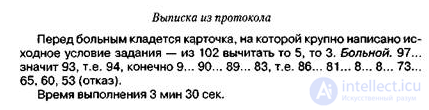
On the other hand, externalizing the intermediate result of the counting off and relying on the sequence of the counting-off process written down on the card produced a significant effect: the time taken to perform the operation was reduced several times over, and errors were reduced to zero.
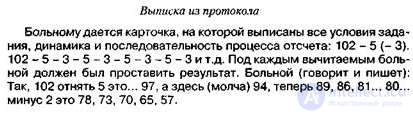
Starting from the result "25" on the card, the subtrahends (5 and 3) were written down successively. Therefore, in this part of the experiment the patient worked considerably more slowly, often went back, but did not make a single error. The total time for performing the task was 2 min. 30 sec (cf.: 5 min 50 sec in the first series of experiments). There were no errors.
We have presented records in which the patient performed a more difficult task, requiring maximal mobility of the nervous processes. Essentially the same results were obtained when the patient performed the simpler task (from 100 by 7).
This series of experiments clearly confirms the fact of a significant facilitation of the performance of the action of counting off when the intermediate result (the difference) of the counting and the linear scheme of the successive subtraction are externalized, and this is evidently the main link whose impairment leads to difficulty or complete inability to perform arithmetic actions.
In patients with lesions of the frontal systems of the brain, errors in counting (involving crossing a ten) are frequently encountered, indicating an impairment of the program for decomposing the number (the subtrahend) into two numbers corresponding to the given example (cf.: 82 - 5; 5 = 2 + 3, hence: 1) 82 -2 = 80; 2) 80 - 3 = 77). These patients often, instead of further subtracting the remaining part of the number 5 — the three — carry it down into the difference (82 - 5 = 73).
In these cases, to the described methods of teaching counting (externalizing all the elements of the arithmetic action) one should add the externalization of the scheme of subtracting one number from another, namely: on the card with the written-out condition and the result of the counting, two minus signs are placed. These minus signs (or sticks) in these cases serve as an external factor fixing the patient's attention on the need to perform two successive subtractions.
In the third series of experiments we investigated the influence of speech defects (perseverations) on the course of the counting operations. In the previous experiments, difficulties in counting were found that were directly connected with speech defects. The patient often named the number incorrectly, while operating with the correct number. Let us give some examples.
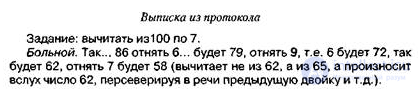
As the task proceeded, the perseverations in speech increased, the patient stopped controlling his speech and correlating it with the counting actions, and then errors in counting appeared, owing their origin to the speech defects. An experiment conducted with speech excluded showed the effectiveness of this method.
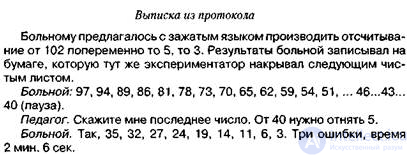
From the record it can be seen that under the conditions of speech switched off, the number of errors decreased significantly and their character changed (there are practically no perseverations), and the time taken to perform the task also decreased threefold. The same results were obtained in experiments with other patients of the group described.
The materials presented show that the basis of the counting impairment in patients with lesions of the postfrontal systems of the brain consists of defects of the dynamics of the counting process, failure to retain intermediate results, and perseverations in the motor and speech spheres.
The method of teaching counting to this group of patients should be directed toward restoring the dynamics of the counting process, on the one hand, and toward restoring the general strategy of behavior in a counting situation, on the other, toward restoring the ability to retain intermediate results, to retain the sequence of operations, and toward overcoming the motor and speech perseverations. For this purpose it is useful to create such a system of successive operations, the performance of which would consolidate in the patient the dynamics of the counting-off process and its scheme (program).
A completely different structure of the counting impairment is found in this experiment in patients with lesions of the parieto-occipital parts of the brain.
Patient L., 59 years old, secondary education. The patient had an arachnoendothelioma removed from the left parietal parasagittal region. In the patient's neuropsychological status elements of amnestic and semantic aphasia were noted, together with impairment of spatial gnosis and praxis. Reading and writing — without defects. Counting and counting operations are distinctly impaired because of defects of spatial gnosis: the patient has an impaired understanding of the composition of number, the counting operations are defective, and calculations involving crossing a ten are especially difficult. The patient's personality is preserved, and the intellectual sphere (apart from counting) shows no visible defects.
Excerpt from the record
The patient is given the task of subtracting 7 from 110 orally.
Patient. 103, that means, take away 3...100, and 3 more...103, good heavens, 103 again, do I have to take away a second time? 96, and now 89... 82, now I take away 2, that means, 2, oh my goodness, and how much will it be, how much will be left, aha, 80, now take away 80? Yes, taking away 5 will be 75, from 75 taking away 7 that will be 72 or something?..
Teacher. No.
Patient. Oh, good heavens, where do I put the 2, I never know what to do with these remainders, 68, or something, then. Oh, what am I doing, am I doing it right? Just a moment, just a moment, may I check it all from the beginning again? (Again counts off from 110 by 7, counts correctly down to 47). 47 - 7 = 40, that's all simple, 40, 33, but now what do I do again, 4... 4, that means, take away again, or how? 26, again... six minus, that means, and the one... I've muddled something again.
Time taken: 9 min 3 sec. Three errors, connected with defects of the direction of counting.
The patient experienced the same difficulties in the experiment with alternating subtraction of two subtrahends. There were no defects of switching or perseverations, but there remained defects connected with a failure to understand the very structure of counting and its direction.
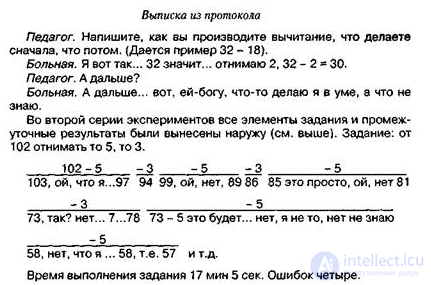
From the record it can be seen that the help given to the patient did not produce a positive result. The patient was then given a card on which the subtraction was written out in expanded form — with the full composition of the operations; in addition, the card indicated that the last two operations required successive subtraction.
2) - 3) -
32-7 =
1) 7 = 2 + 5
2) 32 - 2 = 30
3) 30 - 5 = 25
Reliance on this scheme of subtraction significantly improved the process of successive subtraction
The third series of experiments, which envisaged studying the influence of loud speech on the counting process, conducted with these patients, proved to be inaccessible to them: all the patients immediately refused to perform the tasks with the tongue clamped, arguing their refusal by saying that "nothing comes into my head".
Thus, the data obtained in special experiments aimed at investigating the mechanisms and structure of the impairment of counting operations in two groups of patients with different sites of the lesion
the brain, confirm the hypothesis of different mechanisms and structures of impairment of this kind of intellectual activity. In patients with lesions of the postfrontal parts of the brain, the counting operation and the concept of number are impaired secondarily and are a consequence of increased inactivity in behavior, inertness of stereotypes, and perseverations. In other cases — with defects of the purposefulness of the activity, impairment of orientation in the task and of control, impairment of the selectivity of associations — counting is impaired primarily, and defects of the concept of number and of the structure of the counting operations arise there. And finally, counting impairments can be the result of instability of attention and impulsivity in actions.
The same errors in counting operations in patients with lesions of the parieto-occipital parts of the brain (loss of the direction of counting, the inability to break an arithmetic action down into its constituent operations, etc.) arise as a result of a primary impairment of the perception of spatial relations. Impairment of the concept of number, of the complex relationships among numbers within the decimal system, defects of understanding of the meaning of signs in arithmetic actions — all this belongs to the syndrome of impairments of the semantic sphere of speech, to the syndrome of semantic aphasia. And whereas in patients of the "frontal" group acalculia is caused by impairment of the general strategy of activity, of the understanding of the meaning of counting and of counting operations, parietal acalculia is caused by defects of the perception of space and of the understanding of the meaning and sense of arithmetic numerical signs.
The experiments allowed us to identify the general direction and specific methods for restoring counting operations in these groups of patients. The methods of restoring the function of counting differ between them both in their general aims and in the specific means of achieving the effect. The methods of restoring counting operations in patients with lesions of the parieto-occipital systems of the brain were examined above. The experimental material confirmed those initial premises in the method of restoring the counting process in these patients, which require restoring in them the concept of the composition of number, the internal structure of counting, and the understanding of the direction of counting.
As for the methods of restoring counting operations in patients of the "frontal" group, the starting point of the method for them should be, in some cases, the restoration of the patient's general activity, of the strategy of activity, of orienting-investigative activity, of the semantic sphere, and in other cases — the removal of defects of the emotional-volitional sphere of the patient's personality, the overcoming of impulsivity and inertness in actions and of speech perseverations. The method that envisages direct work on overcoming defects in counting operations should be directed above all toward restoring the process of retaining the intermediate results of counting and its direction.
Patients of the parietal group, as is known, we teach anew the understanding of direction in counting, whereas patients of the second group do not need to be taught the understanding of this factor in counting operations, but they must be taught the retention of direction in counting, the understanding of the composition of number and the interrelation of the system of operations. For this purpose it is useful to create such a system of interrelated operations, the successive performance of which would consolidate in the patient the dynamics of the counting-off process and its direction. Such a series of operations in restorative learning can be provided by the method that we used in the experiment and that was applied in teaching practice.
At the start of teaching the patients to count off, all the elemen-1 ts of the condition and the task itself are externalized. In solving the given serial example, the patient has everything before his eyes — the task, the initial data, the intermediate results obtained, and the direction of counting.
2)-3) +
54 - 18 = X
1)18 + 2 = 20 (rounding of the number)
2) 54 - 20 = 34
3) 34 + 2 = 36 X = 36
After this method of action, based on the expanded materialized scheme, has been consolidated, the supports can gradually be reduced, thereby collapsing the composition of the action (first the record of the first result is removed, while it itself is retained "in the mind", later the record of the result of the second link of the action is removed, then of the third, etc.). The action is gradually transferred to the ideal plane, bypassing the level of loud speech, which in this case, because of speech defects, it is useful to replace with speech "to oneself".
It is very useful, in the link where calculation involving crossing a ten is required, after removing the operation and replacing it with retention of the result "in the mind", to have the patient lay out, successively, following the performance of each part of this operation, one marker at a time (pieces of paper, buttons, sticks, etc.), each of which will successively indicate the completion of the first, and then the second, part of the operation, and the possibility of moving on to the next link in solving the given example.
In cases where counting impairments are directly connected with impulsivity, it is necessary to strengthen the orienting basis of the action, to stretch out the process of solving over time, breaking down the integral action for this purpose into separate operations, which the patients must perform successively. This creates the conditions for concentration of attention and for transferring the action to a voluntary and conscious level. All the operations must be performed with obligatory vocalization aloud of the entire program of the action. In the case of a primary impairment of the concept of number and of the counting operations, arising from lesions of the prefrontal convexital parts of the frontal zone, fundamentally different methods of restorative learning are needed, directed toward overcoming the defects of intellectual activity itself. Work must be done to restore its structure — orienting actions, planning, programming of the activity, and control. Also important is work on restoring the psychological content of counting — overcoming defects of understanding: understanding of the task, of the sense, understanding of operations with numbers, their meaning and interrelation, i.e., restoring the concept of number.
Briefly summarizing, the following can be said.
Primary acalculia arises not only in lesions of the parieto-occipital zones of the brain, but also of the prefrontal convexital parts of the frontal zone. In both cases, the concept of number and the computational operations are primarily impaired, but the mechanisms of these impairments are different.
A primary impairment of the concept of number arises not only because of defects of spatial gnosis, because of an impairment of the spatial perception of number and of the dependence of its magnitude on the position of the digit in the place-value grid, but also because of an impairment of the understanding and discernment of these interactions between the number and its position, a failure to understand the connection and dependence of the magnitude of the number on the coordination of the positional and quantitative characteristics of the number. All these defects occur against a background of primarily preserved spatial gnosis.
The experimental studies described, in addition to the practice of restorative learning, have convincingly proved the existence of differences in the mechanisms and structure of the impairment of the function of counting, have shown the dependence of the structure of the defect on the topography of the brain lesion and the dependence of the methods of restoration on the structure of the counting impairment, and have confirmed the necessity of a precise qualification of the symptom of the counting impairment in order to ensure restoration of the function in each given case of its pathology.
This section presents a picture of the counting impairment and methods of its restoration in patients with lesions of different areas of the cerebral cortex. It has been shown that different forms of acalculia exist, whose structure is directly dependent on the topography of the brain lesion. Among the various forms of counting impairment, the most frequently encountered is primary acalculia, arising in lesions of the parietal parts of the brain. In this form of acalculia, which is the principal one in the pathology of counting, counting is impaired in its essential aspect. Patients lose their awareness of the spatial schemes of counting; their concept of number, their concept of its place value, and the scheme of the ten are impaired. Frequently, in these patients, the meaning of arithmetic signs also breaks down; they cannot carry out the action indicated by the sign, since they have lost their understanding of the meaning of these arithmetic signs. All this, undoubtedly, leads to gross impairments of counting, requiring special and adequate methods of overcoming them.
Restorative learning of counting in patients of this group is directed, above all, toward restoring the spatial schemes in counting, toward restoring the concept of number (its composition and place value), the awareness of the expanded composition of arithmetic operations, etc. A significant role in these cases of impairment is given to external supports — externalizing the internal structure of one or another operation, as well as to means promoting the gradual interiorization of the actions being restored. At a certain stage of learning, an essential role belongs to loud speech — vocalization.
Counting can also turn out to be impaired in lesions of the frontal systems of the brain. However, in these cases the counting impairments acquire a completely different picture. This group of patients is divided into three subgroups, described above. The first includes patients with lesions of the prefrontal convexital parts of the frontal cortex of the left and right hemispheres, leading to a primary impairment of counting as an intellectual activity because of its primary defects, which we discussed above. In the other two subgroups, the basis of the counting impairment consists of defects of the dynamics of the process, and counting is not impaired primarily or in its essential aspect.
We have made an attempt to show the existence of varieties of acalculia within a single form of it — the so-called "frontal acalculia". In the practice of restorative learning, counting impairments are frequently encountered that occur now in the syndrome of inactivity, increased inertness of stereotypes, and motor and speech perseverations (lesions of the postfrontal parts of the brain), now in the syndrome of general disinhibition of behavior, decreased concentration of attention, and impulsivity (lesions of the basal parts of the frontal systems of the brain), now in the syndrome of gross pathology of orienting-investigative activity, of the strategy of behavior, impairment of the selectivity of associations, of the semantic sphere, and of understanding (lesions of the polar parts of the frontal region of the brain). In all the cases listed, the picture of the impairment of counting skills will be different, and a different methodological approach is required for them.

Comments