
Lecture
We have seen that writing is currently regarded in psychology as a complex mental process, having its own psychological content, a not-simple structure, and characterized by particular pathways of its formation in children, as well as a complex interaction with the brain. Naturally, the impairment of such a mental process in brain lesions cannot be simple, still less linked to a lesion of any single area of the brain. Today it is known that writing, when impaired as a result of a brain lesion, takes different forms, which depend on which link in the structure of writing is impaired, which in turn is connected with the localization of the site of the lesion. At present, different forms of agraphia are known in the clinical picture of brain lesions, arising from lesions of different areas of the cerebral cortex.
However, this view of agraphia has not always existed, and even now not all scientific schools and practicing specialists — speech therapists, psychologists, and others working with patients with agraphia — hold to the view of the existence of different forms of agraphia and its connection with lesions of different areas of the brain. Agraphia is a frequent disorder accompanying brain lesions, so the beginning of its study goes back many centuries.
Disorders of writing began to be studied later than aphasias; however, the first mentions already appear in 1798, and then in 1829 in the observations of S.Jackson (USA). In 1837 a writing disorder was described by R. Chapter, in 1856 the French physician A. Trussougt reported one case, and finally, in 1864, H.Jackson for the first time gave a deep analysis of writing and defined the writing disorder as a defect of the conscious, voluntary process. «The patient, — he writes, — may write his own name or even copy words, but is unable to express his thoughts in writing or write from dictation». (FOOTNOTE: Critchley M. Aphasiology. Moscow: Meditsina, 1974, p. 90).
The term «agraphia» is attributed to V. Benedict (1865), as well as to W. Ogle. Later the term «dysgraphia» came into use and became more popular. However, the term «agraphia» is more precise. This term is of Greek origin («a» — negation, «grapho» — I write).
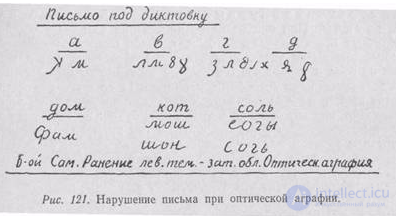
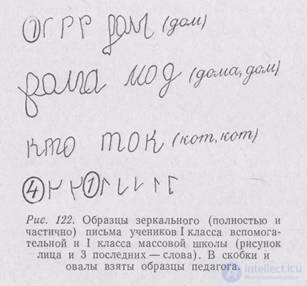
Above we described how, in contemporary Russian psychology and neuropsychology, writing is regarded as a mental process complex in structure, which at the level of the brain is provided by the joint work of a number of zones of the cortex of the left hemisphere. Each area of the brain contributes its own specific element to the structure of the course of writing, and this joint activity constitutes an integral functional system underlying writing. Therefore, disorders of writing that arise from brain lesions bear a systemic character: although each time the work of some one area of the brain, which provides one condition (factor) in the structure of writing, will be impaired, writing will be impaired as a whole, as a system.
The lack of formation of writing in children (or difficulties in its formation in primary school) also bears a systemic character, but has its own specificity. Whereas in adult patients the basis of a systemic disorder of writing, as a rule, lies in defects of some one mental process, and as a rule an elementary one, in children the mechanisms of the disorder are most often complex and may lie in the sphere not only of elementary mental processes (motor skills, graphomotor coordination, disorders of sound analysis and synthesis, etc.), but also in the sphere of higher mental functions — in disorders of general behavior, attention, the lack of formation of the personality and of abstract forms of thought, and others.
Most often the lack of formation of writing (or difficulties in its formation) is connected with dysfunction (of varying etiology) of the TPO zone, i.e., the tertiary zone of the cortex of the left hemisphere, which underlies complex forms of spatial and quasi-spatial perception. In this case, difficulties arise in the perception and actualization of the image of letters that have a spatially oriented configuration, which is precisely what carries the meaning of the letter and its name. These forms of agraphia (or dysgraphia) occur within the syndrome of spatial disorders, and consequently within the syndrome of semantic aphasia, primary acalculia, optic-spatial alexia, spatial disorders in object-related actions, and general orientation in space
This entire syndrome in children may be expressed not severely and may not appear with the full set of symptoms, but all these symptoms will underlie the difficulties children have in learning to write. It is important to know and remember that, as L.S. Vygotsky wrote, «...by the start of learning written speech ...instruction relies on mental processes that are immature, only just beginning the first and basic cycles of development». And further: «...the immaturity of functions at the start of instruction is a general and fundamental law...» (FOOTNOTE: Vygotsky L. S. Collected Works. Moscow: Pedagogika, 1982, Vol. 2, p. 211). Nevertheless, agraphia in children is still often regarded either only as a speech disorder, or as a disorder of the optic-motor act. And, as a result of this misconception, methodological approaches often bear either only a verbal character, or are aimed at forming the motor side of writing, which in no way can lead to success in teaching not only written speech, but even writing itself.
Writing may be impaired by a lesion of almost any area of the cortex of the left hemisphere of the brain — the posterior frontal, inferior parietal, temporal, and occipital regions. Each of the cortical zones mentioned provides a specific condition necessary for the course of the act of writing. In addition to these zones, each of which provides a modality-specific condition for the course of writing, the frontal lobes of the brain provide the overall organization of writing as a complex speech activity. They create the conditions for the programming, regulation, and control of the activity taking place.
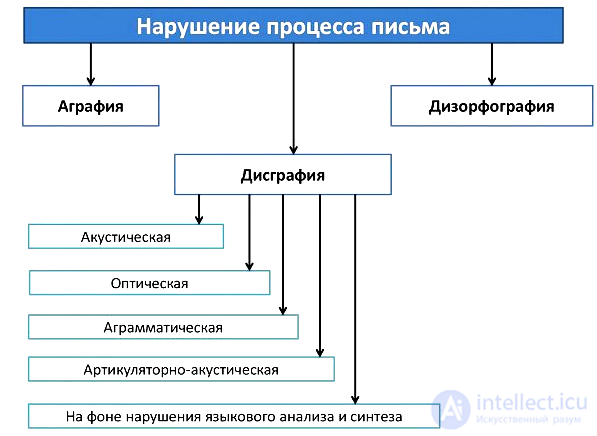
Thus, agraphia is a complex and heterogeneous disorder of writing and written speech, and it manifests itself in different forms, which can conditionally be divided into two groups, underlain by impairments of different psychological content and by different mechanisms:
1) speech agraphias, underlain by speech disorders;
2) gnostic (non-speech) forms of agraphia, underlain by disorders of various types of gnosis.
The first group of agraphias occurs within the syndromes of various forms of aphasia, the second group — within the syndromes of various forms of agnosia, within which the following are distinguished:
a) optical agraphia (simultaneous and literal),
b) optic-spatial,
c) optic-mnestic.
Below we shall turn to a neuropsychological analysis of all types of agraphia and to a description of the methods of restoring or forming writing.
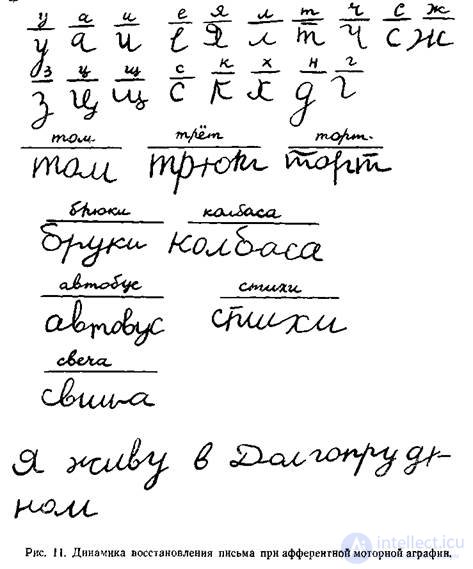
Speech forms of agraphia occur within the syndrome of the corresponding forms of aphasia. As for the motor types of agraphia, in contemporary Russian neuropsychology they are now regarded not as a homogeneous group of speech disorders, as was thought earlier (and as many researchers still think today), but as two forms of aphasia, and correspondingly of agraphia, that differ in their mechanisms of occurrence and in their clinical and neuropsychological picture. They are underlain by different neurophysiological, psychophysiological, and psychological mechanisms. Correspondingly, the localization of the brain lesion that leads to motor aphasias and agraphias also differs.
Let us turn once again to the structure of writing and its psychophysiological basis for a clearer picture of the structural disorders of writing, i.e., in which link the impairment occurred and at what level of its organization, and defects of which psychophysiological mechanisms underlie one or another type of agraphia. This knowledge is necessary for a clearer picture of the strategy and tactics of restoring writing.
A. The psychological level includes a number of links:
1) the emergence of an intention, a motive for written speech,
2) the creation of a plan (what to write about),
3) the creation on this basis of the general meaning (what to write) of the content,
4) regulation of the activity and the exercise of control over the actions performed.
B. The psycholinguistic level provides the operational aspect of the realization of the plan (program) and consists of several links:
1. The process of sound discrimination, with the help of which an analysis is carried out of the sound composition of the word, of its acoustic, kinesthetic, and kinetic basis at the level of the phrase. This link carries out the analysis of larger units of speech — the number of words in the phrase and the perception of the general sound outline of the phrase.
2. The volume of acoustic perception and auditory-verbal memory ensure the perception of a certain amount of information and its retention in working memory.
3. The actualization of the image-representations of the grapheme on the basis of incoming sound information, and its recoding into the corresponding letters.
4. The actualization of the motor image of the letter and its recoding into the series of fine hand movements corresponding to the letter.
5. The writing of letters, words, phrases.
C. The psychophysiological level ensures the realization of all the operations and actions indicated above:
1) the process of sound discrimination is ensured by the joint work of the speech-motor and acoustic analyzers;
2) the volume of perception of acoustic speech signals is provided by the acoustic analyzer (and possibly jointly with the kinesthetic one); as has become known, the structure of perception includes a link of iconic memory, and it is this that provides the short-term selection and retention of the necessary information for its processing;
3) recodings from one mental process to another (from sound to letter) take place owing to the joint work of the acoustic, visual, and spatial analyzer systems, which are provided by the work of the tertiary posterior zone of the brain — the TPO (temporalis — parietalis — occipitalis), the temporo-parieto-occipital zone; it is here that the actualization of the image-representations of letter signs takes place;
4) the recoding of the optical image of the letter into a motor one and into the writing of the letter takes place owing to the complex joint work of the visual and motor analyzer systems.
Thus, it is evident that the formation and course of writing and written speech are impossible without the presence of inter-analyzer connections, and that writing is carried out not by the work of any single analyzer, but by a group of jointly acting analyzer systems. It should be noted that when writing is being thought through, at its initial stage all the levels indicated come into play sequentially, but in the actual performance of this function all the levels work jointly, in a close and complex hierarchy: depending on the task, now one level, now another, comes to the fore.
The cerebral basis of writing is quite complex, which naturally requires the joint work not of one, but of a number of areas of the brain. The psychological level is realized through the work of the frontal regions of the brain — the anterior, posterior, and medio-basal regions of the frontal area of the cerebral cortex The psychophysiological level is provided by the joint work of the posterior frontal, inferior parietal, temporal, posterior temporal, and anterior occipital regions (the TPO zone) The linguistic level, at which the selection of linguistic means takes place (the needed sounds, words, syntax), is provided by the joint work of the anterior and posterior speech zones, which are responsible for the syntagmatics and paradigmatics of speech. The joint work of all these morphological formations of the brain constitutes the cerebral basis of the process of writing.
The functional system that ensures the normal process of writing includes various areas of the cortex of the left hemisphere of the brain and various analyzer systems (acoustic, optical, motor, etc.), each of which ensures the normal course of only one particular link in the structure of writing, while all of them together provide the normal conditions for carrying out the complex, integral process of writing
Thus, writing cannot be attributed either only to speech, or only to the processes of visual perception and motor skills. Writing is a complex mental process, including in its structure both verbal and nonverbal forms of mental activity — attention, visual, acoustic, and spatial perception, fine motor skills of the hand, object-related actions, and others.
In an adult who possesses highly developed writing, it is predominantly the first, psychological level that operates, and consciously so, while the other two levels work as though in an automatic mode.
In the formation of writing in children a different picture is observed: all the levels of the organization of writing proceed voluntarily, and it is predominantly the linguistic block of operations that works. The methods of teaching children to write at school, unfortunately, make little use of the first, psychological level. After children have been taught the first skills of writing letters and a number of words, it is significantly more effective to move on to the psychological level of writing: the formation and formulation of the motive (why to write, the arousal of interest in writing a particular content (the plan), reflection, and comprehension of the content of the writing (with the help of narrative pictures and others) and so on. All these methodological devices, which we shall dwell on below, bring about general and intellectual activity, promote the actualization of the images of whole words and individual letters, and activate the work of the corresponding groups of analyzer systems.
Above, we described a particular approach, developed in Russian psychology and neuropsychology, to the genesis, structure, and disintegration of writing and written speech. This approach requires a different method of restoring writing in adults and of forming it in children. One of the new methods for solving this problem of practical psychology and neuropsychology is described in a number of publications by the author of this work, which set out the basic principles of the restorative learning of HMF, including written speech in cases of its impairment as a result of brain lesions. (FOOTNOTE: Tsvetaeva L. S. Aphasia and Restorative Learning. Moscow: Moscow University Press, 1988).
At the basis of restorative learning lie certain important, scientifically grounded psychological principles, taking which into account will make it possible to arrive at more effective results in teaching written speech to children and adults.
Meaningful instruction, and instruction on meaningful material, is an important principle of restorative learning in writing.
Teaching writing from the whole to the part. This principle is based on contemporary scientific concepts in psychology, linguistics, physiology, and other fields. In contemporary psychology and psycholinguistics, some researchers regard the word as a certain unity of the meaning of the word with its «natural matter», i.e., that shell — sound, motor, graphic — in which a particular content is enclosed. (FOOTNOTE: Trudny A.L. Scientific Notes of the Faculty of Physiology, Kirghiz State University, 1956, Issue No. 2). In contemporary linguistics, theoretical studies have shown that the process of synthesizing a word or a sentence in any language is carried out according to the principle from the general to the particular, and for this the synthesizing process must possess information about the word or sentence as a whole even before the word or sentence begins to be actualized.
Psychologically this means that first the meaning of the text, of the sentence as a whole, must be actualized, and only afterward — the words, before their analysis. The physiology of speech likewise addresses the problem of perceiving speech from the whole to the part, and so on. All this attests to the fact that, for both children and adults, the initial and simpler unit of perception and understanding is not the sound, and not the letter, but the word (and sometimes the text), which carry information and meaning and (FOOTNOTE: Speech, Articulation, and Perception, ed. V. A. Kozhevnikov and L. A. Chistovich, Moscow, 1965) direct and hold the subject's attention. Such a mode of perception, from the whole to the part, then makes it possible to move on to a more precise analysis of its component parts. All this determined the development and application of methods of restoring writing and written speech not from the letter to the word and sentence, but, on the contrary, the restoration of analytic writing from the text, the sentence, the word — to the letter.
The principle of relying on context. Context (a word, phrase, text, picture) provides additional information about the composition of a word (a phrase, etc.), which promotes the formation of the plan, the actualization of the knowledge necessary for writing, and the strengthening of the subject's analytical capacities.
The principle of the special selection of verbal and pictorial material taking into account: a) the phonetic complexity of the word; b) the frequency of words; c) the grammatical complexity and length of phrases; d) the subject's system of relations.
Despite the difference in the nature and mechanisms of the disorder of the process of writing, there are several general methodological requirements for the organization and conduct of restorative learning in writing:
1) restorative learning of writing in patients begins with a neuropsychological syndrome analysis of the defect, as a result of which the nature and mechanisms of the writing disorder are established, i.e., through the qualification of the defect, the factor underlying the agraphia is isolated;
2) analysis of the psychological structure of the defect makes it possible to isolate the level at which the organization of writing is impaired and the link that has been affected;
3) on the basis of the neuropsychological and psychological analysis of the defect, the ways of overcoming it are outlined, and methods are developed (or selected) that are adequate to the nature, mechanism, and structure of the defect; these may be intra- or inter-systemic reorganizations of the affected functional system;
4) the transfer of the process of writing from one level of organization (or realization) to another is also used; for this purpose, methods are employed that engage the preserved analyzer systems as a support for the reorganization of the impaired functional system or for the creation of a new one;
5) the work relies on the preserved semantics of writing and speech — the sense, meaning, and object-relatedness of the word;
6) the use, primarily, of conscious forms of activity, proceeding at the voluntary level of organization of the process of writing;
7) restorative learning of writing in speech agraphias is carried out jointly (and within) the restoration of oral speech and reading; in the gnostic forms of agraphia, overcoming it proceeds jointly with the restoration of the process of perception of the corresponding modality;
8) restorative learning of writing, in all forms of its disorder and at all its stages, proceeds against the background of constant work on the sense and meaning of the word, the phrase, the text, which must precede analytical work on the composition of the word, and so on.

Comments