
Lecture
Let us turn to an analysis of the psychological content of writing, which, as contemporary research data show, is highly complex. Written speech proceeds on the basis of the interaction of various HMF and, above all, of perception of different modalities, speech, memory, and object-related actions. These mental functions provide the processes, necessary for the realization of writing, of sound discrimination, the actualization of images-representations of letter signs, and their recoding into a system of hand movements.
The psychological content of writing would be incomplete if nothing were said about the participation, in the formation of writing, of emotional-volitional processes, motives, and the behavior of the person.
In understanding the development and content of writing, a large role belongs to the genetic method of research. L.S. Vygotsky wrote that the development of written speech, and preparation for it, begin long before the child is taught to write at school. The fact is that children go through a peculiar stage of object-writing: when children begin to draw, this is already a preparation for writing, just as gesture is writing in the air, which later, in the course of development, turns into a written sign. In drawings there appears, as it were, a stage of pictographic writing, and later, on the basis of the development of drawing, of awareness and interpretation of what has been drawn, the child comes to understand that one can draw not only objects but also speech. Written speech proper, according to L.S. Vygotsky, develops by way of a transition from drawing things to drawing speech (L.S. Vygotsky, 1956). Mastery of written speech means the assimilation of a special and complex symbolic system of signs. Writing is therefore the product of a lengthy development of the HMF, personality, and behavior of the child.
The psychological level, solves the tasks of forming motives, interest in written speech, and the semantic content of the information, and regulates and controls the activity of writing
The linguistic level of the organization of written speech — answers the question — by what means writing is carried out; it realizes the translation of the internal sense and content, formed at the psychological level, into linguistic codes — into lexico-morphological and syntactic units, i.e., into words, phrases, and texts
The psychophysiological level in the structure of writing carries out the joint work of several analyzer systems, which underlie written speech.
The psychological level includes a number of links:
The psycholinguistic level provides the operational aspect of the realization of the plan (program) and consists of several links:
The psychophysiological level ensures the realization of all the operations and actions indicated above:
The cerebral basis of writing. The performance of such a complex process as writing is possible only with the joint work of a number of brain zones, each of which has its own function and ensures one or another condition (component) of the formation and course of writing.
The cerebral basis of writing is highly complex, which naturally requires the joint work not of one, but of a number of areas of the brain
The content of teaching writing at school includes three components:
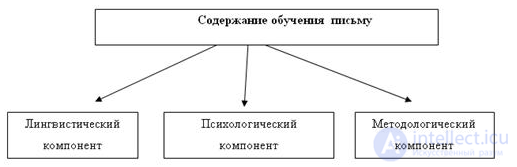
. The psychological level is realized through the work of the frontal regions of the brain — the anterior, posterior, and medio-basal regions of the frontal area of the cerebral cortex. The psychophysiological level is ensured by the joint work of the posterior frontal, inferior parietal, temporal, posterior temporal, and anterior occipital regions (the TPO zone). The linguistic level, at which the selection of linguistic means (the needed sounds, words, syntax) takes place, is ensured by the joint work of the anterior and posterior speech zones, which are responsible for the syntagmatics and paradigmatics of speech. The joint work of all these morphological formations of the brain constitutes the cerebral basis of the process of writing.
By now, psychology has investigated and formulated certain psychological prerequisites for the formation of this type of speech activity, the disruption (or lack of formation) of which leads to various forms of impairment of writing or to difficulties in its formation in children.
The first prerequisite is the formation (or preservation) of oral speech, voluntary command of it, and the capacity for analytic-synthetic speech activity.
The second prerequisite is the formation (or preservation) of various kinds of perception, sensations, knowledge, and their interaction, as well as of spatial perception and representations, namely: visuo-spatial and audio-spatial gnosis, somato-spatial sensations, and knowledge and sensation of the body scheme, of "right" and "left." The third prerequisite is the formation of the motor sphere — fine movements, object-related actions, i.e., various kinds of hand praxis, mobility, switchability, stability, and others.
The fourth prerequisite is the formation in children of abstract modes of activity, which is possible through their gradual transition from actions with concrete objects to actions with abstractions.
And the fifth prerequisite is the formation of general behavior — regulation, self-regulation, control over actions, intentions, and motives of behavior.
The obligatory participation, in the formation of writing, of all the prerequisites described, as well as of all the links in the structure of writing, and subsequently in the carrying out of this process, can be traced with particular clarity in its pathology.
Despite the complexity of writing, until quite recently, in the practice of school instruction, writing occupied too small a place. L.S. Vygotsky wrote that, in comparison with the enormous role it plays in the process of cultural development, the child is taught to trace out letters and put together words, but is not taught written speech. To a large extent this state of affairs still holds true today, when children are taught writing, but not written speech. Attention is drawn to this fact, and to other shortcomings in teaching children written speech at school, in many psychological studies. "The teaching of written speech in the contemporary primary school is built in such a way as if the most important thing in it were the ability to trace out letters and not make mistakes in words and sentences." (FOOTNOTE: Lyaudis, V.Ya., Pegure, I.P. Psychological Foundations for the Formation of Written Speech in Younger Schoolchildren. Kishinev: Shtiintsa, 1983).
In contemporary psychology, the formation of writing at school in the course of instruction is regarded as a complex, conscious, and voluntary process, and the structure of written speech as multilevel and multi-linked. At the early stages of mastering the skills of writing, it breaks down into a series of separate, conscious operations, which we wrote about above, and the whole process of writing is expanded in its composition of operations and is carried out at a voluntary level with the obligatory inclusion of speech ("vocalizing"). As the process of writing is mastered, its psychological structure changes, and what was formerly conscious and voluntary now becomes unconscious and automatized.
It is also important to note the fact that, as comparative studies of the writing of adults and children have shown, the development of writing in children does not come down merely to the fact that individual operations become combined, automatized, and so on, but that the participation in it of individual mental processes, i.e., the psychological content of writing does not remain one and the same, but changes in the course of development. Teaching children to write at school presents significant difficulties, and therefore knowledge of the genesis of writing, of its psychological essence (i.e., on the basis of which HMF it is formed), of its structure, functions, and its place and role in mental activity is necessary for a correct methodological approach to teaching written speech. Some studies of recent years have shown a close connection between the difficulties of forming and the underdevelopment of writing in younger schoolchildren, not so much with an underdevelopment of speech, as with a lack of formation of nonverbal forms of mental processes, such as visuo-spatial representations, auditory-motor and optic-motor coordinations, general motor skills, with a lack of formation of the process of attention, as well as of goal-directedness of activity, self-regulation, and control over actions; by this time the motives, too, are insufficiently formed.
We have examined only one aspect of the psychological content of written speech, one that corresponds more to the tasks of forming the "technique" of writing, its operational side, than to written speech, which addresses tasks of a second order — the influence on the development of behavior, voluntary activity, personality, and thinking. Such a view of written speech also requires a different methodological approach to teaching children to write. One such approach is developed in the works of V.Ya. Lyaudis and I.P. Negure (FOOTNOTE: Lyaudis, V.Ya., Negure, I.P. Psychological Foundations for the Formation of Written Speech in Younger Schoolchildren. Kishinev: Shtiintsa, 1983), as well as in the author's own works on restoring writing when it is impaired as a result of a brain lesion. (FOOTNOTE: Tsvetkova, L.S. Aphasia and Restorative Training. Moscow: Moscow University Press, 1988). This approach can be designated as "from the whole to the part and from sense to meaning," or "analysis through synthesis," which presupposes teaching writing in the direction from the intention to the text, to the phrase, etc., and then (or simultaneously) the formation of the means of written expression of thought (the operations in the structure of writing).
From this point of view, teaching written speech should begin not with developing the ability to carry out its individual operations in isolation from the integral structure, but with forming written speech as the action of constructing an integral text (V.Ya. Lyaudis and I.P. Negure, 1983). This approach to teaching written speech has shown its validity and effectiveness in the restorative training of writing in adults, in whose case history writing had already been formed and many HMF were preserved, reliance on which helped this strategy of restoring writing.
Thus, a brief analysis of the psychological essence of writing and of the paths of its formation in children shows the complexity of this type of mental activity. Writing cannot be regarded merely as an ideomotor act (as it once was) and merely as a motor and sensory act (as some researchers still regard writing even today). Writing should be regarded as a mental function, whose psychological content includes various mental processes in their interaction, and which is formed only through training.
The works of many authors note the necessity of the preservation of the links indicated for the normal performance of the process of writing. Thus, R.E. Levina and R.M. Boskis point to the necessity of the preservation of auditory analysis for writing as a full-fledged mental action. In the studies of A.R. Luria, L.K. Nazarova, M.N. Kadochkin, A.N. Solovyev, E.S. Bein, R.E. Levina, and others, mention is made of the no less important role and necessity of the preservation of articulatory kinesthetic analysis of sounds, on the one hand, and of clarifying the place of each sound in words, on the other. In the works of A.R. Luria, R.E. Shif, S.I. Kaufman, and others, mention is made of the necessity of the preservation of visual and mnestic processes, as well as of the preservation of the perception of space.
These processes have more of a bearing on the formation of the sensorimotor level of writing, at which the skills of writing are formed. For the formation of written speech, a certain level of development of oral speech, of the semantic sphere, and of knowledge in children is necessary, as is the formation of goal-directedness in behavior and of the personal and emotional-volitional sphere. It is known that personality is a multiform formation that arises during life and only in activity; it is not personality that gives rise to activity, but activity that forms personality, which is a semantic formation, and its formation proceeds hand in hand with the formation and development of written speech.
As for the structure of writing, which will be discussed in more detail below, it too is highly complex. It consists of at least four levels and a multitude of structural links within each of them. The first level is the psychological one, which addresses the tasks of forming motives and interest in written speech and the semantic content of information, and which regulates and controls the activity of writing.
The next is the linguistic level of the organization of written speech — it answers the question — by what means writing is carried out. This level provides writing with the linguistic, language means of realizing the process, i.e., it realizes the translation of the internal sense and content, formed at the psychological level, into linguistic codes — into lexico-morphological and syntactic units, i.e., into words, phrases, and texts. The psychophysiological level in the structure of writing carries out the joint work of several analyzer systems, which underlie written speech. The system of analyzers is not a sum, but a complex formation, which is formed on the basis of inter-analyzer connections at all their levels (primary, secondary, and tertiary fields).
Naturally, the cerebral basis of writing likewise cannot be simplified, and it cannot be localized in some "narrow center" of the human brain. Neurology and pedagogical psychology of the end of the last century, as we have already written above, approached the solution of this question in precisely a simplified way, believing that there exists a certain "writing center," which they localized in the premotor part of the motor analyzer, regarding writing as only a motor function. Now, thanks to the development of neurology, psychology, and other related fields of scientific knowledge, it has become clear that the HMF, including writing, are so complex in their structure that they cannot be connected with the work of any isolated area of the brain. The performance of such a complex process as writing is possible only with the joint work of a number of brain zones, each of which has its own function and ensures one or another condition (component) of the formation and course of writing.
Studies have shown that writing is ensured by the interaction of the inferior frontal, inferior parietal, temporal, and occipital zones of the cortex of the left hemisphere of the brain. This fact points to the necessity of the preservation or the timely formation of all these areas of the brain for mastering writing. The preservation both of the general organization of the joint activity of these zones and of each of them individually is necessary. Thus, writing and written speech are among the most complex mental processes with respect to the manner and time of their emergence, their connection with oral speech and other HMF, their structure and psychological content, their formation in children, and the cerebral mechanisms underlying them.

Comments