
Lecture
Photosynthesis — the process by which plants form predominantly nitrogen-free organic substances (carbohydrates) from atmospheric carbon dioxide and soil water with the participation of sunlight:

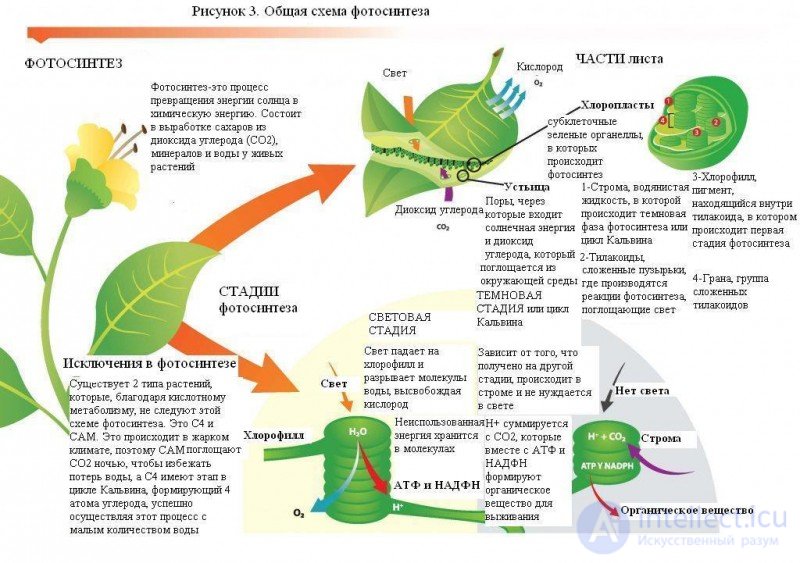
sugar. In addition, photosynthesis is also the primary source of the energy needed for the uptake of mineral substances through the roots and their movement through the plant. On average, plants contain 45% carbon, 42 — oxygen, and 6.5% hydrogen. The solar energy absorbed in the process of photosynthesis is spent on splitting water into oxygen and hydrogen. The oxygen released is partly used for plant respiration, while most of it is released into the atmosphere. As for the hydrogen, it apparently gives rise to substances not yet studied, which actively bind carbon dioxide without it first being broken down into carbon and oxygen. The simple sugars formed in the process of photosynthesis serve as the starting material for the synthesis of complex carbohydrates: sucrose  , starch
  ‚ cellulose
 ‚ as well as proteins, fats, organic acids, and others.
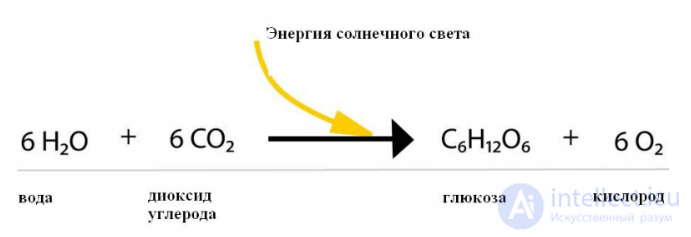
Direct products of photosynthesis may be not only carbohydrates but also certain other organic substances, in particular proteins. Carbohydrates and proteins are not formed in the leaves at once, but as a result of the transformation, in the chloroplasts, of a primary product whose nature is not sufficiently clear. The direction of the photosynthetic apparatus's activity depends on the species characteristics of the plant, the age of individual leaves and of the whole plant, the intensity and quality of light (red light — carbohydrates, blue light — proteins), the level of nitrogen nutrition, and other factors. There are two pathways of protein synthesis: one independent of light (associated with complex processes of secondary carbohydrate transformation) and the photosynthetic pathway (which proceeds only in the light, in the chloroplasts, and is not linked to carbohydrate transformation).
In the process of photosynthesis, plants, using solar energy, synthesize highly complex organic substances from carbon dioxide entering through the leaves from the atmosphere, and from water and mineral salts absorbed by the roots. Each plant synthesizes one or several organic substances that are of the greatest interest for human nutrition, for example protein and starch in cereal and grain-legume crops, sugar in sugar beet, starch in potato, fats in sunflower, fiber in cotton and fiber flax, and so on. The task is to create optimal conditions for the maximum accumulation of nutrients, based on the biological characteristics of each agricultural crop. The formation of organic substances in the process of photosynthesis is accompanied by the absorption of a large amount of solar energy. However, only a small part of it (2-4%), falling on the surface of the growing plants, is used by them for the synthesis of organic substances. The remaining part of the solar energy is used for transpiration, and is also lost without a trace in the atmosphere through reflection. Over the course of the growing season, a plant transpires 300 - 500 times more water than the weight of its dry harvest. The plant transpires water for cooling. The process of transpiration involves a large expenditure of heat. No less than 25%, and in southern regions up to 70-95%, of the energy of the sunlight reaching the plant is spent on evaporation by the leaves. This is approximately 10 - 45 times more than is stored in the plant's yield. One of the most important tasks of biologists, physiologists and biochemists — is to find methods for sharply increasing the coefficient of utilization of the solar energy reaching the earth. K.A. Timiryazev wrote on this subject: «If the consequences of predatory farming, which involuntarily removes nutrients from the soil, can be remedied in one way or another, by fertilizing the land, then what is ultimately irreparable is only the wasteful, unskillful use of the chief source of the nation's wealth — sunlight». The regulation of the process of photosynthesis and the search for methods aimed at a significant increase in the coefficient of utilization of solar energy — is an important way to sharply raise the productivity of agriculture and, consequently, to increase the quantity and quality of agricultural products. Many scientists in our country and abroad are working on solving these problems. From an energy standpoint, photosynthesis can be regarded as a process, immense in scale, of capturing the kinetic energy of the sun and converting it into the potential energy of the harvest.
Thanks to solar heat, optimal temperature conditions are created for seed germination, plant growth, and the formation of high-quality produce. The main part of the organic substances in a plant is formed through the secondary transformation of the products of photosynthesis within it. The primary products of photosynthesis, apparently, do not arise through the simple addition of hydrogen to carbon dioxide followed by condensation, but through a chain of various transformations involving many ions of mineral salts and various biological catalysts. Yet at the same time, carbohydrates in plants are the most important primary starting substances, from which, through various combinations with other chemical elements and with the participation of the corresponding enzymes, new complex organic compounds arise (proteins, fats, organic acids, etc.). These organic substances are an indispensable food for animals and humans. Thus, carbon, oxygen and hydrogen — are the main elements of carbohydrates and other, more complex, starting organic products for all subsequent biochemical synthetic processes. The most important oxidation-reduction energy processes also take place with the participation of oxygen and hydrogen. The formation of secondary complex organic substances from the primary products of photosynthesis requires energy that arises in the plant as a result of respiratory processes. The essence of respiration can be reduced to the oxidation of carbohydrates by oxygen. This process is the opposite of photosynthesis: whereas photosynthesis is accompanied by the absorption and accumulation of heat in the plant, the process of respiration is accompanied — by the release of heat.
It can be represented by the following equation:

The energy released during respiration is used for various vital processes in plants:
1) the synthesis of other organic substances richer in potential energy (for example, fats, proteins, etc.);
2) the absorption by the roots of various salts and water from the soil and their movement to the leaves, and from there — to the growing parts (growth points, flowers, seeds, tubers and other organs);
3) the performance by the roots of work in the soil as they grow. The energy of respiration is also used so that plant shoots can overcome the resistance of the soil and emerge at the surface of the ground. The vital processes of a plant are quite diverse, but all of them occur owing to respiration.
In plant organisms, 60-70% of the energy that can be used in processes associated with an increase in free energy is stored, while 30-40% is thermal energy released during the oxidation of organic compounds. Most of it is released during the oxidation of hydrogen-containing compounds by molecular oxygen with the formation of water. These processes take place during particular phases of the di- and tricarboxylic acid cycle. Let us consider in what form the energy needed for the formation, in plants, of complex organic substances of secondary origin is stored, transported and used in the organism. The energy released in the course of the oxidation reaction of substances is not converted directly into heat, but passes into a special form of chemical energy. Such a specific form of energy storage is provided by the high-energy phosphate bonds of adenosine triphosphate (ATP) and other high-energy compounds. The formation of ATP with high-energy phosphate bonds is the most important stage in the conversion of energy in living organisms — the use of the free energy released during the breakdown of substances. High-energy phosphate bonds and high-energy compounds can be divided into two main groups:
1) glycerophosphate, 3-phosphoglyceric acid, glucose-6-phosphate, fructose-6-phosphate and certain other compounds (for the compounds of this group, the free energy of hydrolysis of the phosphate bond ranges from 0,8 to 3,0 kcal per 1 M);
2) adenosine triphosphate (ATP), adenosine diphosphate (ADP), 1,3-diphosphoglyceric acid, phosphoenolpyruvic acid and certain other substances (for the compounds of this group, the free energy of hydrolysis of the phosphate bond ranges from 6 to 16 kcal per 1 M). In living organisms, the principal significance among high-energy compounds belongs to adenosine triphosphate. The other high-energy compounds, however, very often serve only as intermediate carriers of energy. In all metabolic reactions, energy can be used only when the processes of energy release are coupled with its use, and the transfer of energy from one reaction system to another is possible only when the two reactions proceed sequentially and have common intermediate products. For example, the formation of sucrose requires a large amount of energy and can proceed coupled with the hydrolysis of ATP. This mechanism can be represented as follows:
ATP + glucose — glucose phosphate + ADP (AE = - 7000); glucose phosphate + fructose — sucrose + H3PO4.
In total: ATP + glucose + fructose — sucrose + ADP + H3PO4, (ΔF = - 7000).
The same mechanism underlies other synthetic processes, such as the formation of starch from glucose, proteins from amino acids, and others. The transfer of energy and the transfer of phosphate groups in these processes are ensured by the participation of ATP in the reactions. It is important to note that all biological reactions proceed at the temperature of the living organism, and the energy expended in these reactions is, in most cases, delivered or stored in the form of high-energy phosphate bonds. This is one of the differences between biochemical reactions and ordinary chemical reactions, in which most of the energy is released or absorbed in the form of heat, and the reactions, as a rule, proceed at high temperatures. Consequently, photosynthesis, in which the plant consumes most of its carbon, hydrogen and oxygen with the help of solar energy to create organic compounds, is closely linked to the root nutrition of the plant, which supplies it with nitrogen compounds and ash substances. In the process of respiration, in turn, energy is generated that is used in the synthesis of more complex organic compounds of secondary origin.
The processes of formation of organic substances in plants are closely linked to the processes of energy exchange in the plant organism, an important link of which is the formation of adenosine triphosphate as a carrier of energy with high-energy phosphate bonds. The great role of water in plant nutrition cannot fail to be noted. It often makes up 80-90% of the mass of a living plant. All plant organs and tissues retain their vital activity provided they contain a sufficient amount of water. Water in the plant organism — is not only a medium, but also a direct participant in biochemical reactions.
It can serve as a connecting link between parts of protein molecules. In the cells and tissues of plants, water has a definite structure and forms the connecting framework of the cell's cytoplasm. Thanks to water, proteins and molecules of other complex organic substances become hydrated in the protoplasm into particular structural aggregates, turning into jelly-like complexes and thereby acquiring certain colloidal and physicochemical properties. The most important metabolic processes take place within them. Only under an optimal water regime is a plant capable of the rational use of nutrients and maximum productivity. A sharp shortage of moisture in plants leads to the disruption of all vital processes, and its loss beyond a certain limit inevitably leads to irreversible changes in the organism and its death. To maintain the normal turgor state of plants, a constant inflow of moisture, supplied through the roots from the soil, is required. If a plant is not provided with the optimal amount of water, the wilting of young plant organs occurs, in which turgor falls and cell plasmolysis sets in. Under a moisture deficit, the intensity of photosynthesis and plant growth sharply declines, up to complete cessation, since processes of hydrolysis and decomposition of organic substances take place and the coordinated functioning of the enzymatic apparatus is disrupted. To maintain the normal vital activity of plants and the optimal temperature of the leaf surface, continuous transpiration of water by the plant is necessary. Plants are usually adapted to a temporary moisture deficit, but prolonged drought has a sharply negative effect on their development. The effect of drought manifests itself, first and foremost, in a water deficit that appears when evaporation exceeds the intake of water by the plants.
In this case, there is a loss not only of free water but also of colloidally bound water, which leads to a disruption of biochemical processes: the adsorption capacity of colloids decreases, along with their degree of hydration and the viscosity of the protoplasm; the synthesis of proteins and chlorophyll is suppressed; phosphorus metabolism is disrupted; nucleic acids, phosphatides and nucleoproteins break down; the conversion of mineral phosphorus into organic compounds sharply decreases; and the ratio of organic to mineral phosphorus decreases. Temperatures above the critical level and a moisture deficit lead to disruption of the structural elements of the cell, mitosis stops, the cell nucleus is destroyed, and DNA degradation occurs in parallel. In dry, hot years with hot dry winds (sukhovei), the process of photosynthesis in plants is possible only in the early morning and evening hours.
At other times, there is an intensified expenditure of plastic substances and energy on resistance and protective reactions. This is accompanied by a disruption of the balance between the intake and expenditure of high-energy phosphorus compounds of the ATP type, and a decline in energy potential caused by the unproductive expenditure of accumulated energy. A high oxidative potential in the cell leads to the vigorous oxidative breakdown of carbohydrates and proteins, as a result of which ammonia accumulates in plant tissues and poisoning sets in. The relationship between plant nutrition and the water regime is of interest. The positive influence of phosphorus and potassium on the hydration of protoplasm colloids and the reduction of moisture expenditure on transpiration has repeatedly been noted. Plant tissues sufficiently supplied with phosphorus are characterized by a high water-holding capacity. Such plants have a more stable water exchange, which is due to an increase in the total content of osmotically and colloidally bound water and increased hydration of the components of the protoplasm. The effect of phosphorus on these processes is particularly pronounced under conditions of insufficient water supply during the early periods of plant development. This explains, to a certain extent, the high effectiveness of row (band) application of superphosphate.
In addition, during the early growth phases, the processes of synthesis of organic compounds, and especially nucleic acids, proceed more actively in plants. The uptake of phosphorus by a plant depends on temperature. Many researchers have repeatedly noted an increase in phosphorus uptake with a rise in ambient temperature during dry years. However, under especially arid conditions, a reverse outflow of phosphorus from the above-ground organs into the roots and soil is also observed. Studies have shown that under short-term (4 h) exposure to high temperatures in the range of 37-41°C and an air humidity of 16-19%, that is, under sukhovei (hot dry wind) conditions, wheat plants grown against a background of phosphorus-potassium fertilizer had a higher osmotic pressure and a greater water content in their tissues. Such plants are more resistant to the dehydrating effect of the sukhovei, which is due to the positive influence of phosphorus and potassium on the hydrophilic properties of the protoplasm. Drought also worsens soil conditions: the osmotic pressure of the soil solution rises, which leads to the manifestation of the toxic effect of fertilizers, especially nitrogen fertilizers. This is confirmed by extensive data on the negative effect of nitrogen fertilizers on plant yield in drought years. An increase in the concentration of phosphorus in the soil solution has no harmful effect on plants. Phosphorus, and sometimes also potassium, has a positive effect on the plant under temporarily arid conditions, but they cannot eliminate the negative effect of a prolonged severe drought. Such an effect can be prevented only by a set of measures in which the decisive role must be played by improving the water supply to plants and improving water use efficiency. The most radical way of creating an optimal water regime for plants under arid conditions is irrigation.
Under non-irrigated conditions, agrotechnical practices aimed at improving the soil moisture regime are of definite importance: the retention of snow and meltwater, the creation of a deep arable layer with a well-developed, agronomically valuable structure, the use of bare (clean) fallow, the application of shelterbelt strips, and weed control. Under these conditions, the positive role of phosphorus-potassium fertilizers increases. Although humans do not yet have sufficiently effective means of influencing the enhancement of photosynthetic productivity to the same extent as, for example, the improvement of soil fertility and the mineral nutrition of plants, it is necessary to constantly search for ways and methods that allow the planned high yields to be obtained. Many agrotechnical measures are already being applied that make it possible, indirectly, to substantially increase the productivity of photosynthesis and, consequently, the accumulation of organic substances. For example, with insufficient mineral nutrition of plants, as well as with poor water supply, the assimilating leaf surface of plants in crop stands, in most cases, does not reach optimal values, and a significant part of the solar energy falls not on the leaves but on the soil, that is, it is spent unproductively.
By regulating the conditions under which plants are grown, the assimilating leaf surface can range from 5-6 to 40-50 thousand m² per 1 ha. Thin (sparse) crop stands can absorb only 20-25% of the photosynthetically active radiation falling on them, and use only 1- 2% of what is absorbed for photosynthesis. Good crop stands, on the other hand, can absorb 50 - 60% of the photosynthetically active radiation falling on the stand over the growing season and accumulate in the organic substances of the yield only 2-3% of the absorbed energy. Yet, theoretically, the use of 20- 25% of the photosynthetically active radiation absorbed by the leaves is possible. What does this mean? If the coefficient of utilization of the absorbed energy for photosynthesis were raised to just 6- 8%, the water expenditure for creating 1 t of dry matter would fall from 400 - 500 to 75 - 100 t. The main task of geneticists and breeders — is to create more productive varieties possessing a high photosynthetic capacity. The conditions of the photosynthesis process and the use of solar radiation largely determine the biological and economic yield. For example, under unfavorable conditions for the development of above-ground biomass and the formation of the assimilating surface, the grain yield is about 10 c/ha; under normal conditions — 25 - 40, and under very good conditions — 50 - 70 c/ha or more.

Comments