
Lecture
Micronutrients, also referred to as trace elements or micro-nutrient elements, are mineral elements required by plants in small quantities, but they play a critical role in various physiological and biochemical processes. Here are several important micronutrients and their significance in plant nutrition:
Iron (Fe): As mentioned above, iron is a key component of chlorophyll, necessary for photosynthesis. Without iron, plants cannot produce energy from light, and they turn yellow due to chlorosis.
Manganese (Mn): Manganese plays an important role in photosynthesis processes by activating certain enzymes. It also affects chlorophyll formation and regulates nitrogen metabolism in plants.
Copper (Cu): Copper participates in the processes of photosynthesis and iron assimilation. It also activates enzymes important for protein synthesis.
Zinc (Zn): Zinc is necessary for the formation of amino acids and growth hormones. It also activates enzymes involved in the synthesis of DNA and RNA.
Molybdenum (Mo): Molybdenum is necessary for nitrate metabolism and nitrogen fixation, which makes it important for amino acid synthesis.
Cobalt (Co): Cobalt participates in the formation of vitamin B12, which is important for plant growth.
Boron (B): Boron is necessary for the formation of cell walls and normal root growth. It also participates in regulating sugar and water metabolism in plants.
Nickel (Ni): Nickel plays a role in metabolic processes, such as nitrogen fixation and enzyme formation.
Boron, manganese, molybdenum, copper, zinc, cobalt, and iodine are of substantial significance for plant nutrition, yield formation and yield quality. The content of most of these elements in plants ranges from thousandths to hundred-thousandths of a percent. This is why they are called micronutrients. Micronutrients take part in many physiological and biochemical processes in plants.
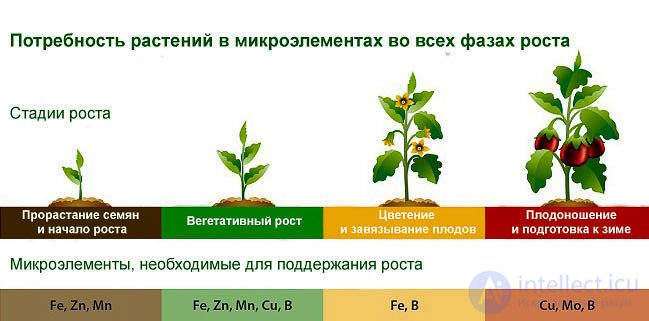
They are an obligatory component of many enzymes, vitamins, and growth substances that act as biological accelerators and regulators of the most complex biochemical processes. If enzymes are catalysts, then micronutrients can be called catalysts of catalysts. Microbiological processes also proceed with the participation of enzymes, which contain micronutrients as part of their composition.
4.17. Removal of micronutrients with crop yields, g/ha
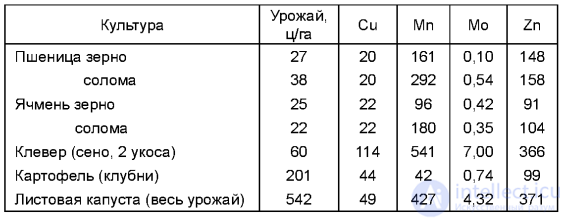
Plants require micronutrients in negligibly small amounts. However, a deficiency of them, like an excess, disrupts the activity of the enzymatic apparatus and, consequently, metabolism in plants. When micronutrients are deficient, plants become diseased: sugar beet, for example, with heart rot, flax — with bacteriosis, cereal crops on peaty and drained bogs — with grain sterility, etc. Micronutrients accelerate plant development, the processes of fertilization and fruit formation, the synthesis and translocation of carbohydrates, protein and fat metabolism, etc. Therefore, it is necessary to carefully study the plant's requirement for each micronutrient and to satisfy it optimally. It should be remembered that with increasing chemicalization of agriculture, yields increase significantly, and consequently so does the removal of micronutrients from the soil (Table 4.17). The requirement for micronutrients is largely satisfied by the application of manure, as well as certain mineral fertilizers, especially crude potassium salts, phosphate rock meal, Thomas slag, ash and others. The substantial content of boron, manganese, copper, zinc and cobalt in superphosphate is apparently related to their content in the original phosphate raw material (Table 4.18). Manure shows a high
4.18. Content of micronutrients in mineral and organic fertilizers, mg/kg
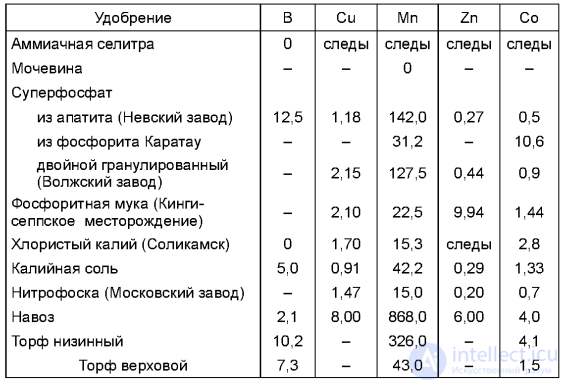
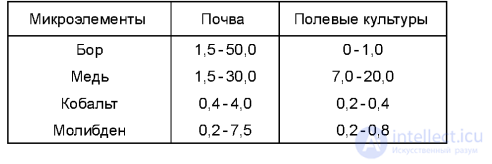
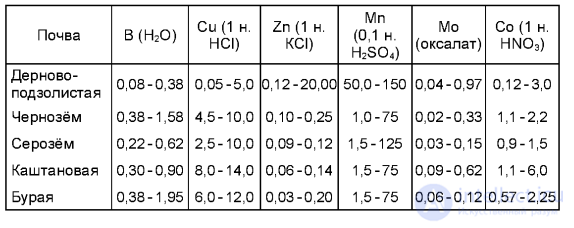
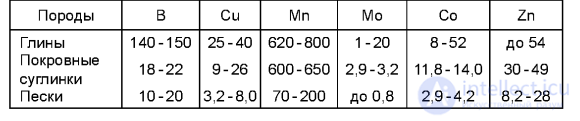
content of all micronutrients. It should be noted that the amount of micronutrients supplied with ordinary doses of mineral fertilizers is much less than that required to replenish their soil reserves (Table 4.18). In mineral fertilizers, 70-75% of the gross micronutrient content is in mobile form, i.e., available to plants. The mobility of micronutrients in manure is significantly lower than in mineral fertilizers, amounting to no more than 25%. However, a single application of manure at a dose of 40 t/ha per rotation fully compensates for the removal of copper, manganese, and molybdenum by four or five ordinary crops, and almost fully replenishes the removal of zinc. The content of micronutrients in soil and plants can be judged from the data in Table 4.19. The content of micronutrients in the soil in available form depends on the soil type (Table 4.20). It varies sharply even within a single soil type. The content of micronutrients in the soil is influenced by the particle-size composition of the soil-forming rocks (Table 4.21, Podkolzin, Demkin, Burlai, 2002).
4.19. Content of micronutrients in soil and plants, mg/kg of dry matter
4.20. Content of available forms of micronutrients in soils, mg/kg
4.21. Gross content of micronutrients in soil-forming rocks, mg/kg
A deficiency of any of these micronutrients can lead to various deficiency symptoms and limit plant growth and development. Therefore, it is important to provide plants with a sufficient amount of micronutrients through proper fertilization and by maintaining an optimal soil pH, which can affect the availability of micronutrients to plants.

Comments