
Lecture
Soil organic matter is the totality of all organic substances present in the form of humus and plant and animal residues, i.e., an important component of the soil, representing a complex chemical assemblage of organic substances of biogenic origin, divided into two groups: 1. Humic or humus substances of a specific nature. 2. Non-humified substances of plant and animal origin (plant residues, worms, insects, the bodies of microorganisms). This part of the organic matter makes up 10-15% of its total reserve in the soil; it decomposes easily and is a source of nutrients for the plant. HUMIC SUBSTANCES Humus is the part of soil organic matter represented by the totality of specific and non-specific organic substances of the soil, excluding compounds that are part of living organisms and their residues. Humus is a high-molecular-weight, nitrogen-containing compound of a specific nature. Humus (humus matter) arises as a result of the biochemical processes of decomposition of plant residues and, owing to this, has a very complex structure. Humic substances constitute a special system of nitrogen-containing organic compounds of cyclic structure and acidic nature.
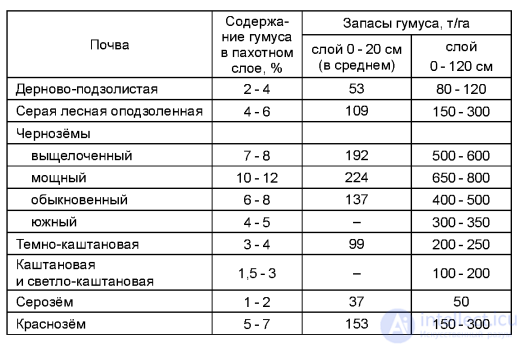
The amount of humus in the soil varies and depends on many factors, especially the type of soil, natural and climatic conditions, the specialization of the crop rotation, and the nature and intensity of farming (Table 3.3). Humus is most abundant in the upper layers of the soil; down the profile, the content of organic matter, including humus, decreases. With the rational application of organic and mineral fertilizers in crop rotations with perennial legume-grass mixtures, beneficial microbiological processes generally develop, the humus content of the soil increases, and its quality improves. If fertilizers are not applied, its content decreases, as is confirmed by research in all zones of our country. Under optimal biological processes, the amount of humus in the soil increases over time. If organic fertilizers are applied systematically and the scientific principles of farming are observed, the rate of humus accumulation increases even further. If not, the plant residues that enter the soil every year gradually decompose, are mostly mineralized, and therefore do not accumulate. The humus content of the soil is an important indicator of its potential fertility and of the activity of all the biological processes taking place in it. Humus accounts for
3.3. Humus content in the main soil types (according to I.V. Tyurin)
85-90% of the total amount of soil organic matter. It consists of two main groups: 1) humic acids; 2) fulvic acids. Humins have also been distinguished. Humic acids are a group of dark-colored humic acids that are soluble in alkalis and insoluble in acids. They are high-molecular-weight, nitrogen-containing organic acids of cyclic structure, readily soluble in weak solutions of caustic alkalis, sodium pyrophosphate, sodium oxalate, sodium fluoride and ammonia, forming soluble salts — humates. Depending on the concentration and the type of soil, solutions of humates have a cherry-brown or black color. Humic acids consist of carbon, hydrogen, oxygen and nitrogen. Their composition varies within relatively narrow limits: C — 52 - 62%, H - 2.8-5.8, O — 31-39, N - 1.7- 5%. The content of these elements in humic acids depends on the type of soil, the chemical composition of the decomposing residues, and the conditions of humification. Humic acids of chernozems contain the most carbon. Agricultural production changes the elemental composition of these acids only slightly. Preparations of humic acids isolated from the soil contain, in addition to the elements named, a certain amount of ash elements (P, S, Al, Fe, Si); depending on the degree of purification of the preparation, their amount varies from 1 to 10%. The presence in humic acids of functional groups (3 - 6 phenolic hydroxyls (-OH), 3 - 4 carboxyl (-COOH), methoxyl (-O-CH3) and carbonyl (-C=O) groups) determines the properties of humic acids and the nature of their interaction with the soil. For example, the carboxyl groups in a humic acid determine its acidic properties and account for its participation in the processes of exchangeable cation absorption. The hydrogen of the carboxyl groups can be replaced by various cations, resulting in the formation of salts — humates (Ca, K, Mg, NH4 etc.). Fulvic acids are a group of humic acids that are readily soluble in water, alkalis and acids; they are high-molecular-weight, nitrogen-containing organic acids consisting of carbon, hydrogen, oxygen and nitrogen. But unlike humic acids, they contain less carbon and more oxygen. Their elemental composition is approximately as follows: C — from 40 to 52%, H — from 4 to 6, O — from 42 to 52, N — from 2 to 6%. Fulvic acids are colored yellow or brown. They are more mobile and move comparatively easily through the soil profile.
Fulvic acids, having a strongly acidic reaction and good solubility in water, break down the mineral part of the soil fairly effectively. At the same time, it should be noted that the destructive action of fulvic acid on the soil, on its mineral part, largely depends on the amount of humic acids present in that soil: the less humic acid it contains, the stronger the action of the fulvic acids. Like humic acids, they have functional groups capable of exchangeable cation absorption and form soluble salts of calcium, magnesium and others (fulvates). Fulvic acids are more mobile, and the nitrogen compounds in them are bound less strongly, so they undergo acid hydrolysis more readily than the nitrogen compounds of humic acids. Humic acids contain 15 - 30%, and fulvic acids — 20 - 40% of the soil's nitrogen. Humins are a complex of humic and fulvic acids (closer in nature to humic acids), differing from the latter in that they are more strongly bound to the mineral part of the soil and more resistant to decomposition by microorganisms; they are insoluble in acids, alkalis and organic solvents. The nitrogen of humins makes up 20-30% of the total soil nitrogen. Different soil types differ not only in their total humus content but also in the amount and ratio of humic acids to fulvic acids. For example, in sod-podzolic soils this ratio is 0.4-0.6, while in chernozems it is 1.0-1.5 or more. These differences largely account for the higher mobility of organic matter, and consequently of nitrogen, in sod-podzolic soils compared with chernozems. Humic substances can occur in the soil in the form of calcium, magnesium and sodium humates; in the form of humates and mixed salts with aluminum and iron hydroxide, or as complex organo-mineral compounds with aluminum, iron, phosphorus and silicon. They are able to be absorbed by clay minerals. The bond between humic substances and minerals of the montmorillonite type is particularly strong; with kaolinite or feldspars the bond is weaker. The formation of various organo-mineral compounds in the soil (a complex of humic substances with the mineral part) leads to the fixation of humus in the soil. Humus plays the most important role in creating soil fertility and in plant nutrition. 1. Organic matter is a source of nutrient elements for plants. It contains 98 - 99% of the nitrogen, 30-40 — of the phosphorus, 90% of the sulfur of their total content in the soil.
2. Humic acids, fulvic acids and others, as well as the carbonic acid formed during the decomposition of organic matter, gradually break down silicates and aluminosilicates, dissolve calcium and magnesium carbonates, phosphates and other salts, converting these nutrient elements into a form available to plants. 3. Organic substances are a source of food for microorganisms. As they decompose, nitrogen, phosphorus and sulfur pass into readily assimilable mineral compounds. 4. Many organic substances — humic acids in a highly dispersed state, organic acids (acetic, propionic, succinic and others), as well as enzymes, antibiotics and vitamins entering plants in micro-quantities — sometimes stimulate their growth under water- and sand-culture conditions. 5. Soil organic matter takes part in adsorption processes in the soil, increases its absorption capacity and buffering ability, and improves the physical properties of the soil (moisture capacity, water and air permeability, thermal regime, etc.). Processes of humus formation and breakdown are constantly taking place in the soil. Although humus is resistant to microbiological decomposition, it is gradually mineralized. Depending on which process predominates, the humus content of the soil increases or decreases. In the arable layer of sod-podzolic soils, 6 - 7 c/ha of organic matter is mineralized annually, and in chernozem soils about 10 c/ha, which amounts to about 1 and 0.4 - 0.5%, respectively. Organic and mineral fertilizers and the plowing-in of plant residues increase the humus and nitrogen content of the soil. Soil organic matter is formed under the influence of the life activity of plants, microorganisms and soil fauna. The process of organic matter decomposition is influenced by air, moisture and the chemical composition of the plant residues. With an abundant supply of air and optimal moisture, rapid aerobic decomposition takes place. With a lack of air and an excess of moisture, conditions arise in the soil for an anaerobic microbiological decomposition process. The best conditions for the economical decomposition of organic matter arise in well-structured, loose, cultivated soils, in which the ratio between the aerobic and anaerobic microbiological processes of organic matter decomposition (including that of humus) is optimal. On the surface of structural aggregates (crumbs) a rapid aerobic (fast) decomposition process develops, while inside the structural
crumbs, into which air penetrates with great difficulty because the capillaries are saturated with water, — an anaerobic (slow) decomposition process takes place. With such simultaneous decomposition of organic matter, plants are best supplied with food, water and air, the soil's fertility is expended most economically, and no losses of water-soluble nutrients into groundwater and river water occur. Besides aeration conditions, the completeness and character of organic matter decomposition are also influenced by other factors (temperature, soil reaction, the presence of organic matter and of the nutrient elements needed by — microorganisms — phosphorus, nitrogen and others). Simple organic substances (sugar, starch, etc.) decompose faster than carbohydrates of complex origin (cellulose, hemicellulose). Proteins of plant origin also decompose quickly. Resins and waxes are resistant to decomposition by microorganisms. Lignin is the most resistant of all. When it combines with microbial protein and other nitrogenous organic substances, a dark-colored, complex substance is formed that constitutes the main nucleus of humus. As a result of the life activity of microorganisms, substances of secondary origin are formed, of which the bodies of the microorganisms themselves and the products of their metabolism are composed. Protein substances form a considerable part of the composition of the bodies of microorganisms. Therefore, the relative content of protein substances, including the protein substances of microbial bodies, does not decrease but increases during the decomposition of plant residues. Depending on the conditions of decomposition, qualitatively different humic substances accumulate in the soil. During aerobic decomposition of forest litter by fungal flora, soluble, colorless fulvic acids are formed. During bacterial decomposition of the organic residues of herbaceous plants, sparingly soluble, dark-colored humic acids are formed. Changes in the composition of plant residues, resulting from the unequal rate and completeness of decomposition of their constituent parts in the soil and from the activity of microorganisms, lead to the gradual formation of new specific humic substances. Consequently, the leading role in the cycling of chemical substances in the soil, and above all of the organic compounds entering it from plants and various fertilizers, belongs to microorganisms, i.e., to the living part of the soil.
Any soil is inhabited by various microorganisms: fungi, bacteria and actinomycetes, as well as algae and protozoa. Their numbers differ from one soil to another. The composition and number of microorganisms are determined not only by the type of soil but also by its degree of cultivation. The higher the degree of cultivation of a soil, the more beneficial microbes it contains. The microbial mass per hectare amounts to 5-7 t. If one takes into account that several generations of microorganisms succeed one another in the soil during the growing season, the total living mass of microorganisms per hectare can reach quite impressive proportions — 15 - 20 t or more. Microorganisms are the most energetic and mobile part of the soil. Their important role in soil processes and in plant nutrition is determined not only by the fact that these living organisms exert an enormous enzymatic action on the surrounding dead substrate, but also by their huge active surface area, on which the most complex transformations of various soil compounds and applied fertilizers take place at great speed. The total surface area of the microbial population of 1 ha of soil is approximately 500-600 ha, i.e., microorganisms are the main living plasma of the soil. Ultimately, they determine the course of most processes in the soil and greatly influence the character of plant nutrition. The transformation of applied fertilizers is also, to a certain extent, connected with the life activity of the soil biota.

Comments