
Lecture
The connection between carbon (air) nutrition and mineral (root) nutrition of plants is closely tied to the process of photosynthesis and the circulation of nutrients within the plant. Here is how it works:
Photosynthesis and carbon nutrition: Photosynthesis is the process by which plants use solar energy to convert carbon dioxide and water into glucose and oxygen. This process takes place in the green parts of plants, such as the leaves, with the help of chlorophyll. The glucose produced by photosynthesis is the main source of energy for plant growth and metabolic processes.
Transport of nutrients: Glucose and other organic compounds synthesized during photosynthesis are transported through the phloem, a system of tubular structures located in the plant. This ensures the distribution of energy and organic substances from the leaves to other parts of the plant, such as the roots, stems, and fruits.
Root nutrition and uptake of mineral elements: Plant roots play an important role in the uptake of mineral elements from the soil. Roots actively absorb water and the mineral elements dissolved in it, such as nitrogen, phosphorus, potassium, and other micronutrients. These mineral elements are used by the plant to form organic compounds, including amino acids, proteins, nucleic acids, and others.
The connection between the processes: Carbon nutrition (photosynthesis) and mineral nutrition (uptake of mineral elements) are closely interrelated. The organic compounds synthesized during photosynthesis provide the energy and materials for various metabolic processes, including protein synthesis, growth, and reproduction. In turn, the mineral elements absorbed by the roots play a key role in forming the structural components of cells and participate in many biochemical reactions.
Thus, the carbon and mineral nutrition of plants are strongly interrelated and ensure the effective functioning of the plant organism as a whole.
Depending on a number of external and internal factors, absorbed substances can accumulate in plants without exerting a significant effect on the yield. Thus, as the rates of mineral fertilizers increase, their effectiveness gradually diminishes, and with a further increase in rates a decline in yield may even begin. The reasons for this phenomenon are as follows:
1. An increase in the concentration of the soil solution to levels that can be toxic.
2. A disturbance of the normal ratio of chemical elements and ions in the soil medium, arising from the application of high rates of fertilizers.
3. A shortage of moisture in the soil and of carbon dioxide in the air of the stand.
4. Excessive growth of the vegetative part, and especially of the leaves, which leads to a deterioration of illumination within the stand and, as a result, to a decrease in the intensity of photosynthesis.
Regulating the process of photosynthesis and seeking methods aimed at a significant increase in the coefficient of utilization of solar energy — an important way of sharply increasing the productivity of agriculture. The conditions of mineral nutrition exert both a direct and an indirect effect on photosynthesis. Nitrogen, for example, takes a direct part in the synthesis of amino acids — the products of photosynthesis, and it indirectly participates in the formation of the plant's green pigments (chlorophyll) and in the synthesis of proteins — the structural elements of chloroplasts, as well as of the enzymes responsible for the various reactions of photosynthesis. The direct action of phosphorus consists in the fact that residues of phosphoric acid form part of the acceptor — the compound that binds CO2, and of the intermediate products of photosynthesis. In addition, with the help of light energy, adenosine triphosphate (ATP) is synthesized from inorganic phosphorus and adenosine diphosphate (ADP), which participates in the reduction reactions of CO2. The indirect action of phosphorus consists in the fact that phosphates form part of phosphatides and phosphoproteins, as well as of nucleic acids. Potassium apparently exerts only an indirect effect on photosynthesis, influencing the structure of the photosynthetic apparatus and activating a number of enzymes. A number of other elements (Mg, Mn, Fe, B, Mo, etc.) are also necessary for the normal process of photosynthesis.
The coordination between nitrogen uptake and the photosynthetic activity of the leaves was very clearly revealed in experiments with pumpkin plants using labeled carbon “14C. When the plants were placed with their roots in distilled water, the flow of assimilates to the roots weakened, and the formation in them of organic acids, which act as acceptors of ammonia, noticeably decreased. When such plants were instead placed with their roots in a solution of ammonium sulfate, the influx of assimilates from the leaves to the roots noticeably increased within an hour. In this case, the conversion of sugars into keto acids in the roots was accelerated, and this led to the roots acquiring a greater capacity for assimilating the nitrogen of the nutrient solution and for synthesizing a larger amount of nitrogen-containing compounds. In turn, a deterioration in leaf illumination leads to a decrease in the intensity of assimilation of mineral nutrition elements, and especially of the most important of them — nitrogen. Another example is the relationship between root and foliar nutrition. Applying a urea solution to maize leaves (during the leaf-formation period) inhibits nitrogen uptake by the roots for one to two weeks. This is because the leaves themselves begin to use the products of photosynthesis to bind ammonia, which reduces the influx of assimilates to the roots and decreases their capacity to absorb and assimilate soil nitrogen (Fig. 4.3). The conditions of nitrogen nutrition affect not only the intensity of photosynthesis but also the intensity of the flow of assimilates to the attracting centers (growth points, developing reproductive organs). A deficiency of nitrogen, phosphorus, or potassium reduces their outflow from the leaves. The greatest intensity of photosynthate supply, for example to wheat ears during the heading phase, was observed with a complete nutrient mixture, a lower intensity — with a phosphorus deficiency, and an even lower one — with a nitrogen deficiency. In cotton, an increase in the outflow of photosynthesis products from the leaves to the fruiting elements was likewise observed when nitrogen fertilizers were applied. An increase in nitrogen nutrition has a positive effect on the intensity of assimilate outflow only when the plants experience an acute nitrogen deficiency. Under a more or less adequate nitrogen supply, an additional application of nitrogen not only fails to accelerate the outflow but even inhibits it. For example, a one-sided increase in nitrogen nutrition decreases the intensity of assimilate outflow from the leaves to the ears. The simultaneous application of phosphorus and potassium together with nitrogen to some extent removes the inhibiting effect of nitrogen fertilizers.
With abundant nitrogen supply to plants, the outflow of assimilates from the leaves is weakened because conditions arise in the leaves for their more prolonged growth, and they work «for themselves». In addition, with excess nitrogen, the growth of shoots and roots is enhanced, and they too become consumers of photosynthesis products. As a result, the supply of photosynthesis products to the reproductive and storage organs deteriorates. Thus, with intensified nitrogen nutrition (especially with nitrogen top dressings), the sugar content of sugar beet roots decreases. Excess nitrogen lowers the starch content of potato tubers and can even lead to a decrease in the overall yield. The increase in plant photosynthetic productivity under intensified nitrogen nutrition occurs mainly as a result of an increase in the area of the assimilating surface and the duration of the vital activity of the leaves and other photosynthesizing organs. However, an increase in leaf area has a favorable effect on yield only up to a certain limit (usually 4-5 m² of leaf area per 1 m² of stand). Beyond this, strong self-shading of the leaves occurs, illumination within the stand deteriorates, the lower leaves die off, there is intensified additional growth of the plants in length in pursuit of light, the average intensity of photosynthesis decreases, and respiration losses increase. The consequences of this are often lodging of the plants and a decrease in yield and its quality.
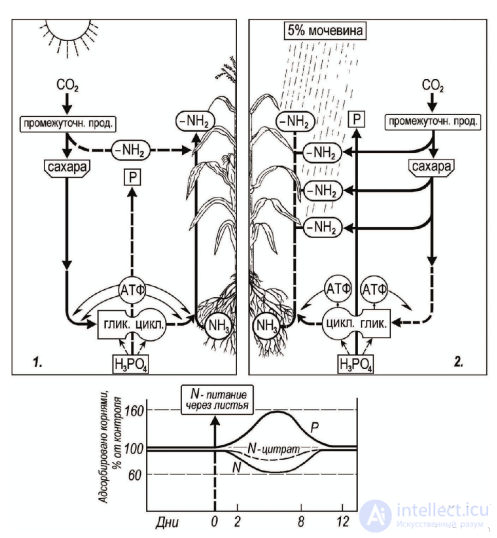
Fig. 4.3. Use of photosynthesis products for binding nitrogen under root (1) and foliar (2) plant nutrition
Naturally, such an effect of nitrogen fertilizers on growth processes occurs under conditions of an adequate water supply to the plants. Under limited water supply, there is no danger of excessive plant growth, but the effectiveness of nitrogen fertilizers will also be low. Thus, an increase in plant productivity under the action of mineral fertilizers, nitrogen fertilizers in particular, is inseparably linked to an increase in the productivity of photosynthesis and the utilization of solar energy.

Comments