
Lecture
The mineral part of soil arose as a result of the weathering of rocks and minerals in the upper layers of the lithosphere and their transformation in the process of soil formation. This is confirmed by the similarity between the chemical composition of the lithosphere and that of soils. Under the combined influence of physical and chemical factors on the mineral substrate, and especially of living organisms (plants and microorganisms), profound changes took place that led to the formation of a soil cover on the surface of the Earth's crust. Thus, the «builders» of soil are plants and microorganisms, as well as the micro- and macrofauna living in the soil, while the building material — the parent (bedrock) rocks and the atmosphere and hydrosphere surrounding them, and the energy source of soil formation — solar energy. Soils inherit the geochemical features of their parent rocks. For example, a rock rich in silica also determines an increased silica content in the soil, while an excess of clay minerals is reflected in their predominance in the genetic horizons of the soil. Soils enriched with alkaline-earth elements develop on carbonate rocks, while saline soils form on salinized rocks, and so on. However, the decisive role in soil formation is played by the biological factor. Under the influence of living organisms, the carbon content of soil, compared with that of the Earth's crust, has increased 20-fold, and the nitrogen content — in 10-fold. This shows that plants promote the accumulation of biologically important elements in the soil. Soil formation under natural conditions proceeds quite slowly. With the help of fertilizers and proper agrotechnical practices, the intensity of soil processes can be significantly accelerated. For example, when fertilizers are applied, the vital activity not only of plants but also of the soil microflora is enhanced, which sharply accelerates the processes of accumulation of organic matter and biologically important elements, that is, it increases soil fertility. In the greater part of soils, the mineral basis of the solid phase consists of silicon-oxygen compounds. The most widespread mineral in soil — quartz (silica). Aluminum and iron are for the most part contained in aluminosilicate and ferrosilicate minerals. Silicon atoms combined with oxygen form tightly bonded SiO, groups, in which the silicon is surrounded, in tetrahedral coordination, by four oxygen atoms. Since silicon is tetravalent and oxygen is divalent, the SiO, tetrahedron has unsaturated oxygen valences, and it can be regarded as a tetravalent anion. Of considerable importance is the ability of SiO, tetrahedra to combine with one another, forming groups made up of a certain number of silicon and oxygen atoms (Fig. 3.1 a-d).
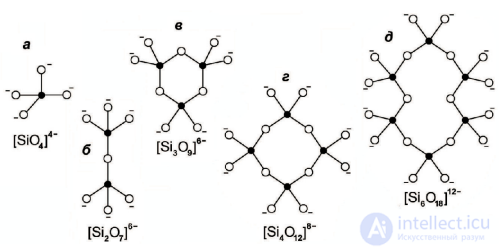
Fig. 3.1. Groups of combinations of SiO, tetrahedra
In the structure of the minerals of the finely dispersed soil fractions, the silicon-oxygen tetrahedra are joined into layers, chains, or isolated groups of SiO, tetrahedra, forming complex anionic complexes, since an oxygen atom not involved in linking two SiO, tetrahedra together retains a free valence, that is, a single negative charge. In complex combinations of silicon-oxygen tetrahedra, part of the silicon atoms may be replaced by aluminum atoms, which increases the unsaturation of the anionic radical. In the crystal lattice of quartz, an SiO, tetrahedron is linked, through shared oxygen atoms, to four other SiO, tetrahedra according to the scheme
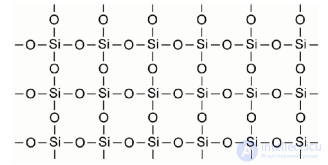
The general formula of such a compound is (SiO,)*n. In feldspars, part of the silicon atoms in a similar structure is replaced by aluminum, as a result of which such a silicon-aluminum-oxygen framework acquires a negative charge that is compensated by a corresponding number of sodium, calcium, and other cations located inside the framework, in the «cavities» of the lattice. For example, the feldspar albite, which has the general formula Na[SiAlOg], is built from interlinked silicon-oxygen and aluminum-oxygen tetrahedra, with one aluminum atom and one sodium ion, neutralizing the negative charge of the framework, occurring for every three silicon atoms. Aluminum in tetrahedral coordination with oxygen or hydroxyl ions forms octahedral groups, in which the aluminum ion is surrounded by six oxygen or hydroxyl ions. The general formula of such a compound (layer) [Al(OH),]' n corresponds to the composition of the mineral gibbsite (hydrargillite), found in soil. The structure of such minerals can be written as follows:

The formula shows the chemical composition of the layer (packet), and the dots — the interlayer spaces. Primary and secondary minerals occur in soils. Primary minerals are those that passed from the Earth's crust into the soil unchanged or almost unchanged. These include the minerals of the soil skeleton: quartz and its varieties, feldspars, including plagioclases, micas, hornblendes, augite, tourmaline, magnetite, calcite, dolomite, and others. Primary minerals form part of the parent soil-forming rocks that arose from the weathering and disintegration of rocks making up the shell of the Earth's crust. In soils, these minerals are present mainly as particles of sand size (from 0,05 to 1,0 mm) and silt-size particles (from 0,001 to 0,05 mm). In small amounts, some of them are present as clay-size (<0,001 mm) and colloidal (< 0,25 μm) particles. Under the influence of chemical and physicochemical processes (hydration, hydrolysis, oxidation) and the vital activity of various organisms, primary minerals give rise in soil to hydrates of sesquioxides and silicas, various salts, as well as secondary minerals (clay minerals) — kaolinite, montmorillonite, hydromicas, and others. These occur mainly as clay-size and colloidal particles and rarely as silt-size particles, that is, they are distinguished by a high degree of dispersion. The crystal lattice of the aluminosilicate minerals of the finely dispersed soil fraction is based on combinations of silicon-oxygen tetrahedral and aluminum-hydroxyl octahedral layers. In kaolinite, the crystal lattice is formed of packets of two layers joined to each other by shared oxygen atoms: a tetrahedral silicon-oxygen layer and an octahedral aluminum-hydroxyl layer, of the type

In montmorillonite and hydromicas, the packet of the crystal lattice is formed of one aluminum-hydroxyl layer with two silicon-oxygen layers attached to it, of the type

In minerals of the kaolinite group, the bond between packets is stronger and the interlayer spaces are small. Interaction of microcrystalline particles © the solution occurs, in this case, only at the outer surface.
In minerals of the montmorillonite group, the interlayer spaces are larger, the bond between packets is weak, and upon wetting water enters the interlayer spaces. Therefore, in exchange with the cations of the soil solution, cations located both on the surface of particles and those found in the interlayer spaces take part. This explains the higher exchange sorption capacity of minerals of the montmorillonite group, as well as their capacity for non-exchangeable cation sorption. Soil clay minerals are divided into four groups: montmorillonite minerals (montmorillonite, beidellite, nontronite, and others), kaolinite minerals (kaolinite and halloysite), hydromicas, and sesquioxide minerals (hematite, boehmite, hydrargillite, goethite, and others). Among the secondary minerals, the montmorillonite minerals possess the highest sorption capacity, and the lowest — kaolinite. For example, the sorption capacity of kaolinite is 8 - 15 times lower than that of montmorillonite. This characteristic of minerals is of substantial importance for the sorption of fertilizers and should be taken into account when applying them. Secondary aluminosilicate minerals in soil occur as crystals, have high dispersion, and possess a high sorption capacity. Amorphous substances are also part of the mineral fraction of soil. These are hydrates of aluminum oxides Al2O3' n H2O and of iron oxides Fe2O3 * n H2O, as well as hydrates of silica SiO2 ' n H2O. They can crystallize. Minerals of the oxides and hydroxides of aluminum and iron occur in significant quantities in red earths and yellow earths. By chemical composition, minerals are divided into silicates and aluminosilicates. Among silicates, quartz is the most widespread. It usually makes up more than 60% of soils, and in sandy soils — over 90%. It is a chemically inert, stable, and durable mineral. Aluminosilicates are represented by primary and secondary minerals. Of the primary ones, feldspars are the most abundant: potassium feldspars (orthoclase KAlSi3O8) and sodium-calcium feldspars (plagioclases). There are fewer micas in soil compared with feldspars. They contain potassium. Muscovite contains a great deal of aluminum, while biotite — an iron-magnesium mica. Feldspars and micas gradually break down, releasing potassium, calcium, magnesium, iron, and other nutrient elements for plants. By chemical nature, secondary aluminosilicates belong to the hydroaluminosilicates and are divided into three groups.
1. Montmorillonites (montmorillonite — Al54O, (OH), ‘n H2O, beidellite — Al;Si;O4(OH); *nH2O, and others). This group of clays is characterized by high dispersion, swelling capacity, stickiness, and viscosity. 2. Kaolinites (kaolinite — Al2Si2O5(OH)4 and halloysite Al2Si2O5(OH)4 *2H2O). This group of clays is less dispersed and has low swelling capacity and stickiness. In sod-podzolic soils and chernozems formed on mantle loams, montmorillonite and hydromicas predominate among the highly dispersed minerals. In red earths, yellow earths, and sod-podzolic soils formed on the products of ancient humid weathering of granite, minerals of the kaolinite group occur in significant amounts. 3. Hydromicas (hydromuscovite, hydrobiotite, vermiculite) form from micas, have a variable chemical composition, and occupy, in their physical properties, an intermediate position between montmorillonite and kaolinite. Micas determine the agrochemical and physical properties of soil. They serve as a source of potassium nutrition for plants. The energy of potassium sorption by colloids is high, as a result of which the absorbing complex of many soils contains 0,5- 10 mmol/100 g of soil. Some soils have a potassium deficiency, for example red earths and laterites, which is explained by their low content of micas and hydromicas and their abundance of kaolinite-group minerals, which contain almost no potassium. Secondary minerals have a crystalline nature. Representatives of poorly crystallized minerals and other substances that play an important role in the sorption capacity of soils include allophane, free silicic acid, amorphous sesquioxides (that is, oxides of iron and aluminum), and various acids and their salts (carbonates, sulfates, nitrates, chlorides, and phosphates of calcium, magnesium, potassium, and sodium). Besides macronutrients, soil contains a certain amount of micronutrients: some in greater amounts than in the lithosphere (iodine, boron), others — in lesser amounts (copper, cobalt), and some in roughly the same amounts (Table 3.1). The main source of micronutrients in soil is the soil-forming parent rocks. For example, soils formed on the weathering products of acidic rocks (granites, liparites, granite-porphyries, and others) are poor in nickel, cobalt, and copper, while soils formed on the weathering products of basic rocks (basalts, gabbro, and others) are, on the contrary, enriched with these elements. Some micronutrients (I, B, F, Se, As) can enter the soil
3.1. Content of micronutrients in soil (A) and in the lithosphere (B), mass %
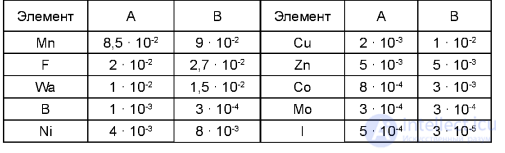
with gases from the atmosphere, from volcanic eruptions, and with meteoritic deposits. Moreover, for such micronutrients as iodine and fluorine, these sources are the main ones. Fractions of the mineral part of soil that differ in granulometric composition differ sharply in the content of various minerals. Quartz and feldspars predominate in sand and coarse silt. The finely dispersed (<0,001 mm) clay and colloidal fractions, on the other hand, consist mainly of secondary aluminosilicate minerals. Because of this, different mechanical fractions of soil differ substantially in chemical composition. Sandy and silty soils contain more silicon. As particle size decreases, its content falls, while the amounts of aluminum, iron, potassium, magnesium, and phosphorus increase (Table 3.2). The highly dispersed part of the soil also contains humus — an indicator of its potential fertility. The clay and colloidal fractions are therefore of the greatest value for plant nutrition. These fractions also determine the sorption capacity of soil. It is in them that the processes of physical and physicochemical adsorption proceed most actively.
3.2. Approximate chemical composition of different granulometric fractions of soil, mass %
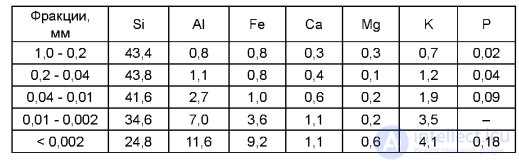
Soils of different granulometric composition differ substantially in physical, physicochemical, and chemical properties. Their mineralogical composition is likewise not the same. Sandy soils and loamy sands consist of quartz and feldspars, loams — of a mixture of primary and secondary minerals, and clays — predominantly of secondary clay minerals with an admixture of quartz. The content of the main mineral nutrients — calcium, potassium, magnesium, iron, and others — is likewise determined by the degree of soil dispersion, since they are contained in the mineral part of the soil, phosphorus and sulfur are found in both the mineral and the organic parts, while the amount of nitrogen is determined by the level of soil humus content. Consequently, soils of different granulometric composition also differ substantially in their content of nutrient elements. Heavier clay and loamy soils are richer in nutrient elements than sandy and loamy sand soils.

Comments