
Lecture
Calcium (Ca) is one of the most important macronutrients necessary for the healthy growth and development of plants. Its role in plant nutrition can be summarized as follows:
Structural component of cells: Calcium plays a key role in the formation and strengthening of plant cell walls. It promotes the formation of pectins, which are important components of cell walls, making them strong and stable.
Regulation of cellular processes: Calcium is an important secondary messenger in plant cells. It is involved in the regulation of many biological processes, such as cell division, growth, flowering and responses to stress conditions.
Transport of water and nutrients: Calcium is involved in regulating the transport of water and nutrients within the plant. This is important for meeting the plant's needs for water and mineral elements.
Protection against diseases and pests: Calcium helps plants respond resiliently to attacks by diseases and pests. It can activate defense mechanisms, such as the synthesis of phytoalexins, which makes plants less vulnerable.
Participation in photosynthesis processes: Calcium is an important component of a number of enzymes involved in photosynthesis processes, which makes it an integral part of the process of converting solar energy into chemical energy.
Plants obtain calcium from the soil, so a shortage of calcium in the soil or its poor availability can lead to various problems in plant growth and health. This can manifest as deficiency symptoms, such as yellowing and deformation of leaves, as well as more serious disruptions in the development of roots and stems.
To ensure a sufficient amount of calcium in the soil, fertilizers containing calcium are often used. It is also important to maintain an optimal soil pH level, since acidic soil can hinder plants' access to calcium.
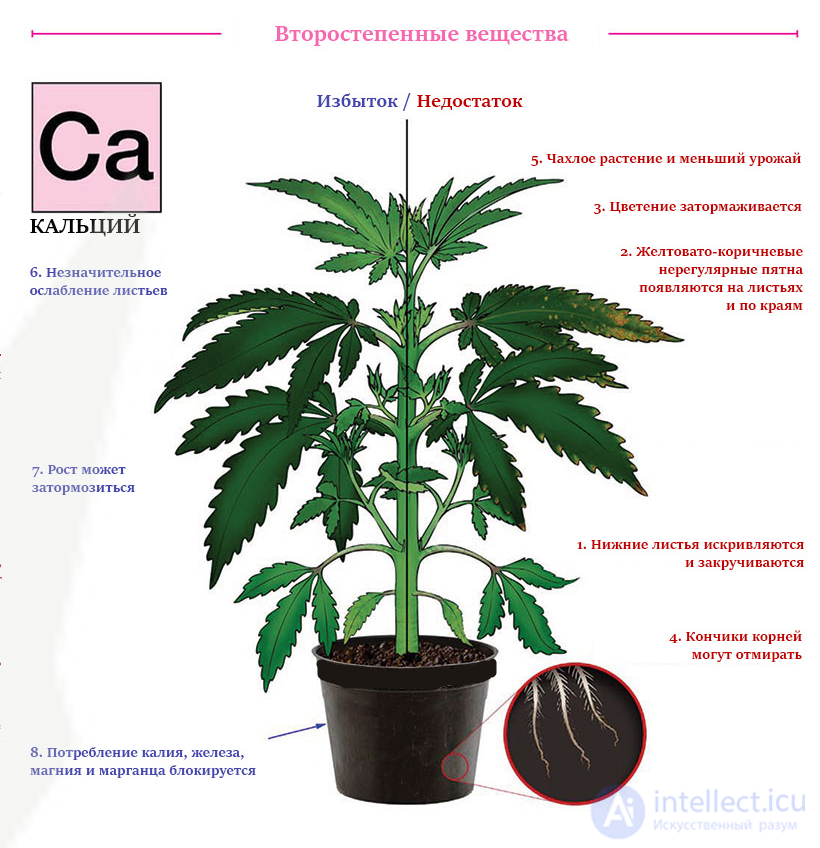
Calcium deficiency and excess
Calcium neutralizes excess organic acids in the plant. It is involved in carbohydrate and nitrogen metabolism, and ensures the permeability of cell walls. It is also an antagonist of potassium. The correct ratio of calcium to potassium influences the most important life processes in the plant.
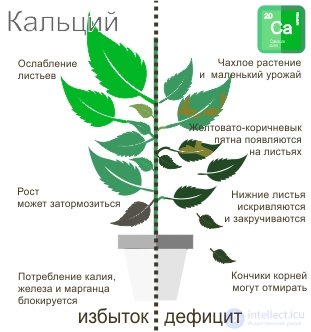
Excess calcium manifests as interveinal chlorosis. This occurs because too large an amount of calcium leads to difficulties in the uptake of iron and manganese.
Calcium deficiency most often arises due to:
Signs of calcium deficiency are not hard to recognize. The shape of the leaves changes, becoming domed, and the leaves become bumpy, while the stems and leaf petioles become brittle and break off easily. The roots suffer especially: they partly die off, are often affected by rot, and break off easily during transplanting.
We suggest the following measures for eliminating calcium deficiency.
Calcium has a many-sided positive effect on the plant. In nature, plants rarely experience a deficiency of this element. It is needed on strongly acidic and solonetzic soils, which is explained by the saturation of the absorbing complex with hydrogen in the first case, and with sodium in the second. Calcium is present in all plant organs; more of it is found in aging cells in the form of calcium oxalate, and sometimes in the form of salts of pectic, phosphoric and sulfuric acids. In plants, 20-65% of calcium compounds are water-soluble, while the remaining amount can be extracted with weak solutions of acetic and hydrochloric acids. A calcium deficiency primarily affects the development of the root system. Root hairs stop forming on the roots, through which the main mass of nutrients and water enters the plant from the soil. In the absence of calcium, the roots become slimy and rot, their outer cells are destroyed, since the pectic substances and lipoids that impregnate the cell walls dissolve without calcium, and the tissue turns into a slimy, structureless mass. This can occur both with a calcium deficiency and with a predominance of monovalent cations (hydrogen, sodium, potassium) in the nutrient solution, which leads to a disruption of the physiological balance of the nutrient solution.
Introducing calcium into the nutrient solution restores the physiological balance of the solution. Calcium is a strong antagonist of other cations and prevents their excessive uptake into the plant. Calcium also has a positive effect on the growth of the plant's above-ground organs. With a sharp deficiency of it, leaf chlorosis appears, the apical bud dies off, and stem growth stops. Calcium apparently also plays a certain role in the process of photosynthesis, since green plant leaves contain more of this substance. Calcium enhances metabolism in plants, plays an important role in the movement of carbohydrates, influences the transformation of nitrogenous substances, and accelerates the consumption of seed storage proteins during germination. One of the important functions of this element is its influence on the physicochemical state of the protoplasm — its viscosity, permeability and other properties, on which the normal course of biochemical processes depends. Calcium compounds with pectic substances cement together the walls of individual cells. Calcium also affects enzyme activity.
For example, under the influence of lime, invertase activity increased in oat plants and catalase activity rose. The effect of lime on enzyme activity is manifested not only through direct action, but also, apparently, thanks to an improvement in the physicochemical properties of the soil and its nutrient regime. Liming of the soil substantially affects vitamin biosynthesis. Plants remove varying amounts of calcium with the harvest. Thus, cereal crops at a yield of 20 c/ha remove about 20 kg CaO per hectare, clover at a yield of 60 c/ha — about 140, sunflower at a seed yield of 13 c/ha — 135, cabbage at a yield of 500 c/ha — up to 300, peas, vetch and beans with a grain yield of 20-30 c/ha — 40-60, and potatoes and sugar beet with a yield of 200-300 c/ha of roots and tubers — 60-120 kg per hectare. Calcium is consumed most of all by cabbage, alfalfa and clover, which are distinguished by high sensitivity to increased soil acidity.
The presence in the soil of a high concentration of other cations (H+, Na+, K+ and others) hinders the uptake of calcium by the plant, which is explained by cation antagonism. The presence of nitrate nitrogen in the solution enhances the uptake of calcium into plant tissues, while ammonium nitrogen reduces it. On acidic sandy and sandy loam soils, as well as on solonetzes, applying lime and gypsum improves not only the physicochemical properties of the soil owing to the neutralization of excess acidity or alkalinity, but also the plants' nutrition with calcium. This is especially important to take into account when growing crops that remove large amounts of calcium with the harvest. Calcium is contained more in the vegetative parts of plants. For example, potato tubers contain about 7% of this cation, while the leaves and stems contain 93%; corn seeds contain 3.4% of calcium, while the other parts of the plant contain 96.6%. Therefore, unlike other nutrients, most of the calcium is not removed with the agricultural produce but is returned to the fields. The gross calcium content is determined primarily by the soil type. For example, its content (% of dry matter) is 0.73 on podzolic soils, 0.90 on gray forest soils, 1.44 on chernozems, and 6.04 on sierozems.
The loss of calcium from the soil occurs not so much as a result of its removal with the harvest of agricultural crops, but rather due to leaching from the soil. These losses often reach significant amounts. According to I.A. Shilnikov (1984), the ratio between calcium losses with infiltration waters and removal with the plant harvest averaged 4:1. Losses of calcium from soils of various genetic types and granulometric composition were as follows (kg/ha): from sod-podzolic loamy soil — 151-162, from sandy loam — 198-207, from gray forest soil — 161-170, from peat soil — 196. With liming, the migration of this element beyond the arable layer increased by 5-7%. Fertilizer application accelerates the loss of calcium from the soil. For example, ammonium fertilizers displace calcium from the absorbing complex, which is then lost with percolating water. The application of 1 centner of ammonium sulfate entails a loss of calcium equivalent to approximately 1 centner of calcium carbonate.
Given the above, calcium is of critical importance for the healthy growth and development of plants, and its sufficient presence in the soil and attention to the nutrient balance are important for successful agriculture and horticulture.

Comments