
Lecture
Sulfur (S) is a macronutrient that plays an important role in plant nutrition. Here are the main aspects of its significance:
Component of amino acids and proteins: Sulfur is a key component of amino acids such as cysteine and methionine, which in turn are the building blocks of proteins. Proteins play an important role in the structure and functioning of plant cells.
Important for enzymes: Sulfur is present in the composition of many enzymes, including those involved in metabolism and regulating numerous biochemical processes in plants.
Formation of living tissues: Sulfur is part of the living tissues of plants, such as bark, leaves, stems and roots. It is necessary for the growth, development and maintenance of these tissues.
Synthesis of phytohormones: Sulfur participates in the processes of phytohormone synthesis, such as auxins and cytokinins, which regulate plant growth and development, including flowering, fruiting and root formation.
Protection against stress: Sulfur helps plants respond resiliently to stress conditions such as drought and pest attacks. It participates in the synthesis of compounds such as glucosinolates, which can serve as protection against insects and diseases.
A shortage of sulfur in the soil, or its insufficient uptake by the plant, can lead to various problems, including yellowing of the leaves (as in the case of nitrogen deficiency), limited growth, and insufficient development of plants.
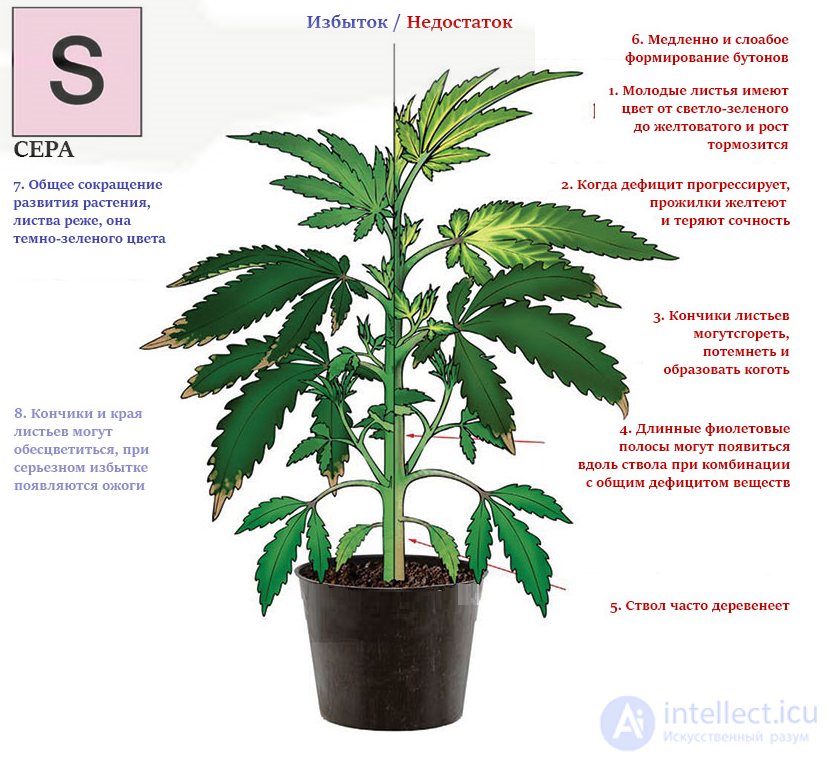
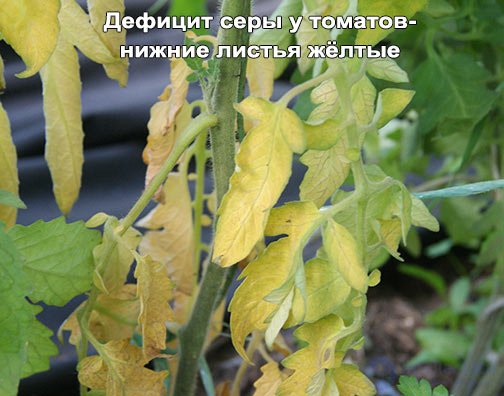
Sulfur deficiency and excess
Sulfur is part of all proteins; it is found in amino acids such as cystine and methionine, in vegetable oils (mustard, garlic, and others), and in vitamins (thiamine and biotin). It is also a constituent element of certain antibiotics, in particular penicillin. Sulfur is of great importance in the oxidation-reduction processes taking place in plants, in the activation of enzymes, and in protein metabolism. It promotes the fixation of nitrogen from the atmosphere, enhancing nodule formation in legumes. The greater part of the sulfur compounds in plants is found in the reduced form. With organic matter it can be bound through a disulfide (—S—S-) group or a sulfhydryl (—SH) group. These groups play an important role in oxidation-reduction reactions. For example, the sulfhydryl group loses hydrogen upon oxidation and is converted into a disulfide group. The source of sulfur nutrition for plants is mainly the salts of sulfuric acid. Sulfur can also be partially absorbed by the leaves from the air in the form of sulfur dioxide gas (SO2). The oxidized form of sulfur is the starting product for protein synthesis.
It is also the final product of their breakdown. In young, growing plant organs, where synthetic processes predominate, sulfur is found mainly in the reduced form. As plants age, when hydrolysis processes begin to predominate over synthesis, the amount of the oxidized form of sulfur compounds increases. With a sulfur deficiency, protein synthesis is delayed, since the synthesis of amino acids containing this element is impeded. Accordingly, the manifestation of signs of sulfur deficiency resembles the signs of nitrogen starvation. Plant development slows, leaf size decreases, stems elongate, and the leaves and petioles become woody. Under sulfur starvation, the leaves do not die off, although their color becomes pale. The requirement for sulfur differs among various plants. It is found in the greatest amounts in legumes, sunflower, mustard, cabbage and other crops of the crucifer family. The sulfur content (calculated as SO3) in plants is expressed by the following values (in % of air-dry matter): in the grain of winter wheat — 0,02, of peas — 0,08, in potato tubers — 0,06, in wheat straw — 0,11, in pea straw — 0,27, in potato haulm — 0,13. In a good yield of grain crops and potatoes, sulfur is contained at 10-15 kg per 1 ha, of leguminous grasses and sugar beet — 20 - 30, of turnip and cabbage — 45 - 75 kg. The removal of sulfur with the yields of agricultural crops can also be judged from the data in Table 4.16.
Cereal straw contains 5 times more sulfur than the grain. In terms of the amount consumed by agricultural crops, sulfur approaches phosphorus. The soil contains about 0,1% SO3. Peat soils, solonetzes and solonchaks are distinguished by a high sulfur content, while on the sandy loam and sandy soils of the Non-Chernozem zone sulfur is often insufficient. As a rule, more sulfur is found in soils that have more humus, since 80-90% of this element is found in organic matter and only 10 - 20% — in the form of sulfates of calcium, magnesium, potassium and sodium. Therefore there is more sulfur in the upper arable layer. Sulfates are the main source of sulfur for plant nutrition. Their amount in the soil fluctuates, and the dynamics of their content resembles the dynamics of nitrate content. Organic and mineral fertilizers serve as sources for replenishing sulfur in the soil. For example, when 36 t of manure is applied, about 36 kg of SO3 enters the soil; when applying 60 kg of P2O5 in the form of simple superphosphate — 100, and 40 kg of nitrogen in the form of ammonium sulfate — 120 kg of SO3. Sources of sulfur also include potassium sulfates used as fertilizers, as well as potassium salts containing sulfates of potassium, magnesium and sodium. The use of coal (and, to a lesser extent, oil) as fuel in cities and industrial enterprises leads to a significant input of sulfur into the soil through the atmosphere. In Scandinavia, about 3,4 kg of sulfur per 1 ha is deposited annually with precipitation, in Western Europe — 13,5, in the USA, in the state of Michigan — 9-13, and in the state of Indiana (an industrial region) — 142 kg per year.
4.16. Removal of sulfur with crop yields
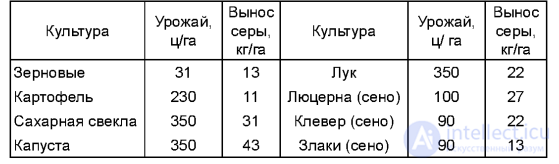
The loss of sulfur from the soil occurs not only in connection © its removal with the harvest of agricultural crops, but also as a result of leaching into groundwater, since anions of sulfuric acid are weakly retained by soils. According to American researchers, up to 50 kg of sulfur is leached out annually with drainage water from 1 ha. However, this figure can vary considerably depending on the amount of atmospheric precipitation, the particle-size composition of the soil, and other factors. Losses of sulfur due to leaching are significant, since sulfates, like nitrates, are mobile in the soil. It is believed that 40-60 kg of sulfur is removed with precipitation percolating into the soil, especially in winter. The removal of sulfur with the harvest, on average for a crop rotation, amounts to 25-30 kg/ha per year if the straw is returned to the soil, and 40-45 kg if it is removed from the field. Consequently, the amount of sulfur lost annually by the soil amounts to 60-110 kg/ha, depending on crop yield and the intensity of leaching. The processes of transformation and migration of sulfur in the soil are shown schematically in Fig. 4.10.
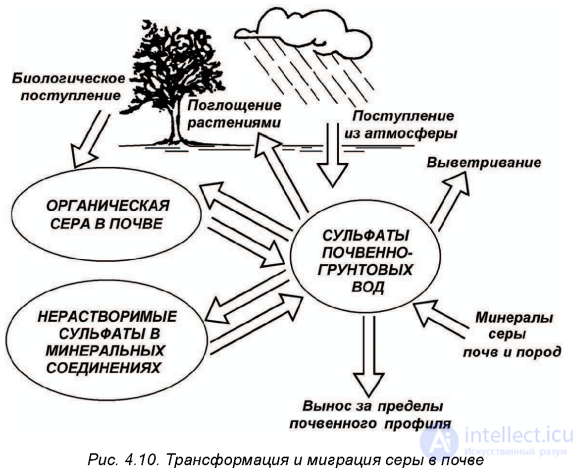
Fig. 4.10. Transformation and migration of sulfur in the soil
A high responsiveness to sulfur-containing fertilizers is usually observed in areas remote from sea coasts, or in places where intensive leaching occurs and there are no industrial facilities. In many cases, the application of sulfur-containing fertilizers results in increased yields of legumes and cotton, as well as of grain crops.
To provide plants with sulfur, fertilizers containing sulfur can be applied to the soil. It is also important to monitor the balance of macronutrients in the soil so that plants can effectively assimilate sulfur and other elements necessary for their health and growth.

Comments