
Lecture
In the general planetary understanding, «The biological cycle of substances is a set of processes by which chemical elements enter living organisms from the soil and atmosphere, new complex compounds are synthesized biochemically, and elements return to the soil and atmosphere with the annual litterfall of part of the organic matter» (Orlov, Bezuglova, 2000). The intensity of the biological cycle is regarded as the quantity of chemical elements contained in the increment of the phytocenosis per unit area per unit time. The task of agrochemistry is to assess the direction of the cycling of biogenic elements and the degree of intensity of anthropogenic impact on the soil-plant system based on the nutrient balance in the agrocenosis. This makes it possible to optimize the nutrition of agricultural crops through the application of a scientifically grounded fertilization system for individual crops in a crop rotation. The presence in the soil of plant-available forms of nutrient elements in the proper ratio is the main condition for the formation of high yields. This circumstance determines the effective fertility of soils. Questions of the cycling and balance of nutrients in farming have long interested researchers. The first scientific work in Russia, «Agricultural Chemistry», was published in 1825, in which the author, Professor M.G. Pavlov of Moscow University, wrote that the task of increasing soil fertility is to increase the amount of nutrients in the soil, or at least to return what has been taken from the soil by plants.
The genuine development of research on the nutrient balance in agrochemistry began with the appearance of J. von Liebig's work «Chemistry in Its Application to Agriculture and Physiology» (1840) and his doctrine of the complete return to the soil of all mineral substances taken from it by the crop yield. D.N. Pryanishnikov, the founder of Russian agrochemistry, devoted much attention to the problem of the cycling of substances in farming and their balance. He wrote that the development of the chemical industry was becoming one of the most important material prerequisites for regulating the cycling of substances in farming, their exchange between man and nature. Developing this proposition further, D.N. Pryanishnikov noted that whereas the depletion of soils as a result of a disruption of the exchange of substances between man and the land disrupts the «natural condition of constant soil fertility», the mass application of fertilizers, based on large-scale chemical industry, is one of the powerful factors not only for maintaining fertility at a constant level (as J. von Liebig envisioned it), but also for further increasing the effective fertility of the soil, as can be seen, for example, from the historical case of rising yields in Western European countries with a high level of chemicalization. Creating the necessary conditions for a rational cycling of nutrients in farming, and their positive balance, is the most important task of agrochemistry. Human economic activity, including the intensification of agricultural production and, above all, chemicalization, causes definite changes in the processes of transformation of substances and energy in nature.
For example, substantial changes occur in the nitrogen cycle in the biosphere during the transition from the natural state of the soil to its state under intensive cultivation (Fig. 3.3 and 3.4). In the soils of natural biocenoses, nitrogen losses through volatilization and denitrification are balanced by the input of this element with precipitation and through biological fixation. When a plot of land is brought into intensive agricultural production, the nitrogen cycle undergoes substantial changes. In this case, nitrogen losses from the system exceed its inputs, which inevitably depletes the soil of this element.
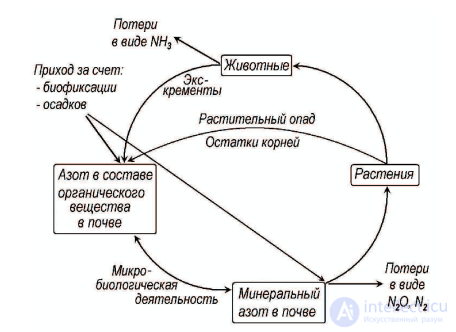
Fig. 3.3. Nitrogen cycle in the biosphere under the natural state of the soil
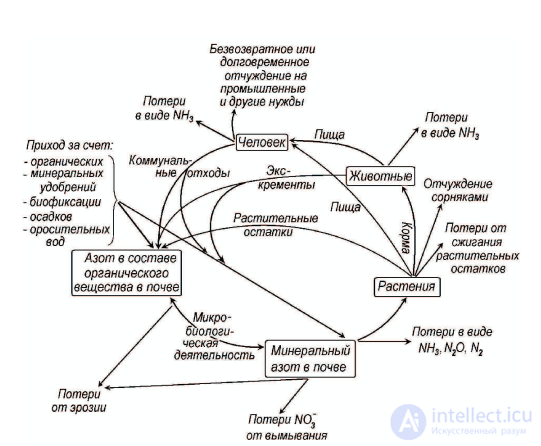
Fig. 3.4. Nitrogen cycle in the biosphere under intensive soil cultivation
When a territory is brought into agricultural use, the number of causes of nitrogen loss from the system also increases. Along with the growing loss of nitrogen from the soil in the form of gaseous compounds, the leaching of nitrate nitrogen increases significantly. Nitrogen is also irretrievably removed from the system when plant residues are burned. A significant amount of it is withdrawn when agricultural produce is consumed for industrial and other purposes, and it is also absorbed by weeds. The natural input of nitrogen into the cycle occurs as a result of its biological fixation, together with atmospheric precipitation and irrigation water. Only by applying nitrogen fertilizers and manure can the deficit in the nitrogen balance be eliminated and conditions created for preserving and even increasing soil fertility. Losses of nitrogen and other nutrients from the soil and fertilizers not only reduce the productivity of farming, but also cause eutrophication of water bodies, pollute groundwater, and give rise to a number of other undesirable phenomena in the surrounding natural environment.
It is therefore important to properly manage the cycling of nutrients in farming and to create an active balance for them through the application of mineral fertilizers, while preventing their loss into the environment. This is one of the most important conditions for scientific farming. Provided that the nutrients removed with the harvest are returned to the soil, plants capture ever greater quantities of biogenic elements from the surrounding environment (the atmosphere and the upper layers of the earth) into their sphere, and thereby contribute to an increase in the effective fertility of the soil. A disruption of the balance of macro- and micronutrients can substantially change the chemistry of plants and thereby disrupt the normal nutrition of animals and humans. Mineral fertilizers, as a means of intensifying farming, are not alien in chemical composition to living nature and, when applied sensibly, are a powerful factor in its development. For example, regardless of the form in which nitrogen is applied to the soil — as part of organic or mineral fertilizers — and regardless of the form in which it enters plants — nitrate, ammonium, amide, or molecular nitrogen fixed by legumes — ultimately, only the reduced form of nitrogen (NH4+) can take part in the synthesis of amino acids and proteins within the plants themselves. All other forms are reduced to ammonium as a result of chemical and biological transformations in the soil or directly in the plants. Organic and mineral fertilizers are of equal value as a source of nutrient elements. However, it is easier for the farmer to work with organic fertilizers, since they are less concentrated.
Thus, in terms of nitrogen, 1 centner of urea is equivalent to 10 tons of manure. Violations in the technology of applying mineral fertilizers lead to the creation of high concentrations of nutrient elements in the soil, which enter plants in excessive amounts, impairing the quality of the produce (as, for example, nitrates and nitrites) or causing ammonia poisoning of plants. The mineralization of organic fertilizers occurs gradually over the course of plant vegetation and does not create an increased concentration of mineral salts in the soil. At the same time, a positive nutrient balance in farming cannot be achieved without mineral fertilizers. Consequently, fertilizers must be applied in agriculture in such a way that they improve the cycling of nutrient elements in farming. This will help preserve and improve the state of the environment. All this will undoubtedly have a positive effect on the quantity and chemical composition of the produce obtained.
A disruption of the nutrient balance in farming can worsen the chemical composition of the soil and natural waters, and consequently of plants as well. This, in turn, can change the quality and nutritional value of agricultural produce and animal feed, and lead to functional diseases in humans and animals. In natural biocenoses a closed cycle of biogenic elements is achieved, whereas in artificial agrocenoses this cycle is broken due to the removal of elements with the harvest and significant losses of nutrients through erosion, infiltration and volatilization. The application of mineral fertilizers, on the other hand, directs the entire cycle of biogenic elements along an expanding spiral. In this connection, the starting point for expanding the production of crop output is an increase, to the necessary extent, in the application of mineral fertilizers. With the accelerating development of science and technology, agricultural products will, for centuries to come, remain the main source of wholesome food for people, and their production is based on the use of nature's greatest gift — soil fertility. The expanded reproduction of soil fertility is the starting condition for ensuring continuous growth in yields. Moreover, as yields grow, more favorable conditions are created for improving the environment. And this is possible with an active nutrient balance in farming. The nutrient balance is a quantitative expression of the nutrient content of the soil for a specific area or object of study (a field, a crop rotation, a long-term stationary trial, a farm, a zone, a republic, etc.), taking into account all items of their input (fertilizer application, natural sources, etc.) over a given period of time. The input of nutrients is provided by the following sources:
1) mineral fertilizers;
2) organic fertilizers;
3) plant residues;
4) seed material;
5) biological nitrogen fixation by nodule and free-living microorganisms;
6) precipitation.
The expenditure side accounts for:
1) removal with the harvest of the main and by-products;
2) removal with plant residues;
3) leaching into groundwater and surface runoff;
4) losses due to possible erosion processes;
5) gaseous losses, etc.
There are methods for determining each source of nutrient input and expenditure. For research purposes, the quantitative values of the balance items are adopted on the basis of experimental data, while for practical purposes reference data are most often used. Although the balance items of a farm, zone or republic are relative in nature and often undergo substantial changes depending on natural and economic factors, determining the nutrient balance is of great importance for assessing the level of chemicalization of farming. For conducting in-depth theoretical research that takes into account all items of income and expenditure, the study of the nutrient balance in lysimeters is of considerable interest. This method is widely used by research institutions. It makes it possible to uncover more deeply the patterns of change in the balance items and to give them a scientific explanation. Fertilizers with labeled elements are often used in these experiments. For example, the results of lysimetric studies conducted at the All-Russian Research Institute of Fertilizers and Agricultural Soil Science on sod-podzolic soils of the Non-Chernozem zone using the stable nitrogen isotope 15N showed that of the nitrogen applied with fertilizer, 30-60% is used by plants, 15-30% is accumulated in the soil, 10-30% is lost as a result of the volatilization of gaseous compounds, and 1-5% is leached out with lysimetric waters. For practical purposes, data on biological, economic and extra-farm balances are used.
Biological balance quite fully covers all items of input and expenditure of nutrients involved in the cycle. It can be used in assessing the fertilization system of individual crops and specialized crop rotations.
Economic balance is based on accounting only for the removal of nutrients with the main and by-products and their compensation through the application of mineral and organic fertilizers. As a rule, the calculation of such a balance gives an objective agroeconomic assessment of the fertilization system on a farm, in a zone, region, republic, etc.
Extra-farm balance accounts for the removal of nutrient elements with marketable produce beyond the boundaries of the farm and their input with mineral fertilizers. The calculation of this type of balance is of great importance for the correct distribution of fertilizers and is largely determined by the specialization of the farm. If a farm specializes in the production of marketable produce (grain, vegetables, etc.), the balance will be more deficient than on farms specializing in livestock production based on their own feed base, where a significant part of the nutrients is returned to the soil. The balance and cycling of individual nutrient elements (nitrogen, phosphorus and potassium) in farming have their own particular features. Nitrogen — the principal carrier of life — is of special interest. The particular features of its balance in the soil-fertilizer-plant system consist in its very high mobility. Nitrogen is a biogenic element that has natural sources replenishing its reserves in the soil.
The plants' requirement for nutrition with this element is, as a rule, the greatest. A significant source replenishing the active part of the balance is its biological fixation by symbiotic and free-living microorganisms. Therefore, when determining the nitrogen balance in farming, it is important to take into account the optimal combination of technical nitrogen, supplied with fertilizers, and biological nitrogen. Under any fertilization system, a high yield cannot be expected with a deficient nitrogen balance. The balance of phosphorus in farming and its cycling in ecosystems is of particular scientific and practical interest. Although a living organism requires it in several times smaller amounts than nitrogen, it is an important biogenic element. Phosphorus is not only a food source for plants but also a carrier of energy, and it is part of various nucleic acids. With a phosphorus deficiency, plant productivity drops sharply.
At the same time, phosphorus, unlike nitrogen, for example, has no natural sources replenishing its reserves in soils. The consumption of its reserves from the soils of agroecosystems for creating a harvest is replenished practically only through the application of phosphorus and organic fertilizers. It should therefore be assumed that, in the future, the problem of phosphorus as a biogenic element in farming will arise first of all.
In the atmosphere phosphorus is present in the form of dust and in small quantities (0.5-1 kg/ha per year). Its cycling is therefore relatively simpler than the cycling of nitrogen, i.e. only soil, water and plants are involved in the cycling of phosphorus in ecosystems. However, its availability to plants is influenced by many environmental factors. The problem of phosphorus therefore needs to be taken into account especially carefully when determining prospective farming systems. Losses of phosphorus occur mainly through soil erosion, as part of fine earth and liquid runoff. Leaching of phosphorus on soils of medium and heavy granulometric composition usually does not exceed 1 kg/ha, and only on light and peaty soils is 3-5 kg/ha of phosphorus leached out. Due attention has not yet been paid to studying the potassium balance. This is explained by the fact that, first, the high natural potassium content of the soil in a number of farming zones has often not limited yields, and second, our chemical industry has practically provided the country's agriculture with the necessary quantity of potassium fertilizers. However, in a number of zones the application of increased doses of nitrogen and phosphorus is already leading to a significantly negative potassium balance, and consequently to a decline in yield.
When analyzing the state of nutrient cycling in farming, and accordingly their balance in connection with fertilizer application, it is important to take into account the level of the yields obtained of agricultural crops. Recommendations on fertilizer application for achieving a certain level of yield of the crops grown should therefore also provide not only for maintaining the existing level of soil fertility, but also for its expanded reproduction. A low level of farming culture and a negative nutrient balance in the crop rotation are the most important causes holding back the growth of yields.
The application of a fertilization system in the agrocenosis, taking into account the state of the balance of biogenic elements, makes it possible not only to obtain the planned yields of agricultural crops, but also contributes to the reproduction of soil fertility. There are many methods of balance calculation, and they have their own specifics depending on whether the balance is used for the theoretical substantiation of a scientific proposition or for practical tasks in assessing fertilization systems. Studies of the nutrient balance in long-term stationary fertilizer trials are of particular interest. In these, the long-term application of various nutrient elements with fertilizers over the rotations of the crop rotation, and their removal with the harvests, are precisely recorded. The trials are conducted under conditions close to production conditions. The balance data obtained in long-term stationary trials can therefore quite well be used for both scientific and practical purposes. A balance established on the basis of such trials is an important link in research for the correct assessment of all items of income and expenditure of nutrients at the level of a farm, zone, republic, etc. The most important source of nutrient expenditure is their removal with the harvest of agricultural crops (Table 3.23).
3.23. Removal of nutrients in kg/t of main produce accounting for by-products (2010)
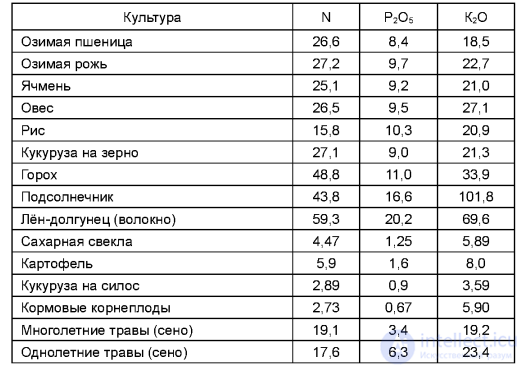
The figures given for nutrient removal are refined for specific crops, varietal characteristics and soil-climatic conditions. Corresponding formulas have been developed for calculating the balance of nutrient elements in an agrocenosis. The phosphorus balance (Bp) is determined from the difference between its input into the soil with fertilizers, seeds and precipitation, and its removal from the fields with the harvest, as well as losses due to leaching and erosion. This can be expressed by the equation:
Bp = (Pu + Ps + Pro + Po ) — ( Pvu + Pro + Pp ),
where Bp — phosphorus balance, kg/ha P2O5. Income items of the balance: Pu — input with fertilizers Pu = ( Pm + Por), where Pm — input with mineral fertilizers; Por — input with organic fertilizers; Ps — input with seeds ( with seed material); Pro — input with plant residues; Po — input with precipitation.
Expenditure items of the balance:
Pvu - removal with the harvest of the main and by-products;
Pro — removal with plant residues;
Pp — losses from the soil Pp = ( Ppv + Ppe), where
Ppv — losses due to leaching;
Ppe — losses due to erosion processes.
The potassium balance (Bk) is determined by an analogous formula :
Bk = (Ku + Ks + Kro + Ko ) - (Kvu + Kro + Kp ),
Bk — phosphorus balance, kg/ha KO.
Income items of the balance:
Ku — input with fertilizers Ku = ( Km + Kor), where
Km — input with mineral fertilizers;
Kor — input with organic fertilizers;
Kro — input with plant residues;
Ks — input with seeds ( with seed material);
Ko — input with precipitation.
Expenditure items of the balance:
Kvu — removal with the harvest of the main and by-products;
Kro — removal with plant residues;
Kp — losses from the soil Kp = ( Kpv + Kpe), where
Kpv — losses due to leaching;
Kpe — losses due to erosion processes.
The input of phosphorus and potassium with fertilizers and seeds is established from their chemical composition and seeding rates. The amount of input from the atmosphere with precipitation across the country's territory does not exceed 0.5 kg/ha for phosphorus, while for potassium it ranges from 2-6 kg/ha. The removal of phosphorus and potassium with the harvest of agricultural crops (Pv and Kv) is established on the basis of the content of these elements in the yield of the main and by-products and the magnitude of the yield. Losses of phosphorus and potassium as a result of soil erosion (Ppe and Kpe), according to averaged data, amount to: for phosphorus — 1.5-2, for potassium — 3-5 kg/ha. Losses of these elements from the soil and fertilizers due to leaching depend to a large extent on the granulometric composition of the soil, the amount of precipitation, the doses of fertilizers applied, and the crops grown. The greatest losses of nutrients are observed under bare fallow, somewhat less under row crops, and further, in order of decreasing loss level, come cereals, perennial grasses, hayfields and pastures.
Phosphorus losses (Ppv) for loamy soils on average do not exceed 0.1, and for sandy and sandy loam soils — 1.2 kg/ha. Losses
of potassium due to leaching of fertilizers (Kpv) amount approximately to: for light soils — 5%, for heavy soils — 2% of the amount applied.
For nitrogen, the following income and expenditure items are taken into account:
BN = (Nu + Ns + Nb + Npo + No ) — ( Nv + Npo + Np )
BN — nitrogen balance, kg/ha N.
Income items of the balance:
Nu — input with fertilizers Nu = ( Nm + Nor), where
Nm — input with mineral fertilizers;
Nor — input with organic fertilizers;
Ns — input with seeds ( with seed material);
Nb — input via biological fixation;
Nb = ( Nsym + Nnsym), where
Nsym — input via symbiotic fixation;
Nnsym — input via fixation by free-living microorganisms;
Npo — input with plant residues;
No — input with precipitation;
Expenditure items of the balance:
Nv — removal with the harvest of the main and by-products, kg/ha N;
Npo — removal with plant residues;
Np — losses of nitrogen from the soil Np = ( Npg + Npv + Npe), where
Npg — gaseous losses;
Npv — losses due to leaching;
Npe — losses due to erosion processes.
Nitrogen applied with seeds, and the removal of this element from the soil with the main and by-product yield, are determined analytically
or from reference data. The input of nitrogen into the soil with seed material depends on the crop type, seeding rates, and the nitrogen content
in the seeds, and the structure of the crop rotation. For example, when sowing cereal grains, 4-6 kg/ha of nitrogen is applied with the seeds, for grain legumes —
8-15, when planting potatoes — 9-12, etc. Depending on the type and saturation of the crop rotation with a particular crop, over one rotation with
the seed material 20-50 kg/ha of nitrogen or more is applied.
Enrichment of the soil with biological nitrogen from leguminous crops
is recommended by E.P. Trepachev to be determined by the formula:
Nob = [(Mpk x 2.5) %N + (Mpu %N)] Kf — Nhy(1 — Kf)
or Nob = Nb - Nv,
where Nob — enrichment of the soil with biological nitrogen, kg/ha; Nb — biological nitrogen of plant residues (kg/ha); 2.5 — correction coefficient for complete accounting of organic matter; Mpk — mass of dry stubble-root residues (c/ha); Mpu — mass of yield lost over all cuttings (c/ha); Kf — nitrogen fixation coefficient (ratio of the amount of fixed nitrogen to the total); Nhy — total nitrogen in the hay yield (kg/ha) over all years of growing the legume; Nv — nitrogen removed with the yield of leguminous plants (kg/ha). The biological nitrogen of plant residues (Nb) is determined by the formula: — Nb = [(Mpk x 2.5) %N + (Mpu %N)] Kf. And the removal of nitrogen from the soil by leguminous plants — Nv = Nhy(1 — Kf). Let us give an example of calculating the amount of soil enrichment with nitrogen in a trial with clover. The hay yield of clover over 3 years of life was 129.7 c/ha with a weighted average nitrogen content of 2.7%. Consequently, the total nitrogen consumption by clover amounts to 129.7 x 2.7 = 350.2 kg/ha. The stubble-root residues (Mpk) after the third year of clover's life amount to 71.8 c/ha of dry matter with a total nitrogen content of 2.3%, while the mass of yield lost over all cuttings (Mpu) amounts to 4.1 c/ha of dry matter with a total nitrogen content of 2.8%, and the averaged nitrogen fixation coefficient (Kf) equals 0.74. Substituting all the data into the formula
Nob = [(71.8 x 2.5) x 2.3 + (4.1 x 2.8)] x 0.74 — 350.2 x (1 - 0.74),
we obtain the soil nitrogen enrichment, i.e. Nob = 222.9 kg/ha. The nitrogen fixation coefficient (Kf), according to the results of research institutions, is taken as 0.7 for clover, lupine and sainfoin, 0.8 for alfalfa, and 0.6 for peas and vetch. The nitrogen fixation coefficient of the stubble residues of grain legume crops is 0.3-0.4, and of the stubble-root residues of leguminous grasses — 0.5-0.7. If the stubble and root residues were not determined, the nitrogen content in them can conventionally be taken as equal to half its content in the above-ground mass. An important source of nitrogen entering the soil is nitrogen fixation by free-living heterotrophic and saprophytic microorganisms. Under various soil-climatic conditions, non-symbiotic nitrogen fixation binds unequal amounts of nitrogen: in the zone of the northern taiga and tundra a few kilograms per hectare are bound, in sod-podzolic and gray forest soils — 15-20 kg/ha, in chernozems — 30-40, and in the tropics and subtropics — up to 80 kg/ha or more.
Nitrogen losses as a result of soil erosion, subsurface runoff and infiltration into deep soil layers (down to the groundwater level) are quite substantial. The annual nitrogen losses from erosion that can be adopted in balance calculations are given in Table 3.24. The following values (% of the amount applied) can be taken as minimum standards for nitrogen losses on soils of different granulometric composition due to infiltration:
heavy loam — 0 - 0.5;
medium loam — 0.5 - 1.5;
sandy loam — 2.0 - 4.0;
sandy — 5.0 - 8.0.

Comments