
Lecture
Potassium (K) is another important macronutrient for plants, which is of great significance in their nutrition and growth. Here are several key aspects of its role:
Regulation of osmotic pressure: Potassium participates in maintaining osmotic pressure in plant cells. This allows plants to effectively retain water and nutrients, especially under conditions of changing water availability.
Photosynthesis: Potassium is necessary for the proper functioning of enzymes involved in the process of photosynthesis. It helps in the transfer of energy and the conversion of light into chemical energy.
Regulation of stomatal function: Potassium plays a role in regulating the opening and closing of stomata (microscopic pores on the leaf surface), which affects the exchange of gases (the uptake of carbon dioxide and release of oxygen) and water vapor between the plant and the environment.
Stress tolerance: An adequate level of potassium in the plant helps increase its tolerance to stress conditions such as drought, salt stress and low temperatures.
Formation and transport of carbohydrates: Potassium participates in the formation and transport of carbohydrates in the plant. It affects the synthesis of sugars and their movement to the active parts of the plant.
Enzyme activation: Potassium activates numerous enzymes that regulate various biochemical processes in the plant.
Participation in protein synthesis: Potassium plays a role in protein synthesis and thereby affects the growth and development of the plant.
Participation in the formation of flowers and fruits: An adequate level of potassium affects the formation and quality of flowers, fruits and seeds.
A deficiency of potassium can lead to various disorders in plant physiology, such as impaired growth, reduced stress tolerance, and lower yield quality. It is therefore important to provide plants with a sufficient amount of available potassium for their optimal development.
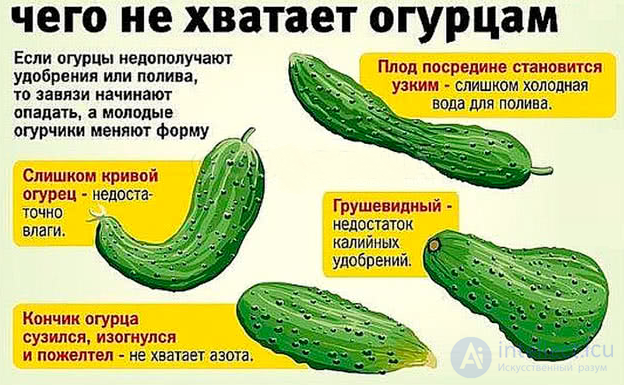
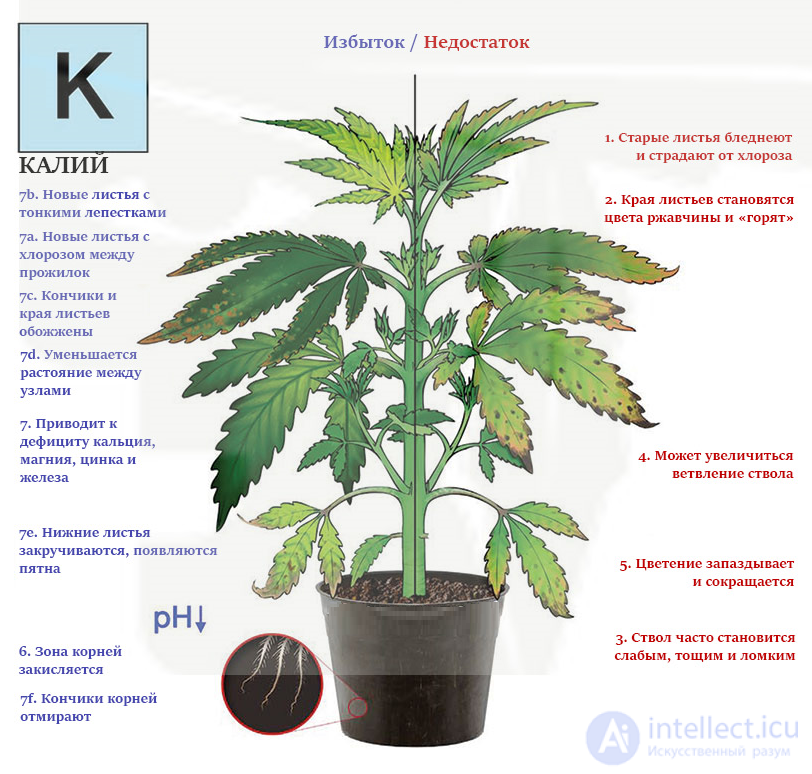
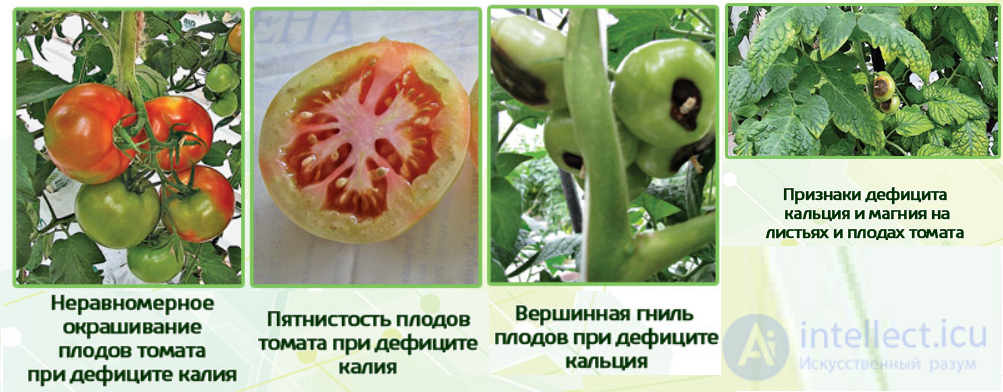
Fig. Potassium deficiency and excess
The physiological functions of potassium are diverse. There is more of it in young, growing parts of plants. Potassium plays an essential role in the life of plants, affecting the physicochemical properties of the biocolloids found in the protoplasm and walls of plant cells. Unlike the calcium and magnesium cations, the potassium cation promotes the swelling of biocolloids and their transition to a stable sol state, i.e., potassium increases the degree of dispersion of biocolloids and enhances their hydration, whereas calcium, on the contrary, coagulates and dehydrates colloids. Potassium therefore increases the hydrophilicity of the protoplasm colloids, which keeps the organism in an active state. The aging of cell protoplasm colloids is associated with a decrease in hydration, with the transition of colloids from sol to gel. Therefore, with an adequate supply of potassium, plants retain water better and more easily tolerate short-term droughts. The physicochemical process of aging is caused by a decrease in the amount of potassium and an increase in the amount of calcium in plant cells. It is no coincidence, therefore, that young tissues contain more potassium, while aging tissues contain more calcium. Potassium enhances the stability of cell biocolloids and improves the entire course of metabolism, increasing the vitality of the organism. It also improves the entry of water into cells, increases osmotic pressure and turgor, reduces the rate of evaporation, and makes plants more resistant to drought. Potassium participates in carbohydrate and protein metabolism.
Under its influence, the formation of sugars in the leaves and their movement to other organs of the plant is enhanced. This is especially noticeable in the yield of vegetable crops, tuber and root crops, and fruit and berry crops, which accumulate more carbohydrates under optimal potassium nutrition. Potassium fertilizers improve the quality of the fiber of flax, hemp and other fiber crops, and also increase crop resistance to light frosts. This happens owing to an increase in the osmotic pressure of the cell sap and a lowering of its freezing point. With good potassium nutrition, winter crops and perennial legume grasses overwinter better, and their resistance to various diseases increases. Potassium increases the intensity of oxidative processes, which leads to an increase in the content of organic acids in plant tissues, and has a strong effect on protein formation. With a deficiency of potassium, protein synthesis is delayed and non-protein nitrogen accumulates. Moreover, under potassium starvation, protein breakdown intensifies, which creates favorable conditions for the development of various pathogenic fungi and bacteria in the tissues. For example, a deficiency of potassium can cause powdery mildew to appear on cereal crops. The role of potassium increases under ammonium nutrition of plants. In this case, nitrogen is absorbed better and more protein is formed. Potassium promotes better use of iron in chlorophyll synthesis. This is especially noticeable when there is a deficiency of assimilable iron in the nutrient medium. Potassium stimulates the process of photosynthesis and increases the outflow of carbohydrates from the leaf blade to other organs.
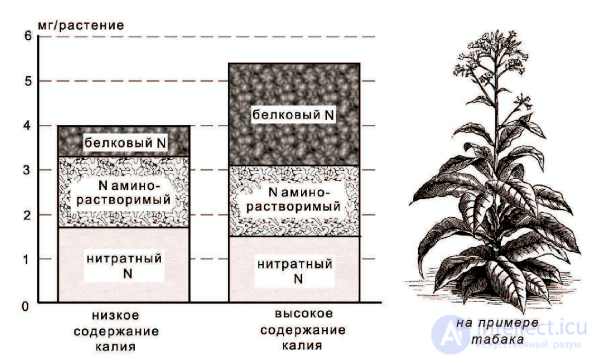
Fig. 4.7. Effect of the potassium content level on the utilization of nitrogen (15N) introduced into plants for protein synthesis (5 h after treatment) (according to K. Koch, K. Mengel, 1978)
It activates the work of many enzymes, with the participation of which certain peptide bonds are synthesized, which increases the biosynthesis of proteins from amino acids, along with other processes. The effect of potassium on the intensity of protein biosynthesis is clearly shown in Fig. 4.7. Under the influence of potassium, activation of the process of nitrogen fixation by legume crops is also observed, since it has a positive effect both on root growth, the growth of root hairs, and on the development of nodule bacteria in the rhizosphere, as well as on the number and mass of nodules and their nitrogen-fixing activity (Fig. 4.8, M.K. Hagh-parast-Fanha, 1975). The enzymes phosphofructokinase and pyruvate kinase, involved in the transfer of energy-rich phosphate residues, also require the potassium cation to display their activity. Potassium increases the activity of amylase, sucrase and proteolytic enzymes. Its deficiency leads to disorganization of metabolism in the plant organism.
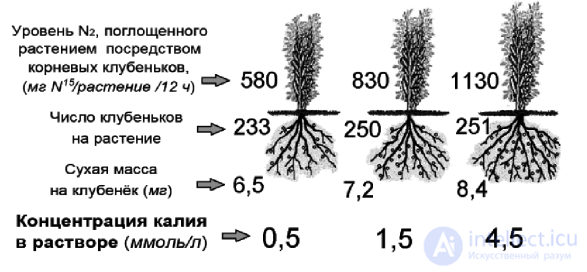
Fig. 4.8. Effect of potassium on the assimilation of atmospheric nitrogen by legume crops
In the plant, potassium apparently exists in ionic form. In any case, no organic compounds synthesized in organisms are known in which the potassium cation would be a constituent part. At least 80% of it is found in the cell sap of plants and can be extracted with water. A smaller part of the potassium is adsorbed by colloids, and about 1% is absorbed non-exchangeably by mitochondria in the protoplasm. It is contained mainly in the protoplasm and vacuoles. There is no potassium in the nucleus or plastids. Potassium improves the quality of agricultural produce: the accumulation of sugars in sugar beet and starch in potato tubers increases. In the latter case, potassium sulfate is more effective. In flax and hemp, fiber yield and quality increase; in cereal crops, the test weight of grain increases, and the mass of 1000 grains increases. Under potassium starvation, the resistance of potatoes, vegetables and sugar beet to fungal diseases decreases, both during the growing period and during storage in fresh form. With a deficiency of potassium, the stem of cereal crops becomes less strong, the crop lodges, which leads to a decrease in yield and impairs grain fill. The application of potassium fertilizers increases the content of water-soluble forms of potassium in the soil, suppresses the development of root rot (Helminthosporium sativum) and reduces the infectious potential of the soil. Visual signs of potassium starvation for a number of agricultural crops are shown in the color illustrations.
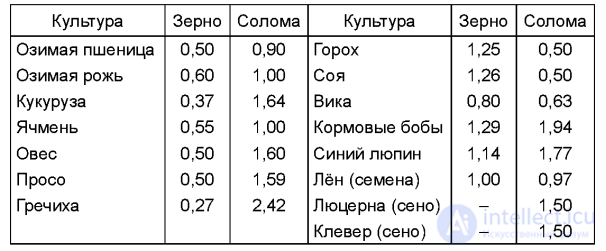
The main functions of potassium in the agroecosystem are shown schematically in Fig. 4.9. Different agricultural crops consume unequal amounts of potassium. Fruit and berry crops, sugar beet, cabbage, root crops, potatoes, clover, alfalfa, sunflower, buckwheat, maize and grain legumes consume relatively large amounts of it. Less potassium is required for the formation of a yield of cereal crops. Unlike nitrogen and phosphorus, potassium is more abundant in the vegetative organs than in the reproductive organs (seeds) of plants. For example, in the straw of winter wheat, rye and barley there is almost twice as much potassium, and in maize stalks almost five times as much, as in the grain. In some grain legume crops there is a large amount of potassium in the grain, but if the gross yields of grain and straw are taken into account, as a rule more of it is removed with the straw than with the grain. In the non-marketable part of the yield there is more potassium than in the marketable grain, with the exception of grain legume crops (Table 4.12).
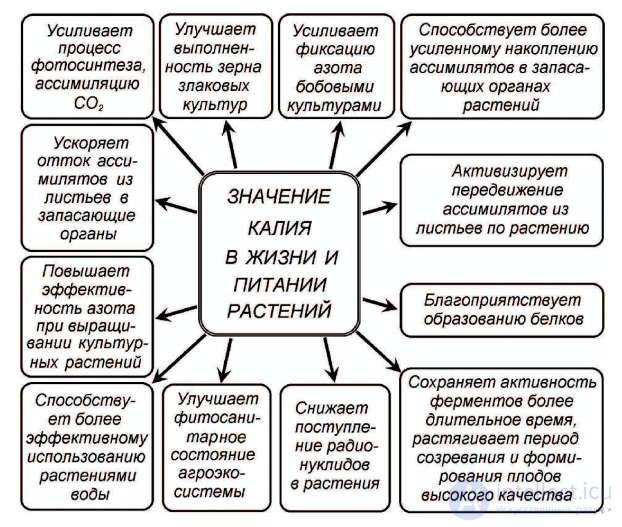
Fig. 4.9. Main functions of potassium in plant life
4.12. Average potassium content in the yield of major agricultural crops, % of total mass
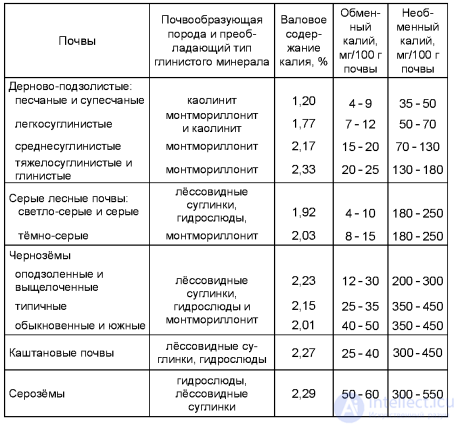
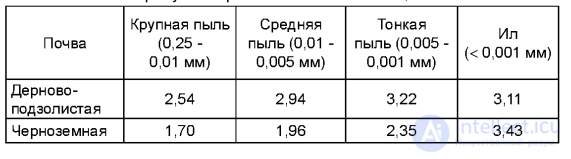
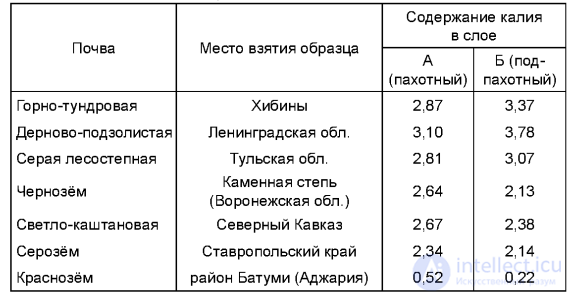
With correct and complete use of organic waste, potassium is returned to the soil in larger quantities than nitrogen and phosphorus. However, to create optimal potassium nutrition for plants at a high level of nitrogen and phosphorus nutrition, it is generally necessary to apply industrial potassium fertilizers to the soil. Soil potassium is the main source of it for plant nutrition. Its gross content in the soil is often much higher than the content of nitrogen and phosphorus. This is largely determined by the character of the parent rock. The Earth's crust contains 2.14% of it. It is present in no smaller amount in sedimentary rocks, which are the parent material for many soils. The amount of potassium in the soil is mainly determined by its particle-size composition. In clay and loamy soils its content reaches 2% or more (Table 4.13). This is explained by the fact that in heavy soils it is part of minerals found mainly in the clay particles. There is considerably less potassium in sandy, sandy loam and especially peat soils. Its amount in these soils falls to 0.1%. As the dispersion of particles in the soil's particle-size composition increases, the potassium content in it rises. This can be shown using the example of the podzolized heavy loamy soil of the Dolgoprudnaya Agrochemical Experimental Station named after D.N. Pryanishnikov and the ordinary loamy chernozem of the Institute of Agriculture of the Central Chernozem Region named after V.V. Dokuchaev (Table 4.14). The potassium of the silt fraction is the most available to plants, since it is present predominantly in exchangeable form. It should be noted that the gross potassium content of the soil does not always characterize the plants' supply of it, since only about 1% of the gross reserves in the soil are available to plants. Therefore, the potassium supply of plants on different soils must be judged not by the overall percentage content of it in the soil, but by the ratio between the forms of its compounds. The gross potassium content in the subsoil layer of sod-podzolic soil and soils transitional to it is often higher than in the arable layer (Table 4.15).
4.13. Approximate potassium (K2O) content in the arable layer of various soils (data of the V.V. Dokuchaev Soil Institute)
According to their availability to plants, all potassium compounds in the soil can be divided into five groups.
1. Potassium of various soil minerals, aluminosilicates. This form contains the largest amount of potassium. There is more of it in orthoclase, and less in muscovite, biotite, glauconite, nepheline and leucite. This form of potassium is poorly available to plants. In 1947, Soviet scientists isolated from the soil bacteria called silicate bacteria, capable of breaking down orthoclase. Some researchers believe that they play a positive role in the potassium nutrition of plants. There is a hypothesis that part of the potassium in orthoclase and leucite, as minerals most resistant to acids, can pass into an available form owing to the mycorrhiza of certain perennial crops. Potassium in muscovite, biotite and nepheline is more available to plants. Part of it passes into a form assimilable by plants as a result of exchange decomposition with the salts of the soil solution. Some of the potassium in these minerals can pass into an available state as a result of the action of carbonic acid and certain organic acids released by plant roots on them. Depending on the type of soil, the transition of potassium from non-exchangeable to exchangeable forms proceeds with varying intensity. In sod-podzolic soils these values amount annually to 15-30 kg/ha, and in leached chernozems to about 60 kg/ha.
4.14. Potassium content in individual fractions of soil particle-size composition, %
4.15. Potassium content in the arable and subsoil layers of various soils, %
2. Potassium of soil colloids. This form is the main source of potassium nutrition for plants. In the soil it can amount to 5-30 mg/100g. Its amount in the soil, as a percentage of the gross content, depends on the type and subtype of soil, especially its particle-size composition. For example, in sandy loam soils this form of potassium amounts to only 0.8%, in loamy soils to 1.5%, and in chernozems and sierozems to 1-3%. The share of potassium in the sum of absorbed bases cannot indicate the degree of the plants' supply of it. For example, according to K.K. Gedroits's data, in the arable layer (0-20 cm) of loamy chernozems (Tula Region) potassium amounted to 2.7%, while in podzolized loam (Smolensk Region) it amounted to 6.1% of the total sum of absorbed bases. The exchange capacity in the first case was 54.8, and in the second 6.21 mmol/100 g of soil. Therefore, the exchangeable potassium in the chernozem was 70.65, and in the podzolized loam only 17.9 mg/100 g of soil. One of the most important tasks of agrochemistry is to establish the degree to which the soil's exchangeable potassium participates in yield formation. Plants use only part of the exchangeable potassium during the growing season, depending on the properties of the soil, the biological characteristics of the plants and weather conditions. Objective data on plants' requirements for potassium fertilizers can be obtained using chemical methods and by conducting large-scale field trials under specific soil and climatic conditions. A small part of the potassium (1-5 mg/kg of soil) is present in the soil solution in the form of salts of carbonic, nitric, phosphoric, sulfuric, hydrochloric and other acids.
3. Water-soluble potassium. The content of this form of the element amounts to 1/5-1/10 of the amount of K2O present in the soil in exchangeable form. In the arable layer of chernozems it is about 0.02-0.06 mmol/100 g of soil; in solonetzic soils, 0.08-0.10; and in sod-podzolic soils, 0.04-0.09 mmol/100 g of soil. The soil solution rarely contains more than 0.1 mmol (4.7 mg) K2O/100 g of soil. In unfertilized sod-podzolic soil of the Timiryazev Agricultural Academy (TSKhA), over the course of the spring-summer period the amount of water-soluble potassium ranged from 1.5 to 5 mg/kg of soil, or 4.5-18 kg/ha. Water-soluble potassium is the most available for plant nutrition. It appears in the soil mainly as a result of the chemical and biological action on soil minerals, as well as their hydrolysis. For example, minerals can be broken down by the action of root exudates of plants, acidic products of microbial activity, including nitric acid accumulated by nitrifying bacteria. Part of the potassium can pass from the exchangeable state into solution as a result of its displacement from the absorbing complex by various salts, including those applied to the soil as fertilizers.
4. Potassium contained in the plasma of microorganisms. In sod-podzolic soil its amount reaches 40 kg K2O per hectare. This potassium passes into available form only after the death of microbes. However, it must not be forgotten that, alongside the process of dying off, microorganisms also multiply intensively. And this requires all the nutrients, including potassium. It is therefore difficult to judge how much potassium is released when microorganisms die and becomes available to plants, and how much is absorbed in the process of their multiplication. These questions remain little studied. Potassium is also found in plant and animal residues, root and stubble residues, manure and other organic matter entering the soil. After their decomposition it becomes available to plants.
5. Potassium fixed by the soil. In the soil, not only do processes of conversion of potassium from poorly soluble forms into exchangeable and water-soluble forms take place, but also processes of fixation of potassium in a non-exchangeable state, i.e., its fixation by the soil. This process proceeds actively under alternating wetting and drying of the soil. Soil of heavy particle-size composition, containing a large amount of finely dispersed fractions, is distinguished by increased fixation of potassium. Potassium is fixed especially actively in the presence in the soil of clay minerals of the montmorillonite and hydromica groups, which are characterized by intracrystalline adsorption of cations. The kaolinite group of clay minerals, on the other hand, does not have this property.
Different types of soil have an unequal ability to fix potassium in a non-exchangeable state. Potassium is fixed most intensively in solonetz soils. It is assumed that peptization, caused by alkalinization, increases the number of colloidal particles in clay minerals and thereby promotes the entry of potassium cations into their crystal lattice. Chernozems fix potassium better than sod-podzolic soils. An increased amount of organic matter in the soil, as well as the liming of acidic soils, enhances the fixation of potassium in non-exchangeable form. Systematic application of potassium fertilizers reduces the fixation of potassium by the soil, since the soil's fixing capacity is not unlimited. Of all the cations of significance in plant nutrition, ammonium and potassium are fixed. The fixation of one of these elements prevents and even excludes the fixation of the other.
The soil's fixing capacity manifests itself up to a certain limit. Fixation of potassium by the soil sharply reduces the utilization coefficient of the potassium applied in fertilizers. For example, in the marsh (alluvial) soils of Holland, 21-59% of the potassium applied over many years is fixed. In Canada, owing to fixation of potassium by the soil, plants used only 25-48% of this element applied with mineral fertilizers. Most of the fixed potassium is found in the arable layer of the soil. Systematic application of fertilizers increases the content of various forms of potassium compared with unfertilized variants. However, the character of potassium transformation depends largely on soil and climatic conditions. In sod-podzolic and gray forest soils, the amount of exchangeable potassium increases noticeably. For example, in the soils of the Dolgoprudnaya Agrochemical Experimental Station, over 36 years it increased by 8-10 mg/100 g of soil. The content of non-exchangeable potassium increased only slightly, which is explained by the absence of conditions for its fixation (excess moisture, low temperature, acidic reaction, etc.). With systematic fertilizer application, exchangeable potassium accumulates on these soils not only in the arable layer but also in deeper layers. In chernozems, owing to their high saturation with divalent cations, exchangeable potassium accumulates almost not at all.
Non-exchangeable absorption of potassium predominates, due to favorable conditions for its fixation (the composition of clay minerals, the absence of a leaching regime, a large amount of organic matter, etc.). An increase in the amount of non-exchangeable potassium is usually observed in the arable and subsoil layers of the soil, reaching significant values. In sierozems, systematic fertilizer application leads to a substantial increase in the content of exchangeable and non-exchangeable potassium. Irrigation promotes the accumulation of exchangeable and non-exchangeable potassium through the soil profile to a depth of 1 m. Fixation of potassium from fertilizers in sod-podzolic soils is small and rarely exceeds 200 kg/ha. In chernozems, absorption of potassium reaches considerable amounts and comes to 300-700 kg K2O per hectare. The shorter the duration of fertilizer application and the smaller the amount of potassium applied, the greater its relative fixation. Evidently, by applying high doses of potassium fertilizers on chernozems it is possible to achieve full saturation of their fixation capacity and, without fear of potassium fixation, to apply the currently recognized method of periodic application of potassium fertilizers.
When developing a fertilization system, it is important to take into account possible losses of potassium from the soil as a result of leaching. It is generally accepted that soil potassium is well adsorbed in the arable layer and migrates weakly through the soil profile. Losses of potassium from applied fertilizers are therefore insignificant. However, with long-term application of potassium fertilizers, their good solubility and deep wetting of sod-podzolic soils can lead to leaching of potassium salts not only from the arable layer but also beyond the root-inhabited layer of the soil. In chernozems, owing to the limited amount of precipitation and shallow wetting, leaching of potassium from the arable layer does not occur. Leaching of potassium is greatest when chlorides or nitrates are applied, smaller when potassium sulfates are applied, and smallest when potassium phosphates are applied. Considerable leaching of it occurs on sandy soils. Losses with autumn fertilizer application are greater than with spring application. The greatest losses of potassium are observed on strongly acidic soils, which is explained by the saturation of their absorbing complex with the less mobile hydrogen and aluminum ions, which cannot be displaced by potassium ions. Such soils therefore absorb less potassium and lose more of it through leaching. With the correct application of potassium fertilizers in combination with other agrotechnical methods, losses of potassium through leaching can be significantly reduced.

Comments