
Lecture
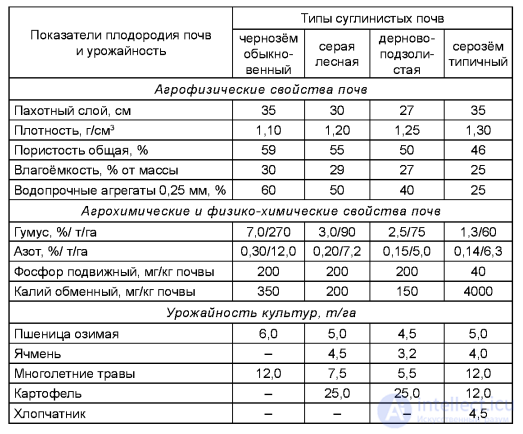
Optimizing soil fertility is the most important problem of agrochemistry, regardless of the type of farming. Thanks to the work of research institutions, and especially the data of long-term stationary fertilizer trials in the Geographic Network, it has become possible to optimize soil fertility according to agrochemical and agrophysical indicators. Soil fertility indicators are considered optimal if they ensure the formation of a high yield and quality of produce for all crops in the rotation, increase economic efficiency, and improve the ecological situation in a specific agrocenosis. The optimal parameters of soil fertility must correspond to the biological requirements of all crops in the rotation and promote the realization of their potential productivity. Therefore, it is important to consider and assess soil fertility by a set of indicators in accordance with the specialization of the crop rotation. The set of optimal fertility indicators and properties, for example of sod-podzolic medium- and light-loamy soils, can be judged from the data in Table 3.11. The optimal parameters of the main fertility indicators are created through the application of a set of agrotechnical methods and agrochemical inputs. The V.V. Dokuchaev Soil Institute has proposed parameters for the main soil fertility indicators that ensure high yields of agricultural crops.
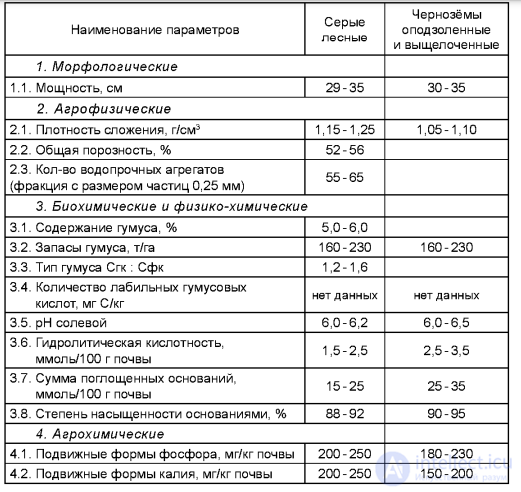
They are differentiated depending on the properties of the soil, the specialization of farming, and other conditions (Table 3.12). For sod-podzolic soils, an important indicator is the optimal level of their acidity‚ which is determined with regard to the specialization of the crop rotation, the biological characteristics of the crops, the particle-size composition, the sum and composition of the absorbed cations, and so on. The optimal pH levels of sod-podzolic soils have been established with regard to the biological characteristics of the crops, the particle-size composition of the soil, and the climatic conditions of the zone. One of the main reasons for the differing sensitivity of plants to an acidic soil reaction is the presence and unequal mobility of aluminum in it, and crops react not only to the content of its active forms in the soil but also to the ratio of exchangeable calcium and aluminum, or of the sum of calcium and magnesium to aluminum. The higher this ratio, the weaker the negative effect of aluminum.
3.11. Fertility indicators of different soils and yields of agricultural crops
3.12. Optimal parameters of the properties of the arable horizon of forest-steppe soils (according to Karmanov N.I., 1993)
The problem of optimizing the reaction of the soil solution is further aggravated by the expanding use of physiologically acidic mineral fertilizers, which lead to a depletion of calcium in the arable horizon. Maintaining an optimal reaction of the medium in acidic soils is inseparably linked with a scientifically based technology for their liming. Soil fertility is determined to the greatest extent by humus. It contains almost the entire reserve of nitrogen, a significant portion of phosphorus and sulfur, as well as potassium, calcium, magnesium, and other nutrients.
Methods of creating a deficit-free humus balance in the soil are an important task of agrochemistry. Optimal parameters for humus content in sod-podzolic soils have been determined: in sandy soils — 1.8-2.0, sandy loam soils — 2.0-2.5, loamy soils — 2.6-3.0. To maintain a deficit-free humus balance in these soils, it is necessary to apply annually 16-18, 13-15, and 10-12 t of manure per 1 ha, respectively.
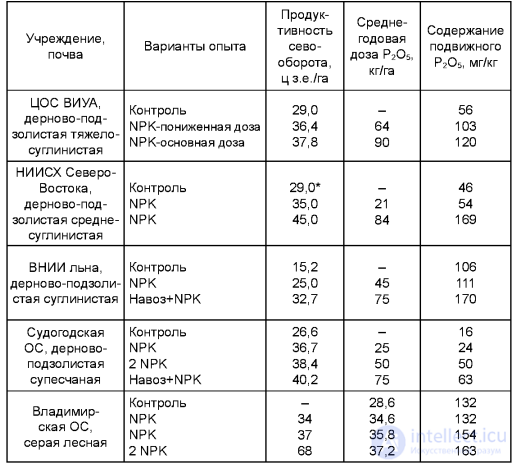
To maintain the optimal humus content in acidic sod-podzolic and gray forest soils, it is recommended to combine liming, the application of organic fertilizers, and the annual application of nitrogen fertilizers at rates covering at least 90% of the nitrogen removal by the crops of the rotation, along with the mandatory inclusion of legume-grass mixtures in the sown area structure. The rates of organic fertilizers depend on the humus content of the soils and their particle-size composition. The nitrogen regime of soils in most zones of the country is assessed by their mineral nitrogen content. There are various modifications for assessing the optimization of nitrogen content in the soil depending on soil-climatic conditions. One of the main characteristics of the overall degree of soil cultivation is the content of available phosphorus, at which the highest yield of the crop being grown is achieved and there is no effect from additional applications of phosphorus fertilizers. In doing so, one should focus on the leading crops of the rotation that are most demanding with respect to the level of phosphorus nutrition, under specific soil-climatic conditions (Table 3.13).
The lower boundary of the available phosphorus content is determined with regard to an assessment of the phosphorus content at the maximum yield of the crop being grown, as well as the absence of an effect from an additional application of phosphorus fertilizers. As an approximation, based on a generalization of data from long-term trials, the lower boundary of the optimal content of P2O5 is 100-150 mg/kg for sod-podzolic loamy soils and 50-100 mg/kg for sandy and sandy loam soils, and 100-150 mg/kg for gray forest soils. A further increase in the content of available phosphates does not provide a noticeable increase in yield. The importance of optimizing the phosphate regime is also dictated by the fact that significant areas of arable land are characterized by a low supply of available phosphorus. In addition, a shortage of phosphorus due to the limited resources of phosphate agrochemical raw materials is already possible in the near future. The optimal level is taken to be the content of available phosphorus (P2O5) in the soil at which at least 90-95% of the maximum yield can be achieved, with the missing 5-10% made up by phosphorus fertilizers that compensate for the removal. Such a level of the phosphate regime makes it possible, provided other growth factors are supplied, to obtain the maximum possible yields of the crops grown in each zone (t/ha).
3.13. Productivity of the crop rotation and content of available forms of phosphorus in the long-term trials of the Geographic Network (1993)
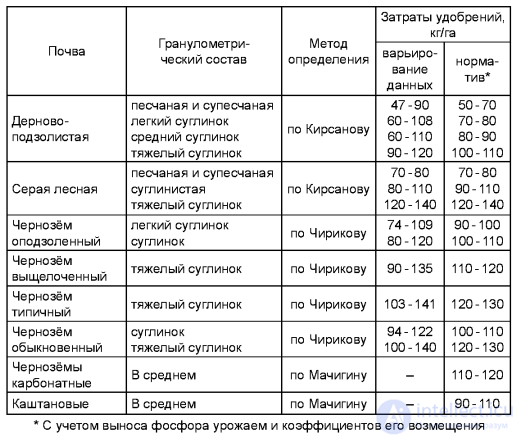
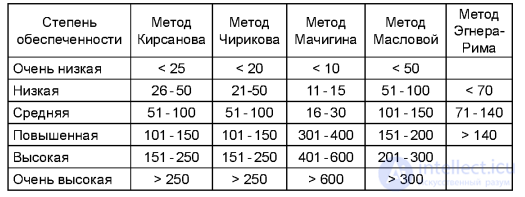
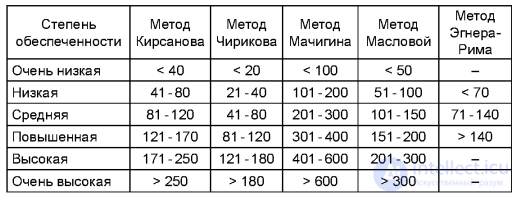
On irrigated land, under conditions of increased productivity, higher levels of available phosphorus supply are required. An increase in the available phosphorus content of the soil from low (2-4 mg/100 g of soil) to medium (8-10 mg/100 g of soil) is accompanied by the highest yield increases. A further increase leads to a decrease in the magnitude of the increases, and finally, having reached a maximum in the zone of optimal values of available phosphorus content in the soil, yields stabilize (Table 3.15). The costs of phosphorus fertilizers required to increase the phosphorus content of the soil are presented in Table 3.14. The degree of soil supply with available phosphorus is determined by various methods depending on the soil type. The main indicator of plant supply with potassium is considered to be its content in the soil in exchangeable form. The soil contains significant reserves of potassium and there is a dynamic equilibrium between its various forms: soil-solution potassium, exchangeable, and non-exchangeable (fixed potassium and the potassium of natural clay minerals). During plant nutrition this dynamic equilibrium is disturbed, and all forms of soil potassium become involved. In this regard, the degree of mobility of exchangeable potassium and the rate of its replenishment from non-exchangeable forms are significant, which makes it difficult to choose an objective indicator for optimizing potassium content in the soil. The degree of soil supply with available potassium is determined by different methods depending on the soil type (Table 3.16).
3.14. Fertilizer rates for increasing the available phosphorus content by 10 mg P2O5/kg of soil (according to Litvak Sh.I., 1990; Sychev V.G., Shafran S.A., 2013)
3.15. Grades of soil supply with available phosphorus, mg/kg of soil (Methodological guidelines for conducting comprehensive monitoring of the fertility of agricultural land soils, 2003)
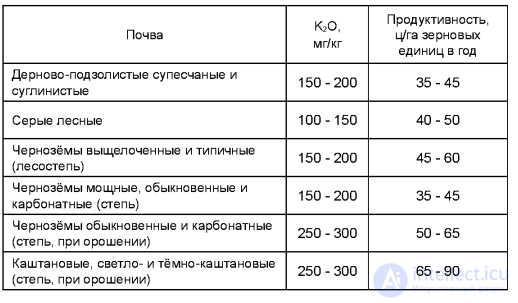
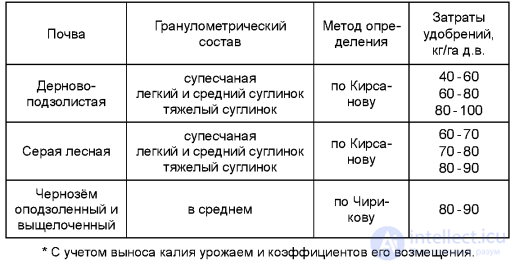
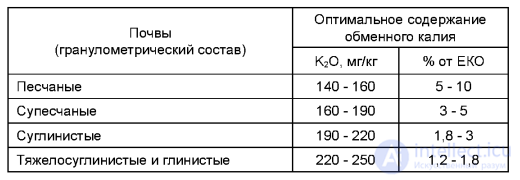
The optimal levels of soil supply with exchangeable potassium are presented in Table 3.17. These parameters of soil potassium supply can be refined according to the specialization of the crop rotation, the liming of acidic soils, the level of soil supply with nitrogen and phosphorus, the biological characteristics of the crops, and other conditions. However, in farming practice these indicators can quite reasonably be used when determining the optimal supply of crops for a given level of productivity. The costs of potassium fertilizers required to increase the potassium content of the soil are presented in Table 3.18. Having studied the potassium regime of Russian soils in detail, M.Kh. Shaimukhametov and D.S. Travnikova (1977) proposed optimal parameters for exchangeable potassium content depending on the share of this element in the cation exchange capacity (CEC) of soils of various particle-size compositions (Table 3.19)
3.16. Grades of soil supply with available (exchangeable) potassium, mg/kg of soil (Methodological guidelines for conducting comprehensive monitoring of the fertility of agricultural land soils, 2003)
3.17. Soil supply with exchangeable potassium and crop rotation productivity
3.18. Fertilizer rates for increasing the available K2O content by 10 mg/kg of soil (according to Litvak Sh.I., 1990)
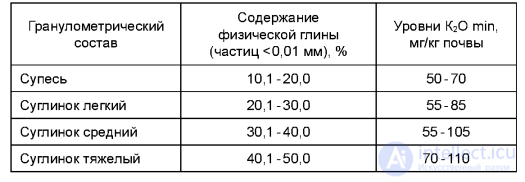
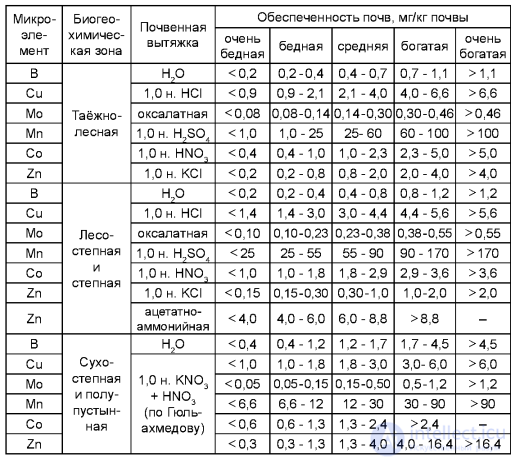
The range of variation in the minimum exchangeable potassium content for sod-podzolic soils is presented in Table 3.20. Based on a generalization of numerous experimental data, grades of varying degrees of soil supply with available forms of micronutrients have been established for the main soil-climatic zones of Russia (Table 3.21).
3.19. Optimal indicators of exchangeable potassium content in soils (M.Kh. Shaimukhametov, L.S. Travnikova, 1997)
3.20. Levels of variation in the minimum exchangeable potassium content for sod-podzolic soils of various particle-size compositions (Nikitina L.V., 2011)
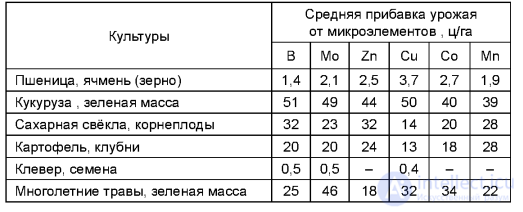
On average, the application of micronutrient fertilizers provides an increase in agricultural crop yields of 10-12% and higher on soils with a low content of micronutrients (Table 3.22). Research institutions of Belarus have conducted numerous studies to determine optimal parameter values and have developed an approximate fertility model for sod-podzolic loamy soils (Fig. 3.2).
3.21. Grades of supply of Russian soils with available forms of micronutrients (Yagodin, Zhukov, Kobzarenko, 2002)
3.22. Effectiveness of micronutrient fertilizer application on the main agricultural crops, based on generalized field trial data (1993)
 '
'
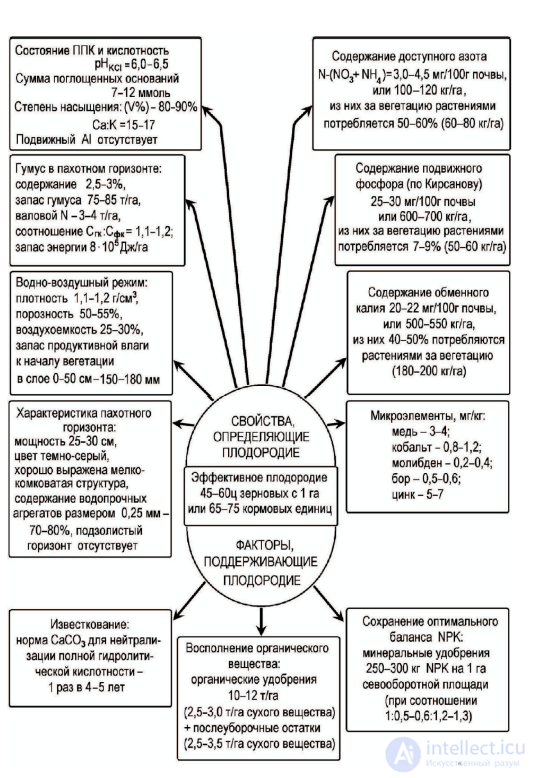
Fig. 3.2. Approximate fertility model of sod-podzolic loamy soils

Comments